For businesses managing multi-location or regional operations — franchises, insurance providers, healthcare networks, field service companies, real estate offices — getting routing right isn't just an operational detail. It directly affects customer experience, compliance exposure, and how often calls convert into booked appointments or closed sales.
This guide covers what zip code routing is, why businesses use it, how it works end-to-end, what affects its performance, and when it may not be the right choice.
Key Takeaways
- Zip code routing captures a caller's zip code via keypad input, data enrichment, or number pool technology, then connects them to the right regional agent or team
- Multi-location, franchise, and territory-based operations benefit most
- It reduces misrouted calls, cuts handle time, and supports compliance in regulated industries
- Performance depends on data accuracy, well-maintained routing tables, and defined fallback logic
- It's not the right fit for single-location businesses, low-volume operations, or callers whose mobile numbers don't reflect their actual location
What Is IVR Call Routing Based on Zip Codes?
An IVR (Interactive Voice Response) system automates phone interactions through prompts and menus, collecting caller input and directing calls without a live operator. Zip code routing is a subset of location-based routing where the caller's 5-digit zip code acts as the primary routing variable — not their area code or account number.
The goal is straightforward: connect the caller to whichever agent or location is geographically most appropriate, without making them navigate complex menus or explain their address to multiple people.
Why Area Code Routing Misidentifies Callers
Area code routing uses NPA-NXX telephone number prefixes to infer geography. The problem is that number portability has made this unreliable. The FCC allows consumers to keep their number when switching providers. The NPAC manages approximately 1 billion telephone numbers across roughly 1,600 service providers, and many of those numbers have been ported across regions. A caller with a Dallas area code may be physically located in Denver.
Zip code routing bypasses this problem by working from verified address-level data rather than telephone number prefixes — making it far more reliable for geographic matching.
Zip Code vs. Skills-Based Routing: Two Different Dimensions
Skills-based routing directs calls based on what an agent knows or can do. Zip code routing directs calls based on where the caller is located. The two aren't mutually exclusive — many operations layer both, routing by geography first, then by skill set within the matched regional team.
Want to see this in action? Watch AI Call Flow Demo
Why Businesses Use Zip Code-Based IVR Routing
Geographic Agent Matching
When a caller reaches an agent who knows their local territory — the regional regulations, the service boundaries, the nearby office — first-call resolution improves. SQM Group reports that 93% of customers expect their call to be resolved on the first call, yet the industry average first-call resolution rate sits just under 70%. Only 5% of call centers reach 80%+ FCR, which SQM considers world-class. SQM also identifies redirection to a third party as one of the top root causes of repeat calls.
Zip code routing reduces transfers, which means less repeat effort, shorter handle times, and higher FCR.
Regulatory and Compliance Requirements
In insurance and financial services, agents must hold licenses specific to the state where they're doing business. The NAIC's Producer Licensing Model Act states that no person shall sell, solicit, or negotiate insurance without a license for that line of authority. FINRA Rule 1210 similarly requires registration for anyone engaged in a firm's investment banking or securities business.
Zip code routing automates the compliance step: calls from a given state route only to agents licensed there, without relying on manual triage.
One Number, Many Locations
Multi-location businesses can present a single national phone number while still connecting callers to their local office. This removes caller confusion about which branch number to dial and maintains brand consistency across locations.
The scale of this need is significant. The IFA projected U.S. franchise establishments would reach 821,000 units in 2024, a 1.9% increase. U.S. Census Bureau data shows more than 2 million multi-unit establishments nationwide. Most of those businesses handle inbound calls that need geographic sorting.
Load Balancing and Overflow
When one regional center is at capacity, zip code data can redirect calls to the nearest available team. Platforms like EvaSpeaks' Smart Call Routing handle overflow by routing to live agents, on-call rotations, voicemail, or SMS based on location and availability, so no caller hits a dead end. EvaSpeaks' configurable office hours feature also enables automatic time-based routing — so after-hours calls from a specific zip code region route differently than business-hours calls without anyone needing to manually toggle settings.
Curious how AI manages overflow and after-hours calls? See How AI Handles After-Hours Calls
Sales and Marketing Alignment
Territory-specific sales teams, regional promotions, and local product availability can all be matched to callers by zip code. Industries where this matters most:
- Real estate (territory-based agent assignment)
- Home services and franchises (dealer or franchisee coverage areas)
- Healthcare (regional practice networks)
- Insurance (state-licensed agent pools)
How IVR Zip Code Routing Works
The end-to-end flow is straightforward: a call arrives → the IVR captures the zip code → the routing engine matches it against a configured rules table → the call transfers to the appropriate destination.
Eva Speaks' platform lets businesses build call-flow scripts and set routing rules per department through a dashboard interface, with location as a configurable routing criterion. No deep technical programming is required.
Here is how traditional IVR zip code routing compares to modern AI-powered routing:
| Traditional IVR Routing | AI-Powered Routing (EvaSpeaks) | |
|---|---|---|
| Features | DTMF digit entry, static routing rules | Natural language zip capture, dynamic routing logic |
| Best-fit Business Size | Large enterprises with IT teams | SMBs to mid-market, any size |
| Key Strengths | Widely deployed, predictable | Conversational, no caller effort | | Implementation Complexity | High - requires telephony engineers | Low - no-code setup | | Integration Capability | CRM integration requires custom dev | Native CRM and scheduling integrations |
Step 1: Capturing the Zip Code
Three main methods exist for collecting zip code data:
| Method | How It Works | Trade-offs |
|---|---|---|
| IVR keypad prompt | Caller is asked to enter their 5-digit zip code via DTMF input | Some friction; highest caller control; VoIP phones can sometimes fail to transmit DTMF digits cleanly |
| Phone number enrichment | Caller's number is matched against a third-party database to return a zip code before any input is needed | Lower friction; less accurate for ported or mobile numbers |
| Inbound number pool / DNI | Zip code is passed from a landing page or lead source before the call connects | Most accurate for digital-sourced leads; requires DNI setup on marketing properties |
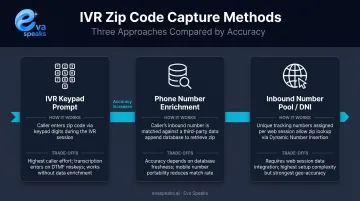
Dynamic Number Insertion (DNI) displays unique phone numbers to website visitors based on their source or session, passing zip code context directly into the IVR before the caller says a word. Marchex and Invoca describe this as a method for tying offline calls to online sources — which also makes it useful for pre-populating geographic routing data.
Step 2: Matching the Zip Code to a Destination
The IVR checks the captured zip code against a pre-configured routing table. That table maps zip codes (or zip code ranges) to specific agents, queues, departments, or locations. The mapping structure depends on the business:
- A national insurance carrier might map by state
- A franchise network might map by franchisee territory
- A healthcare group might map by individual clinic
Genesys Cloud's Collect Input action supports DTMF-based collection of numeric data like postal codes, with digit-length rules, verification, and transfer actions after successful collection. This illustrates the standard configuration pattern at the platform level.
Step 3: Transferring the Call — and Handling Exceptions
After a match, the call routes to the correct destination via warm transfer (with context passed ahead), cold transfer (direct handoff), or queue placement.
Fallback logic is where many implementations fail. Not every call produces a clean zip match, and without defined fallback rules, calls can stall or drop. Common scenarios that require fallback handling:
- Invalid entries: caller enters a non-existent or mistyped zip code
- Out-of-territory callers: zip code exists but falls outside any mapped region
- Unassigned regions: zip code is valid but has no routing rule configured
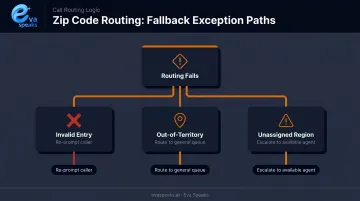
Each scenario needs an explicit resolution: route to a general queue, prompt the caller to re-enter, or escalate to an available agent. This isn't an edge case — it's a core design requirement.
Eva Speaks supports configurable office-hours and after-hours behavior, and its overflow handling ensures calls are redirected rather than abandoned when a destination is unavailable.
See how a complete zip code routing call flow is handled end-to-end. Explore AI Call Automation
Key Factors That Affect Zip Code Routing Performance
Data Accuracy
The zip code source determines routing quality. Caller-entered zip codes are the most reliable signal. Phone number enrichment is less accurate for mobile and ported numbers. IP geolocation is the weakest option — MaxMind notes that IP geolocation is probabilistic and provides confidence factors rather than guarantees, particularly at the postal-code level.
Use validated, regularly updated zip-to-location databases. Static NPA-NXX mappings don't account for portability.
Routing Table Maintenance
A routing table is only as current as the last time someone updated it. New service territories, agent reassignments, office openings, and office closures must all be reflected in the routing configuration. Stale routing tables cause misrouted calls even when the zip data is perfectly accurate.
CRM Integration
Zip code routing delivers more value when the captured data flows into the CRM record. NICE describes CTI screen pops as displaying caller information — including data entered before the agent conversation begins — so agents see context before answering.
Eva Speaks integrates with Salesforce, HubSpot, and GoHighLevel, with calls, transcripts, and structured data — including captured zip codes — populating automatically into connected CRM workflows when the agent picks up.
Fallback and Exception Handling
Every routing system needs defined logic for:
- Unrecognized zip codes
- Out-of-territory callers
- High-volume overflow scenarios
- Invalid or incomplete input
Without this, the system either drops calls or routes them arbitrarily — neither outcome is acceptable.
Not sure which routing setup fits your operation? Get a Customized Workflow Recommendation
Common Misconceptions and When Zip Code Routing Isn't the Right Fit
Common Misconceptions and When Zip Code Routing Isn't the Right Fit
Two assumptions trip up most IVR implementations before routing logic is even built.
Area code ≠ location. Number portability means a caller's area code reflects where they got the number — not where they are now. Zip code routing, especially with data enrichment, works from verified address-level data, not telephone numbering geography.
More IVR steps ≠ better accuracy. IVR menus with too many options cause callers to hang up or press whatever they last heard. A zip code prompt only makes sense when geographic routing actually changes the destination. If all callers end up in the same queue regardless, the extra step adds friction with no payoff.
When to Skip It
Zip code routing adds complexity that not every operation needs. Poor fits include:
- Single-location businesses with no geographic differentiation in routing outcomes
- Low call volume operations where setup cost exceeds the operational benefit
- Teams without defined territory assignments — zip code routing doesn't create coverage structure, it reflects one that already exists
- Businesses with highly mobile caller bases where numbers no longer match physical locations, making enrichment-based zip capture unreliable
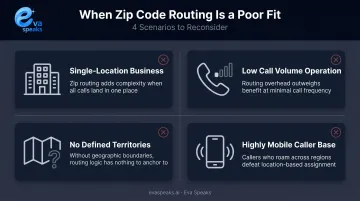
If you can't answer "which zip codes belong to which team," that's a territory design problem — not a routing configuration one. Solve the structure first, then build the routing logic around it.
Frequently Asked Questions
What is IVR call routing?
IVR call routing is how an Interactive Voice Response system directs incoming calls to the right agent, department, or location — without a live operator. It uses caller inputs, menu selections, or pre-collected data (like a zip code) to determine where each call should go.
What is location-based routing?
Location-based routing uses a caller's geographic information — zip code, area code, or IP-derived location — to connect them with the team or office that serves their region. This ensures callers reach agents who are relevant to their territory or service area.
What is the difference between ACD and IVR?
An IVR collects information from the caller and determines routing logic. An ACD (Automatic Call Distributor) is the system that physically distributes and queues those calls to agents. They typically work together — the IVR decides where the call should go, and the ACD gets it there.
What is an IVA vs IVR?
An IVR uses pre-recorded prompts and touchtone or basic voice inputs to collect information and route calls. An IVA (Intelligent Virtual Assistant) goes further — it uses AI and natural language processing to understand conversational speech and respond dynamically, without locking callers into a fixed menu.
What are the different types of IVR systems?
The main types are touch-tone (DTMF) IVR, speech-recognition IVR, and AI-powered conversational IVR. Modern platforms often blend AI with traditional flows, and most are cloud-hosted — though that's a deployment model, not a distinct IVR type.
What is IVR call transfer?
IVR call transfer is the action taken after routing logic identifies the correct destination — the call is handed off to a specific agent, queue, or external number. A warm transfer passes context ahead of the connection; a cold transfer is a direct handoff with no pre-call context shared.