Introduction
Phone calls remain one of the highest-converting customer touchpoints — but manually staffing inbound and outbound lines at any meaningful volume has become operationally unsustainable. Voice AI APIs have moved from experimental to essential, handling everything from appointment scheduling to lead qualification without a human agent picking up.
Choosing the wrong platform doesn't announce itself during procurement. It shows up later: in response lag that kills conversation flow, or in a $0.05/min headline rate that balloons to $0.28/min fully loaded.
It also shows up in a HIPAA BAA that only exists on enterprise tiers, and in a vendor architecture that creates hard lock-in after you've already deployed.
The conversational AI market is projected to grow from $17.05B in 2025 to $49.80B by 2031, which means every platform on this list is actively iterating. What was accurate six months ago may not be now. This guide cuts through the noise on each of those pain points: architecture, latency, compliance paths, and fully-loaded cost — the factors that determine whether a platform works for your business long-term.
Key Takeaways
- Voice AI APIs chain telephony, STT, LLM reasoning, and TTS into a single pipeline for real phone conversations
- Three architecture types exist: full-stack carrier-owned, orchestration layers, and no-code builders — each with distinct latency and cost tradeoffs
- Advertised per-minute rates rarely reflect production cost; fully-loaded stacks typically run $0.15–$0.32/min
- Platforms covered: Vapi, Retell AI, Bland AI, Telnyx, and Synthflow — spanning developer-focused to no-code options
- What to evaluate: end-to-end latency, native inbound/outbound support, compliance access, and pricing transparency at scale
What Is a Voice AI API for Calling?
A voice AI API is a programmable interface that chains four components into a real-time phone conversation pipeline:
- Telephony — PSTN or SIP to connect to the phone network
- Speech-to-text (STT) — converts caller audio to text
- LLM reasoning — processes intent and generates a response
- Text-to-speech (TTS) — converts the response back to audio
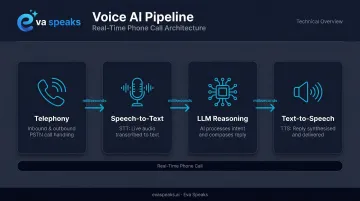
Each component hands off to the next in milliseconds — a very different model from traditional IVR, which forces callers through numbered keypad menus and rigid scripted sequences. Voice AI APIs use LLMs to understand natural language, manage multi-turn conversations, execute tasks mid-call, and route based on intent rather than button presses.
The Three Architecture Types
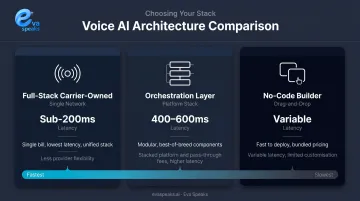
| Architecture | How It Works | Latency | Cost Structure |
|---|---|---|---|
| Full-stack carrier-owned | All components on one network (e.g., Telnyx) | Lowest — sub-200ms audio RTT possible | Single bill, most predictable |
| Orchestration layer | BYO LLM + third-party telephony (e.g., Vapi, Retell AI) | 400–600ms typical | Platform fee + pass-through costs stack |
| No-code builder | Visual flow designer over hosted infrastructure (e.g., Synthflow) | Variable | Bundled, easier to estimate |
Latency is where architecture choices get expensive. According to Telnyx's vendor latency benchmarks, stitched multi-vendor pipelines can accumulate 100–300ms for STT, 350–1,000ms for LLM inference, and 90–200ms for TTS — before network overhead. Each additional vendor hop compounds that total. Conversations start feeling broken above 800ms end-to-end. You can Watch AI Call Flow Demo to hear the difference a low-latency architecture makes in a live call.
Best Voice AI APIs for Calling in 2026
Five platforms made this list based on head-to-head evaluation across latency, API completeness (inbound + outbound), developer experience, compliance coverage, and fully-loaded pricing transparency. Here's how they stack up.
Vapi
Vapi gives developer teams a clean API to connect their own LLM, voice engine, and telephony provider — nothing is bundled in unless you want it to be. Its bring-your-own-everything architecture means maximum flexibility — you choose the models, you control the costs. Function calling mid-conversation and real-time webhooks make it well-suited for complex, stateful call flows. Vapi introduced a visual workflow builder in June 2025, though current documentation suggests Assistants or Squads are now preferred for new builds over Workflows.
| Attribute | Details |
|---|---|
| Key Features | BYO LLM and voice model; function calling during live calls; real-time webhooks; inbound and outbound support |
| Pricing | $0.05/min platform fee; LLM, STT, TTS, and telephony passed through separately; HIPAA add-on $2,000/month; zero data retention add-on $1,000/month |
| Best For | Technical teams prototyping and iterating quickly with their own model stack |
Retell AI
Retell AI uses a proprietary turn-taking model that goes beyond silence detection — it analyzes conversation state and speech intent to prevent improper interruptions and support natural backchanneling. Post-call analytics score 100% of calls with sentiment and resolution tracking, making it a strong choice for operations teams that need visibility into call performance at scale.
HIPAA BAA access is available through Retell's Trust Center and HIPAA blog for pay-as-you-go users, though the pricing page lists "Custom BAA" under Enterprise — verify the current access path in Retell's legal portal before making compliance commitments.
| Attribute | Details |
|---|---|
| Key Features | Drag-and-drop agentic flow builder; warm transfer with context handoff; post-call analysis with custom dashboards; CRM integrations; HIPAA BAA access |
| Pricing | $0.07–$0.31/min for AI Voice Agents depending on model and configuration; $10 in free credits for new users |
| Best For | Support and sales teams needing production-grade automation with robust post-call reporting |
If you want to see how Eva Speaks compares in a live setting, you can Request Live Demo at any point during your evaluation.
Bland AI
Bland AI is built for high-volume outbound calling. Its Conversational Pathways system structures call logic as nodes and conditions — Default, Webhook, Knowledge Base, End Call, Transfer Call, and Wait for Response — giving developers precise control over branching and edge cases. No visual builder exists here; the platform assumes full API fluency. Enterprise tier supports unlimited concurrent calls with dedicated infrastructure or on-premise deployment.
| Attribute | Details |
|---|---|
| Key Features | Pathway-based conversation logic; high-concurrency outbound calling; proprietary TTS; SOC 2 Type I & II, HIPAA (with BAA), GDPR, PCI DSS |
| Pricing | Free tier at $0.14/min (no monthly fee); Scale tier $499/month at $0.11/min (up to 100 concurrent calls); Enterprise is custom |
| Best For | Developer teams running high-volume outbound campaigns requiring precise call flow control and concurrency |
Telnyx
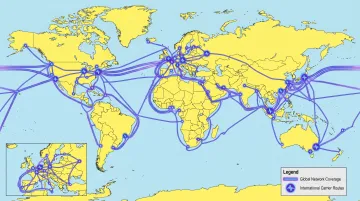
Telnyx is the only platform on this list that operates as a licensed carrier in 30+ markets, with PSTN reach across 60+ countries. Because telephony, LLM inference, STT, and TTS are co-located on Telnyx's private backbone — not stitched across vendors — audio and inference travel the same network. Telnyx publishes a sub-200ms audio RTT benchmark based on its own network data, though this figure has not been independently validated.
That same co-location architecture consolidates compliance as well: SOC 2, HIPAA, PCI, and GDPR all fall under a single provider relationship.
| Attribute | Details |
|---|---|
| Key Features | Carrier-owned network; co-located LLM inference; full call control (SIP, DTMF, warm transfers, recording); SOC 2, HIPAA, PCI, GDPR; PSTN reach in 60+ countries |
| Pricing | Voice AI orchestration $0.05/min; Call Control $0.002/min; TTS from $0.000009/character; LLM inference priced by model |
| Best For | Production teams needing carrier-grade reliability, lowest latency, and a single-bill architecture |
Synthflow
For non-technical teams, Synthflow offers the shortest path from decision to live voice agent. Its drag-and-drop flow designer and out-of-the-box integrations with HubSpot, Salesforce, and GoHighLevel mean most businesses can deploy without writing code. White-labeling is available as a $2,000/month add-on on pay-as-you-go or included in Enterprise, making it viable for agencies. Off-script handling is weaker than LLM-native platforms — complex, unpredictable conversations are better served elsewhere.
| Attribute | Details |
|---|---|
| Key Features | Visual drag-and-drop flow builder; HubSpot, Salesforce, GoHighLevel integrations; white-label option; SOC 2, HIPAA, GDPR, ISO 27001; unlimited agents on Enterprise |
| Pricing | Pay-as-you-go starts free; typical fully-loaded stack $0.15–$0.24/min; Enterprise from 10,000 min/month (contact for pricing) |
| Best For | Agencies and non-technical teams launching a working voice agent without engineering resources |
Platform Comparison at a Glance
Here is how the leading voice AI API platforms compare for businesses building inbound and outbound call solutions:
| EvaSpeaks (Business-Ready) | Retell AI (Developer) | Vapi (Developer) | |
|---|---|---|---|
| Best-fit Business Size | SMB to mid-market, non-technical teams | Engineering teams, startups | Dev teams, mid-market |
| Key Strengths | No-code, CRM-native, fast time to value | Full programmability, transparent pricing | Flexible, community support | | Implementation Complexity | Low - no code | Medium - developer needed | Medium | | Integration Capability | CRM, scheduling, EHR out-of-box | Custom via REST API | Custom via REST API |
How We Chose the Best Voice AI APIs
The Hidden Cost Problem
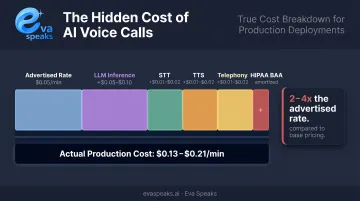
The most expensive mistake buyers make is comparing headline rates. The advertised price rarely reflects what you actually pay in production:
Assume a platform advertises $0.05/min. Add:
- LLM inference: ~$0.05–$0.10/min depending on model
- STT: ~$0.01–$0.02/min
- TTS: ~$0.01–$0.02/min
- Telephony: ~$0.01–$0.02/min
- HIPAA BAA: amortized per-minute cost if usage is under the fixed fee threshold
Actual production cost: $0.13–$0.21/min, which is two to four times the advertised rate. Always calculate fully-loaded cost at your projected monthly volume before committing — and if you want to walk through those numbers with someone who understands the stack, you can Talk to an AI Communication Expert.
The Five Evaluation Criteria
1. End-to-end latency Natural conversation requires fast response. ITU-T G.114 recommends keeping one-way transmission delay under 150ms for essentially transparent interactivity, with 400ms as the general planning ceiling. Voice AI adds processing time on top of transport delay — production targets below 800ms end-to-end are the practical threshold for conversational feel.
2. Native inbound and outbound support Some platforms optimize for one direction. Verify that both are first-class API capabilities, not workarounds.
3. Compliance access path Check: HIPAA BAA tier availability, GDPR data processing agreements, SOC 2 Type II attestation, and TCPA consent tooling for outbound. The access path matters — a BAA locked behind an enterprise contract affects deployment timelines and budget.
4. Developer experience Documentation depth, time-to-first-call, and SDK quality vary significantly. Factor in engineering cost, not just platform cost.
5. Integration ecosystem Telephony providers, CRMs, and automation tools need to connect without custom middleware. For businesses running existing stacks — Salesforce, HubSpot, GoHighLevel, or EHR systems — native integrations reduce deployment time substantially.
TCPA Compliance Is Non-Negotiable for US Outbound
Criteria #3 above — compliance access path — carries particular weight for US outbound calling.
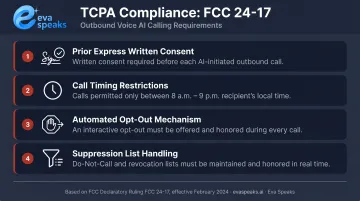
FCC Declaratory Ruling FCC 24-17 (February 2024) confirmed that AI-generated voices fall under TCPA restrictions on artificial or prerecorded voice calls. That means prior express consent is required, calls to residential subscribers are restricted before 8 a.m. or after 9 p.m. local time, and automated opt-out mechanisms must be provided.
Platforms with built-in consent management, suppression list handling, and time-of-day restrictions reduce legal exposure. When evaluating any provider, verify these controls exist at the API level — not just in the UI — so they can be enforced programmatically across your workflows. You can also See Industry Use Cases to understand how compliant outbound calling works across different sectors.
Conclusion
No single platform is the right answer for every use case:
- Lowest latency, single-bill architecture → Telnyx
- Developer flexibility, BYO model stack → Vapi or Retell AI
- High-volume outbound with precise flow control → Bland AI
- Fast deployment without engineering resources → Synthflow
Before signing any contract: calculate fully-loaded production cost at your expected call volume, stress-test latency under realistic concurrency, and confirm the compliance access path your use case actually requires — not the tier it's theoretically available on.
If your priority is a managed solution rather than a raw API — one that handles inbound and outbound calls, LLM-backed routing, and appointment scheduling without building the stack yourself — EvaSpeaks provides AI-powered call handling with customizable call flows built for SMBs through enterprise clients across healthcare, legal, automotive, and property management. For businesses and developers evaluating the build-versus-buy decision, EvaSpeaks removes the need to manage STT providers, LLM integrations, and telephony connections separately — the whole stack is delivered as a configured service, which can reduce time-to-production from months to days.
Frequently Asked Questions
What is the difference between a Voice AI API and a traditional IVR system?
Traditional IVR forces callers through DTMF menus — press 1 for billing, press 2 for support. Voice AI APIs use LLMs to understand natural language, manage multi-turn conversations, execute tasks mid-call, and route based on intent. In practice, callers reach the right outcome on the first attempt — without menu navigation or repeated prompts.
How much does a Voice AI API typically cost for a business?
Advertised rates range from $0.05–$0.31/min, but fully-loaded production stacks — adding LLM, STT, TTS, telephony, and compliance fees — typically run $0.15–$0.32/min. Calculate total cost at your projected monthly volume — headline rates rarely reflect what production actually costs.
What latency should I expect from a Voice AI API in production?
Carrier-owned full-stack platforms like Telnyx publish sub-200ms audio RTT benchmarks (vendor data). Orchestration platforms typically land at 400–600ms in production. Multi-vendor stitched stacks frequently exceed 900ms under load, where conversations start feeling noticeably delayed.
Is voice AI legal for outbound calls in the US?
Yes, with compliance requirements. FCC ruling FCC 24-17 (February 2024) classifies AI-generated voices as "artificial" under TCPA, requiring prior express consent, call timing restrictions, and automated opt-out mechanisms. Platforms with built-in consent management and suppression handling reduce exposure significantly.
Can a Voice AI API handle both inbound and outbound calls?
Most platforms on this list support both directions, but depth varies. Bland AI is stronger on outbound volume; Retell AI excels at inbound flow management. For businesses running both use cases, verify each direction is a native API capability rather than a bolted-on feature.
How do I choose between a no-code voice AI platform and a developer-first API?
No-code platforms like Synthflow work best when a non-engineering team owns the agent and launch speed matters most. Developer-first platforms like Vapi or Retell AI are better when custom call logic, BYO model flexibility, or deep CRM integration is required.