The result: phones ring, staff scramble, and patients with genuinely urgent needs land in the same general queue as someone rescheduling a routine appointment. Routing the wrong call to the wrong person isn't just a customer experience failure — it can delay care.
Dynamic call routing is the infrastructure fix telehealth organizations are increasingly turning to. It's no longer optional for practices managing multi-provider workflows, after-hours coverage, and high call volumes. This article covers what dynamic call routing is, how it works in a triage context, and what to look for when evaluating solutions. Telehealth organizations that want to see AI-powered dynamic routing in practice can Watch AI Call Flow Demo before reading further.
Key Takeaways
- Dynamic call routing redirects calls automatically based on real-time conditions: time of day, caller identity, urgency, and staff availability
- Unlike static routing, it adapts on the fly without manual changes when schedules or volumes shift
- Telehealth-specific rules (new vs. established patient, after-hours, urgency flags) enable true triage by phone
- AI-powered systems interpret open-ended caller intent, not just menu selections, for smarter call prioritization
- Any routing platform used in healthcare must meet HIPAA standards — BAA availability included
What Is Dynamic Call Routing?
Dynamic call routing automatically redirects incoming calls based on flexible, real-time rules — caller number, time of day, staff availability, or caller-provided input — without requiring manual intervention each time conditions change.
The contrast with static routing is straightforward:
| Static Routing | Dynamic Routing | |
|---|---|---|
| Logic | Fixed, predetermined path | Conditional "if-then" rules |
| Adaptability | Requires manual changes | Adjusts automatically |
| Best for | Small, predictable call volumes | Variable staff, multi-provider environments |
| After-hours handling | Manual toggle required | Automatically activates based on time rules |
| Caller context | Not considered | Can pull from CRM, EHR, or scheduling data |
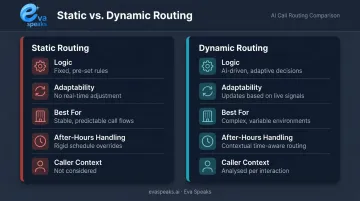
The mechanism that makes dynamic routing work is answering rules — configurable conditions that determine how each call is handled. A simple example: if a call arrives after 6 PM, route to the on-call nurse line; if it comes from a recognized patient number, route to their assigned care coordinator.
From IVR Menus to Intelligent Routing
Call routing has come a long way. Early systems relied on human operators, then gave way to basic IVR menus ("press 1 for appointments, press 2 for billing"). Today's dynamic routing uses AI and large language models to interpret what callers actually say, not just which button they press.
In healthcare, this distinction carries real weight. A caller who says "I'm having chest tightness" needs a completely different response than one saying "I need to update my insurance." Systems that can only parse DTMF inputs cannot make that distinction.
Modern platforms like EvaSpeaks integrate LLMs, speech-to-text, and text-to-speech to handle open-ended conversations in real time — shifting routing from a mechanical switching function into active triage support. EvaSpeaks is designed to be configurable by clinical and administrative staff rather than requiring IT or developer involvement, which is an important consideration for telehealth organizations that need to update routing rules quickly as staffing and provider schedules change.
Here is how dynamic AI routing, traditional IVR, and skills-based ACD routing compare:
| Dynamic AI Routing (EvaSpeaks) | Traditional Static IVR | Skills-Based ACD Routing | |
|---|---|---|---|
| Features | Real-time intent detection, adaptive routing rules, CRM context | Fixed decision trees, DTMF input | Agent skill matching, queue management |
| Best-fit Business Size | SMB to mid-market | Large enterprise | Mid-market to enterprise contact centers |
| Key Strengths | Adapts in real time, easy rule updates, no IT team needed | Predictable, proven | Best-fit agent matching |
| Implementation Complexity | Low - no code | High | Medium |
| Integration Capability | CRM, EHR, scheduling native | Custom dev required | CRM via API |
You can Watch AI Call Flow Demo to see how AI-powered dynamic routing handles a telehealth triage call in real time.
How Dynamic Call Routing Works in Telehealth Triage
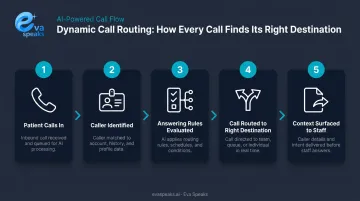
Here's what a dynamic routing interaction looks like in practice for a telehealth organization:
- Patient calls in — the system answers immediately, no hold required at the initial stage
- Caller is identified — new vs. established patient, recognized phone number, or self-identified through conversation
- Answering rules are evaluated — time of day, patient type, stated reason for calling, current staff availability
- Call is routed to the right destination — care coordinator, triage nurse, specialist line, or after-hours service
- Context is surfaced — relevant information accompanies the routed call so staff don't need to re-gather it
Routing Rule Types That Matter for Triage
Not all routing rules are equally valuable in healthcare. These four categories do the heaviest lifting:
- Time-based rules — calls after hours redirect to an on-call nurse or virtual answering service automatically, no manual toggle at the end of each shift
- Patient-type rules — new patients route to intake coordinators; established patients route to their assigned provider team
- Urgency-based rules — callers describing acute symptoms are elevated in priority and bypass standard queues
- Provider-specific rules — patients linked to a specific physician route directly to that provider's line
The Role of AI and Natural Language Processing
Rigid IVR menus create a specific problem in healthcare: patients don't describe their needs in menu-friendly language. Someone calling about a medication side effect might say "I've been feeling dizzy since starting the new prescription" — not "press 3 for medication questions."
AI-powered routing systems process that natural language and route based on clinical relevance. Research published in PMC demonstrates NLP's application in pre-hospital telephone triage, with studies analyzing large teleconsultation record sets to support smarter triage decisions.
Eva Speaks' platform applies this same logic: conversational AI interprets open-ended caller input and routes based on clinical intent rather than keypad selections.
After-Hours Coverage Without Manual Management
After-hours routing is where static systems consistently fail telehealth operations. Staff forget to toggle settings, calls go unanswered, and urgent requests hit a general voicemail.
Dynamic routing eliminates this gap. The system detects that a call arrives outside configured business hours and automatically redirects it — to an on-call nurse line, a telehealth answering service, or an AI-powered virtual agent. The shift change requires no manual intervention from staff at all. You can See How AI Handles After-Hours Calls to watch what this automatic redirection looks like from a patient's perspective.
Why Telehealth Providers Are Adopting Dynamic Routing
Three pressures are driving adoption, and they're all getting worse.
Patient Experience Expectations
Telehealth patients don't lower their expectations just because the care is virtual. They still want fast, accurate responses — and they notice when they're transferred twice before reaching the right person. A Veterans Health Administration study found that longer telephone wait times directly correlated with lower patient perceptions of access to urgent care. Routing that reduces unnecessary transfers and gets callers to the right person first matters to how patients perceive care quality overall.
Operational Efficiency Under Staffing Pressure
When calls arrive pre-sorted and pre-contextualized, front-desk staff spend less time re-routing and clinical staff handle fewer calls outside their scope. The efficiency gains stack quickly:
- Fewer transfers = less time per call
- Better first-call resolution = lower callback volume
- After-hours automation = no overtime for coverage gaps
MGMA's 2023 polling of 508 medical groups found phone systems and contact centers in focus as organizations seek to fill appointments and improve access — precisely the problem dynamic routing addresses.
Surge Readiness
Seasonal flu spikes, disease outbreaks, and sudden telehealth demand increases don't come with advance notice. Dynamic routing lets organizations adjust call handling in real time — activating backup lines, rerouting overflow, and prioritizing urgent calls — without a reconfiguration project.
The Compliance and Patient Safety Angle
Routing errors in healthcare aren't just operational inconveniences. Research on telephone medicine found that faulty triage appeared in 84% of telephone-related malpractice cases, with failure to diagnose the most common allegation. Dynamic routing with clear escalation rules — particularly for callers describing urgent symptoms — reduces the probability that a high-acuity patient gets caught in a standard queue.
That safety obligation extends to the platform itself. Any routing system that creates, receives, or transmits protected health information (PHI) qualifies as a business associate under HHS guidelines — meaning a signed Business Associate Agreement is required before go-live. Telehealth organizations that want to discuss BAA requirements and routing compliance can Talk to an AI Communication Expert.
What to Look for in a Dynamic Routing Solution for Telehealth
Evaluating routing platforms isn't the same as evaluating general contact center software. Telehealth has specific requirements that many generic platforms don't address.
Non-Negotiable Capabilities
- Customizable routing rules — administrators should be able to configure time-based, patient-type, and urgency-based rules without involving an IT team on every change
- AI-powered natural language handling — the system needs to interpret open-ended caller input, not just IVR menu responses
- EHR and scheduling integrations — routing decisions become meaningfully smarter when the system can access scheduling data, patient records, or care team assignments
- After-hours automation — automatic time-based routing that activates without manual toggling
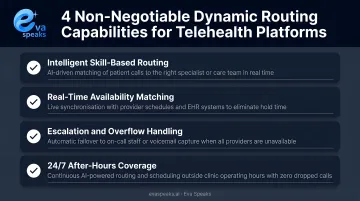
Eva Speaks addresses each of these directly — LLM-powered call handling, configurable routing rules, and real-time conversational AI make it a practical fit for telehealth organizations that need more than a basic phone tree. Telehealth administrators who want to see this applied to their specific triage workflows can Request Live Demo.
Scalability That Doesn't Require a Project
A platform that requires engineering intervention to add a new routing path creates friction at exactly the wrong moment — when call volumes spike and you need to adapt fast. The right solution lets administrators modify rules, add routing paths, and adjust office hours configurations without opening a support ticket.
Reporting and Analytics
Routing data is also operational intelligence. Look for platforms that surface:
- Call volume patterns by time of day and day of week
- Transfer rates (high rates signal routing misconfiguration)
- After-hours call frequency (informs staffing decisions)
- Routing accuracy over time
Without this visibility, administrators can't tell whether routing logic is working or quietly sending patients to the wrong destination.
HIPAA Compliance Verification
Before deployment, verify:
- Whether the vendor signs a Business Associate Agreement
- How call log data is encrypted in transit and at rest
- What data residency guarantees apply
- Whether customers can opt out of call data being used for AI model training
Eva Speaks stores data in U.S. data centers and offers an opt-out for AI model training — customers can opt out by contacting privacy@evaspeaks.ai. For HIPAA compliance documentation and BAA availability, direct consultation with their team is the right next step.
Frequently Asked Questions
What is dynamic call routing?
Dynamic call routing is an automated system that redirects incoming calls based on real-time conditions — time of day, caller identity, urgency, and staff availability — rather than a fixed path. It evaluates each call as it arrives and routes accordingly.
What is an example of dynamic call routing in telehealth?
An established patient calling during business hours is automatically routed to their assigned care coordinator. The same call placed after 6 PM is redirected to the on-call nurse line — all without any staff manually changing settings at the end of the day.
Which is better, static or dynamic call routing?
Static routing works for small, single-location practices with predictable call patterns. For telehealth providers managing variable schedules, multiple patient types, or after-hours coverage, dynamic routing is the stronger choice — it adjusts to conditions static systems can't handle.
Should I turn on dynamic call routing?
If your practice is experiencing missed calls, frequent misdirects, patient complaints about transfers, or after-hours coverage gaps, dynamic routing is worth implementing. In telehealth specifically, misdirected calls aren't just an inconvenience — they directly affect triage accuracy and patient outcomes.
Is dynamic call routing HIPAA-compliant?
Compliance depends on the platform, not the routing process itself. Any vendor that handles PHI during routing or logging qualifies as a business associate under HHS guidelines and must sign a BAA. Verify encryption practices, data residency, and BAA availability before deployment.