Introduction
International call routing determines the path every cross-border business call takes: from the moment a caller dials in one country to the moment it connects in another. It's not a passive background process. The carriers involved, the route quality selected, and the logic applied at each decision point directly shape whether that call completes cleanly, costs a reasonable amount, and clears the regulatory requirements on both ends.
This guide is written for businesses operating across borders: customer support teams managing agents in multiple time zones, remote-first companies, and enterprises handling international call volume at scale.
Whether you're evaluating your first international setup or troubleshooting an existing one, understanding how routing works end-to-end is what separates a reliable global communications system from one that creates constant firefighting.
What follows covers how international call routing actually works, what factors determine its performance, and the common mistakes that trip up businesses who treat it as a default setting instead of a deliberate one. Businesses that also want to see how AI layers on top of international routing infrastructure can Explore AI Call Automation.
Key Takeaways
- International call routing is the network-level process that directs calls across carrier infrastructure from one country to another.
- Businesses use it to control costs, maintain global availability, and connect customers to the right team regardless of geography.
- Route quality, carrier agreements, time zone logic, and regulatory compliance all shape routing outcomes.
- Confusing routing with call forwarding is the most common setup mistake; the two operate at entirely different network layers.
- AI-powered platforms like Eva Speaks add customizable, real-time decision logic on top of carrier defaults.
What Is International Call Routing?
International call routing is the mechanism that determines the path a call takes from its originating country — through one or more carrier networks — to its destination country. It's not simply "making an international call." It's the infrastructure logic governing how that call travels.
The distinction that matters most for businesses: routing is not the same as call forwarding.
| Feature | Call Routing | Call Forwarding |
|---|---|---|
| Where it operates | Network/infrastructure level | Account/application level |
| What it controls | Path selection between carriers | Redirection from one number to another |
| Who configures it | Carrier or business phone system | End user or admin |
| Scope | Entire call journey | Last-mile redirection only |
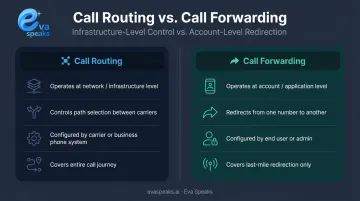
Forwarding is a feature you switch on in an account dashboard. Routing is the underlying system — it determines which carrier handles the call, how the call travels across networks, and which gateway delivers it at the destination. A business can have call forwarding configured correctly while the routing underneath is costing too much, degrading quality, or failing silently.
The goal of international call routing is to connect a caller in one country to a recipient in another reliably, at viable cost, and within applicable regulatory boundaries. Each of those constraints — quality, cost, compliance — shapes routing decisions in distinct ways, which is what the rest of this guide covers.
Why International Call Routing Matters for Businesses
The Business Cost of Getting It Wrong
The stakes are higher than most teams assume. According to a Neustar/TransUnion paper citing Omdia 2021 research, 75% of enterprises report losing over 10% of revenue due to negative call experiences. Separately, Hiya's State of the Call report found that 86% of unknown calls go unanswered — meaning a call that arrives via a poorly configured route, with an unrecognized number or spoofed caller ID, may complete and still fail commercially.
Poor routing doesn't always announce itself as a dropped call. It shows up as:
- Calls completing but landing in the wrong queue
- Callers hanging up due to excessive latency or audio quality issues
- Outbound calls blocked or labeled as spam because of CLI (caller ID) problems on the route
Cost, Local Presence, and Compliance
Beyond reliability, routing strategy has three direct business implications:
- Cost control: Least-cost routing (LCR) logic automatically selects the cheapest viable carrier for each destination at call time — without manual intervention. Without it, international calls default to expensive carrier paths by default.
- Local presence: Calls can route through local or toll-free numbers in a customer's country while connecting internally to agents anywhere. The caller experiences a local business; the agent handles a standard inbound call.
- Regulatory compliance: Many countries require calls to use licensed carriers, meet specific technical standards, or pass through approved gateways. Non-compliance results in blocked calls, carrier penalties, or legal exposure.
Without a deliberate strategy, businesses often end up on grey routes — unofficial paths that manipulate call origin to exploit tariff differences. The result is unpredictable quality, compliance risk, and costs that are difficult to audit or control.
How International Call Routing Works
At a high level, a call placed in Country A travels through the originating carrier's network, crosses international interconnects — physical submarine cables, satellite links, or IP-based paths — passes through one or more transit carriers, and terminates with the destination carrier in Country B.
The ITU notes that submarine cables carry approximately 99% of the world's internet traffic, making them the physical backbone of modern international voice as well.
Two infrastructure types handle the bulk of this traffic:
- PSTN (Public Switched Telephone Network): Established bilateral settlement agreements between carriers; higher reliability on major routes, generally higher cost
- VoIP/IP-based routes: Voice converted into data packets transmitted over internet or dedicated IP connections; typically lower cost, increasingly dominant for business telephony
Here is how PSTN-based, standard cloud VoIP, and AI-powered international call routing compare:
| AI + Cloud VoIP (EvaSpeaks) | Standard Cloud VoIP Routing | PSTN International Routing | |
|---|---|---|---|
| Features | Conversational AI routing, real-time language detection, dynamic rules | VoIP trunk routing, IVR, basic ACD | Fixed PSTN circuits, manual routing |
| Best-fit Business Size | Global SMBs, multi-regional teams | Mid-market to enterprise | Large enterprise with legacy infrastructure |
| Key Strengths | AI handles language + intent, easy to update | Lower cost than PSTN, flexible | Maximum reliability, carrier-grade SLA |
| Implementation Complexity | Low - no-code routing rules | Medium | High |
| Integration Capability | CRM, scheduling, multilingual native | API-based, custom | Custom dev required |
The entire process is governed by signaling protocols. RFC 3261 defines SIP (Session Initiation Protocol) as the application-layer protocol for establishing, modifying, and terminating voice sessions over IP. Legacy networks rely on SS7 — which the FCC confirms plays a critical role in fixed and mobile telecommunications infrastructure. These protocols carry call metadata (caller ID, destination number, routing instructions) alongside the voice traffic itself.
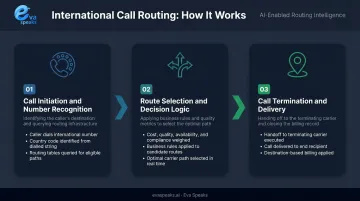
Step 1: Call Initiation and Number Recognition
When a caller dials an international number, the originating carrier reads the country code prefix — for example, +1 for the US and Canada, +44 for the UK — to identify the destination country. The system queries routing tables to determine which carriers or gateways serve that destination.
This step relies on ITU-T E.164, the international public telecommunication numbering plan that standardizes how countries and numbers are identified globally. Number format errors here — missing country codes, incorrect prefixes, legacy formatting — cause calls to be misdirected or rejected before they ever reach a carrier.
Step 2: Route Selection and Decision Logic
The carrier or business phone system applies routing logic to choose between available paths, weighing cost per minute, call quality scores, route availability, and regulatory compliance.
Intelligent routing platforms let businesses layer their own logic on top of carrier defaults. EvaSpeaks, for example, supports customizable call-flow scripts with conditions based on office hours, department, and inbound number — so calls follow business-specific rules rather than generic carrier behavior.
The platform's AI capabilities integrate LLMs, text-to-speech, and speech-to-text to handle real-time conversational routing in addition to standard rule-based decisions. EvaSpeaks is designed to operate without dedicated telephony hardware, which means international businesses can extend their call handling across regions by connecting EvaSpeaks to their existing phone infrastructure rather than standing up new systems in each market. Businesses evaluating this approach can Request Live Demo to see how AI-powered international routing works in practice.
Step 3: Call Termination and Delivery
Once a route is selected, the call is handed off to the terminating carrier in the destination country, which connects it to the end recipient — a physical phone, VoIP device, or softphone extension. Billing is calculated based on the destination country and number type (mobile vs. landline). This is where destination-based billing applies, and where route choice has the most direct cost impact.
Key Factors That Affect International Call Routing
Several technical and operational variables determine whether an international call connects cleanly — or fails entirely. Understanding these factors helps businesses build more reliable, compliant routing setups.
Carrier agreements and route quality: Calls traveling over direct bilateral agreements between major carriers carry the highest quality — dedicated fiber links, minimal latency, fewer handoffs. Multi-hop transit routes through the wholesale market introduce more points of potential degradation at each handoff.
White vs. grey routes: White routes use legitimate, licensed carrier paths with proper interconnect agreements. Grey routes involve re-origination or CLI manipulation to make international calls appear domestic — exploiting tariff gaps illegally. As Ofcom's 2024 statement on CLI documents, scammers use exactly this technique to disguise international call origin. Businesses unknowingly using grey routes face blocked calls, regulatory penalties, and reputational damage.
Time zone and agent availability logic: For inbound international calls routed to human agents, the routing system must account for agent location and availability. Eva Speaks supports office hours configuration as part of its call-flow setup, ensuring calls aren't routed to unmanned queues outside business hours.
Number format and country code accuracy: Routing failures frequently trace back to incorrectly formatted destination numbers. Missing country codes or legacy dial prefixes cause calls to be rejected at the carrier level before any routing logic runs.
AI and real-time routing intelligence: Platforms that assess caller intent, process conversational context, or apply configurable routing rules can meaningfully reduce misrouted calls and manual intervention. For businesses handling calls across multiple regions or time zones, this adaptability translates directly into better customer outcomes and lower operational overhead.
Common Issues and Misconceptions
Routing vs. Forwarding: The Persistent Confusion
The most widespread mistake: treating call routing and call forwarding as the same thing. The distinction matters more than most businesses realize.
A business that sets up a forwarding rule to redirect international calls to a specific number believes it has a routing strategy. What it actually has is a last-mile redirect sitting on top of an unmanaged carrier path. The underlying cost, quality, and compliance variables remain completely unaddressed.
Routing is a network-level process. Forwarding is a feature. When businesses conflate the two, the real problems go unaddressed:
- Expensive carrier defaults with no cost control
- No failover logic when a carrier path fails
- No quality monitoring to detect degraded connections
Static Configuration in a Dynamic Environment
Many businesses configure a single static destination for international calls and never revisit it. No quality scoring. No time-of-day logic. No failover if the primary carrier has an outage. The result is predictable: degraded quality during peak periods and complete call failure when something goes wrong upstream.
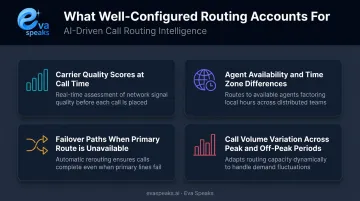
Well-configured routing accounts for:
- Carrier quality scores at the time of the call
- Agent availability and time zone differences
- Failover paths when the primary route is unavailable
- Call volume variation across peak and off-peak periods
The Grey Route Trap
Some organizations end up on grey route configurations because the per-minute rates look attractive. The problem is what those cheap rates actually represent: CLI manipulation, calls that may appear to originate domestically when they don't, and paths that destination carriers actively work to identify and block.
The short-term savings are real — but so are the consequences. Blocked calls, compliance violations, and sudden operational disruption when a route gets shut down are all predictable outcomes. Grey routes aren't a cost optimization strategy; they're deferred risk with a defined expiration date. To see how AI-enhanced routing manages quality and compliance simultaneously, you can Watch AI Call Flow Demo.
Conclusion
International call routing is one of the most consequential infrastructure decisions behind every cross-border business call. Treating it as a background setting leads to inflated costs, unexplained call failures, and compliance exposure that surfaces at the worst possible time.
The right approach combines proper carrier selection, well-structured routing logic, and regulatory awareness. For businesses handling significant call volumes across regions, that also means intelligent routing tools that apply real-time decision logic to each call rather than relying on static configurations.
Eva Speaks consolidates call handling, configurable call-flow scripts, and routing rules into a single system — giving businesses direct control over routing behavior that reflects how they actually operate. Businesses with multi-region operations can Get a Customized Workflow Recommendation to see how AI routing would fit their specific international setup.
Frequently Asked Questions
How are international calls routed?
International calls travel from the originating carrier through a series of interconnects — either PSTN settlement routes or VoIP IP paths — to the destination country's terminating carrier. At each handoff, routing decisions are made based on cost, quality, and availability using signaling protocols like SIP and SS7.
Is US +1 for international calls?
Yes. +1 is the country code assigned by the ITU to the North American Numbering Plan (NANP), which includes both the United States and Canada. When dialing into the US internationally, callers prefix the 10-digit number with +1.
What is the difference between international call routing and call forwarding?
Call routing is a network-level process that determines the path a call takes between carriers and countries. Call forwarding is an account-level feature that redirects calls from one number to another — it only affects the final destination, not the underlying carrier path.
What is least-cost routing in international calls?
Least-cost routing (LCR) is a method where a business phone system or carrier automatically selects the cheapest available carrier path to a given destination at call time. It reduces international calling costs without requiring manual route management, though cost should always be balanced against route quality and compliance.
How can businesses reduce international call routing costs?
The main approaches are using VoIP/IP-based routes instead of PSTN paths, implementing LCR logic to automate carrier selection, and using local virtual numbers in target markets. Avoid grey routes — they appear cheaper but carry surcharges, call blocking, and compliance risks that outweigh the savings.
Can AI improve international call routing for businesses?
Yes. AI systems can route calls based on caller context, agent availability, office hours, or live quality conditions — rather than fixed rules. Platforms like Eva Speaks offer customizable call-flow scripting that adjusts routing behavior in real time, reducing missed calls and manual intervention.