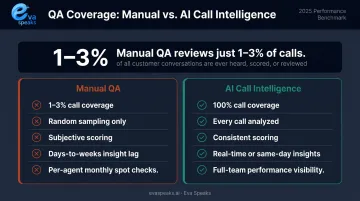
That's not a minor inefficiency. According to Cresta, upwards of 90% of organizational data — including conversational data — is unstructured, which means it can't be searched, sorted, or acted on without AI. Phone calls sit squarely in that category. And with manual QA programs typically reviewing only 1–3% of interactions, the overwhelming majority of calls go completely unanalyzed.
This guide covers what AI call intelligence is, how the technology works, what types of insights it surfaces, and how to put those insights to work across sales, support, and operations.
Key Takeaways
- Manual QA catches 1–3% of calls; AI analyzes all of them
- AI call intelligence extracts sentiment, buying intent, keywords, compliance signals, and churn indicators — without manual review
- Post-call outputs — summaries, scores, CRM notes — eliminate most after-call work
- Sales, support, and operations teams each have distinct use cases
- Getting started requires defining one clear outcome before picking a platform
What Is AI-Powered Call Intelligence?
AI call intelligence is a technology layer that automatically transcribes, analyzes, and surfaces insights — sentiment trends, script adherence, escalation flags — from phone conversations — both during live calls and after they end. It goes well beyond recording and storage.
The contrast with traditional call monitoring is stark. Legacy QA programs rely on random sampling: a supervisor manually listens to a handful of calls per agent per month and scores them against a checklist. ICMI found that roughly four-fifths of contact centers randomly sampled interactions, mostly manually, and 42% of respondents identified highly manual processes as their primary quality-management challenge.
That approach has three fundamental problems:
- Coverage: A random sample of 2–4 calls per agent per month misses almost everything
- Subjectivity: Different supervisors score the same call differently
- Speed: Insights arrive days or weeks after the conversation, long past the point of action
AI-powered systems process every call, apply consistent scoring criteria, and deliver insights in real time or immediately post-call. That means 100% call coverage, uniform scoring across every agent, and coaching conversations that happen the same day — not after the damage is done.
Watch it work on a real call. Watch AI Call Flow Demo
How the three main approaches to call intelligence stack up against each other:
| Eva Speaks | Standard AI Platform | Legacy Manual QA | |
|---|---|---|---|
| Features | AI transcription, real-time sentiment, LLM-powered intent scoring, automated CRM notes, configurable routing | AI transcription, post-call analytics, basic keyword tracking | Manual sampling, supervisor scoring, checklist-based review |
| Best-fit Business Size | SMBs to mid-market; flexible deployment | Mid-market to enterprise | Any size, but scales poorly |
| Key Strengths | Fast setup, LLM-grade nuance detection, deep integrations, 100% call coverage | Broad feature set, strong reporting | Familiar workflow, no new tooling required |
| Implementation Complexity | Low - no infrastructure overhaul; fits existing phone and CRM setup | Medium - requires IT involvement and integration configuration | Low initially; complexity grows with team size and call volume |
| Integration Capability | Native CRM, scheduling, EHR, telephony integrations out of the box | CRM and telephony via APIs; varies by vendor | Limited; data lives in spreadsheets or siloed QA tools |
How AI Extracts Insights from Customer Calls
The Technology Layer: AI, ML, and NLP Working Together
Three technologies work in combination to make call intelligence possible:
- Speech recognition (ASR) converts spoken audio to text in real time
- Natural language processing (NLP) interprets meaning, context, and intent — not just the words themselves
- Machine learning (ML) identifies patterns across thousands of interactions over time, improving detection as it processes more data
NLP is what separates modern call intelligence from older keyword-spotting tools. Where a keyword system flags calls that contain the word "cancel," an NLP-based system understands that "I've been thinking about whether this is still worth it" carries a similar signal — even without that word appearing.
Platforms that integrate large language models (LLMs), like Eva Speaks, go a step beyond standard NLP. LLM integration processes voice through speech-to-text, then applies language model reasoning to interpret intent, tone, and nuance across the full conversation — not just isolated phrases.
Real-Time vs. Post-Call Analysis
That technology stack powers two distinct modes of analysis, each suited to different business needs.
Real-time analysis happens during the call:
- Live transcription appears as the conversation unfolds
- Sentiment monitoring flags when tone shifts negative
- Agent coaching prompts surface relevant information mid-conversation
Post-call analysis happens after the call ends:
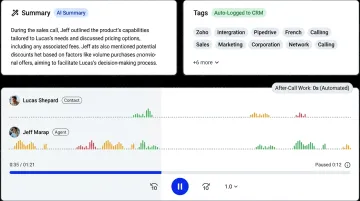
- Automated call summaries
- Keyword frequency and topic trend reports
- Agent performance scores against defined criteria
- CRM-ready notes — generated without manual input
Post-call automation has a measurable operational payoff. Five9 reports that agents spend up to six minutes on after-call work — typing summaries, logging data, updating CRM records — and that TruConnect reduced after-call work by 40% using AI-powered summaries. At scale, that's hundreds of hours per month redirected toward live customer interactions.
Types of Insights You Can Extract from Customer Calls
Sentiment and Emotional Signals
AI detects tone, emotional intensity, frustration, hesitation, and satisfaction throughout a call — not just at the end. This matters because customers often signal dissatisfaction before they state it directly.
Practical applications:
- Flag calls where sentiment dropped sharply for supervisor review
- Identify callers showing frustration patterns before they escalate
- Track sentiment trends across all interactions with a single customer over time
- Surface calls where tone recovered after agent intervention, for positive coaching examples
A customer who sounds increasingly resigned across three calls in two weeks is a churn risk, even if they've never said so explicitly. Catching that pattern early creates an intervention window that wouldn't otherwise exist.
Buying Intent and Lead Qualification
Not all callers are at the same point in a decision. AI identifies language patterns and conversational signals that indicate where a caller sits in the buying journey — specific questions they ask, objections they raise, or comparisons they make.
This matters most for sales teams. Rather than treating all inbound calls equally, intent scoring lets teams prioritize follow-up on the conversations most likely to convert. A caller who asked about implementation timelines and contract terms is a different priority than one who asked a general product question.
Keyword and Topic Tracking
Custom keyword detection lets teams define specific terms to track: competitor names, pricing objections, compliance-sensitive phrases, product features under discussion. AI flags every call where they appear — no manual listening required.
Beyond custom lists, trending topic analysis surfaces recurring themes across all calls automatically. If a product issue or a new competitor starts appearing in conversations, the pattern shows up in the data before any individual agent connects the dots.
Agent Performance and Compliance Signals
AI evaluates calls against predefined scripts and scoring criteria. Each call gets checked for the same criteria:
- Required disclosures delivered at the right moment
- Objection handling aligned with trained responses
- Key steps completed in the correct sequence
- Language compliance with regulatory or brand requirements
AI QA delivers something manual review can't match: consistent scoring across every call, which eliminates scoring inconsistency between reviewers that makes traditional QA data unreliable for coaching decisions.
For compliance-sensitive industries, this is especially valuable. Missed disclosures and required language gaps are caught across all calls, not just the ones that happened to be randomly selected for review.
Customer Churn and Satisfaction Indicators
AI surfaces behavioral patterns that predict dissatisfaction: repeated callbacks about the same unresolved issue, declining sentiment across a customer's interaction history, or language that signals someone is considering leaving.
The value here is timing. Churn signals don't usually appear as a single dramatic conversation — they build across multiple interactions. AI can track those patterns across your full call history and alert teams before the customer makes a final decision.
Want to hear what AI-captured calls actually sound like? Listen to Sample AI Call
Key Business Benefits of AI Call Intelligence
Recovering lost revenue before it disappears
Missed or unresolved calls represent lost pipeline. When AI flags unanswered high-intent calls and triggers automated follow-up, those opportunities don't fall into a log that nobody checks. Combined with intent scoring, teams can prioritize the calls most likely to convert rather than working through a queue chronologically.
Cutting after-call work so agents focus on conversations
AI eliminates the manual tasks that consume agent time after every call: note-taking, CRM entry, summary writing. The TruConnect/Five9 case (40% ACW reduction) shows what's possible when these tasks are automated at scale. Agents recover meaningful time per call, and that compounds across hundreds of daily interactions.
That recovered time has a direct impact on customers, too. When agents enter a follow-up call with full context from prior transcripts, customers don't repeat themselves. When AI surfaces the right information mid-call, resolution happens faster. SQM Group research shows that every 1% improvement in first-call resolution corresponds to a 1% improvement in customer satisfaction, along with a 1% reduction in operating costs.
Turning call data into coaching material
Replacing random QA sampling with AI-scored analysis across all calls gives managers a complete, objective picture of agent performance. Coaching conversations become specific — grounded in actual call moments rather than impressions from a handful of monitored calls.
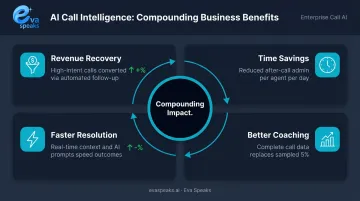
The four improvements compound on each other:
- More high-intent calls converted through automated follow-up
- Less time lost to post-call admin per agent, per day
- Faster resolutions driven by real-time context and AI prompts
- Coaching grounded in complete call data, not a sampled 5%
AI Call Intelligence in Action: Use Cases Across Teams
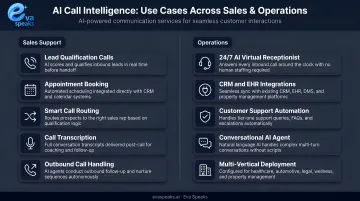
AI call intelligence delivers different value depending on where it's applied. Here's how it breaks down across the teams that interact with customers most.
Sales teams use AI to:
- Detect buying signals and score inbound callers by intent
- Analyze which objection-handling approaches correlate with conversions
- Automatically log call outcomes to CRM without manual entry
- Prioritize follow-up queues based on conversation signals, not call order
Customer support teams put AI to work by:
- Monitor first-call resolution rates across all agents
- Detect escalation risk in real time before a call goes wrong
- Flag recurring complaints that indicate a product or process issue
- Catch declining sentiment patterns that signal churn risk early
Operations and management can use AI to:
- Monitor script compliance across every agent, not a random sample
- Identify training gaps from aggregated performance data
- Track trending customer concerns for product and process planning
- Generate audit-ready documentation automatically
See how businesses in your industry are using this. See Industry Use Cases
How to Get Started with AI Call Intelligence
Step 1 — Define Your Priority Outcome First
Before evaluating any platform, identify one or two specific goals. Improving lead conversion, reducing after-call work, tightening compliance monitoring, and lowering churn all require different configurations. A clear outcome prevents over-engineering and ensures the system surfaces insights that actually matter to your team.
Step 2 — Choose a Platform Built for Your Workflow
Look for a solution that checks these three boxes:
- Integrates with your existing phone system and CRM
- Uses LLM-powered analysis for nuanced call content review
- Supports customization of call flows, routing rules, and scoring criteria
Eva Speaks, for example, handles AI-enabled call answering with configurable scripts, routing rules, and direct LLM integration — built to fit your existing operations without a full infrastructure overhaul. For teams that want call intelligence capabilities without committing to an enterprise contact center platform, Eva Speaks offers a way to start with AI-powered transcription and routing without extensive deployment complexity.
Want a setup tailored to your workflows? Get a Customized Workflow Recommendation
Step 3 — Analyze, Review, and Iterate
Start collecting data from day one. Schedule regular team reviews of AI-generated insights and refine keyword tracking, scoring criteria, and follow-up workflows based on what the data shows. AI call intelligence compounds in value over time — patterns invisible in week one become clear after months of consistent data.
Frequently Asked Questions
What is AI powered call center intelligence?
AI call center intelligence uses machine learning and NLP to automatically analyze customer phone calls, extracting insights like sentiment, intent, keyword trends, and performance signals rather than just recording and storing them. It turns unstructured voice data into structured, actionable information at scale.
What types of customer insights can AI extract from calls?
The main categories include sentiment and emotional signals, buying intent indicators, keyword and topic trends, agent performance and compliance adherence, and churn or dissatisfaction patterns. Different teams — sales, support, compliance — draw on different categories depending on their goals.
Does AI call intelligence replace human agents?
No. AI call intelligence handles note-taking, scoring, and analysis so agents can focus on conversations and judgment calls that require a human. It augments agent performance by surfacing better information — not by stepping in for it.
How to tell if a caller is AI?
Common indicators include slight processing pauses, unnaturally consistent pacing, and scripted-sounding responses. You can also ask directly — regulations in many U.S. jurisdictions require disclosure. Existing FCC rules require automated or prerecorded messages to identify the responsible caller at the outset of the call.
Is AI cold calling illegal?
AI-assisted outbound calling is legal when it complies with applicable regulations. The FCC ruled in 2024 that TCPA restrictions on "artificial or prerecorded voice" calls encompass AI-generated voices and generally require prior express written consent. Compliance requirements vary by jurisdiction and use case — consult legal counsel for your specific situation.
Can AI call intelligence integrate with existing CRM and phone systems?
Most modern platforms, including Eva Speaks, are built to integrate with existing tools and systems through third-party integration support. Platforms with configurable call-flow and routing rule support can typically be adapted to existing workflows without a complete infrastructure overhaul.