Introduction
Enterprise help desks are under serious pressure. According to HDI's State of Tech Support 2025, support organizations process an average of 10,675 tickets monthly — and 34% report that volume is still climbing. Meanwhile, 75% experienced notable staff turnover in the past year, leaving teams stretched thin on coverage they can't easily replace.
AI chatbots are filling that gap — and today's platforms look nothing like the rule-based bots of five years ago. Modern enterprise solutions use large language models (LLMs) to understand intent, handle multi-step requests, route tickets intelligently, and resolve interactions without human intervention.
Gartner projects that agentic AI will autonomously resolve 80% of common customer service issues by 2029, alongside a 30% reduction in operational costs.
This guide reviews five leading enterprise AI chatbot platforms for 2026, evaluated on automation depth, integration breadth, channel coverage, and real-world enterprise readiness.
See how AI handles help desk calls live. Request Live Demo
Key Takeaways
- Enterprise AI chatbots use LLMs and NLP to understand intent, ground answers in your knowledge base, and handle resolution end-to-end — not just surface FAQ responses.
- Key criteria: LLM capabilities, CRM/ITSM integration, omnichannel support, security compliance, and pricing clarity.
- The five platforms reviewed: ServiceNow Virtual Agent, Zendesk AI, IBM Watson Assistant, Eva Speaks, and Salesforce Agentforce.
- Your dominant support channel (voice, chat, or email) should drive platform selection — not feature count alone.
- Eva Speaks is purpose-built for enterprises with high voice and phone help desk volume, backed by LLM accuracy and flexible call routing.
What Are AI Chatbots for Enterprise Help Desk Automation?
Enterprise AI chatbots are software platforms that use NLP and LLMs to automatically handle, route, and resolve employee or customer support requests. They're distinct from rule-based bots, which follow fixed decision trees and break down the moment a user asks something unscripted. LLM-powered bots understand natural language intent — even when requests are ambiguous, multi-part, or phrased in ways no one anticipated.
What Makes a Tool "Enterprise-Grade"?
Enterprise-grade platforms are built for scale, security, and cross-functional deployment. They offer:
- High-volume ticket handling without degradation in response quality
- Role-based access controls (RBAC) and SSO/MFA for secure administration
- Data residency compliance and certifications (SOC 2, GDPR, HIPAA where relevant)
- Multi-department deployment across IT, HR, facilities, and customer service
- Deep integrations with CRM, ITSM, and ticketing platforms
- Transparent human-to-bot handoff with full context transfer
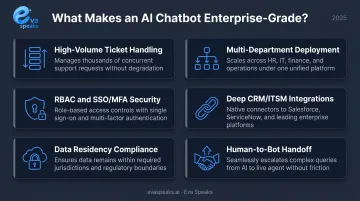
Forrester counted over 650 vendors competing in conversational AI as of Q2 2026 — which means differentiation matters. The tools covered here meet all six criteria above, separating them from the broader pool of general-purpose or SMB-focused chatbots.
Best AI Chatbots for Enterprise Help Desk Automation in 2026
Platforms below were evaluated across six criteria. Rule-engine-only bots without genuine AI capability were excluded.
- LLM/NLP depth — quality of language understanding and contextual reasoning
- Integration quality — native connectors, APIs, and ecosystem fit
- Omnichannel support — coverage across chat, email, voice, and messaging
- Enterprise security posture — certifications, data residency, and compliance features
- Scalability — performance under high-volume enterprise workloads
- Pricing transparency — published rates or clear pricing structure
ServiceNow Virtual Agent
ServiceNow Virtual Agent is a GenAI-powered chatbot built natively into the ServiceNow ITSM platform, designed for IT, HR, and facilities service desks. It uses ServiceNow's Now Intelligence AI layer to resolve requests, execute workflows, and support multi-turn conversations with contextual recall across sessions.
The LLM topic discovery feature removes the need for predefined intents or keywords — the bot understands what users mean without requiring IT teams to map every possible phrasing. Federation University reported a 50% increase in self-service rate over five years and a 10% decrease in phone support within six weeks after embedding the bot in Microsoft Teams.
| Attribute | Detail |
|---|---|
| Key Features | Native ITSM workflow execution, Now LLM-powered NLP, multi-department virtual agent support, pre-built IT and HR topics, real-time agent handoff with full context |
| Best For | Large enterprises already invested in the ServiceNow ecosystem requiring deep ITSM automation |
| Pricing | Available as part of ServiceNow platform tiers; Now Assist licensing required for advanced AI features — contact sales for enterprise pricing |
Watch an AI enterprise call flow in action. Watch AI Call Flow Demo
Zendesk AI (Copilot + AI Agents)
Zendesk AI combines automated deflection, ticket triage, and agent guidance across email, chat, and voice in one platform. Its AI agents are knowledge-base-grounded, meaning responses cite source articles to reduce hallucinations — a critical differentiator for compliance-sensitive environments. The Copilot add-on surfaces suggested replies to human agents in real time, keeping augmented and automated support in sync.
Zendesk reports its AI agents can resolve up to 80% of customer interactions autonomously, with automated resolutions billed as the unit of measurement for AI agent usage.
| Attribute | Detail |
|---|---|
| Key Features | KB-grounded AI chatbot, AI Copilot for agents, intent detection, sentiment analysis, omnichannel ticketing, 1,200+ integrations |
| Best For | Enterprise teams with high-volume mixed-channel support seeking AI-augmented agents alongside automated deflection |
| Pricing | Suite starts at $55/agent/month (annual); AI Copilot available as add-on — contact Zendesk for current add-on pricing |
IBM Watson Assistant (watsonx Assistant)
IBM Watson Assistant is an enterprise conversational AI platform for building and deploying virtual agents across web, mobile, phone, and messaging channels. Its no-code/low-code flow builder reduces dependency on developer resources, while its compliance posture makes it a strong fit for heavily regulated sectors.
Watson's certifications include ISO 27001, SOC 2, and GDPR readiness, with HIPAA eligibility on Enterprise plans in specific regions. The City of Austin deployed watsonx Assistant for public-facing COVID-19 citizen support in under one week, pre-loaded with CDC guidance — demonstrating rapid deployment even in high-stakes contexts.
| Attribute | Detail |
|---|---|
| Key Features | Multi-channel deployment, no-code flow builder, enterprise-grade security certifications, API-based backend integrations, built-in analytics, 13+ language models |
| Best For | Regulated industries (healthcare, finance, government) requiring high customization and strict data governance |
| Pricing | Lite plan available at no cost; paid plans scale from usage-based tiers — Enterprise pricing on request with dedicated SLA support |
Eva Speaks
Eva Speaks is an AI-powered communication platform that handles enterprise voice and chat interactions using LLMs, real-time transcription, and customizable call-flow routing. Where most enterprise chatbots are built primarily for chat and email, Eva Speaks addresses a gap that many organizations underestimate: high-volume phone-based help desk support.
Instead of scripted IVR trees, EvaSpeaks uses LLM integration to deliver contextually accurate, real-time AI responses during live calls. IT and CX teams can configure call-flow scripts, routing rules, and office hours to tailor bot behavior precisely to their support workflows. A key differentiator for enterprise buyers evaluating EvaSpeaks alongside heavyweight CCaaS platforms is deployment simplicity: EvaSpeaks can go live in days and connect to existing telephony without a multi-month implementation project.
Every call is transcribed automatically, creating a searchable, auditable record for QA and compliance review. Businesses can also opt out of having their data used for AI model training, giving enterprise customers direct control over data governance.
| Attribute | Detail |
|---|---|
| Key Features | LLM-powered real-time AI responses, AI call handling and transcription, customizable call-flow scripts and routing rules, seamless escalation to live agents, U.S.-based data storage |
| Best For | Enterprises with significant voice/phone-based help desk volume needing LLM-backed accuracy and customizable routing without complex IVR scripting |
| Pricing | Contact Eva Speaks for enterprise pricing tailored to call volume and deployment scope |
Here is how AI-native voice, ServiceNow-style enterprise platforms, and traditional human help desks compare for conversational automation:
| AI-Native (EvaSpeaks) | Enterprise IT (ServiceNow, Freshservice) | Traditional Human Help Desk | |
|---|---|---|---|
| Features | Voice AI + ticketing sync, call routing, 24/7 | ITSM, IT workflow automation, AI assist | Human agents, full incident handling |
| Best-fit Business Size | SMB to mid-market | Mid-market to enterprise | Any size |
| Key Strengths | Fast deploy, voice-first, CRM-native | Proven ITSM, deep automation | Full judgment, complex incidents |
| Implementation Complexity | Low | High - months | None (hire) |
| Integration Capability | Zendesk, Freshdesk, ticketing native | Enterprise ITSM | Manual |
Want a workflow built for your help desk call types? Get a Customized Workflow Recommendation
Salesforce Agentforce
Salesforce Agentforce goes beyond automated responses — it executes multi-step workflows autonomously using live CRM data. Built into Salesforce Service Cloud, Agentforce agents pull full customer interaction history, open cases, order records, and account details. They act on that context, not just retrieve it.
Datasite reported Agentforce resolved 70% of day-to-day chat questions accurately, 24/7. Pricing is consumption-based: standard Agentforce actions use 20 Flex Credits, voice actions use 30, with Flex Credits at $500 per 100,000. Conversations are also available at $2 per conversation.
| Attribute | Detail |
|---|---|
| Key Features | Native Salesforce CRM integration, autonomous multi-step action execution, pre-built agent templates, cross-team data access (sales, service, marketing), agentic AI with real-time reasoning |
| Best For | Enterprises deeply embedded in the Salesforce ecosystem needing unified, CRM-grounded AI across service, sales, and marketing touchpoints |
| Pricing | Service Cloud Starter from $25/user/month; Agentforce 1 Service Edition at $550/user/month; Agentforce Conversations at $2/conversation |
How We Chose the Best AI Chatbots for Enterprise Help Desks
Evaluation Framework
Platforms were assessed on genuine AI capability: specifically, how they handle ambiguous or multi-intent queries, which is where most enterprise deployments fail in practice. Marketing claims about "AI-powered" features were ignored without evidence of LLM or advanced NLP implementation underneath.
Enterprise-specific criteria applied:
- Integration compatibility with leading ITSM/CRM/ticketing platforms
- Omnichannel deployment breadth (voice, chat, email, messaging)
- Security certifications relevant to regulated industries (SOC 2, GDPR, HIPAA)
- Scalability under concurrent high-ticket loads
- Quality of human-to-bot handoff and context transfer
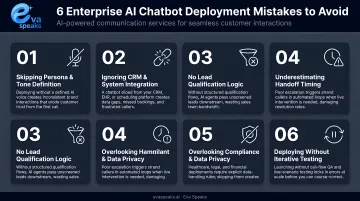
Common Mistakes Enterprises Make
These errors derail otherwise well-resourced deployments:
- Evaluating on demo performance rather than testing against real historical ticket data
- Underestimating integration complexity — native connectors behave differently than open API workarounds
- Ignoring handoff quality: a bot that drops context at escalation creates more work, not less
- Optimizing for base per-agent price while ignoring total cost of ownership (add-ons, API calls, volume overages)
- Skipping knowledge management readiness: Gartner found 61% of service leaders have a backlog of outdated knowledge articles, which directly degrades bot accuracy
- Overlooking pricing transparency — platforms that publish clear tiers let IT and finance teams model costs before committing to deployment, rather than relying on "contact sales for everything" quotes
Explore how AI is transforming enterprise help desks. Explore AI Call Automation
Conclusion
The right AI chatbot for enterprise help desk automation integrates cleanly with your existing stack, handles your dominant support channel reliably, and delivers measurable deflection and resolution rates.
Before committing to full deployment, run a pilot with actual historical ticket data. Test bot-to-agent handoffs under realistic concurrent loads. Benchmark against three core KPIs:
- First contact resolution (FCR) — what percentage of issues are resolved without escalation
- Deflection rate — how often the bot fully handles tickets without agent involvement
- Average handle time (AHT) — whether automation is actually reducing per-ticket effort
For enterprises where phone-based support is the primary channel — and where scripted IVR trees have already proven inadequate — Eva Speaks offers a dedicated voice AI solution. LLM-backed accuracy, customizable routing rules, and automatic transcription reduce help desk burden without requiring you to rebuild your communication infrastructure. Reach out to the Eva Speaks team to explore how AI call handling fits your support environment.
Frequently Asked Questions
What are the best conversational AI chatbots for enterprise customer support?
The leading enterprise-grade platforms in 2026 include ServiceNow Virtual Agent, Zendesk AI, IBM Watson Assistant, Salesforce Agentforce, and Eva Speaks. The best fit depends on your dominant channel (voice vs. chat), existing tech stack, and compliance requirements. No single platform works across all environments.
Which conversational AI help desk tools integrate best with existing CRM and ticketing systems?
Salesforce Agentforce integrates natively with Salesforce CRM, ServiceNow Virtual Agent with ServiceNow ITSM, and Zendesk AI within its own ticketing ecosystem. IBM Watson Assistant and Eva Speaks offer API-based integration for broader compatibility with platforms outside those native ecosystems.
What is the difference between a rule-based chatbot and a conversational AI chatbot for help desks?
Rule-based bots follow predefined decision trees and fail on any query that falls outside their scripted paths. Conversational AI bots use NLP and LLMs to understand natural language intent, handle ambiguous requests, and improve from interaction data without requiring every scenario to be manually scripted.
What features should enterprises prioritize when evaluating AI chatbots for help desk automation?
Prioritize these six criteria:
- LLM/NLP quality for accurate intent recognition
- CRM and ticketing integration depth
- Omnichannel support across voice, chat, and email
- Clean human-to-bot handoff with full context transfer
- Enterprise security certifications
- Pricing models that allow cost forecasting before full rollout
How much does enterprise AI chatbot software for help desks typically cost?
Pricing varies widely: Zendesk Suite starts at $55/agent/month, Salesforce Service Cloud from $25/user/month, and Agentforce conversations at $2 each. IBM Watson Assistant and Eva Speaks use custom enterprise pricing based on volume and deployment scope — contact vendors directly for accurate quotes.
Can AI chatbots fully replace human agents in enterprise help desks?
Not completely — and the best deployments don't try to. AI chatbots handle routine, high-volume requests effectively, but complex, sensitive, or escalated issues still require human judgment. The goal is augmentation: AI handles the repetitive workload so agents focus on the interactions that actually need them.