Static IVR menus can't deliver that. AI call routing platforms use NLP, real-time intent detection, and LLM integration to match every caller to the right agent or automated flow—dynamically, not through keypad-driven decision trees.
This guide covers the 15 best AI call routing platforms for 2026: what makes each stand out, verified pricing where available, G2 ratings, and a clear-eyed framework for choosing the right fit.
Key Takeaways
- AI call routing replaces rigid IVR menus with NLP- and machine learning-driven routing that responds to caller intent in real time
- These 15 platforms range from purpose-built AI voice solutions to enterprise CCaaS with advanced routing modules
- Evaluate platforms on LLM/NLP depth, routing customization, CRM connectivity, scalability, and pricing transparency
- Eva Speaks leads the list for businesses needing LLM-driven call handling, real-time transcription, and flexible call-flow scripts
- Score any platform against your needs using the "How We Chose" criteria below
What Is AI Call Routing?
AI call routing is a system that uses artificial intelligence—NLP, intent detection, and predictive analytics—to automatically direct inbound calls to the best-matched agent, team, or self-service flow in real time.
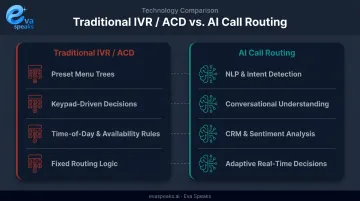
That's a meaningful departure from traditional ACD and IVR. As Genesys explains, traditional routing uses preset factors like time of day, phone number, and agent availability. AI-powered routing goes further—analyzing caller speech, CRM data, sentiment, and historical patterns to make routing decisions that adapt with every interaction.
The practical result: fewer misroutes, shorter handle times, and callers who reach the right agent on the first try.
Watch how AI-powered call routing handles complex enterprise flows. Watch AI Call Flow Demo
Not every platform delivers that equally. The 15 options below were evaluated on:
- AI depth — quality of NLP, intent detection, and adaptive learning
- Routing flexibility — rule complexity, fallback handling, and customization
- Integration ecosystems — CRM, helpdesk, and telephony compatibility
- Business fit — suitability across SMB, mid-market, and enterprise contexts
15 Best AI Call Routing Platforms in 2026
Platforms evaluated on AI/NLP capability, routing rule flexibility, CRM integration, scalability, deployment model, and verified user ratings.
1. Eva Speaks
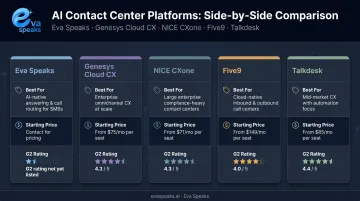
Eva Speaks is a Hayward, CA-based AI-powered communication platform built around LLM-driven call handling. Its core capabilities—AI-enabled inbound call routing, real-time transcription, and customizable call-flow scripts—are designed to reduce agent workload while keeping customer experience consistent.
What separates EvaSpeaks from bolt-on AI features is architecture: the platform integrates directly with large language models for conversational routing, meaning callers aren't forced through numbered menus. Call flows, routing rules, and office-hours logic are all configurable by the business. This flexibility also means EvaSpeaks can be deployed by operations teams without developer resources — a meaningful advantage for small and mid-sized businesses that need AI-powered routing but can't support the implementation overhead of enterprise contact center platforms.
Data is processed and stored in U.S. data centers, with CCPA compliance and an opt-out mechanism for AI model training.
| Key Features | AI-enabled call handling and transcription, LLM integration, customizable call-flow scripts and routing rules, real-time AI responses, cloud-hosted with U.S. data centers |
| Best For | US-based businesses seeking AI-powered communication with flexible routing and transcription |
| Pricing | Contact Eva Speaks directly for current plan details |
2. Genesys Cloud CX
Genesys Cloud CX is a cloud-native contact center platform used by enterprises globally. Its predictive routing engine trains ML models on historical interaction, agent, and customer data to match each caller with the available agent most likely to achieve a positive outcome—not just the next available one.
Rush University System for Health saw a 9%–15% handle-time reduction after deploying Genesys Predictive Routing.
| Key Features | Predictive AI routing, omnichannel orchestration, workforce engagement management, real-time analytics |
| Best For | Large enterprises requiring advanced omnichannel CX and AI-driven routing at scale |
| Pricing | CX 1: $75/user/month · CX 2: $115 · CX 3: $155 · CX 4: $240 (annual billing) |
| G2 Rating | 4.4/5 (1,546 reviews) |
3. NICE CXone
NICE CXone is an enterprise-grade cloud contact center known for analytics depth and workforce optimization. Its AI routing layer assesses agent performance—call length, customer satisfaction scores, personality interaction patterns—to route based on real behavioral data, not just availability.
The platform's sentiment analysis captures feedback on every interaction, feeding routing logic that can escalate calls before frustration peaks.
| Key Features | AI-driven omnichannel routing, quality management, workforce optimization, real-time sentiment analysis |
| Best For | Large enterprises and regulated industries prioritizing analytics-led routing and compliance |
| Pricing | From $110/agent/month (Omnichannel Suite) to $249/agent/month (Ultimate Suite) |
| G2 Rating | 4.3/5 (1,730 reviews) |
4. Five9
Five9 is a cloud contact center platform built specifically for high-volume inbound and outbound call management. Its Intelligent Virtual Agent handles AI triage before routing—understanding what the caller wants without a human agent—then transfers to the best-matched live agent with full context attached.
This handoff design is what reduces repeat calls: the agent already knows what the customer tried before being transferred.
| Key Features | Intelligent Virtual Agent, skills-based and predictive routing, CRM integrations, real-time dashboards |
| Best For | Mid-market to enterprise teams running high-volume inbound support or outbound sales with AI triage |
| Pricing | Core: $149/month · Premium: $169 · Optimum: $199 · Ultimate: $229 |
| G2 Rating | 4.1/5 (611 reviews) |
5. Talkdesk
Talkdesk has built a strong AI identity with purpose-built models for specific industries. Its AI Routing product scores agent-caller fit dynamically using real-time and historical data. The platform ships pre-built AI models for healthcare, financial services, and retail, so organizations in those verticals don't start from scratch.
| Key Features | AI Routing, industry-specific AI models, agent assist, omnichannel, CRM integrations |
| Best For | Businesses in regulated or specialized industries needing pre-built AI routing with industry context |
| Pricing | Essentials: $75/user/month · Elevate: $95 · Elite: $125 |
| G2 Rating | 4.4/5 (2,503 reviews) |
6. Amazon Connect
Amazon Connect is AWS's cloud contact center service, built to integrate natively with Amazon Lex (conversational AI/NLP), Amazon Comprehend (sentiment analysis), and Amazon Polly (text-to-speech). There are no seat licenses—you pay per minute of voice, per message, per email.
For engineering-led teams that want to build completely custom AI routing workflows without per-seat pricing constraints, this is the most flexible infrastructure-level option on the list.
| Key Features | Native AWS AI integration (Lex, Comprehend, Polly), contact flows, pay-per-use, omnichannel |
| Best For | Engineering-led teams and AWS-native organizations building scalable, custom AI routing solutions |
| Pricing | Pay-per-use: voice $0.038/min · chat $0.010/message · email $0.080/email |
| G2 Rating | 4.5/5 (75 reviews) |
Want routing built around your team's structure? Get a Customized Workflow Recommendation
7. Dialpad
Dialpad's Voice Intelligence (Vi) layer captures caller intent in real time and surfaces coaching cues to agents mid-call. Its AI-powered IVR handles intent-based routing, skills-based routing, and queue logic, directing callers to the right team or agent without complex implementation.
For SMB and mid-market teams without dedicated AI engineering, Dialpad delivers meaningful AI routing capability at a practical price point.
| Key Features | Real-time AI transcription, Voice Intelligence (Vi), intent-based routing, CRM integrations |
| Best For | SMB and mid-market teams wanting AI-assisted calling and routing without complex implementation |
| Pricing | Standard: $15/user/month · Pro: $25/user/month · Enterprise: custom (100-license minimum) |
| G2 Rating | 4.4/5 (695 reviews) |
8. Twilio Flex
Twilio Flex is a fully programmable cloud contact center where routing logic, AI integrations, and channel handling are all code-configurable. For developer-driven organizations, that means no ceiling on what's possible. Routing rules can incorporate any data source, any ML model, any business logic.
The tradeoff: this platform rewards engineering investment. Teams without development resources will find it demanding.
| Key Features | Programmable routing APIs, omnichannel, third-party AI integration, custom workflows |
| Best For | Engineering-led enterprise teams that need fully custom AI call routing built to specification |
| Pricing | Contact Twilio for current platform pricing |
| G2 Rating | 4.1/5 (36 reviews) |
9. RingCentral Contact Center
RingCentral Contact Center combines skills-based, priority-based, and predictive routing within the same platform that handles video, messaging, and voice. For organizations already on RingCentral's UCaaS stack, adding AI call routing here avoids vendor fragmentation.
| Key Features | AI skills-based and predictive routing, omnichannel, UCaaS integration, analytics dashboards |
| Best For | Organizations already using RingCentral UC that want AI routing in the same ecosystem |
| Pricing | Contact RingCentral for current plan pricing |
| G2 Rating | 4.1/5 (198 reviews) |
10. Salesforce Service Cloud Voice
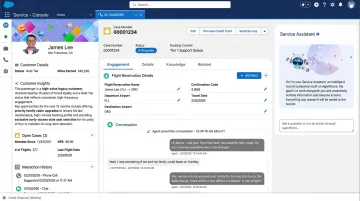
Service Cloud Voice embeds telephony and AI routing directly inside Salesforce CRM, powered by Amazon Connect infrastructure and Einstein AI. Routing decisions incorporate live CRM context—customer tier, open cases, interaction history—so agents receive callers already briefed, not cold.
| Key Features | CRM-native AI routing, Einstein AI integration, real-time transcription, omnichannel within Salesforce |
| Best For | Salesforce-native contact centers that want AI routing driven by live CRM data |
| Pricing | Contact Salesforce for current add-on pricing |
| G2 Rating | 4.4/5 (7,328 reviews — Agentforce Service) |
11. Avaya Experience Platform
Avaya's platform—now branded Avaya Infinity—suits large enterprises migrating from on-premise telephony to AI-enhanced cloud routing. The platform allows organizations to choose their AI models, deployment model, and how much human-AI collaboration fits their workflows, which makes it a practical fit for complex migration scenarios.
| Key Features | AI virtual agents, skills-based and sentiment-driven routing, hybrid/cloud deployment, workforce management |
| Best For | Large enterprises transitioning from on-premise telephony to AI-enhanced cloud routing |
| Pricing | Contact Avaya for enterprise pricing |
| G2 Rating | 4.1/5 (181 reviews) |
12. Cisco Webex Contact Center
Cisco unveiled its AI-powered Webex Contact Center solutions in late 2025, including a Webex AI Agent and Cisco AI Assistant for contact center workflows. Its routing capabilities sit within Cisco's compliance and security infrastructure, which matters in regulated environments.
| Key Features | AI routing, enterprise security and compliance, omnichannel, Cisco ecosystem integration |
| Best For | Regulated industries and large enterprises requiring AI routing within a secure, compliance-ready stack |
| Pricing | Contact Cisco Webex for enterprise pricing |
13. 8x8 Contact Center
8x8 combines UCaaS and CCaaS in one platform. Its AI speech analytics flag compliance risks, support script adherence, and document interactions—feeding routing decisions that can incorporate context from internal team communications alongside customer data.
| Key Features | Unified UCaaS + CCaaS, AI speech analytics, skills-based routing, global calling coverage |
| Best For | Mid-market to enterprise teams wanting unified communications and AI call routing in a single platform |
| Pricing | Contact 8x8 for current tiered pricing |
14. Bland AI
Bland AI is a conversational AI platform built to replace IVR entirely with natural-language voice agents that handle inbound triage, routing, and resolution before escalating to human agents. A self-hosted option is available for organizations with data sovereignty requirements.
For high-volume triage, lead qualification, or after-hours coverage, the per-minute pricing model makes costs predictable and scales without seat-license overhead.
| Key Features | Conversational AI voice agents, NLP-based triage and routing, self-hosted option, live agent handoff |
| Best For | Businesses replacing legacy IVR with AI voice agents for triage, routing, and automated resolution |
| Pricing | Start: free ($0.14/min) · Build: $299/mo ($0.12/min) · Scale: $499/mo ($0.11/min) |
15. Aircall
Aircall is a cloud-based call center platform with AI routing capabilities designed for fast-growing sales and support teams. Its strength is integration breadth—100+ native connectors including HubSpot, Salesforce, Zendesk, Intercom, and Shopify—which reduces routing setup time for teams already running a modern SaaS stack.
| Key Features | AI transcription and intent tagging, CRM-native routing, 100+ integrations, cloud-based |
| Best For | Fast-growing SMB and mid-market teams wanting AI-assisted routing tightly integrated with their CRM stack |
| Pricing | From $30/license/month |
Here is how AI-first, mid-market, and heavy enterprise call routing platforms compare:
| AI-Native SMB/Mid-Market (EvaSpeaks) | Genesys / Avaya (Enterprise) | RingCentral / Dialpad (Mid-Market) | |
|---|---|---|---|
| Best-fit Business Size | SMB to scaling mid-market | Large enterprise (1000+ seats) | 50-1000 seats |
| Key Strengths | Fast deploy, no IT dependency, LLM-native | Full CCaaS suite, global scale | UCaaS + routing, strong analytics |
| Implementation Complexity | Low - days | High - months + integrators | Medium - weeks |
| Integration Capability | CRM, EHR, scheduling out-of-box | Deep but custom-dev heavy | Standard CRM integrations |
How We Chose the Best AI Call Routing Platforms
Picking the wrong platform is a more common mistake than most teams expect. Businesses often prioritize brand recognition or price while underweighting AI depth and integration flexibility. The most frequent pitfall is choosing a platform where AI routing is a bolt-on feature layered onto legacy ACD architecture, rather than built into the routing engine itself.
Key Evaluation Criteria
Each platform was assessed on the following factors, with the operational outcome each criterion drives:
| Criterion | Why It Matters |
|---|---|
| AI/NLP/LLM integration depth | Determines whether routing is conversational or menu-driven |
| Customizable routing rules | Allows routing logic to match actual business complexity |
| CRM and helpdesk connectivity | Enables routing decisions informed by live customer data |
| Real-time transcription and analytics | Supports quality assurance and continuous routing improvement |
| Deployment model | Cloud, hybrid, or self-hosted—affects data sovereignty and setup time |
| Scalability | Platform must handle call volume growth without re-platforming |
| Pricing model transparency | Per-seat, usage-based, or tiered—each fits different business models |
| Verified user ratings | G2 and Capterra scores reflect real-world implementation experience |
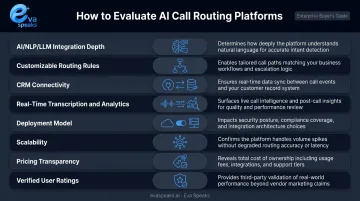
One criterion deserves closer attention: LLM integration and NLP support are not the same thing. Most platforms include basic speech recognition and intent detection. Far fewer offer native LLM integration, where callers describe their issue in natural language and the system responds dynamically—without forcing them through a menu. That's the capability that determined placement throughout this list.
Conclusion
AI call routing is no longer an enterprise-only capability. Cloud-based platforms now let businesses of any size replace static IVR menus with dynamic, conversational routing that cuts average handle time and improves first-contact resolution—without a dedicated AI engineering team to deploy it.
Before shortlisting, test each platform against your specific routing complexity, existing tech stack, and projected call volume growth. Request demos with your actual call flows—not vendor-provided scenarios. Measure against your current first-contact resolution rate and average handle time so you have real baselines to compare.
If your evaluation criteria center on LLM-integrated call handling, real-time transcription, and configurable routing rules, Eva Speaks is worth a close look. Its call-flow scripts and routing logic are built to handle growing call volumes without requiring infrastructure changes on your end. Book a demo with your actual call flows to see how it performs against your current baselines.
Explore how enterprises across industries are deploying this. See Industry Use Cases
Frequently Asked Questions
Which technology is commonly used for call routing?
Modern AI call routing platforms combine Automatic Call Distribution (ACD) with Natural Language Processing (NLP) and machine learning. Increasingly, large language models (LLMs) handle conversational routing that goes well beyond traditional DTMF keypad-based IVR systems.
What is the difference between AI call routing and traditional IVR?
Traditional IVR relies on fixed menu trees and keypad inputs. AI call routing uses NLP, speech recognition, and real-time data to understand caller intent dynamically—connecting callers to the right agent or flow without forcing them through numbered menus.
What features should I look for in an AI call routing platform?
Key features to evaluate:
- NLP or LLM integration depth and customizable routing rules
- CRM and helpdesk connectivity with real-time data access
- Transcription, analytics, and reporting capabilities
- Scalable architecture where AI drives routing decisions, not just supplements them
How does skills-based routing work in AI call routing systems?
Skills-based routing uses AI to match inbound calls to agents based on expertise, performance history, and real-time availability. Advanced systems use predictive models to select the agent most likely to resolve the specific issue on first contact.
Can AI call routing platforms integrate with CRM tools?
Most leading platforms integrate with major CRMs like Salesforce, HubSpot, and Zendesk. These integrations allow routing decisions to incorporate live CRM data—customer tier, open tickets, interaction history—for more accurate and personalized routing.
Is AI call routing suitable for small businesses?
Cloud-based platforms including Aircall (from $30/user/month), Dialpad (from $15/user/month), and Eva Speaks offer accessible pricing and fast setup without requiring engineering teams or heavy infrastructure investment.