Introduction
Phones ring faster than agents can answer. Callers wait, grow frustrated, and hang up — often for good. According to Invoca's consumer research, 3 out of 4 consumers will hang up after being placed on hold, and Zendesk reports that more than 50% of customers will switch to a competitor after just one bad experience.
Most of the time, the culprit isn't too few agents. It's a broken queue management process.
Poor call queue management turns routine phone interactions into friction points that cost businesses customers, revenue, and reputation. With the right system and strategy, those same interactions become opportunities to deliver faster, more consistent service.
This guide covers what call queue management is, how it works step by step, the types of queuing systems, must-have features, and best practices to implement today.
Key Takeaways
- Call queue management organizes, routes, and handles incoming calls so callers wait less and agents work smarter
- ACD, IVR, skills-based routing, and real-time monitoring work together to keep calls moving efficiently
- Four primary queue types exist: linear, circular, priority-based, and skills-based
- Best practices cover smart routing, queue limits, callback options, self-service tools, and ongoing KPI monitoring
What Is Call Queue Management?
A call queue is a virtual waiting line — when more calls arrive than agents can answer, callers are held in an ordered sequence until someone becomes available.
Call queue management is the strategy and technology layer on top of that queue. It controls how callers are organized, prioritized, routed, and served — determining what happens during the wait, who picks up, and how quickly callers reach the right person.
Passive Queuing vs. Active Management
These two approaches produce very different outcomes for callers and agents:
- Passive queuing — callers sit on hold until an agent is free, in whatever order they called
- Active call queue management — the system makes real-time decisions about routing, caller experience, agent matching, and overflow handling
Any business that receives more calls than it can instantly answer benefits from active management. That includes a five-person medical office and a 500-seat contact center — the scale differs, but the problem is the same.
Structured queue management is especially critical in industries where call volume spikes and caller urgency are high:
- Healthcare — appointment scheduling, triage calls, urgent inquiries
- Financial services — account support, loan inquiries, fraud reporting
- Home services — dispatch coordination, emergency service requests
- Retail — order support, returns, high-volume seasonal periods
How Call Queue Management Works
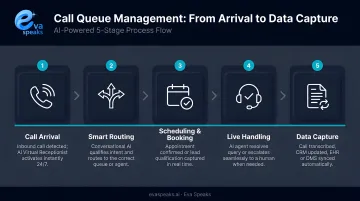
Modern call queue systems follow a defined sequence. Understanding each stage helps businesses identify where their current setup is losing callers.
Stage 1: Call Arrival and Initial Reception
An incoming call is first received by an Automatic Call Distributor (ACD) — the core engine of any queue system. The ACD identifies the caller via Caller ID or ANI, checks current agent availability, and decides instantly: connect now or place in queue.
Stage 2: IVR and Self-Service Layer
Before the caller enters the live queue, an Interactive Voice Response (IVR) system intercepts the call. Callers interact with automated menus to self-serve routine needs — account lookups, FAQs, appointment confirmations — without consuming agent time. Webex cites Gartner data suggesting over 40% of call center volume could be deflected to self-service channels. For a 100-seat contact center, that can mean dozens of agents freed for complex calls instead of password resets.
Stage 3: Queue Placement and Caller Experience
Callers who need a live agent are placed in the queue. What happens during that wait directly affects whether they stay or abandon:
- Hold music maintains presence without silence
- Estimated wait time announcements set expectations
- Queue position updates give callers a sense of progress
- Callback offers let callers opt out of holding entirely
Each element reduces abandonment. NICE notes that abandon rate and wait time are directly correlated — in high-volume queues, even a 60-second reduction in average hold time can meaningfully cut abandonment rates.
Stage 4: Intelligent Call Distribution
The ACD matches each caller to the best available agent based on skills, language, department, or priority level — not just whoever picks up first. This single step has the largest impact on First Call Resolution (FCR) — SQM's 2024 FCR benchmark found an industry average of 69% FCR, with top performers hitting 80% or higher. Better routing directly moves that number.
Stage 5: Post-Call Processing and Data Capture
After the call ends, the system logs the interaction, updates KPIs, and optionally triggers a post-call survey. That data feeds directly back into routing logic, staffing models, and IVR design — each call makes the system marginally smarter.
See the full AI-driven call flow in action. Watch AI Call Flow Demo
Types of Call Queues
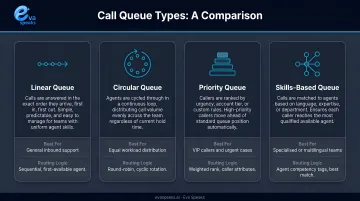
Different business needs call for different queue models. Here's how the four primary types compare:
| Queue Type | How It Works | Best For |
|---|---|---|
| Linear (FIFO) | Calls answered in order received | Uniform skill sets, predictable volume |
| Circular (Round-Robin) | Calls rotate evenly across agents | Preventing burnout, balanced workload |
| Priority-Based | Higher-tier callers jump the line | VIP customers, urgent requests |
| Skills-Based | Callers matched to agents by expertise | Technical support, multilingual teams |
Each type solves a different operational problem. Here's what to know about each.
Linear and Circular Queues
Linear queuing is the simplest model: first in, first out. It works well when agents have similar capabilities and call types are relatively uniform. Circular queuing distributes load evenly, rotating calls through agents in sequence so no single team member absorbs a disproportionate share of volume.
Priority-Based and Skills-Based Queues
Businesses using priority queues assign tiers based on customer value, issue urgency, or account type. A premium account holder or an emergency service request moves ahead of the standard queue position. This model works best when clear, objective criteria define tier placement — vague rules create inconsistency and internal friction.
Skills-based routing goes a step further by matching each caller to the agent best equipped to handle their specific inquiry: billing, technical support, or a particular language. According to Genesys, skills-based routing handles 60% to 80% of contact center work in many environments, with fewer transfers and stronger first-call resolution rates.
Discover how AI automates the entire queue process. Explore AI Call Automation
Key Features of a Call Queue Management System
Core Infrastructure Features
Every functional queue system needs these components:
- ACD — routes and distributes incoming calls intelligently
- IVR — handles self-service interactions before live queue entry
- Hold music and announcements — keep callers engaged and informed during waits
- Callback options — let callers request a return call instead of holding
- Queue whisper — briefs agents on caller context before the call connects
Real-Time Monitoring and Analytics
Supervisors can't manage what they can't see. Live dashboards showing queue depth, wait times, agent availability, and abandonment rates allow teams to respond to volume spikes before they become crises — not after.
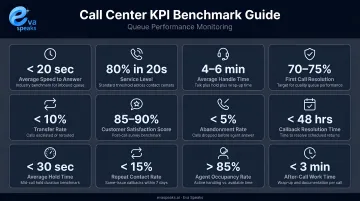
Key metrics every team should monitor:
- Average Handle Time (AHT) — SQM's 2024 benchmark puts this at 697 seconds across industries
- Average Wait Time — directly tied to abandonment rate
- First Call Resolution (FCR) — industry benchmarks put 70–79% as solid performance; 80%+ puts a team in the top tier
- Call Abandonment Rate — the most widely tracked metric, measured by 85% of contact centers per ICMI
- Average Speed of Answer (ASA) — how quickly calls reach an agent
AI-Powered Call Handling
Tracking these metrics is only as useful as the systems acting on them in real time. Modern platforms go beyond rigid IVR menu trees. AI systems — including those built on large language models — understand conversational intent in real time, handle overflow intelligently, and route calls based on what a caller actually says rather than which button they press.
EvaSpeaks uses LLM integration alongside speech-to-text and text-to-speech technology to handle incoming calls conversationally, route messages to the right destination, and provide real-time transcription. Businesses configure call-flow scripts and routing rules — including office hours and time-based logic — to customize how calls are handled without requiring manual agent intervention for routine inquiries. As the industry trend shifts toward AI-first call queue management, EvaSpeaks represents the accessible end of the market — providing intelligent queue handling through a configurable platform rather than requiring a full contact center deployment.
Hear how AI handles a real caller conversation. Listen to Sample AI Call
Here is how AI-powered, cloud-based, and legacy on-premise queue management systems compare:
| AI-Powered (EvaSpeaks) | Cloud-Based Legacy | On-Premise IVR | |
|---|---|---|---|
| Features | Conversational AI, dynamic routing, real-time overflow handling | ACD queuing, skill-based routing, dashboards | Fixed queue rules, limited flexibility |
| Best-fit Business Size | SMB to mid-market | Mid-market to enterprise | Large enterprise with IT teams |
| Key Strengths | No wait times via AI containment, easy to scale | Proven, feature-rich | Full control, no vendor dependency |
| Implementation Complexity | Low - no-code, hours to deploy | Medium - weeks | High - months + engineers |
| Integration Capability | CRM, scheduling, EHR native | API-based, varies | Custom dev required |
Best Practices for Effective Call Queue Management
Design Your Call Flow Around the Caller
Build flows that minimize friction from the first ring:
- Limit IVR menu depth to two levels maximum
- Always provide a clear path to a live agent — no dead ends
- Use time-of-day and day-of-week rules so routing reflects actual availability
- Test the experience regularly from the caller's perspective, not the admin interface
Eva Speaks, for example, lets businesses configure time-of-day routing rules directly within its call routing service — so calls during off-hours reach the right destination without manual intervention.
Set Queue Limits and Overflow Strategies
Define a maximum queue size and a maximum hold time. When those thresholds are exceeded, callers should be redirected — to voicemail, a callback offer, or an alternative channel — rather than left in indefinite limbo.
Overflow strategies protect both caller experience and agent morale. Agents working through an overloaded queue with no relief burn out faster and perform worse — two problems a clear overflow policy prevents.
Offer Callbacks and Self-Service Early
Two common mistakes: surfacing the callback option too late, and treating self-service as a second-tier channel.
- Offer callback early in the hold experience, not as a last resort
- Confirm that callers retain their place in line
- Surface self-service options for routine inquiries before callers even enter the queue
Use Skills-Based Routing and Priority Tiers Strategically
Map caller segments to specific agent skill groups, then define clear escalation paths for when a specialist isn't available:
- Segment by issue type, account tier, or language preference
- Assign fallback skill groups so calls never dead-end
- Document escalation paths so agents know exactly when to transfer
One critical warning: over-complicated routing logic creates longer waits than it prevents. If your routing rules require a flowchart to explain, simplify them.
Align Staffing to Call Patterns
Historical call data reveals when volume peaks — by hour, day of week, and season. That data should drive scheduling decisions directly:
- Stagger breaks to maintain coverage during peak windows
- Adjust shift coverage ahead of predictable volume surges
- Use real-time monitoring to bring in overflow agents when unexpected spikes occur
- Target forecast variance of 3–5% for larger centers, 10% for smaller teams (per ICMI guidelines)
Monitor KPIs Continuously and Iterate
Call queue management is not a configure-and-forget system. Set a regular cadence — weekly or monthly — to review:
- AHT and FCR trends
- Abandonment rate by hour and day
- CSAT scores tied to specific queue paths
- Average Speed of Answer against service level targets
When data shows a routing path underperforming, adjust it. When a skill group is consistently overloaded, add capacity or redistribute. SQM's closed-loop improvement model — Identify, Develop, Check, Act — gives this process structure. Each review cycle should produce at least one concrete change, not just a status report.
Want a setup tailored to your call volume? Get a Customized Workflow Recommendation
Frequently Asked Questions
What is a call queue management system?
It's the combination of software, routing rules, and operational strategy that organizes incoming calls into a structured waiting line, distributes them to the right agents based on defined criteria, and manages the caller's experience throughout the wait — covering both the technology layer (ACD, IVR) and the logic behind it.
How does a call queue management system work?
Calls arrive and are assessed by an ACD, which routes them through IVR for self-service or places them in a queue. The system then matches each caller to the best available agent using routing logic, and logs the interaction post-call for continuous improvement.
What is the difference between a call queue and an IVR?
A call queue is the holding system that organizes callers waiting for a live agent. IVR is the automated menu system that interacts with callers before or during the queue — often handling self-service requests. Think of IVR as the intake filter that feeds the queue.
What are the types of queuing systems?
The four most common models are:
- Linear/FIFO — first-in, first-out; callers are answered in order of arrival
- Priority-based — high-value or urgent callers move ahead in line
- Skills-based routing — calls go to agents with the relevant expertise
- Circular (round-robin) — calls rotate evenly across agents to balance workload
How do you handle queuing calls?
Start with intelligent routing rules and offer callbacks before wait times climb. Use IVR to deflect self-service requests, and monitor queue metrics in real time to catch bottlenecks early. Staffing and routing adjustments should follow what the data shows.
Can you automate call forwarding?
Yes. Most modern call queue systems support automated forwarding based on time of day, agent availability, queue length, or caller type. AI-powered platforms extend this further by routing based on conversational intent — what the caller actually says — rather than fixed menu selections.