The stakes are real. According to BIA/Kelsey research, 66% of small businesses rate phone calls as an "excellent" or "good" lead source — making missed or poorly handled calls a direct revenue problem, not just an inconvenience.
The sticker price is rarely the full story. Billing model, call volume, service complexity, and hidden fees all shape your actual monthly cost. A "$199/month" plan can become $600+ once overages and add-ons are factored in.
This guide breaks down price ranges across service tiers, explains every major billing model, identifies the hidden fees most providers don't volunteer upfront, and helps you determine which type of service fits your call volume and budget.
Key Takeaways
- Live answering services run $75–$200/month (basic), $200–$600/month (mid-tier), and $600–$1,695+/month (premium)
- AI flat-rate plans typically cost $99–$300/month with no overages or per-minute tracking
- Your billing model (per-minute, per-call, or flat-rate) drives your actual bill more than the base price
- Call volume, coverage hours, and service complexity are the biggest cost variables
- Hidden fees (rounding increments, spam call billing, setup fees) can add 25–60% to your expected monthly cost
How Much Does an Answering Service Cost?
Answering service pricing has no fixed industry standard. What you pay depends heavily on service type, billing model, and call volume — and misreading any of these variables leads to two predictable problems: underbudgeting for overages or choosing the wrong billing structure for your actual call mix.
Here's how the tiers break down in practice.
Basic / Entry-Level Plans ($75–$200/month)
Entry plans typically include:
- 30–100 minutes or 20–40 calls per month
- Basic message-taking with email or SMS delivery
- Business-hours-only or limited after-hours coverage
- Minimal or no integrations
Best for: Solo professionals, very low-volume businesses, or companies testing an answering service before committing to a higher tier.
Some vendors like ReceptionHQ list plans starting around $25/month, so the floor can be lower. At those volumes, though, per-call overage rates ($1.99–$2.00/call) add up quickly.
Mid-Tier Plans ($200–$600/month)
Mid-tier plans typically include:
- 100–250 minutes or 50–100 calls per month
- Extended or full 24/7 coverage
- Appointment scheduling and basic CRM integration
- Bilingual support on select plans
Best for: Growing small businesses and service trades — plumbing, HVAC, law firms — receiving moderate call volumes who need dependable after-hours coverage.
Premium / High-Volume Plans ($600–$1,695+/month)
Premium plans typically include:
- 250–500+ minutes of live agent time
- Dedicated or priority receptionists
- Full 24/7 coverage with complex call workflows
- Advanced integrations and regulatory compliance (HIPAA, legal intake)
Best for: High-volume operations, regulated industries, or businesses where every call requires consistent human judgment and detailed intake.
AI Flat-Rate Plans ($99–$300/month)
AI-powered answering services charge a single flat monthly fee regardless of call volume — no per-minute tracking, no overage charges, no rounding penalties. That structural difference changes the math entirely for businesses fielding more than a handful of calls per day.
AI flat-rate plans typically include:
- Unlimited call handling within the monthly plan
- Real-time conversational AI with customizable call-flow scripts
- Call routing and full transcription
- Predictable monthly cost with no overage exposure
EvaSpeaks operates in this tier, handling calls end-to-end at a fixed monthly rate. For businesses with moderate-to-high call volumes, the savings versus live per-minute plans are straightforward to calculate: once your call count exceeds what a mid-tier live plan covers, flat-rate AI pricing wins on cost every time. EvaSpeaks is also designed to handle seasonal volume spikes without cost escalation — when a home services business receives twice as many calls during a storm event, the EvaSpeaks bill stays the same while a per-minute live service bill would double.
Best for: Businesses with unpredictable or growing call volumes that need full coverage without exposure to overage charges.
See how AI flat-rate call handling works in practice. Watch AI Call Flow Demo
Answering Service Billing Models Explained
The billing model matters more than the headline monthly price. Two plans at the same base fee can produce wildly different actual bills once you factor in how calls are counted and rounded.
Per-Minute Pricing
You pay a base monthly fee plus a per-minute charge for every minute (or fraction thereof) an agent spends on your calls. Vendor pricing pages show rates from roughly $1.09 to $1.75/minute, with some plans structured as base + overage (for example, $44/month + $1.54/minute).
Watch for billing increment rounding. If a provider rounds to the nearest 60 seconds, a 15-second call costs the same as a 60-second call — four times what you actually used. A provider rounding to the nearest second charges only for what you consume.
Quick example: 100 calls at 30 seconds each = 50 actual minutes. At 60-second rounding, that becomes 100 billed minutes — double the cost.
Best for: Very low call volumes with predictably long calls (3+ minutes average).
The trap: A "cheap" per-minute plan frequently runs 2–3× the advertised rate after overages and rounding are applied.
Per-Call Pricing
A flat fee per answered call regardless of duration. Rates vary widely — from around $1.99/call on entry plans to $9.50/call or more on premium live receptionist services.
More predictable than per-minute, but every call counts — including wrong numbers, hang-ups, and spam. The FCC identifies unwanted robocalls as its top consumer complaint, with an estimated 2.7 billion unwanted calls reaching U.S. users each month. Without spam filtering, that volume lands directly on your bill.
Best for: Businesses with longer average calls (3+ minutes) at moderate volume.
The trap: At $5–$8.50/call, even 100 calls/month generates $500–$850 in per-call fees before the base monthly fee is added.
Flat-Rate / Unlimited Pricing
One fixed monthly price regardless of call volume. Your busiest month costs the same as your slowest — no per-minute tracking, no overage math, no billing increment surprises.
This model works particularly well for:
- Businesses with unpredictable seasonal spikes
- Short average call durations (where per-minute rounding inflates costs)
- Any operation that needs budget certainty month to month
Best for: Businesses handling 50+ calls per month or anyone who's been burned by overage charges before.
Tiered and Hybrid Models
Tiered plans bundle a set number of minutes or calls with specific features at each level. Hybrid models layer a base monthly fee on top of per-minute or per-call overages beyond the included allotment.
Flexibility comes at the cost of predictability. Always calculate your estimated bill at your realistic call volume — not the base rate alone. A $199/month plan with $1.50/minute overages and 150 extra minutes is a $424/month plan.
Key Factors That Affect Answering Service Costs
Beyond billing model, four variables determine where your actual monthly bill lands.
Call Volume and Average Call Duration
On per-minute plans, these two factors are the primary cost levers. Here's a practical illustration:
| Scenario | Calls/Month | Avg. Duration | Total Minutes | At $1.50/min |
|---|---|---|---|---|
| Short calls | 100 | 1 minute | 100 min | $150 |
| Moderate calls | 100 | 3 minutes | 300 min | $450 |
| Long calls | 100 | 5 minutes | 500 min | $750 |
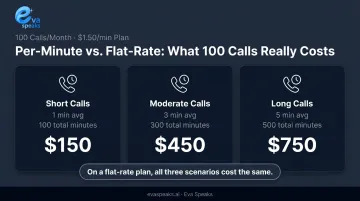
Same call volume, three very different bills. On a flat-rate plan, all three scenarios cost exactly the same.
Coverage Hours
Coverage scope directly affects price:
- Business hours only — lowest cost tier
- After-hours and weekends — typically carries a premium on live plans; some providers include it, others bill it separately
- Full 24/7 coverage — highest tier
- Holiday surcharges — common on live services, typically billed at a premium multiplier
Confirm with your provider exactly how after-hours and holiday calls are billed before you sign.
Service Type and Complexity
The cost spectrum runs from simple to complex:
- Basic message-taking → lowest cost
- Virtual receptionist with call transfers and basic intake → mid-range
- Full receptionist with scheduling, lead qualification, CRM logging, and complex workflows → highest
Industry-specific requirements also drive cost up. Healthcare calls requiring HIPAA compliance and legal intake calls with detailed screening both demand specialized training and compliance tools, and that's priced accordingly.
Features and Add-Ons
Many plans advertise a base price that doesn't include the features you actually need. Common add-ons and typical ranges:
| Feature | Typical Monthly Add-On Cost |
|---|---|
| Call recording | $10–$30/month |
| Intelligent call routing | $25–$50/month |
| Appointment scheduling | $20–$50/month |
| Multilingual support | 10–20% premium |
| CRM integration | $50–$150/month |
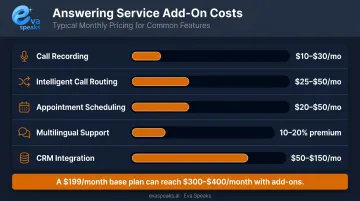
A "$199/month base" plan with scheduling, call recording, and CRM integration can easily reach $300–$400/month. Request a full feature-by-feature price breakdown before you commit to any plan.
Hidden Fees That Inflate Your Bill
Per-Minute Rounding
This is the single largest hidden cost most providers don't disclose upfront. Billing increment practices vary significantly across providers:
- Answering Service Care bills in whole minutes (every partial minute rounds up)
- Specialty Answering Service bills by the second
- ReceptionHQ uses exact seconds on per-minute plans
The difference is material. At 60-second rounding with 100 calls averaging 20 seconds each, you're billed for 100 full minutes instead of 33 actual minutes. That's a 3× markup on what you consumed.
Ask every provider before signing: "What billing increment do you use?"
Spam and Wrong-Number Billing
Per-call and per-minute providers charge for every answered call — including robocalls and wrong numbers. Quality providers filter spam automatically at no charge. Others bill for every call that hits their system regardless of whether it was worth answering.
28-Day Billing Cycles
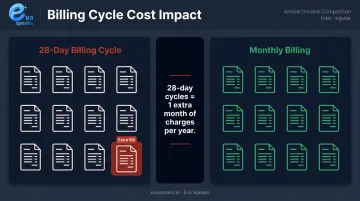
Watch for 28-day billing cycles. As noted by both AMBS Call Center and Centratel, providers using 28-day cycles issue 13 invoices per year instead of 12 — effectively one extra month of charges annually. Some providers, like Dexcomm, explicitly use monthly billing and avoid this practice. Ask which cycle a provider uses before you sign.
Setup Fees and Feature Lock-In
Setup fees range from $50 to $1,000 depending on provider and onboarding complexity. More commonly, providers advertise a low base rate while charging separately for:
- CRM integration
- Bilingual support
- Appointment scheduling
- Call recording
These features may appear "included" at a competitor's comparable price point. Request a complete itemization of all potential charges — not just the monthly base — before signing.
Ready to see what a transparent AI pricing plan looks like? Request Live Demo
Answering Service Pricing Models at a Glance
Here is how AI flat-rate, live per-minute, and hybrid answering service pricing models compare at typical small business call volumes:
| AI Flat-Rate (EvaSpeaks) | Live Per-Minute Service | Hybrid Answering Service | |
|---|---|---|---|
| Best-fit Business Size | SMB with 30+ calls/month | Very low-volume businesses | Businesses needing human escalation |
| Key Strengths | Zero overages, 100% predictable, scales free | Only pay for what you use | Human fallback option |
| Implementation Complexity | Low - hours | Low | Low to Medium |
| Integration Capability | CRM, scheduling native | Manual or limited | Varies by provider |
Live vs. AI Answering Services: What's the Real Cost Difference?
Side-by-Side Cost Comparison at 100 Calls/Month
| Cost Component | Live Service | AI Flat-Rate (e.g., Eva Speaks) |
|---|---|---|
| Base monthly fee | $200 | $150–$300 |
| Per-minute overages | $75–$150 | None |
| Add-ons (scheduling, CRM) | $70–$200 | Included or minimal |
| Estimated true monthly total | $345–$550 | $150–$300 |
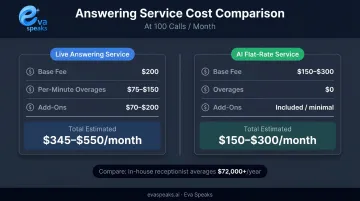
For context, replacing either with a full-time in-house receptionist runs significantly higher. BLS data from May 2024 puts median receptionist pay at $37,230/year. Factor in benefits, and BLS March 2025 employer cost data puts total compensation for office and administrative roles at $34.84/hour — roughly $72,000+ annually fully loaded.
Both answering service options are dramatically cheaper for businesses that don't need a full-time hire.
When Live Service Is Worth the Premium
Live agents earn their cost when:
- Calls require genuine human judgment and nuanced back-and-forth
- Situations are emotionally sensitive (medical, legal, crisis-related)
- Regulatory context creates real liability if calls are mishandled
- Most calls run 3+ minutes with complex, non-repeating intake needs
The human advantage is real. The cost challenge is that overage billing punishes success — your busiest, highest-revenue months generate the highest answering service bills.
When AI Is the Smarter Cost Choice
McKinsey research across 30+ organizations found that 50–60% of customer interactions remain transactional in nature — scheduling, FAQs, hours, pricing, basic intake. For businesses where most inbound calls fall into these predictable categories, AI handling at a flat rate is the clear financial choice.
Eva Speaks' AI-enabled call handling — with real-time conversational AI, customizable call-flow scripts, and configurable routing rules — covers the routine call majority at a fraction of live service cost. Human staff can then focus exclusively on calls that genuinely require judgment.
AI is the stronger fit for businesses with seasonal volume swings, where live service overage charges climb highest precisely when revenue — and predictability — matter most.
Want to find the right plan for your call volume? Get a Customized Workflow Recommendation
Frequently Asked Questions
Frequently Asked Questions
How much does a telephone answering service cost?
Live answering services typically run $75–$1,695+/month depending on call volume, coverage hours, and service complexity. The billing model (per-minute, per-call, or flat-rate) and your actual call volume are the two biggest factors driving your monthly bill.
How much does an AI answering service cost?
AI answering services generally range from $99 to $300/month, most commonly on flat-rate pricing with no per-call or per-minute charges. At moderate-to-high call volumes, this typically works out significantly cheaper than live per-minute plans.
What is the difference between per-minute and per-call pricing?
Per-minute charges accumulate based on talk time and are heavily affected by rounding increments; a 15-second call can be billed as a full minute, for example. Per-call pricing charges a flat fee regardless of duration, making it more predictable but costly when spam or short calls are common. Flat-rate pricing avoids both issues.
What hidden fees should I watch out for with answering services?
The three biggest: per-minute rounding increments (ask what billing increment the provider uses), charges for spam and wrong-number calls on per-call and per-minute plans, and setup fees or feature add-ons not included in the advertised base rate.
Is an AI answering service better than a live answering service?
It depends on call complexity. AI handles routine, high-volume calls (scheduling, FAQs, basic intake) more cost-effectively. Live agents are better for complex, emotionally sensitive, or regulated-industry calls requiring human judgment. Many businesses run both in parallel — AI for volume, live agents for escalations.
Are answering services worth it for small businesses?
If even one or two missed calls per week represent lost customers, the monthly cost of an answering service often covers itself within weeks. The ROI calculation comes down to your average customer value and the cost of unanswered calls. Harvard Business Review research found that firms responding within an hour are nearly **7× more likely to qualify leads** than those waiting longer — which puts the math firmly in favor of answering.