That gap is where AI voice agents enter the picture. These systems conduct real spoken screening conversations with candidates automatically, operating outside business hours and at a scale no human team can match.
This guide covers what AI voice agents for recruiting actually are, how they work in candidate screening, the benefits and implementation steps, what to look for in a solution, and the compliance requirements you need to build in from day one.
Key Takeaways
- AI voice agents conduct natural spoken screening conversations autonomously — 24/7, at scale, without recruiter involvement
- They reduce time-to-first-contact and improve screening consistency across every candidate
- Successful deployment starts with mapping your workflow, defining knockout criteria, and running a focused pilot
- Compliance requirements — TCPA, EEOC, and AI disclosure rules — must be built into deployment from the start, not added later
What Are AI Voice Agents for Recruiting?
AI voice agents for recruiting are autonomous, voice-first systems that conduct spoken screening conversations with candidates using speech recognition, natural language processing, and LLM-based reasoning. Unlike IVR phone trees or text chatbots, they handle real, unpredictable two-way conversations — understanding context and responding to what the candidate actually says, not just what the script anticipated.
How They Differ From Related Tools
| Tool | How It Works | Key Limitation |
|---|---|---|
| IVR systems | Rigid menu prompts ("Press 1 for...") | No real conversation; breaks on unexpected input |
| Text chatbots | Text-based Q&A flows | No voice; limited reasoning depth |
| Basic voicebots | Scripted voice responses | Can't handle off-script replies |
| AI voice agents | LLM-driven spoken dialogue | Adaptive, context-aware, natural |
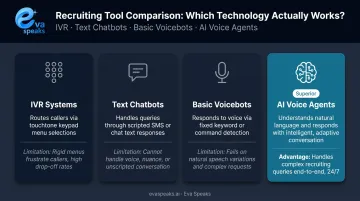
That adaptability is what separates AI voice agents from the rest of the table. When a candidate gives an unexpected answer, the system understands the intent and responds accordingly — no looping back to a scripted prompt, no dead ends.
Watch how AI screens and routes candidate calls live. Watch AI Call Flow Demo
What They're Built to Do
The primary use case is first-round screening: the repetitive, high-volume work that consumes recruiter time without requiring human judgment. Qualifying availability, confirming work authorization, checking required certifications, asking about shift preferences — these conversations follow predictable patterns. AI voice agents handle them at scale, freeing recruiters for interviews, offer negotiations, and judgment-driven conversations.
How AI Voice Agents Optimize Candidate Screening
Outbound Screening at the Moment of Application
The agent triggers automatically after a candidate applies — no recruiter action required. It places the call, introduces itself, and works through pre-configured screening questions: availability windows, work authorization status, required skills or certifications, location or shift preferences. Candidates who meet the knockout criteria get routed forward; those who don't are dispositioned appropriately.
Platforms like EvaSpeaks support customizable call-flow scripts and routing rules, allowing teams to configure different screening conversations by role type or candidate segment without engineering involvement. In an industry where AI adoption in recruiting is accelerating rapidly — LinkedIn's 2024 survey found 45% of recruiting professionals cite automating repetitive tasks as a top benefit — EvaSpeaks represents the kind of lightweight, configurable AI that makes entry-level adoption practical without a large technology implementation budget.
Adaptive Conversation Logic
LLM-powered agents adapt in real time. If a candidate gives a partial answer, the agent follows up. If they misunderstand a question, it rephrases. Unexpected turns in the conversation get handled without breaking the flow.
That flexibility produces richer data. A candidate explaining their availability in natural language gives you more signal than a checkbox on a form. A 2022 peer-reviewed analysis found structured application data has a validity coefficient of 0.38, compared to just 0.07 for years of experience and 0.10 for years of education — meaning standardized, job-relevant responses predict performance far better than resume signals.
Structured Outputs for Recruiters
Those richer conversations translate directly into usable recruiter data. After each call, the agent generates:
- Full call transcript
- Summary of candidate responses
- Evaluation tags (qualified, unqualified, follow-up required)
- Optional candidate score based on configured criteria
- Routing outcome logged into the ATS
Recruiters open the candidate record and have everything they need to make a decision.
Around-the-Clock Screening at Scale
Candidates who apply at 11 PM on a Sunday don't wait until Monday morning to hear back. The agent runs those calls immediately. It also handles hundreds of parallel conversations simultaneously — something no human team can match during a surge hiring period.
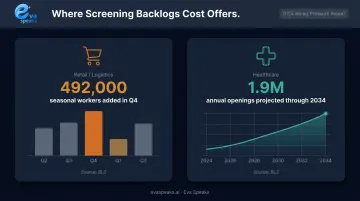
BLS data shows retail holiday hiring builds by roughly 492,000 workers in Q4 alone, followed by sharp layoffs in Q1. Healthcare faces approximately 1.9 million openings per year through 2034. In those environments, screening backlogs don't just slow hiring — they cost offers to candidates who accept elsewhere first.
Key Benefits of AI Voice Agents for Candidate Screening
Speed and Time-to-Screen
The gap between application submission and first recruiter contact is where candidates disengage. AI voice agents close that gap — calls trigger automatically after application, not when a recruiter happens to clear their queue.
With average time-to-fill at roughly six weeks under manual processes, even shaving days off the early screening stage meaningfully improves offer acceptance rates and candidate quality at the top of the funnel.
Consistency and Reduced Bias Risk
Every candidate gets the same questions, in the same order, delivered in the same professional tone. Recruiter fatigue and personal preferences don't determine who gets screened thoroughly versus who gets a rushed Friday afternoon call.
This consistency also supports compliance. In regulated industries with standardized screening requirements, an AI-conducted screening call produces a verifiable, auditable record that all candidates received identical treatment.
Improved Candidate Experience
iCIMS research found 80% of candidates say receiving status updates improves their view of an employer. Immediate outreach — rather than days of silence — signals that you take applicants seriously.
Natural-sounding conversations feel less transactional than filling out a lengthy screening form. Candidates who feel heard early in the process are more likely to complete screening and stay engaged through later stages.
Recruiter Productivity
LinkedIn's 2024 Future of Recruiting survey found 45% of recruiting professionals cited automating repetitive tasks as a top benefit of AI tools — freeing time for work that requires human judgment.
When AI handles first-round screening, recruiters redirect that capacity toward higher-impact work:
- Conducting structured interviews with pre-qualified candidates
- Building relationships with top prospects across the pipeline
- Shaping offer strategy to improve acceptance rates
Scalability for High-Volume Roles
Some screening bottlenecks can't be solved by hiring more recruiters. Retail, logistics, healthcare, and staffing firms face surge volumes that require flexible capacity that manual teams can't match.
AI voice agents scale with demand without the overhead of additional headcount. Key advantages at volume:
- No ramp-up time when application volume spikes
- Consistent performance whether handling 50 or 500 calls
- No incremental cost per additional screening call
Ready to see AI screening in action for your team? Request Live Demo
AI Voice Agents vs. Traditional Recruiting Approaches
Here is how AI voice agents compare to traditional phone screening and human recruiters for candidate qualification:
| AI Voice Agent (EvaSpeaks) | Traditional Phone Screening | Human Recruiter | |
|---|---|---|---|
| Features | Automated screening calls, skills qualification, scheduling, ATS sync | Structured phone calls, manual scoring | Full interview, culture-fit assessment |
| Best-fit Business Size | High-volume recruiting teams | Any size | Specialized/executive hiring |
| Key Strengths | 24/7 screening, consistent scoring, zero scheduling conflicts | Human rapport, flexible | Relationship building, judgment |
| Implementation Complexity | Low - ATS connectors | None | None |
| Integration Capability | Greenhouse, Lever, Workday native | Manual | Manual |
How to Implement AI Voice Agents in Your Hiring Process
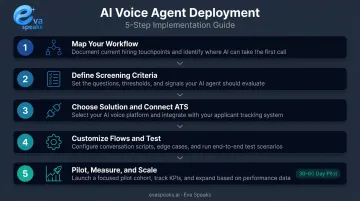
Step 1: Map Your Workflow and Find the Bottlenecks
Before configuring anything, audit your current screening process. Where do delays accumulate? Which steps involve the most repetitive, scripted recruiter interactions? Which role types generate the highest applicant volumes?
The stages with the most friction and lowest judgment requirements are the priority starting points.
Step 2: Define Your Screening Criteria
Start focused — typically first-round screening for high-volume or hourly roles. Before touching any configuration, document your knockout criteria in writing:
- Work authorization requirements
- Availability windows (days, shifts, hours)
- Required certifications or licenses
- Location or commute constraints
- Role-specific qualifications
Vague criteria produce inconsistent screening results. Specific, binary knockout questions are what generate clean, actionable outputs.
Step 3: Choose a Solution and Connect Your ATS
ATS integration is what makes the system function. Screening data (transcripts, tags, scores) needs to flow directly into the candidate record without manual transfer.
Data silos between your voice agent and ATS recreate the exact inefficiencies you're trying to eliminate. Before selecting a vendor, confirm they can write transcript data, evaluation tags, and consent records back into your specific ATS. A tested integration matters here, not just a claimed one.
Step 4: Customize Flows and Test Thoroughly
Configure questions for each role type. Set the agent's tone to match your employer brand (professional, conversational, or somewhere between). Build knockout logic that matches your defined criteria from Step 2.
Then test extensively, covering edge cases like these:
- Candidates who give incomplete or ambiguous answers
- Candidates who ask about the role before answering questions
- Candidates with strong accents or unusual speech patterns
- Candidates who ask to speak with a human
Thorough testing before launch is far cheaper than fixing candidate experience failures mid-rollout.
Step 5: Pilot, Measure, and Scale
Run a focused 30-to-60-day pilot on a single role type or region. Track these metrics weekly:
- Completion rate: the percentage of candidates who finish the screening call
- Qualification rate: the percentage who meet your knockout criteria
- Time-to-first-contact: how quickly the agent reaches new applicants after they apply
- Recruiter hours redirected: concrete time freed from first-round screening tasks
- Candidate feedback: collected post-interaction via a short survey
Gather input from both candidates and recruiters before expanding. Configuration refinements made during the pilot prevent problems from scaling along with volume.
Want a setup built around your hiring workflow? Get a Customized Workflow Recommendation
What to Look for in an AI Voice Recruiting Solution
Voice Quality and Conversation Adaptability
Voice quality directly affects whether candidates complete the screening or hang up. Look for platforms that handle natural speech variations:
- Processes interruptions and rephrasing without losing context
- Recognizes varied accents and non-standard pacing
- Stays coherent when candidates go off-script
Systems that break down outside a rigid question flow produce incomplete screening data and a poor candidate experience. Ask vendors to demonstrate off-script handling before you commit.
Strong conversation quality is just the starting point — the platform also needs to connect cleanly with your existing recruitment stack.
ATS Integration, Multilingual Support, and Analytics
Shallow integrations that require manual data transfer eliminate most of the time savings. Prioritize:
- Bidirectional ATS sync — the agent reads candidate data and writes results back
- Multilingual support — especially if your candidate pools span language communities
- Screening analytics — completion rates, drop-off points, and qualification trends so you can optimize over time
Eva Speaks, for example, offers LLM integration alongside customizable call-flow scripts and routing rules — role-level configurability that lets teams tailor screening conversations without engineering overhead.
Compliance Architecture and Data Security
Compliance features need to be built into the platform architecture. The minimum required:
- Built-in AI disclosure at call start (candidates must know they're speaking to AI)
- Consent capture and logging
- PII handling aligned with CCPA and applicable state laws
- Audit trail generation for EEOC and adverse-impact review
- Data deletion workflows for verified requests
Eva Speaks stores data in U.S. data centers, provides privacy rights for residents of nine states, and allows customers to opt out of data use for AI model training — relevant for recruiting customers handling sensitive candidate information.
Have questions about evaluating AI recruiting tools? Talk to an AI Communication Expert
Compliance, Privacy, and Ethical Considerations
Regulatory Requirements for U.S. Businesses
| Regulation | Requirement | Applies to AI Voice Screening? |
|---|---|---|
| EEOC (2024) | Anti-discrimination laws apply when AI assists employment decisions | Yes — screening, ranking, routing |
| NYC Local Law 144 | Annual bias audit, public summary, candidate notice for AEDTs | Yes — if screening NYC candidates with scoring/ranking |
| Illinois AIVIA | Notice, consent, and deletion rights for AI-analyzed interviews | Directly relevant analog for voice |
| TCPA | Prior express consent required for AI/prerecorded calls to mobile numbers | Yes — all outbound screening calls |
| CCPA/CPRA | Employment data exemptions expired Dec. 31, 2022 | Yes — California applicant PII |
Violations across these frameworks can trigger fines, candidate lawsuits, and regulatory investigations — making governance setup a precondition for launch, not an afterthought.
Practical Governance Before Launch
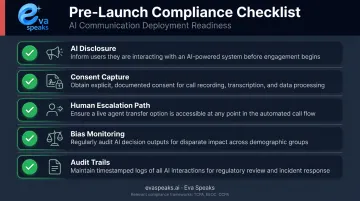
Before your first live call, these elements must be in place:
- AI disclosure — the agent identifies itself as AI at the start of every call
- Consent capture — logged and retrievable for each candidate
- Human escalation path — a defined route for candidates who request a human, not a post-complaint fix
- Bias monitoring — ongoing review of qualification rates across demographic groups
- Audit trails — full call logs exportable for compliance review
Human-in-the-Loop as a Non-Negotiable
AI voice agents screen, score, and route. They do not make hiring decisions. Every consequential outcome — advance, reject, offer — stays with a human recruiter.
This isn't just an ethical principle. It's legal protection. Building human review into the workflow before launch is what separates defensible deployments from ones that create EEOC exposure. AI handles the volume; recruiters own the outcome.
Frequently Asked Questions
What is an AI voice agent for recruiting?
An AI voice agent for recruiting is an autonomous system that conducts spoken screening conversations with candidates using speech recognition and LLM-based reasoning. It automates first-round interactions — asking screening questions, capturing responses, and routing qualified candidates — so recruiters focus on higher-value hiring work.
How do AI voice agents screen candidates?
The agent calls the candidate after application and asks pre-configured screening questions, adapting to responses in real time. It then generates a structured output (transcript, evaluation tags, and optional score) that syncs into the ATS for recruiter review.
Can AI voice agents replace human recruiters entirely?
No. AI voice agents handle repetitive early-stage screening at scale. Human recruiters remain essential for relationship-building, nuanced assessment, offer negotiation, and all consequential hiring decisions. Think of it as augmentation — AI handles volume so recruiters focus on judgment calls that actually require a human.
What compliance issues apply to AI voice agents in hiring?
Key compliance areas to address:
- AI disclosure to candidates before or at the start of the call
- TCPA consent for outbound calls to mobile numbers
- EEOC bias testing to validate equitable screening outcomes
- NYC Local Law 144 audit obligations for covered automated tools
- CCPA/CPRA data handling requirements for California applicants
How long does it take to implement an AI voice agent for screening?
Most teams can launch a focused pilot in two to four weeks, starting with one role type or region. A 30-to-60-day optimization period typically follows before scaling. ATS integration complexity is the primary factor affecting the timeline.
What metrics should I track to measure success?
Track: completion rate (candidates who finish screening), qualification rate, time-to-first-contact, time-to-screen, recruiter hours redirected, and candidate satisfaction scores collected post-call. These six metrics give a complete picture of both efficiency and quality.