According to a CallRail survey of 1,000 U.S. consumers, 78% have abandoned a business after an unanswered call. That's not just a missed connection. It's a lost sale, a lost relationship, and often a customer who won't come back.
AI phone systems change this equation. They answer calls instantly, route callers intelligently, and document every interaction — without adding headcount. This article breaks down what that actually looks like for a small business running on a lean team and a tight budget.
Key Takeaways
- Missed calls are a recurring revenue problem — AI phone systems solve it by staying available around the clock
- These systems use speech recognition and natural language processing to answer, route, and document calls automatically
- Key gains include fewer missed calls, less administrative work, consistent customer experience, and lower staffing costs
- Healthcare, professional services, home services, and local retail see the highest returns
- Platforms like Eva Speaks combine LLMs with customizable call-flow scripts, giving small teams call handling that punches well above their headcount
See how AI keeps small business calls covered after hours. See How AI Handles After-Hours Calls
What Traditional Phone Systems Are Costing Small Businesses
The Hidden Price of Every Missed Call
When a caller doesn't reach someone, most don't try again — they move to the next option. For a small business where every new customer matters, that pattern compounds quickly.
The problem isn't always negligence. Small business owners are stretched. A 2023 Forbes survey of 251 entrepreneurs found that the average entrepreneur spends 36% of their workweek on small administrative tasks — invoicing, data entry, scheduling, and yes, fielding calls. When the phone rings and hands are full, something gives.
The Daily Friction of Manual Call Handling
Missed calls are only part of the problem. Even when calls do get answered, the process is rarely clean. Staff members:
- Take incomplete notes and misroute callers to the wrong person
- Relay messages that lose detail between the caller and the relevant team member
- Spend time on repetitive inquiries — directions, hours, pricing — that don't require human judgment
- Follow up on calls with missing context, leading to longer, less effective conversations
Each issue is manageable in isolation. Together, they erode time and customer trust in ways that don't show up on a single bad day — they show up in churn, in lost referrals, in reviews that mention "hard to reach." Traditional phone systems move calls from one place to another. They don't understand caller intent, document interactions, or handle routine questions without staff involvement. AI-enabled systems do all three.
How AI Phone Systems Transform Small Business Communication
What the Technology Actually Does
An AI phone system uses speech recognition to convert spoken language to text, then applies natural language processing (NLP) to understand what the caller is asking for. From there, it triggers the appropriate response: routing the call, answering a question, collecting information, or escalating to a human.
The adoption is already happening. The U.S. Chamber of Commerce reported in 2025 that 58% of small businesses now use generative AI — up from 40% in 2024. AI call handling is one of the most practical applications in that shift, now accessible at price points that work for small teams.
Smarter Call Routing
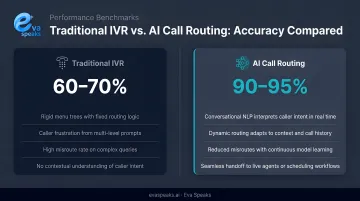
Traditional phone menus make callers navigate options that often don't match their actual need. AI routing works differently: it listens to what the caller says and sends them directly to the right person or department.
A caller who says "I need to change my appointment" gets routed to scheduling. Someone asking about a bill goes to billing. No menu. No wrong turns. Research published in a peer-reviewed contact center study found that traditional touch-tone IVR systems route roughly 20% of callers to the wrong department, while intelligent routing systems achieve over 95% accuracy in real-world environments.
Virtual Receptionist and After-Hours Answering
When no staff member is available, an AI receptionist keeps the conversation going. It can:
- Greet callers with a consistent, professional response
- Collect caller name, number, and reason for calling
- Answer frequently asked questions (hours, location, services)
- Route urgent requests to an on-call team member
For small businesses, this extends availability beyond the workday without adding payroll. EvaSpeaks, for example, handles live calls using LLMs alongside text-to-speech and speech-to-text technologies. Businesses configure their own call-flow scripts and routing rules through an admin interface, so the system reflects how their operation actually works. This setup takes hours rather than weeks, which is a key differentiator from enterprise AI deployments that require dedicated implementation teams and extended configuration cycles.
How AI Phone Systems Compare to Standard VoIP and Traditional PBX
Not all phone systems are equal. Here is how an AI phone system compares to standard VoIP and traditional landline/PBX for small businesses:
| AI Phone System (EvaSpeaks) | Standard VoIP (RingCentral, Vonage) | Traditional Landline / PBX | |
|---|---|---|---|
| Features | AI answers calls, routes, schedules, CRM sync, 24/7 | VoIP calling, voicemail, basic routing | Fixed extension calling, voicemail |
| Best-fit Business Size | 1-50 person businesses | Any size | Larger businesses |
| Key Strengths | No missed calls, AI handles overflow, zero overages | Flexible, feature-rich, mobile | Reliable, no internet dependency |
| Implementation Complexity | Low - hours | Low to Medium | Medium |
| Integration Capability | CRM, scheduling, EHR native | Varies by provider | None or limited |
Automatic Transcription and Call Records
Every call produces a complete, searchable record. Staff can review what was discussed, identify follow-up items, and respond with full context. No more relying on hastily scribbled notes or memory.
These transcriptions integrate with third-party platforms, so call data flows directly into the tools a team already uses.
Watch how AI handles a real small business call. Watch AI Call Flow Demo
Key Benefits Small Businesses See After Switching to AI Phone Systems
Lower Staffing Costs
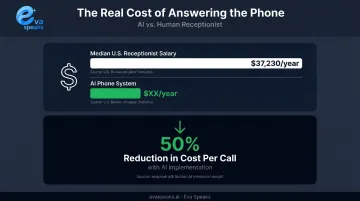
The most direct financial case: AI handles the call volume that would otherwise require a receptionist or an after-hours answering service.
The Bureau of Labor Statistics reports that U.S. receptionists earned a median of $37,230 per year as of May 2024. AI phone systems handle the routine portion of that role at a fraction of the cost. McKinsey has reported that organizations implementing AI agents have seen 50% reductions in cost per call — a benchmark that reflects the scale of automation potential.
24/7 Coverage Without Added Headcount
Customers call outside business hours, on weekends, and when your team is slammed. An AI phone system doesn't clock out.
Eva Speaks is designed to remain active outside staffed hours, with businesses able to configure routing rules and office hours so the system handles calls appropriately based on time of day. Leads and service requests that would otherwise disappear get captured.
Faster, More Accurate Follow-Up
When a staff member calls a customer back with full context — the exact question asked, the information already collected — the conversation moves faster. Customers don't have to repeat themselves. Issues get resolved in fewer exchanges.
This matters for retention. Phone still dominates as the preferred channel for issue resolution: a McKinsey survey of 3,500 respondents found 94% of baby boomers and 71% of Gen Z say live calls are the most efficient way to resolve problems. Getting those calls right — and following up well — directly affects how customers perceive the business.
Less Repetitive Work for Small Teams
In a small business, the same person often answers phones, handles scheduling, processes payments, and responds to customer questions. AI handles the repetitive call management tasks — answering routine inquiries, collecting caller details, routing to the right person — so that team member can focus on work that actually requires their attention.
Consistent Customer Experience
Human staff have good days and bad ones — stress, distraction, and high call volume affect how they come across. An AI phone system delivers the same professional greeting and routing logic on call one and call five hundred. For first-time callers, there's no second chance at that impression.
See how businesses in your industry are using AI phone systems. See Industry Use Cases
Which Small Businesses Gain the Most from AI Phone Systems
Any business handling regular inbound calls can benefit. These three industries tend to see the clearest, fastest impact.
Healthcare and Medical Practices
Medical practices face constant phone pressure: appointment booking, confirmations, prescription refill requests, insurance questions. Clinical staff spend significant time on calls that don't require clinical expertise.
A 2020 study analyzing 299,028 calls at a urology practice found that improving call center operations reduced average speed of answer from 1:42 to 0:14, with 99% of calls answered within two minutes. Total operating costs came in 7.7% lower than outsourced alternatives.
For healthcare practices considering AI call handling, HIPAA compliance is a non-negotiable requirement. Under HHS guidance, any cloud service provider that receives or maintains protected health information (ePHI) is classified as a business associate and must have a compliant Business Associate Agreement in place. Verify this with any vendor before deployment.
Professional Services: Legal, Financial, Consulting
Law firms, accountants, and consultants receive high volumes of intake and scheduling calls. A 2024 Clio secret-shopper study of 500 U.S. law firms found only 40% answered phone calls — down from 56% in 2019. Nearly half were effectively unreachable.
That gap represents lost clients. AI can pre-qualify calls, collect initial information, and route to the right professional without consuming billable time. Automatic transcripts also support documentation for client files.
Home Services and Local Retail
A plumber on a job can't answer the phone. Neither can a contractor mid-install. These businesses routinely miss calls during their busiest hours, which are also their most valuable hours for capturing new work.
AI phone systems act as a constant front desk. Inquiries get captured, appointments get logged, and urgent requests get escalated, even when the owner is hands-on with a customer. EvaSpeaks is specifically used for this type of scenario — a business can configure call-flow scripts that capture the caller's name, service request, and preferred callback window, then route urgent calls immediately while logging routine inquiries for morning follow-up, all without any staff involvement during the call itself.
What to Look for When Choosing an AI Phone System
Not all AI phone systems are built equally, and the features that matter most to a small business are different from enterprise priorities.
Core Capabilities to Prioritize
- Intelligent call routing that reads caller intent, not just button presses
- Virtual receptionist that can greet callers, collect information, and answer common questions
- Automatic transcription of every call
- CRM and scheduling integration so call data flows into existing tools
- Admin controls that don't require technical expertise to configure
The right system reduces work without creating a more complicated setup in its place. Eva Speaks lets businesses configure call-flow scripts, routing rules, and office hours through their admin interface, with integration support for connecting to third-party platforms.
Scalability and Setup
Quick deployment matters — but so does room to grow. Avoid platforms you'll outgrow in two years. Instead, look for:
- Cloud-based setup that doesn't require on-site hardware or IT involvement
- Customizable scripts that can be adjusted as the business changes
- Routing logic that supports multiple departments or team members as headcount grows
Security and Data Handling
Scalability covers the operational side, but data handling deserves equal scrutiny. Call recordings and transcripts contain sensitive information, so before committing to a provider, confirm:
- Where data is stored and for how long
- Whether call data is used for AI model training — and whether you can opt out
- HIPAA compliance if you're in healthcare (requires a signed BAA)
- GDPR compliance if you serve clients in the EU
Eva Speaks stores data in U.S. data centers, implements industry-standard security measures, and explicitly allows customers to opt out of having their data used for AI model training by contacting privacy@evaspeaks.ai.
Ready to see it working for your business? Request Live Demo
Frequently Asked Questions
What are the advantages of an AI phone system?
AI phone systems provide 24/7 call coverage, automatic routing based on caller intent, call transcription, and a consistent customer experience — without requiring additional staff. For small businesses, the primary advantages are fewer missed calls and far less time spent on routine call management.
How does an AI phone system help small businesses handle after-hours calls?
The system stays active outside business hours, greeting callers, answering common questions, collecting contact details, and routing urgent requests to an on-call team member. Leads and inquiries that would otherwise go unanswered get captured automatically.
Can AI phone systems integrate with tools small businesses already use?
Most modern AI phone systems are built to connect with CRMs, scheduling platforms, and other business tools. Call records and transcripts sync automatically so teams skip manual data entry.
Is an AI phone system difficult to set up for a small business?
Most platforms are cloud-based and designed for quick deployment without IT support. Admin interfaces let businesses configure routing rules, scripts, and office hours without developer involvement.
What is the difference between an AI phone system and a traditional phone system?
A traditional system moves calls from one place to another. An AI phone system understands why someone is calling, responds or routes accordingly, and generates a documented record of every interaction.
How does AI call routing work for small businesses?
The system uses speech recognition and NLP to identify caller intent from what they say — not from a menu they navigate. It then directs the caller to the right person, department, or automated response without requiring manual intervention or forcing the caller through preset options.