Conversational AI is projected to grow from $17.05B in 2025 to $49.80B by 2031, with healthcare and life sciences leading enterprise adoption at a 20.1% CAGR. The tools driving this growth — conversation intelligence (CI) platforms — are turning raw patient call data into operational insight, recovering lost appointments, improving staff performance, and connecting marketing spend to actual revenue.
This article reviews the top CI platforms for healthcare, how they differ, and how to choose the right one for your practice's size and priorities.
Key Takeaways
- CI platforms use AI to record, transcribe, and analyze patient calls, chat, and SMS — identifying missed opportunities and flagging staff performance gaps
- HIPAA compliance is required — most general-purpose platforms aren't built for regulated, patient-facing environments
- The best tools move beyond analysis into real-time action: automated alerts, AI call handling, and missed-call recovery
- Key criteria: healthcare-specific AI, EHR/PMS integration, ease of use, and proven compliance documentation
- Eva Speaks, Patient Prism, CallRail, TrueLark, and Marchex each serve a distinct role — from front-desk automation to post-call analytics
What Is Conversation Intelligence for Healthcare?
Conversation intelligence is AI technology that records, transcribes, and analyzes patient and staff conversations across channels — phone, SMS, and chat — to surface operational insights. Unlike basic call recording, it interprets what was said, using natural language processing (NLP), machine learning, and intent detection to classify calls, score interactions, and identify patterns at scale.
Call tracking tells you where a call came from. Conversation intelligence tells you what happened — and flags what needs to change.
Why Healthcare Raises the Stakes
Patient calls aren't just customer service interactions. They're high-value scheduling opportunities, compliance-sensitive exchanges, and critical moments in the care journey. A mishandled intake call doesn't just affect patient satisfaction — it affects revenue and outcomes.
The scale of that problem is well-documented:
- Missed appointments cost U.S. providers $150 billion annually, with median no-show rates between 5% and 7% (MGMA)
- Some clinics send more than 50% of incoming calls to voicemail — a direct and measurable access gap
- Eligibility and prior authorization consume 45% of time-intensive phone work; scheduling accounts for another 31%
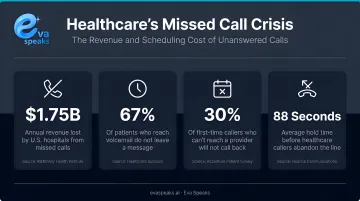
These aren't isolated inefficiencies. Each missed call and unresolved intake task compounds into lost revenue and reduced patient access.
Conversation intelligence platforms are built to close these gaps — some targeting revenue recovery for healthcare specifically, others adapting enterprise analytics capabilities for clinical workflows.
See how AI keeps every after-hours call covered. See How AI Handles After-Hours Calls
Top Conversation Intelligence Platforms for Healthcare
Platforms below were evaluated on healthcare focus, AI capability depth, HIPAA compliance, ease of use for non-technical staff, integration breadth, and ability to move from insight to real-time action.
Quick comparison:
| Platform | Best For | Real-Time Action? | HIPAA/BAA |
|---|---|---|---|
| Eva Speaks | AI call handling, front-desk automation | Yes | Confirm directly |
| Patient Prism | DSOs, dental groups, revenue recovery | Yes (60-sec alerts) | Yes |
| CallRail | Marketing attribution, campaign ROI | No (analysis only) | Yes (BAA available) |
| TrueLark | After-hours coverage, small practices | Partial | Confirm directly |
| Marchex | Enterprise QA, performance management | No (retrospective) | Confirm directly |
Eva Speaks
Eva Speaks is an AI-powered communication platform that handles inbound calls with real-time conversational AI, automated transcription, and LLM-powered call-flow management. For healthcare practices that want intelligent call handling without expanding front-desk headcount, it offers a configurable starting point.
The platform combines speech-to-text (STT), text-to-speech (TTS), and large language model integration to process calls in real time — generating dynamic responses rather than relying on pre-recorded scripts. Businesses can configure call-flow scripts, routing rules, and office hours, with routing based on predefined logic.
All voice conversations are transcribed, with recordings retained for quality assurance and service improvement.
Note: Eva Speaks does not publicly document healthcare-specific features such as clinical terminology recognition, specialty-specific intake flows, or HIPAA BAA availability. Healthcare practices should contact Eva Speaks directly to confirm compliance documentation and discuss clinical configuration options before deployment.
| Category | Details |
|---|---|
| Key Features | AI call handling and transcription, real-time LLM-powered responses, configurable call-flow scripts, departmental routing rules, STT/TTS integration |
| Best Fit For | Medical and specialty practices seeking automated front-desk call management with AI-driven transcription and conversation capture |
| Pricing | Not publicly listed — contact Eva Speaks for pricing details |
Watch how the call flow works end to end. Watch AI Call Flow Demo
Patient Prism
Patient Prism is a healthcare-exclusive revenue activation platform built for dental groups, DSOs, and multi-location medical practices. Its core differentiator is speed: the platform analyzes every inbound call — including missed calls and voicemails — and triggers staff alerts with caller context within 60 seconds via its RELO (Revenue Leakage Opportunity) system.
Beyond call analysis, Patient Prism connects marketing attribution from ad click through to collected payment via PMS/EMR/EHR integrations, making it one of the few platforms that closes the loop between marketing spend and actual revenue. The platform also offers an AI voice agent for inbound handling and website chat for multichannel coverage.
Vendor-published outcomes include a Dental Depot case study claiming over $300,000 recovered in six months and a missed-call rate reduced from 20% to under 5%. These figures are Patient Prism-published and should be treated as illustrative benchmarks rather than guaranteed results.
| Category | Details |
|---|---|
| Key Features | Missed call recovery (RELO alerts), AI voice agent, revenue attribution to collected payment, PMS/EMR/EHR integration, multi-location reporting, website chat |
| Best Fit For | DSOs, dental groups, and multi-location medical practices focused on converting more patient calls into booked appointments |
| Pricing | Not publicly listed — contact Patient Prism for current pricing |
CallRail
CallRail is one of the most widely adopted call tracking and conversation intelligence platforms available, with published HIPAA-compliant plans designed for healthcare marketers. Its standard pricing tiers start at $50/month for Lead Tracking and scale to $195/month for Lead Conversion Complete, with healthcare accounts available through a separate BAA-supported path (contact CallRail for healthcare-specific pricing).
Its conversation intelligence capabilities — call transcription, keyword analysis, sentiment analysis, call summaries, and automatic conversion tagging — are well-documented and accessible. The platform connects inbound call sources to marketing campaigns across Google Ads, social, and other channels with reliable attribution.
One key limitation: CallRail is primarily an analysis platform, not an activation platform. Insights surface in the dashboard, but converting those insights into follow-up actions depends on staff initiative rather than automated workflows.
| Category | Details |
|---|---|
| Key Features | Call tracking, conversation intelligence, form tracking, keyword analysis, sentiment analysis, HIPAA-compliant plans (BAA available), CRM integrations, marketing attribution |
| Best Fit For | Healthcare marketing teams and agencies tracking campaign ROI and patient call sources across multiple channels |
| Pricing | Lead Tracking from $50/mo; Lead Conversion from $150/mo; Healthcare plans available — contact CallRail for BAA-specific pricing |
TrueLark
TrueLark (now part of Weave) is a dedicated AI receptionist platform for appointment-based businesses, including dental practices and wellness providers. Its AI agent answers overflow and after-hours calls, handles basic scheduling inquiries, and captures lead information when live staff are unavailable — vendor-published claims suggest over 80% of inquiries handled without staff involvement.
It's a strong point solution for practices struggling with after-hours gaps or high call volume, but it has real limitations: TrueLark spans dental, beauty, fitness, and wellness verticals, meaning it isn't purpose-built for healthcare. Its marketing attribution depth and post-call revenue recovery capabilities are limited compared to platforms like Patient Prism or CallRail.
| Category | Details |
|---|---|
| Key Features | 24/7 AI call answering, AI-led scheduling, lead capture, overflow call management, basic inquiry handling, dental-specific NLP |
| Best Fit For | Small to mid-size healthcare practices with after-hours coverage gaps or front-desk staffing limitations |
| Pricing | Not publicly listed — contact TrueLark/Weave for current pricing |
Marchex
Marchex is an enterprise-grade conversation analytics platform that analyzes 100% of call recordings for sentiment, keyword trends, agent performance, and compliance signals. Its healthcare-specific positioning focuses on identifying where staff excel and where coaching is needed — and its 2024 AI Breakthrough Award for Best Text Generative AI Solution (Call Summaries and Sentiment Suite) reflects sustained development in this area.
For large health systems and multi-location groups, Marchex fills a QA and performance management role that smaller platforms can't match at scale. It also integrates with Freshpaint to connect inbound call data with downstream marketing analytics.
That said, Marchex is built for retrospective analysis, not real-time revenue activation. Organizations need a dedicated analytics or marketing operations team to translate its insights into operational changes. No public pricing is listed.
| Category | Details |
|---|---|
| Key Features | Conversation analytics, sentiment analysis, AI call scoring, keyword spotting, compliance monitoring, call summaries, Freshpaint integration |
| Best Fit For | Enterprise health systems, hospital networks, and large group practices with dedicated analytics or marketing operations teams |
| Pricing | Not publicly listed — contact Marchex for enterprise pricing |
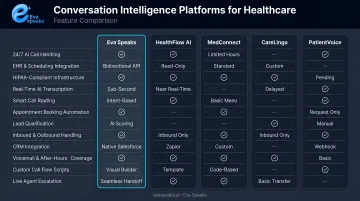
Here is how Eva Speaks compares against the two most common alternatives practices evaluate when choosing a CI platform.
| Category | Eva Speaks | Patient Prism | Marchex |
|---|---|---|---|
| Best-fit Business Size | Solo practices to multi-location groups | DSOs, dental groups, multi-location medical practices | Enterprise health systems and large group practices |
| Key Strengths | Flexible AI call handling, fast deployment, no enterprise IT required | Real-time revenue recovery alerts, PMS/EHR integration, marketing attribution | Deep QA analytics, 100% call scoring, compliance monitoring |
| Implementation Complexity | Low - configurable scripts, no large IT rollout required | Moderate - PMS/EHR integration setup required | High - requires dedicated analytics or marketing operations team | | Integration Capability | CRM, scheduling, telephony, EHR | PMS, EMR, EHR, marketing stack | Freshpaint, call recording infrastructure, analytics platforms |
How to Choose the Right CI Platform for Your Practice
Choosing a general-purpose sales intelligence or B2C call analytics tool for patient-facing healthcare creates real problems: compliance gaps, broken EHR integrations, and software front-desk staff won't touch.
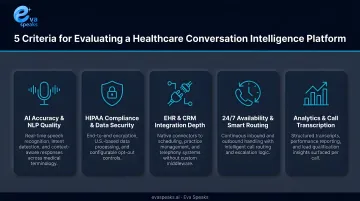
Core evaluation criteria:
- HIPAA compliance — Confirm the vendor signs a BAA and documents encryption, role-based access, and audit logging. Per HHS guidelines, covered entities must obtain satisfactory assurances from business associates before those vendors handle PHI.
- Healthcare AI depth — Can the platform parse clinical terminology, specialty-specific call patterns, and patient intent, or is it a generic NLP engine?
- Analysis vs. activation — Can the platform trigger alerts, route calls, or recover missed opportunities automatically? Or does insight sit in a dashboard until someone acts on it?
- Ease of use — Can front-desk or operations staff actually use it without technical training?
- Integration depth — Does it connect to your PMS, EHR, CRM, or marketing stack?
Match platform to practice size and use case:
| Practice Type | Best Starting Point |
|---|---|
| Solo or small practice (call volume / after-hours gaps) | TrueLark or Eva Speaks |
| Single/multi-location dental or specialty (revenue recovery) | Patient Prism |
| Healthcare marketing team (attribution and ROI) | CallRail |
| Enterprise health system (QA and analytics at scale) | Marchex |
The right choice depends on where your most urgent operational or revenue leak actually is.
Not sure which setup fits your clinic? Get a Customized Workflow Recommendation
Conclusion
Conversation intelligence has moved from optional to measurable. Practices that systematically analyze patient calls recover lost appointments, coach staff with evidence, and connect marketing spend to outcomes that actually matter. Those that don't are leaving data — and revenue — sitting in unreviewed call recordings.
When evaluating platforms, look past feature lists. Ask whether the tool is purpose-built for healthcare or adapted from another vertical, whether it activates real-time workflows or only surfaces retrospective data, and whether your team will realistically use it day-to-day.
Those criteria apply directly to call handling as well. For practices that want AI-powered answering with real-time responses and configurable routing rules, Eva Speaks is built specifically for that use case. Because it does not require a full CCaaS deployment or extensive IT infrastructure, practices can get AI-assisted call handling in place without the implementation timelines associated with larger enterprise platforms. Contact the team at privacy@evaspeaks.ai to discuss configuration options for your practice.
Want to talk through your specific call handling needs? Talk to an AI Communication Expert
Frequently Asked Questions
What is conversation intelligence for healthcare?
Conversation intelligence for healthcare is AI technology that records, transcribes, and analyzes patient conversations across phone, chat, and SMS channels. It surfaces insights on scheduling friction, staff performance, and patient sentiment — going beyond basic call recording to drive operational and clinical improvements.
Are conversation intelligence tools HIPAA compliant?
Not by default. Before deploying any CI platform, confirm the vendor signs a Business Associate Agreement (BAA), encrypts data in transit and at rest, restricts access to protected health information (PHI), and provides compliance documentation on request.
What is the difference between conversation intelligence and call tracking?
Call tracking identifies which marketing source — ad, keyword, or campaign — drove a specific inbound call. Conversation intelligence goes further, using AI to analyze what was actually said, detect caller intent, score interactions, and generate insights about patient needs and staff performance.
How does conversation intelligence improve patient outcomes?
CI reduces missed appointments through proactive follow-up workflows, identifies scheduling friction that causes patient leakage, and helps practices understand what patients are actually asking when they call. Organized intake also speeds care coordination by getting the right information to clinical staff before the appointment begins.
Can small healthcare practices benefit from conversation intelligence?
Yes — tools like TrueLark and Eva Speaks are built for practices without large call center teams. They automate call handling and capture patient inquiries so even a solo-provider office can reduce front-desk workload and recover missed opportunities without adding staff.
What integrations should a healthcare CI platform support?
Look for integrations with Practice Management Systems (PMS) or EHR software, CRM tools for lead tracking, Google Ads and analytics platforms for attribution, and VoIP or softphone systems for unified call management across locations.