Introduction
When an inbound call arrives at your business, the seconds between ring and connection determine the outcome. Route that call to the wrong team, a disconnected extension, or an endless IVR menu doesn't just frustrate callers — it costs you the interaction entirely. According to Zendesk CX Trends 2026, 85% of CX leaders say customers will drop brands after unresolved issues, even on the first contact.
This guide is written for operations managers, IT decision-makers, and business owners evaluating or optimizing their communication stack. Getting routing right directly affects first-call resolution rates, customer retention, and revenue. Getting it wrong means calls silently disappear.
Here's what this guide covers to help you get it right:
- How call forwarding and routing work technically in a cloud phone system
- The main routing rule types and when to use each
- Key factors that affect routing performance
- The most common configuration mistakes and misconceptions
Key Takeaways
- Call forwarding redirects a call to an external number; call routing directs calls within a system based on logic — related but distinct.
- Cloud systems handle routing entirely through software, no on-premises PBX hardware required.
- Routing rules can factor in time of day, caller ID, IVR input, agent availability, or AI-detected intent.
- Misconfigured routing (stale rules, cascading forwards, over-complicated IVR menus) is a leading cause of missed calls.
- AI-powered routing replaces static rule trees with dynamic, intent-based decisions in real time. Businesses ready to move beyond static call forwarding can Explore AI Call Automation to see what intelligent routing looks like in practice.
What Is Call Forwarding & Routing in a Cloud Phone System?
Call forwarding redirects an incoming call from one number to a different external destination — for example, sending calls from your main business number to a mobile phone after hours. Call routing is broader: it refers to the logic that determines where calls go within a system, directing them to the right team, queue, agent, or IVR menu based on pre-configured conditions.
Both functions exist in every cloud phone system, but they operate at different layers. Forwarding handles the destination. Routing handles the decision of how to get there.
What Cloud Delivery Changes
In a traditional PBX setup, routing changes required physical hardware reconfiguration. In a cloud phone system, all routing logic lives in software. Rules are managed through a web dashboard, mobile app, or API — meaning a business can update after-hours schedules, add new departments, or change failover destinations in minutes without touching any hardware.
Scaling follows the same principle. Adding a new location, team, or phone number means updating a configuration — no rewiring, no infrastructure project.
Why It Matters
The stakes are concrete. Zendesk CX Trends 2026 reports that 88% of customers expect faster response times than a year ago, and 74% expect service to be available 24/7. A caller who reaches the wrong department, sits in an unmonitored queue, or hits a dead extension doesn't wait — they hang up and often don't call back.
Most routing failures never generate a complaint. The call simply disappears — no record, no callback, no second chance.
How Cloud Call Forwarding & Routing Works
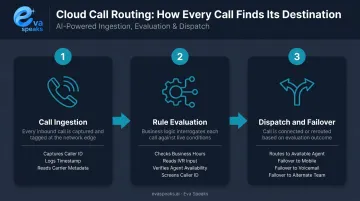
When an inbound call hits a cloud phone system, the entire process from ring to connection happens in milliseconds — seamlessly, with no friction for the caller. Here's what's occurring at each stage.
Step 1: Call Ingestion
The caller dials a Direct Inward Dialing (DID) number. As Vonage defines it, DID is a service that routes incoming calls directly to individuals or departments without requiring an operator. The VoIP or SIP carrier delivers the call to the cloud platform's switching layer, where basic metadata is captured immediately:
- Caller ID
- Dialed number
- Timestamp
- Originating carrier
This metadata is passed to the routing engine, which begins evaluating rules before the caller hears anything.
Step 2: Rule Evaluation
The routing engine checks applicable rules in order of priority. A typical evaluation sequence looks like this:
- Business hours schedule — Is this call arriving during configured open hours?
- IVR input — If an IVR menu is presented, what option did the caller select or say?
- Agent availability — Is there an available agent in the target queue or group?
- Caller ID matching — Does the caller's number match any VIP or routing override rules?
If an IVR step is included, the caller's keypad input or spoken response is processed here before the final routing decision is made. Under the hood, platforms like Twilio use SQL-like expression matching to compare call attributes against worker and queue conditions before dispatching.
Step 3: Dispatch and Failover
Once the routing engine selects a destination, the call is connected — either to a single endpoint or distributed across multiple simultaneously. If the destination doesn't answer within a configured timeout (Twilio's default reservation timeout is 20 seconds before rerouting to another eligible agent), failover rules activate.
Failover options typically include:
- Rolling to the next agent in a queue
- Forwarding to a mobile or external number
- Sending to voicemail
- Routing to an alternate team or after-hours answering service
Without a configured failover, unanswered calls simply disconnect. The caller receives no explanation, and the business has no record the call was lost.
Types of Call Forwarding & Routing Rules Explained
Time-Based Routing
The system checks when a call arrives and routes to different destinations based on schedule:
- Business hours → main team queue
- After hours → voicemail or external answering service
- Weekends/holidays → alternate coverage or automated message
These schedules don't update themselves. Staff changes, holiday closures, and seasonal hours need to be reflected in the routing configuration proactively. A business that configures hours in January and ignores them until July will route calls incorrectly for every intervening change.
Eva Speaks supports office hours configuration as part of its call routing setup, allowing businesses to align routing behavior directly with operational schedules.
Sequential vs. Simultaneous Forwarding
These two methods represent a fundamental trade-off:
| Method | How It Works | Best For |
|---|---|---|
| Sequential | Rings destination 1, then 2, then 3 after timeout | Small teams, prioritized coverage |
| Simultaneous | Rings all destinations at once | Fastest answer speed, higher capacity |
Sequential forwarding preserves a priority order but adds latency: each unanswered ring costs the caller time. Simultaneous ringing reduces wait time but can create contention if multiple agents pick up at once.
Skills-Based and Department Routing
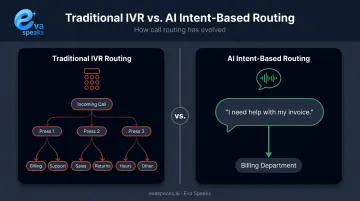
IVR input or direct-dial extensions route callers to teams with relevant expertise. A caller pressing "2 for billing" goes directly to finance. A caller pressing "1 for support" goes to the technical team.
This reduces internal transfers and improves first-call resolution. Salesforce reports that the industry-standard first-call resolution rate is approximately 75% — skills-based routing is one of the levers that pushes teams toward or past that benchmark.
Round-Robin and Load-Balanced Routing
Round-robin distribution cycles calls evenly across available agents, preventing one person from receiving all inbound volume while others sit idle. Load-balanced routing applies the same principle but weights distribution by agent capacity or active call duration.
Basic ring groups work differently: all agents ring simultaneously, but no distribution logic applies. They're simpler to configure and still offer no visibility into wait times, agent workload, or queue performance.
AI-Driven and Intent-Based Routing
Modern cloud platforms can analyze what a caller says, not just what button they press, and route based on detected intent. A caller describing a billing dispute gets connected to finance without navigating a multi-level menu; someone asking about a recent order goes straight to fulfillment.
Platforms like RingCentral's AI Receptionist describe this as intelligent routing based on names, keywords, and conversation context, handling calls 24/7 without a traditional phone tree.
EvaSpeaks takes the same approach using large language model (LLM) technology combined with speech-to-text (STT) and text-to-speech (TTS). Businesses configure call-flow scripts and routing rules that work with the AI layer, directing calls based on conversational context rather than rigid button-press inputs. EvaSpeaks supports time-based routing rules and office hours configuration as a standard feature — which means the kind of after-hours and holiday scheduling that traditionally requires manual toggles is handled automatically once configured. You can Watch AI Call Flow Demo to see how AI-intent routing handles a real inbound call without any button-press navigation.
Key Factors That Affect Call Routing Performance
Well-designed routing logic can still break down when the infrastructure or operations behind it aren't solid. These four factors most often determine whether routing performs the way it was configured.
Network Quality and VoIP Infrastructure
Routing rules mean nothing if the call quality degrades before dispatch. Published VoIP benchmarks show the minimum requirements are stricter than most businesses assume:
| Provider | Bandwidth per call | Latency | Packet loss |
|---|---|---|---|
| Twilio Voice SDK | 40 kbps up/down (Opus) | RTT <200 ms | <3% |
| RingCentral | 90 kbps dedicated | <150 ms | Not specified |
| Cisco (G.711) | ~174 kbps per call | <150 ms one-way | <1% |
Sources: Twilio Voice SDK requirements; RingCentral QoS guidance
Insufficient bandwidth or high packet loss causes call quality degradation and unpredictable timeout behavior — meaning calls may fail to connect even when routing logic is correct.
Network quality sets the floor. Routing rule design determines how well you build on top of it.
Routing Rule Complexity and Maintenance
Complex, layered forwarding chains are difficult to diagnose when something breaks. A rule that made sense when configured may now point to a disconnected extension, a former employee's number, or a department that no longer exists.
Best practices:
- Audit routing logic at minimum annually, or whenever staffing or hours change
- Define clear fallback destinations for every rule branch
- Use simpler rule sets — a routing tree with fewer branches fails more predictably and is faster to repair
Real-Time Agent Availability
Routing accuracy depends entirely on the system knowing who's actually available. Two approaches exist:
- Status-based routing: Routes calls only to agents currently logged in and marked available
- Static routing: Routes to configured destinations regardless of whether anyone will answer
Queue systems that track agent login/logout status outperform ring groups in live environments because they route to available agents rather than ringing toward potentially empty phones. Twilio's TaskRouter, for example, uses Worker Activities (Available, Offline) to determine eligibility before dispatching a task.
Even the best availability logic fails when callers reach the wrong queue to begin with — which is where IVR design becomes the final bottleneck.
IVR Design Quality
Overly deep IVR menus cause callers to abandon the menu or press incorrect options, sending calls to the wrong destination. Zendesk CX Trends 2026 found that 74% of customers find it frustrating to repeat their story to different agents — a direct consequence of IVR-driven misrouting.
AI-powered conversational IVR replaces rigid button trees with natural language interaction. Eva Speaks, for example, integrates LLM processing so callers simply explain their issue instead of navigating "Press 3 for billing" menus — and the system routes accordingly. You can See How AI Handles After-Hours Calls to see how conversational routing works when no human is available to take the call.
Common Mistakes, Misconceptions, and When Routing Alone Falls Short
Forwarding Instead of Porting When Switching Providers
When businesses change phone providers, the path of least resistance is setting up call forwarding from the old number to the new system. The problem: this creates a cascading forwarding chain between carriers.
Each hop adds latency. Troubleshooting where a call is failing becomes considerably harder when it's passing through multiple carrier networks. In edge cases, forwarding loops can cause calls to bounce indefinitely before dropping.
The correct approach is number porting. The FCC confirms that providers cannot refuse to port a number due to an unpaid porting fee or outstanding balance — meaning businesses have the right to take their numbers with them cleanly.
Treating Routing as "Set It and Forget It"
Routing rules are tied to real-world conditions that change constantly: staff assignments, business hours, department structures, phone extensions. A routing configuration that was accurate when deployed becomes a liability as soon as those conditions change without a corresponding update.
Stale rules pointing to wrong destinations don't generate error messages — they just send calls somewhere that won't answer. The business never knows the call was lost.
Routing logic should be treated as operational documentation: reviewed when staff changes occur, when hours shift seasonally, and at least once annually as a standard audit.
When Routing Alone Isn't Enough
Call routing optimizes where calls go. It cannot fix what happens when they arrive. Routing can't compensate for these capacity gaps:
- Agents not logged into queues
- Teams understaffed during peak hours
- No coverage for after-hours calls
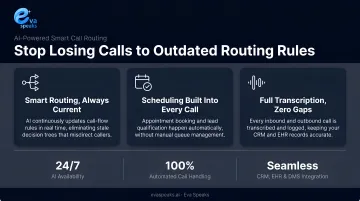
In each case, routing only redirects the call to a different unanswered destination. A well-routed call that reaches an unstaffed queue is still a missed call. Fix the routing and the staffing problem — or you'll keep losing calls, just to different places. Businesses that want to address both the routing and staffing gap in one move can Talk to an AI Communication Expert about how AI call handling covers both dimensions simultaneously.
Cloud Phone + AI vs Standard Cloud vs Legacy PBX: Side-by-Side Comparison
Here is how cloud phone systems with AI compare to standard cloud forwarding and legacy PBX for call routing:
| AI + Cloud Routing (EvaSpeaks) | Standard Cloud PBX | Legacy On-Premise PBX | |
|---|---|---|---|
| Features | Conversational AI, dynamic rules, after-hours AI cover | VoIP forwarding, basic IVR, voicemail | Fixed extensions, basic forwarding |
| Best-fit Business Size | SMB to mid-market | Any size | Large enterprise |
| Key Strengths | No missed calls, AI handles overflow, real-time updates | Flexible, internet-based | Maximum control, no dependency |
| Implementation Complexity | Low - hours | Low to Medium | High |
| Integration Capability | CRM, scheduling, EHR native | Varies by provider | Custom dev |
Frequently Asked Questions
What is the difference between call forwarding and call routing?
Call forwarding redirects a call from one number to a different external destination. Call routing directs calls within a system to the appropriate team, queue, or agent based on logic rules. In cloud phone systems, both are managed through the same software interface — but they operate at different layers of the system.
What is the best cloud-based phone system?
There's no single answer — it depends on business size, routing complexity, integration requirements, and whether AI features like intent-based routing or call transcription matter to your operation. A small business with basic needs has very different requirements than an enterprise contact center running skills-based routing across dozens of agents, so evaluate against those specific criteria.
How does time-based routing work in a cloud phone system?
The system checks when a call arrives against a configured schedule and routes to different destinations for business hours, after-hours, and holidays. Schedules don't update automatically — they require manual adjustment or configured automation to reflect seasonal hours or unexpected closures.
Can cloud phone systems route calls based on language or caller intent?
Yes. AI-enabled cloud systems use speech recognition and natural language processing to detect caller intent or language preference and route accordingly — replacing or augmenting traditional button-press IVR menus. This is the approach Eva Speaks takes through its LLM integration, allowing calls to be handled based on conversational context.
What happens to calls if a cloud phone system experiences an outage?
Calls can be pre-configured to failover to mobile numbers, an alternate carrier, or a third-party answering service. Without a configured failover, calls will ring unanswered or return an error to the caller. Twilio's standard API SLA, for reference, targets 99.95% monthly availability — but even at that level, failover planning is essential.
Which AI tools offer multilingual support for call routing?
Several platforms support multilingual IVR and routing, detecting a caller's language preference and connecting them to appropriately staffed teams. Eva Speaks handles this through its LLM integration, routing based on conversational context rather than button-press menus. Confirm multilingual support during platform evaluation if your customer base spans multiple languages.