Introduction
Picture this: you're mid-installation, hands full, when your phone rings. By the time you've wrapped up and called back — 45 minutes later — the caller has already scheduled with a competitor. This scenario plays out dozens of times a week for contractors across every trade, and the financial cost adds up fast.
Hiring a full-time receptionist feels like the obvious fix, but at a median wage of around $17.90/hour (Bureau of Labor Statistics, 2024), that's $35,000–$37,000 annually before benefits — an overhead most solo operators and small crews simply can't justify.
AI phone answering services fill that gap: always-on call handling at a fraction of the cost, with no payroll overhead attached. This article breaks down the operational advantages these tools offer contractors — lead capture, time recovery, and smarter call management — with real numbers attached.
Want to hear what AI-handled calls actually sound like? Listen to Sample AI Call
Key Takeaways
- AI answering services pick up every call, 24/7 — no leads lost to voicemail or after-hours silence.
- Most AI-only services start under $100/month; Smith.ai's AI Receptionist begins at $95/month versus $35,000+ annually for a full-time hire.
- Routes emergency calls straight to your phone while routine inquiries get handled automatically.
- Contractors reclaim hours every week by cutting out low-priority call interruptions during job hours.
- Better availability means more calls answered, more leads converted, and more jobs booked.
What Is an AI Phone Answering Service?
An AI phone answering service is software that picks up incoming calls, understands what callers need using natural language processing, and responds conversationally — no human operator required.
For contractors, it handles the call types that fill most business phones:
- New job inquiries — collects caller details, job description, and location
- Appointment requests — schedules or logs requests based on your availability
- Service FAQs — answers common questions about pricing, service areas, and availability
- Emergency triage — identifies urgent situations and escalates immediately to your mobile
Systems like EvaSpeaks layer large language models (LLMs) on top of voice processing, which means callers have an actual conversation rather than pressing buttons through a phone tree. The AI can capture structured call summaries and route them to the contractor — so when you do pick up the phone, you already know who's calling and why. EvaSpeaks also handles emergency triage through customizable routing rules — a contractor can configure specific keywords like "flooding" or "no heat" to trigger an immediate escalation to their mobile, so genuine emergencies are never treated the same as a routine price inquiry.
For contractors, that translates directly: more jobs booked, fewer missed calls, and less time managing a phone instead of running a crew.
Key Advantages of AI Phone Answering Services for Contractors
These advantages are tied directly to outcomes that affect revenue and capacity — not abstract features.
Never Losing a Lead to a Missed Call
Every unanswered call is a potential job that doesn't book. The numbers behind this are stark.
A 2025 CallRail survey of 1,000 U.S. consumers found:
- 78% have abandoned a business after an unanswered call
- 82% say they will call a competitor if a business doesn't answer
- Only 42% leave a voicemail — meaning the majority of missed callers simply move on
- 21% immediately call another business after not reaching you
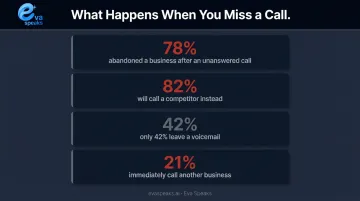
Voicemail is not a safety net. It catches less than half of missed demand, and the other half is gone.
The cost is concrete: Angi's 2026 data puts average HVAC repair costs around $350, ranging up to $3,000 for complex jobs. Plumbing averages $182–$499. At the low end, two missed calls per week at $350 each adds up to over $36,000 in lost annual revenue.
That's from calls you simply didn't answer.
AI answering services fix this by picking up on the first ring, around the clock. The AI greets callers professionally, gathers job details, and either books the appointment or logs the inquiry — without requiring you to be available in real time.
KPIs this affects: Lead capture rate, call-to-appointment conversion, after-hours inquiry volume, new job booking rate.
When it matters most: Peak seasons (summer HVAC, spring landscaping), after-hours windows, and for solo operators with no dedicated office staff.
Wondering how AI keeps your business covered when you're off the clock? See How AI Handles After-Hours Calls
Freeing Up On-Site Focus and Reducing Administrative Interruptions
Phone interruptions during active work don't just waste time — they fragment concentration and introduce errors.
Research from UC Irvine (Gloria Mark) found that workplace interruptions lead to measurably higher stress, frustration, time pressure, and cognitive effort. For a plumber diagnosing a complex leak or an electrician working on a panel, that's more than inconvenient — it's a safety issue.
Beyond safety, the administrative burden is real. A 2023 Time Etc survey of 251 U.S. entrepreneurs found owners spend an average of 36% of their work week on administrative tasks, with 45% managing scheduling specifically. For a contractor working 50-hour weeks, that's potentially 18 hours not spent on billable work.
AI answering services act as a first filter:
- The AI handles routine and low-priority calls without interrupting you
- Spam and non-job-related inquiries are caught before reaching your phone
- Structured call summaries are sent for legitimate inquiries, so your response is informed and deliberate
- Only genuinely urgent calls escalate in real time
The result: fewer reactive interruptions, more deliberate communication, and job days that actually stay on the job site.
KPIs this affects: Billable hours recovered per week, admin time reduced, job completion speed.
When it matters most: Solo contractors, small crews, and high-focus jobs like electrical diagnostics or plumbing troubleshooting where interruptions carry real consequences.
Smart Call Routing, Emergency Prioritization, and Consistent Job Qualification
Not all calls deserve the same response. A burst pipe is not a price inquiry.
AI services with customizable call-flow logic — like Eva Speaks' LLM-powered routing — categorize incoming calls in real time and respond accordingly:
| Call Type | AI Action |
|---|---|
| Emergency (flooding, no heat, electrical fault) | Immediate escalation to contractor's mobile |
| New job inquiry | Collects details, books or logs appointment |
| FAQ (pricing, service area, availability) | Answers from pre-configured information |
| Existing customer follow-up | Routes to appropriate message queue |
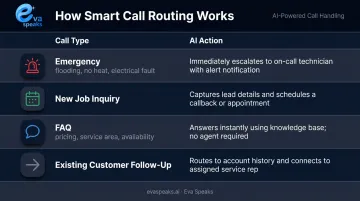
This matters for professionalism as much as efficiency. HubSpot's 2022 State of Service report found 90% of customers rate an immediate response as important or very important, with 60% defining "immediate" as 10 minutes or less. A phone tree that buries callers in menus — or sends every call to voicemail after hours — doesn't meet that standard.
Consistent call handling also protects your reputation. If a potential customer calls three times and gets three different experiences, they book elsewhere. AI enforces the same professional greeting and qualification process on every call, regardless of the time or how busy you are.
SQM Group's research on first-call resolution adds another angle: customer satisfaction drops by an average of 15% each time a customer must call again about the same issue. Getting the right information on the first call, and routing it correctly, keeps customers from calling back frustrated.
KPIs this affects: Emergency response time, lead qualification rate, first-call resolution, customer satisfaction score, repeat business rate.
This is particularly valuable for plumbers, electricians, and HVAC technicians handling both routine bookings and emergency service calls — and any contractor looking to scale without adding office headcount.
Want to see how intelligent call routing works in practice? Watch AI Call Flow Demo
How AI Phone Answering Services Compare
Not all AI answering services are built the same. Here is how three common options stack up for contractor businesses:
| EvaSpeaks | Smith.ai AI Receptionist | Basic AI Answering App | |
|---|---|---|---|
| Features | 24/7 call handling, LLM-powered routing, emergency triage, appointment booking, call summaries, custom scripts | 24/7 answering, lead intake, appointment scheduling, spam blocking | Voicemail transcription, basic auto-reply, missed call alerts |
| Best-fit Business Size | Solo operators to growing multi-crew contractors | Small to mid-size businesses with steady call volume | Freelancers or very low-volume operations |
| Key Strengths | Conversational LLM responses, keyword-based emergency escalation, highly configurable call flows | Established reliability, human backup option available | Low barrier to entry, simple setup |
| Implementation Complexity | Easy - guided setup with customizable scripts and routing rules | Moderate - account configuration and intake form setup required | Minimal - plug-in with little customization |
| Integration Capability | CRM, scheduling tools, telephony, EHR, and property management platforms | CRM integrations (Salesforce, HubSpot, Clio, and others) | Limited - typically standalone with no deep integrations |
For contractors who need emergency triage, custom routing logic, and a system that grows with their business, EvaSpeaks is designed to fit without a complicated rollout.
What Happens When Contractors Skip AI Phone Answering
A contractor who consistently goes to voicemail during work hours isn't just missing individual calls — they're training their local market to call someone else first.
The operational consequences stack up fast:
- Emergency calls go to a competitor — and that competitor gets the job, the review, and the repeat customer
- New leads call back days later — by then you're already booked, or they've moved on
- Scheduling chaos — calls pile up, callbacks get missed, double-bookings happen
- No path to scale — every new crew member or service area just adds more call volume for the same overwhelmed contractor to handle
The numbers back this up. A Lead Response Management study by XANT — drawing on 400+ companies, 5.7 million marketing leads, and 55 million sales activities — found conversion rates are 8X higher when leads are contacted within 5 minutes versus 6+ minutes. The same study found 77% of leads were never responded to at all.
In contracting, the first person to answer often gets the job. Every missed call is a direct transfer of business to whoever picks up instead.
How to Get the Most Value from AI Phone Answering as a Contractor
Generic setups deliver generic results. Configuring your AI answering service around how your business actually operates is what separates a useful tool from a forgettable one.
Before setup, define your most common call types clearly:
- New job inquiry
- Emergency service call
- Estimate request
- Existing customer question
Build routing logic around those categories from day one. Eva Speaks supports customizable call-flow scripts, routing rules, and office hours — which means you can design a flow that reflects your actual service offering, not a generic template.
Review call transcripts and summaries weekly. Most AI services log every call, and that data is more useful than most contractors realize. Regular reviews help you identify:
- Service areas generating the most inbound demand
- Common pricing questions worth adding to the FAQ script
- Peak call hours that inform staffing decisions
Update scripts seasonally — storm season protocols for roofers, summer overload scripts for HVAC — and refine routing rules as the business grows. Contractors who revisit their setup quarterly consistently capture more leads and fewer missed calls than those who configure once and move on.
Not sure which call flow setup fits your business? Get a Customized Workflow Recommendation
Frequently Asked Questions
How much does an AI answering service cost for a business?
AI-only services typically start around $95/month (Smith.ai's entry-level AI Receptionist plan, as of May 2026), while human or hybrid services run $250–$1,380/month depending on call volume. A full-time receptionist costs $35,000–$37,000/year in wages alone — making the savings substantial for most contractors.
Can AI answer my business phone calls?
Yes. Modern AI phone answering services use natural language processing to handle calls conversationally — answering questions, collecting job details, booking appointments, and routing urgent calls. Many callers don't realize they're speaking with AI, particularly when the system is configured with business-specific information.
What are the benefits of AI phone calls for contractors?
The core benefits are 24/7 availability, zero missed leads, reduced on-site interruptions, consistent professional call handling, and smart escalation for emergencies — all at a fraction of what human reception staff costs.
Will my clients know they're talking to an AI?
Well-configured AI services use natural-sounding voices and trained responses. Set up with your business name, service details, and custom scripts, most callers won't suspect they're not speaking with a person.
Can an AI answering service handle emergency calls?
Yes — AI services with smart routing can identify emergency calls based on caller inputs or specific keywords (such as "no heat" or "flooding") and immediately escalate to the contractor's mobile. Urgent calls get through immediately, rather than sitting in a queue alongside routine booking requests.
What types of contractor businesses benefit most?
Any trade business with high call volume, after-hours demand, or limited office staff — plumbers, electricians, HVAC technicians, roofers, landscapers, and general contractors. The highest impact is for solo operators and small crews without a dedicated receptionist who currently handle all incoming calls themselves.