AI call answering is often positioned as a customer service upgrade. That framing undersells it. The real value shows up in lead capture metrics: how many inbound calls get answered, how quickly, what data gets collected, and whether that data reaches the right people for follow-up.
This article breaks down exactly how AI call answering systems drive those outcomes — the mechanics behind 24/7 availability, real-time qualification, and automatic lead logging — and what businesses lose when these gaps aren't addressed.
Key Takeaways
- No more missed leads: AI call answering responds instantly, day or night, eliminating voicemail drop-off and after-hours loss
- Speed matters: Delayed responses dramatically reduce conversion odds — AI eliminates that delay entirely
- Structured qualification: Every call captures the right lead data, consistently, without relying on human memory
- Automatic CRM logging: No manual entry, no forgotten follow-ups, no leads falling through the cracks
- Unanswered calls waste ad spend and send prospects straight to faster competitors
What Is an AI Call Answering System?
An AI call answering system is software that uses conversational AI to answer inbound calls, understand caller intent, and complete tasks — such as capturing lead information, answering questions, or routing calls — without requiring a human agent in the moment.
It functions as the first point of contact for inbound calls, operating 24/7. Businesses can also configure it as an overflow or after-hours solution, so it activates when staff aren't available without displacing live agents.
Systems like Eva Speaks combine large language models (LLMs), speech-to-text (STT), and text-to-speech (TTS) to handle natural conversations, follow customizable call-flow scripts, and apply routing rules based on predefined business criteria. Because Eva Speaks is designed for businesses of varying sizes and technical resources, it can be deployed without heavy infrastructure changes — the platform layers on top of existing phone numbers and workflows rather than requiring a full telephony migration.
The industries where this matters most include:
- Home services: plumbers, HVAC contractors, and electricians fielding high call volume and urgent requests
- Legal and professional services: where intake quality directly affects case acceptance
- Real estate: time-sensitive buyer and seller inquiries
- Healthcare: appointment requests and patient triage
- Businesses running paid advertising: every unanswered call is wasted ad spend
At its most practical, an AI call answering system functions as a lead capture layer. Every call from a potential customer gets handled, qualified, and recorded — regardless of when it comes in or whether staff are available. Businesses ready to see this in practice can Request Live Demo.
Key Advantages of AI Call Answering Systems for Lead Capture
Most lead loss happens at the top of the funnel — specifically, in the moments between a call arriving and someone qualified picking it up. The three advantages below address that gap directly, in operational terms businesses can measure.
Advantage 1: 24/7 Availability Eliminates After-Hours Lead Loss
A lead who calls at 9 PM on a Sunday is often your most motivated prospect. They didn't wait until Monday morning — they acted when the need was fresh. If that call hits voicemail, there's a strong chance they won't call back.
AI call answering systems operate continuously: nights, weekends, and public holidays, with no staffing required. When a call arrives outside business hours, the system greets the caller, identifies their need, collects contact information and intent, and queues the lead for human follow-up with full context already attached.
Consider the math: according to Invoca's 2025 benchmark, based on analysis of 60M+ phone calls across nine industries, 35% of calls from digital marketing are leads. If a business is spending on paid search or social campaigns and a meaningful share of those calls arrive outside staffed hours, those leads disappear — and the ad spend that generated them produces no return.
KPIs directly impacted:
- After-hours lead capture rate
- Missed call rate
- Total inbound lead volume
- Return on ad spend (calls generated but unanswered don't convert)
When this matters most:
- Businesses running paid search or social campaigns where leads are time-sensitive
- Service businesses with emergency or urgent inquiry patterns (HVAC outages, plumbing leaks, legal situations)
- Any market where response speed determines who wins the customer. You can See How AI Handles After-Hours Calls to watch exactly how an AI system captures a lead that arrives at 9 PM on a Sunday.
Advantage 2: Instant Response and Structured Lead Qualification
No hold music. No ring-to-voicemail. No queue.
AI call answering systems respond in seconds, and they use that conversation to do something a ringing phone never can: collect structured, consistent lead data. Through customizable call-flow scripts and large language model (LLM) integration (as used by platforms like Eva Speaks), the system asks the right qualifying questions in natural conversation, capturing caller name, contact details, service interest, urgency, location, and any other criteria the business defines.
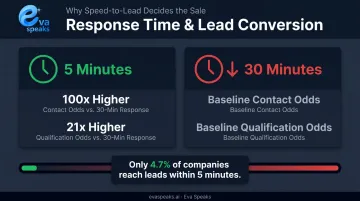
The speed dimension here is significant. The Lead Response Management study, based on 15,000+ leads and 100,000+ call attempts, found that contact odds drop 100x lower and qualification odds drop 21x lower at 30 minutes versus 5 minutes. Only 4.7% of companies hit the optimal 5-minute response window. AI removes that window entirely.
Manual intake introduces a different problem: inconsistency. Different staff ask different questions, capture different details, and record them differently, especially under call volume pressure. That variability degrades lead quality data over time, making scoring unreliable and follow-up inconsistent. Structured data from the first call means sales teams enter every follow-up conversation already knowing the prospect's need, urgency, and fit.
KPIs directly impacted:
- Lead response time
- Lead qualification rate
- First-call resolution rate
- Sales team efficiency (time on qualified vs. unqualified leads)
This advantage is most pronounced for:
- High-volume periods like campaign launches or seasonal demand spikes
- Businesses with defined buyer criteria (service area, budget threshold, urgency level)
- Companies where cost-per-acquisition varies significantly between qualified and unqualified leads
You can Watch AI Call Flow Demo to see real-time lead qualification and CRM logging happening during a single AI-handled call.
Advantage 3: Automatic Lead Logging and CRM Synchronization
Capturing a lead during a call only matters if that data reaches the right system and triggers the right next step. Without automatic logging, lead capture is only as reliable as the human completing the task, and that reliability breaks down precisely when call volume is highest.
AI call answering systems log each handled call automatically: caller details, conversation transcript or summary, lead status, and next-step notes flow directly into a CRM or business management tool without manual entry.
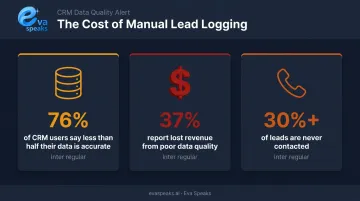
The data on CRM hygiene makes the stakes clear. Validity's 2025 CRM Data Management report, based on 602 CRM users and stakeholders, found:
- 76% believe less than half of their CRM data is accurate and complete
- 37% report lost revenue directly attributable to poor data quality
Vendor research from XANT/InsideSales adds another dimension: over 30% of leads are never contacted, and 50% receive no phone response at all. Much of that failure traces back to data that was never captured or captured incorrectly.
Automatic logging closes that gap. Every inbound call creates a complete, searchable record, so no lead disappears because an agent forgot to update the system after a busy afternoon.
KPIs directly impacted:
- Lead follow-up rate
- CRM data completeness
- Lead-to-conversion rate
- Pipeline accuracy and revenue forecasting
Where this delivers the most impact:
- High inbound call volume with limited administrative capacity
- Multi-location operations where call handling is distributed
- Organizations where sales and operations depend on CRM data to prioritize outreach — these teams can Get a Customized Workflow Recommendation to see how AI logging and routing would work for their specific setup.
AI Call Answering vs. Human Receptionist vs. Voicemail: Lead Capture at a Glance
Here is how AI call answering, human receptionists, and voicemail compare for lead capture performance:
| AI Call Answering (EvaSpeaks) | Human Receptionist | Voicemail / Missed Call | |
|---|---|---|---|
| Availability | 24/7, including nights, weekends, and holidays | Business hours only | Passive - caller leaves message or hangs up |
| Lead Qualification | Instant, structured, consistent every call | Variable - depends on staff and call volume | None |
| CRM Integration | Automatic logging after every call | Manual entry required | None |
| Response Speed | Answers in seconds, no hold time | Immediate when available; queue during peak | Delayed - requires callback |
| Best-fit Business Size | Any business with consistent inbound call volume | Any size | Very small operations with low call volume |
| Implementation Complexity | Low - typically live within hours, no telephony migration needed | None (hire and onboard) | None |
EvaSpeaks is designed to flex around existing phone numbers and workflows, so deployment does not require replacing current infrastructure.
What Happens When AI Call Answering Is Missing
When a call goes unanswered, there's no record of it. No follow-up. No visibility into how many potential customers tried and didn't reach anyone. That invisibility is what makes the problem so easy to underestimate — and so costly.
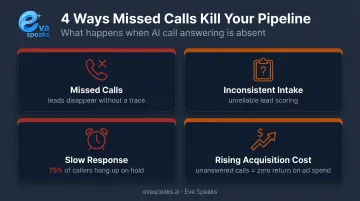
Four failure modes compound the damage:
- Missed calls during peak volume or after hours — leads disappear without a trace, and because no record exists, the loss never gets measured or addressed
- Inconsistent intake quality — different staff capture different data in different formats, making lead scoring unreliable and follow-up ad hoc
- Slower response times — high-intent leads who don't get an immediate response often contact the next business on their list; Invoca research found 75% of callers hang up after being placed on hold
- Rising cost of acquisition — paid media drives inbound calls, but unanswered calls produce zero return; as ad spend scales, the effective cost-per-lead increases without a corresponding increase in leads captured
That last point hits hardest for businesses running paid search. Google/Ipsos research found 48% of mobile searchers said being able to call a business is extremely important when they're about to make a purchase. If that call goes unanswered or hits a voicemail the caller ignores, the ad spend driving that call produced nothing.
How to Get the Most Value from AI Call Answering for Lead Capture
The system produces the strongest results when it's configured around what the business actually needs to know about a caller, not generic defaults.
Three practices that drive results:
Define your qualification criteria before configuring the call flow. What makes a caller a real lead for your business? Service type, geography, urgency level, budget range? Build those criteria into the call-flow script so the system collects the right data from the first call, not after the fact.
Integrate with your CRM or follow-up system from day one. Captured lead data only creates revenue if it lands in your CRM and automatically triggers the next step — assignment to a sales rep, a follow-up sequence, or a booking confirmation. Eva Speaks supports third-party integrations and custom routing rules to keep that handoff seamless.
Review call transcript and outcome data regularly. The patterns in AI-handled calls — common questions, frequent objections, call-to-booking conversion rates — are a direct feedback loop. Use that data to improve the call flow, refine your qualification criteria, and inform the broader marketing and sales strategy.
Conclusion
The lead capture value of AI call answering comes from three compounding advantages: it eliminates the availability gaps that cause lead loss, it captures and qualifies leads consistently in real time, and it ensures every contact is logged and actionable.
These advantages compound over time:
- Better response rates reduce wasted ad spend
- Stronger qualification data improves sales team efficiency
- Cleaner CRM records enable reliable follow-up and more accurate forecasting
Missed or inconsistently handled calls undercut all three — which is why the system configuration matters as much as the technology itself.
The businesses best positioned to benefit aren't necessarily the largest — they're the ones with consistent inbound call volume and the discipline to configure the system around real qualification criteria. AI call answering works best when it's treated as an ongoing operational practice — reviewed and refined as call volume, lead sources, and qualification criteria change.
Frequently Asked Questions
Does AI calling for leads work?
Yes. AI call answering is effective for lead capture because it responds instantly, collects structured qualification data during the call, and eliminates the response gaps that cause high-intent leads to drop off. Results are strongest for businesses with consistent inbound call volume and clearly defined lead criteria.
How reliable is AI for answering questions?
Modern AI call answering systems using large language models handle a wide range of common caller inquiries reliably — FAQs, service details, scheduling requests, and basic intake. They're also designed to escalate to a human when a question falls outside their configured scope — no call falls through the gaps.
What types of businesses benefit most from AI call answering for lead capture?
Home services, legal, real estate, healthcare, and professional services see the clearest gains — especially those running paid advertising where every missed call has a direct cost. When response speed affects conversion, instant answering delivers its sharpest advantage.
How does AI call answering integrate with a CRM?
Most AI call answering systems push call data — caller details, conversation summaries or transcripts, lead status — directly into a CRM via native integrations or tools like Zapier. Eva Speaks supports these integrations so every lead contact is logged automatically, with no manual entry required.
Can AI call answering handle multiple calls simultaneously without dropping leads?
Unlike human receptionists, AI call answering systems handle concurrent calls without placing anyone on hold or routing to voicemail. That scalability is one of its core advantages — peak volume periods don't create the same lead loss risk they do with staffed phone coverage.
What lead data does an AI call answering system typically collect?
Systems can be configured to capture any qualifying data the business needs — typically caller name, phone number, service interest, location, urgency, and preferred callback time. The specific fields are determined by the business's call-flow configuration, not by fixed defaults.