Those fears are understandable. They're also worth examining honestly.
The real story isn't about replacement. It's about the 8 PM toothache call that goes to voicemail. The front desk staffer juggling four tasks simultaneously and giving none of them full attention. The no-show that leaves a hygienist's chair empty because nobody sent a reminder. These are the problems AI actually solves — not by cutting your team, but by removing the tasks that exhaust them before patients ever walk through the door.
This is a practical guide for dental professionals who want clarity on what AI does, what it can't do, and how to bring it into a practice without losing the human element that makes dentistry work.
Key Takeaways
- AI cannot perform clinical care, diagnose conditions, or replace the judgment your team builds through years of patient relationships.
- It handles high-volume, repetitive admin work — after-hours calls, reminders, follow-ups — that burns out front desk staff.
- Practices that adopt AI communication tools see fewer missed calls, fewer no-shows, and less staff turnover pressure.
- Waiting too long is the real risk — patients won't hesitate to call a competitor who actually answers.
See how AI handles after-hours dental calls automatically. See How AI Handles After-Hours Calls
The Real Fear: Why Dental Teams Worry About AI
Three concerns come up almost universally when dental staff hear "AI is coming":
- "Am I going to lose my job?"
- "Are patients going to hate talking to a machine?"
- "Is this just more technology I have to figure out on top of everything else?"
None of these are irrational. A 2024 peer-reviewed qualitative study of 33 healthcare professionals found that staff anxiety centers specifically on the fear that AI will devalue years of training and make experienced team members feel obsolete. That's not stubbornness — it's a reasonable human response to uncertainty.
Most high-profile automation studies focus on manufacturing and industrial processes, which creates a misleading mental image. Dental work doesn't operate that way. It runs on trust, relationships, and the kind of judgment that comes from knowing a patient's history, their anxiety level, and why they've been putting off this appointment for six months. That personal dimension is exactly what makes AI adoption feel so high-stakes for the people delivering that care.
The Real Issue Is Being Overlooked, Not Replaced
When you dig into the resistance, it's rarely about the technology itself. Staff who push back on AI tools are usually responding to how change is being introduced — as something being done to them rather than for them.
The fix isn't technical. Involve your team before anything is implemented — that single step changes the entire dynamic.
What Dental AI Can and Can't Do
Here's what AI cannot do in a dental practice:
- Diagnose or treat any condition
- Perform clinical procedures or deliver anesthesia
- Replace a hygienist's trained eye or a dentist's judgment
- Build the long-term patient trust that keeps people coming back
Those contributions remain entirely human. No AI system changes that.
Where AI Actually Operates
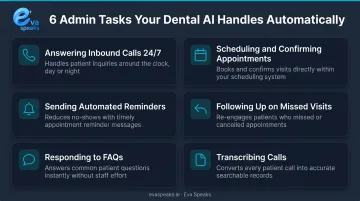
AI operates on the administrative side — specifically in the high-volume, time-sensitive communication tasks that drain front desk energy without requiring clinical judgment:
- Answering inbound calls 24/7
- Scheduling and confirming appointments
- Sending automated reminders
- Following up on missed visits
- Responding to common FAQs about insurance, office hours, and services
- Transcribing calls for accuracy and record-keeping
The After-Hours Problem No One Talks About
Dental practices have a "second shift" problem. Patients don't have toothaches on a schedule. A patient in pain at 8 PM calls your practice, hits voicemail, and faces a choice: wait until morning or search for someone available right now.
McKinsey's 2025 healthcare consumer research found that among patients who experienced scheduling friction, 27% went ahead and scheduled with a new provider. That's not theoretical. Patients actively choose whoever makes it easiest to get help.
Take that 8 PM scenario. Without AI, the patient gets voicemail. With a tool like EvaSpeaks — which uses real-time conversational AI and customizable call-flow scripts — that patient gets immediate answers and, depending on setup, can have their appointment request logged before your team arrives the next morning. EvaSpeaks is designed to deploy without requiring a new phone system or specialized hardware: practices connect it to their existing business number, configure the call flows through the admin interface, and the AI begins handling calls the same day.
AI doesn't compete with your team's skills. It handles the communication volume that no human should be expected to manage alone, at all hours, without a break.
See Eva Speaks handle a real dental intake call. Request Live Demo
Here is how AI receptionists, human front desk staff, and traditional answering services compare for dental practices:
| AI Dental Receptionist (EvaSpeaks) | Human Front Desk | Traditional Answering Service | |
|---|---|---|---|
| Features | 24/7 AI calls, scheduling, reminders, PMS sync, billing Q&A | Full interaction, treatment coordination, check-in | Message-taking, basic call routing |
| Best-fit Business Size | Solo to multi-location practices | Any size | Practices with specific after-hours gaps |
| Key Strengths | Never misses a call, after-hours booking, no sick days | Human warmth, patient relationships | Low cost, low commitment |
| Implementation Complexity | Low - Dentrix, Eaglesoft native | None (hire) | Low |
| Integration Capability | Dentrix, Eaglesoft, Curve, Open Dental native | Manual entry | None or limited |
How AI Empowers Every Role in Your Dental Practice
Front Desk Staff
According to BLS data for dental offices, nearly 299,070 employees work in office and administrative support roles in U.S. dental practices. These are the people constantly pulled in multiple directions — checking in patients, answering phones, verifying insurance, handling billing, all at the same time.
Research on healthcare workflows confirms the cost: a 2021 study of emergency department physicians found that clinicians spent up to 18.7% of work time multitasking, with increased multitasking directly associated with higher work stress. Front desk staff face the same dynamic, often without the same professional infrastructure to manage it.
AI removes the lowest-value, highest-volume tasks from that pile — call answering, reminders, FAQ responses — so staff can give full attention to the patients standing in front of them. The front desk role doesn't shrink — it shifts toward the work that actually requires a person.
Hygienists and Dentists
For hygienists, AI-enabled scheduling and recall systems translate directly into fuller, better-prepared appointment blocks. Fewer last-minute gaps, fewer scrambled mornings, and a more consistent daily workflow.
For dentists and practice owners, call transcripts and communication logs provide something genuinely useful: visibility into where the practice is losing patients before they ever become a problem on a revenue report. Which hours see the most missed calls? Which patient groups reschedule repeatedly? Answers to those questions are strategic intelligence — not just automation output.
Key operational gaps AI helps surface:
- Missed call patterns by time of day or day of week
- Recurring reschedule behavior across specific patient segments
- Communication breakdowns that erode revenue before they appear on reports
Patient Experience
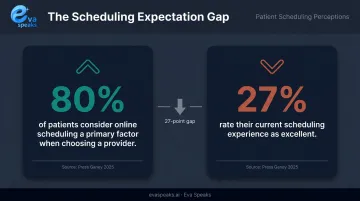
Contrary to the fear that AI feels cold, patients respond positively when communication is fast and available. Press Ganey's 2025 patient experience research found 80% of healthcare consumers consider online scheduling a primary factor when choosing a provider — and only 27% rate their current scheduling experience as excellent. That gap is where practices win or lose patients before the first appointment.
When staff aren't drowning in repetitive tasks, they're more present, more engaged, and better equipped to build the patient relationships that define a great practice. That's what good AI implementation actually looks like in practice: not fewer human moments, but better ones.
Watch how a full AI dental call flow works. Watch AI Call Flow Demo
The Hidden Cost of Ignoring AI
Practices that hold off on AI communication tools aren't staying neutral. Competitors who offer 24/7 responsiveness and instant appointment booking will capture patients who expect convenient access — and patients who hit friction don't wait around. They book elsewhere.
Staff Burnout Is Already a Problem
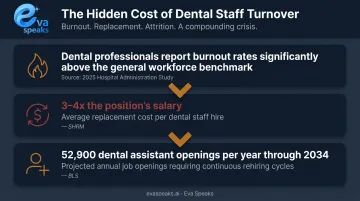
A 2025 study of 117 hospital administrative staff found measurable burnout levels above the general working population benchmark, with scheduling demands and low social support as significant drivers. Dental front offices operate under similar pressure.
When burnout leads to turnover, the cost compounds fast. SHRM estimates the total cost to hire a replacement at three to four times the position's salary. BLS projects 52,900 dental assistant openings per year through 2034 — a figure driven largely by workers leaving the field entirely, not just moving between practices. Every open seat costs more than the salary line suggests.
The Revenue Picture
Those turnover costs hit harder when you factor in what's at stake operationally. ADA Health Policy Institute data shows average gross billings for general dental practitioners reaching $942,290 in 2024. At that revenue scale, administrative gaps aren't minor inconveniences — they're material.
A 2024 dental study found dental appointments average 48.7 minutes each, compared to 17.4 minutes for primary care. A missed dental appointment isn't a quick reschedule problem; it's a significant operational disruption. Multiply that by missed calls that never became bookings, and the cumulative impact over a year adds up fast.
Small daily communication failures compound into revenue leakage that rarely shows up cleanly in any single report — but the total is far from trivial.
Getting Your Team On Board and Starting Small
Team buy-in isn't optional. Rolling out AI without involving staff typically leads to resistance, workarounds, and eventual failure. The goal is to make your team part of the solution.
Involve Before You Implement
Before selecting any AI tool, hold a short team meeting and ask one focused question: "What's the one part of your day you wish you could hand off?"
The answers will tell you exactly where to start. When staff help identify the problem, they're already invested in the solution. A 2021 systematic review of 38 healthcare change studies found that stakeholder engagement is a consistent factor in successful healthcare change — not a nice-to-have.
Show, Don't Just Tell
Run a short live demo before any official rollout. Watching an AI tool handle a realistic call scenario — an appointment request, an insurance question, a cancellation — shifts the conversation from abstract fear to concrete usefulness.
A 2024 systematic review found that technology "champions" in healthcare settings — frontline staff who advocate for and own new tools — significantly improve adoption outcomes. Assign someone on your team to own the rollout and gather ongoing feedback. This person doesn't need to be technical; they need to be trusted by their colleagues.
Start with One Use Case
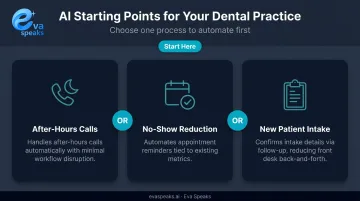
Don't try to automate everything at once. Pick a single, clearly defined pain point:
- Handles after-hours calls automatically, with visible results and minimal disruption to existing workflows
- Reduces no-shows by automating appointment reminders tied to metrics your team already tracks
- Confirms new patient intake details via follow-up, cutting manual back-and-forth at the front desk
One use case, measured carefully, builds confidence for what comes next.
Explore how AI is transforming dental front desk operations. Explore AI Call Automation
Track and Celebrate Early Wins
Consider this: the AI handles after-hours calls for a month. Front desk staff reclaim two hours per week. Say that number out loud in your next team meeting. Share it. When the whole team sees the time returned to them, adoption stops feeling like something imposed from above and starts feeling like a shared gain — which is what keeps the rollout improving over time.
Frequently Asked Questions
Will AI eventually replace dental front desk staff entirely?
AI handles high-volume, repetitive tasks — but relationship-building, judgment calls, and in-person patient interaction aren't going anywhere. The compliance and personal dimensions of dental administration create real barriers to full automation. Staff time gets redirected toward work that genuinely requires them.
How do I introduce AI to my dental team without causing panic?
Involve staff before selecting any tool, and frame AI as something that removes burden rather than people. A focused demo tied to a pain point they've already flagged (say, missed after-hours calls) lands far better than a top-down announcement.
What tasks can dental AI realistically handle right now?
Current AI communication tools handle inbound call answering, appointment scheduling support and reminders, follow-up on missed visits, after-hours patient communication, and responses to common FAQs about services, office hours, and insurance.
Will patients feel uncomfortable interacting with AI instead of a person?
Most patients respond positively to fast, accurate communication, particularly after hours when no human alternative exists. Well-designed AI tools like Eva Speaks maintain a natural, helpful tone and can be configured to reflect the practice's communication style.
Is dental AI difficult to set up if my team isn't technical?
Most modern AI communication tools are designed for non-technical users, with configurable call-flow scripts and routing rules that don't require coding. Onboarding support is typically included. Contact Eva Speaks at evaspeaks.ai to discuss setup for your specific practice.
How does dental AI cost compare to hiring additional staff?
AI communication tools cost a fraction of a full-time hire, with no benefits, turnover, or retraining overhead. ROI typically shows up through captured after-hours appointments, fewer no-shows, and reduced overtime, though exact figures vary by practice volume.