This isn't a worst-case scenario. It's Tuesday too. And the lunch rush. And 6:30 PM when a customer finally has a minute to call.
According to Digital Dealer, the average dealership receives a minimum of 500 monthly service calls — and 38% go unanswered. Flai's analysis of 3,000 stores puts the revenue cost of those missed calls at $850K to $1.17M per year.
This article breaks down exactly why peak-hour call volume defeats traditional staffing, what AI call-handling systems actually do differently, and what to prioritize when evaluating a solution for your dealership.
Key Takeaways
- Dealerships miss roughly 190 service calls per month — adding up to nearly $1M in lost annual revenue
- Hiring more staff, IVR trees, and outsourced call centers all share the same flaw: they can't scale when call volume spikes
- AI systems answer every call simultaneously, book appointments in real time, and operate around the clock — without adding headcount
- DMS/CRM integration is what separates actual appointment booking from expensive message-taking
- Starting with a service department pilot — not a full rollout — generates measurable ROI fastest
Why Dealership Phone Lines Break Down During Peak Hours
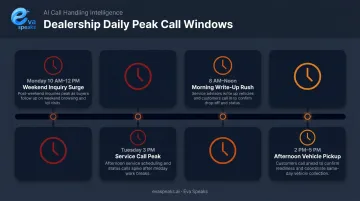
The timing of call surges at dealerships is almost entirely predictable. Flai's analysis of nearly 3,000 U.S. dealerships identifies four recurring daily pressure points:
- Monday 10:00 AM–12:00 PM: The week's single busiest inbound window, as weekend inquiries land all at once
- Tuesday 3:00 PM: Service-specific calls peak in the mid-afternoon
- 8:00 AM–noon: The morning write-up rush across the service lane
- 2:00 PM–5:00 PM: The afternoon vehicle pickup window
These windows recur every single week without exception.
The problem isn't that managers don't know these windows exist. It's that staffing to cover them fully doesn't pencil out. Carrying enough advisors to handle peak Monday morning volume means paying for significant idle capacity on Wednesday afternoons.
The deeper conflict is structural. A service advisor standing with a customer whose keys are already on the counter cannot excuse themselves to answer a ringing phone. Face-to-face interactions will always take priority, which means calls default to hold, voicemail, or go unanswered during exactly the moments when volume is highest.
The Real Cost of a Call That Goes Unanswered
Flai reports that 60% of callers hang up after one minute on hold, and 32% won't wait at all. Once a caller hits voicemail, roughly 75% don't leave a message — they call a competitor instead.
The downstream damage extends well beyond that single lost appointment. Cox Automotive's 2026 Fixed Ops and Ownership Study found that 74% of buyers who returned to the dealer for service said they were likely to repurchase from the same dealer — compared to only 44% of buyers who did not. A missed service call doesn't just cost one oil change; it significantly erodes the probability of selling that customer their next vehicle.
See how AI keeps dealership calls covered around the clock. See How AI Handles After-Hours Calls
Why Traditional Fixes Don't Scale
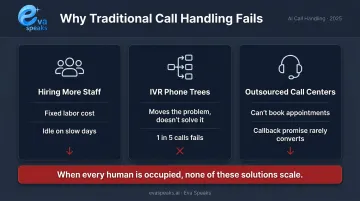
Hiring More Staff
The math simply doesn't work. To adequately cover Monday morning peaks, a dealership would need to staff for that call volume consistently — but those same advisors sit underutilized for most of Tuesday through Friday. Labor costs are fixed; call volume is not. The mismatch makes full staffing economically untenable for most stores.
IVR Phone Trees
Routing a call to the right department only helps if someone in that department can actually answer. IVR systems move the problem, they don't solve it. A caller who navigates three menu options and still lands in voicemail has now experienced both friction and failure. Marchex data indicates 1 in 5 inbound dealership calls fails before any conversation occurs, and 43% of those callers never call back.
Outsourced Call Centers
Third-party call centers hit a hard ceiling the moment a caller wants to book an appointment. Without direct, live integration into the dealership's DMS or scheduling system (CDK, Reynolds & Reynolds, Xtime, Tekion), agents can only take a message and promise a callback.
That promise rarely converts. A caller who waited on hold, navigated a menu, spoke with an agent, and still got told "someone will call you back" has run out of patience. Most won't pick up when that callback comes.
Each of these fixes shares the same blind spot: they assume the bottleneck is routing or staffing levels, when the actual constraint is simpler. When every available human is already on a call, no staffing model or menu tree changes that.
That's the gap AI is built to close.
Watch how AI handles a dealership peak-hour call live. Watch AI Call Flow Demo
Here is how AI-powered call handling, outsourced BDC, and IVR compare for managing dealership peak-hour call volumes:
| AI Call Handling (EvaSpeaks) | Outsourced BDC | Traditional IVR | |
|---|---|---|---|
| Features | Conversational AI, 24/7, DMS integration, scheduling | Human agents, script-based, batch hours | DTMF menus, hold queue, voicemail |
| Best-fit Business Size | Single-rooftop to dealer groups | Mid-size dealer groups | Large chains |
| Key Strengths | Handles unlimited simultaneous peak calls, no missed leads | Human rapport, trained agents | Cost-effective at scale |
| Implementation Complexity | Low - DMS connectors | Medium - sourcing and training | High |
| Integration Capability | CDK, Reynolds, Tekion native | Varies by BDC | Custom dev |
How AI Handles Every Dealership Call During Peak Hours
Parallel Call Handling
This is the fundamental advantage. An AI system doesn't have a maximum number of simultaneous calls in the way a human team does. Whether three calls come in at once or thirty, every caller is greeted immediately. There's no queue, no hold music, no voicemail. Capacity scales automatically to match the volume — including that Monday morning surge after a weekend promotion.
Intent Detection from Natural Speech
Modern AI call handling doesn't operate like an IVR menu. LLM-powered systems listen to what the caller actually says: "I need to get my brakes checked before a road trip" or "I saw you have the Camry in stock, what's the out-the-door price?" The AI identifies the intent behind the words, then routes or handles the call accordingly.
EvaSpeaks is built on LLM integration with real-time conversational AI, responding to natural speech with contextually accurate answers. For callers, it feels like a conversation. For the dealership, calls are handled correctly the first time — no pre-built menu structure required. Unlike enterprise-grade contact center deployments, EvaSpeaks can be configured by a service manager through the admin dashboard without engineering support, which is why it suits independent dealers and franchise groups that need flexible AI call handling without a lengthy IT implementation project.
24/7 Coverage for After-Hours Leads
After-hours volume is a larger opportunity than most dealerships realize. Flai reports that **56% of dealership leads arrive after business hours**. Numa's data shows hang-up rates of 62% to 66% between 7:00 PM and 10:00 PM — callers who tried, got nothing, and left.
AI covers this window completely. A caller at 9:45 PM can describe their service need, get answers to availability questions, and confirm an appointment — all without any staffing cost. Coverage is identical at 10:00 PM as it is at 10:00 AM.
Automated Appointment Booking
When AI connects with the dealership's scheduling system, the interaction goes from information exchange to actual booking. It checks live availability, confirms a slot, and writes the appointment back to the scheduler — no message-taking, no double-booking risk. The caller hangs up with a confirmed appointment time rather than a promise.
Smart Handoff to Human Agents
When a caller is upset, a warranty dispute is escalating, or a negotiation is clearly starting, the AI transfers to a live agent. What makes this work is context: the caller's name, vehicle, and stated concern pass to the agent at the moment of transfer.
The customer never has to repeat themselves. The agent walks in informed.
Hear what an AI dealership call actually sounds like. Listen to Sample AI Call
What to Look for in an AI Call Solution for Your Dealership
Not all AI call systems are built equally. When evaluating options, press vendors on these specifics:
DMS and CRM Integration
Ask whether the integration is native or API-based, and whether data flows in both directions. A system that only pushes data one way can't confirm appointments or update customer records in real time — it just takes messages. Eva Speaks supports third-party integrations via API with configurable integration tokens, but confirm exact DMS platform coverage directly with any vendor before purchasing.
Customizable Call-Flow Scripts and Routing Rules
Out-of-the-box scripts rarely fit how a specific dealership operates. You need control over which call types route to which departments, what the AI says when confirming an appointment, and how edge cases are handled. Eva Speaks offers configurable call-flow scripts, routing rules, and office hours as part of its platform setup.
Concurrent Call Capacity
Ask vendors directly: what happens when 40 calls come in simultaneously? Every caller should be answered immediately, without degradation. A single promotional event or recall notice can spike volume overnight — confirm the system handles it automatically, with no intervention required.
Call Transcription and Analytics
Searchable transcripts and outcome tracking help managers spot recurring caller concerns, measure booking conversion rates, and identify coaching opportunities. Eva Speaks captures caller ID, call duration, audio recordings, transcriptions, and routing outcomes as standard.
Multilingual Support
In many U.S. markets, a significant share of customers prefer to communicate in Spanish. Census ACS data shows approximately 44.9 million people speak Spanish at home in the U.S. — with concentrations above 20% of residents in California, Texas, New Mexico, Florida, and Nevada. Confirm whether the AI detects and responds in multiple languages without requiring callers to navigate a separate language menu.
How to Implement AI Call Handling at Your Dealership
A phased rollout outperforms a full-dealership launch in nearly every case. The complexity is lower, results are measurable faster, and lessons from the pilot shape the broader deployment.
Step 1: Pull 30 days of call data first Identify your highest-volume window and your worst abandonment rate. For most dealerships, this points directly to the service department — which makes it the logical pilot starting point.
Step 2: Complete integrations before going live The implementation checklist must include DMS sync, CRM connection, and full configuration of call-flow scripts mapped to your actual department structure. Skipping this step produces a system that takes messages rather than books appointments — and that's a costly miss during peak hours.
Step 3: Track three KPIs from day one
- Answer rate — target 95%+ to confirm the AI is capturing calls that would otherwise abandon
- Appointment conversion rate — below 40% usually signals a script or availability issue worth fixing fast
- Escalation rate — high rates (20%+) mean call-flow scripts need adjustment, not that the AI is failing
Step 4: Review and refine weekly AI systems improve with tuning. A high escalation rate usually signals that call-flow scripts need adjustment. Low appointment conversion often points to a DMS integration issue or availability settings that are too restrictive. Weekly reviews during the pilot let you catch these patterns early and adjust before the broader rollout.
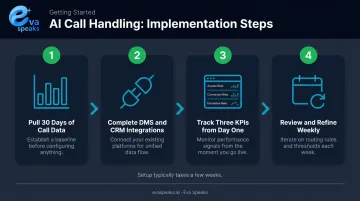
Setup typically takes a few weeks, driven primarily by integration work and script configuration. Starting with one department keeps complexity manageable — and gives you concrete performance data before you scale.
Ready to see it working at your dealership? Request Live Demo
Frequently Asked Questions
How can AI help a car dealership?
AI answers every inbound call instantly — during peak hours, after hours, and during staff meetings — routes callers to the right department based on what they say, and books service appointments directly into the scheduling system. The practical result is that service advisors and sales staff can focus on the customers in front of them rather than a constantly ringing phone.
Which voice AI is best for managing enterprise dealership calls?
Look for LLM-powered natural language understanding (not keypad-based IVR), unlimited concurrent call handling, deep DMS/CRM integration, configurable routing rules, and call analytics. Whether inbound coverage, outbound follow-up, or both are priorities will narrow the field further.
Can AI negotiate a car price?
No — and any system claiming otherwise should raise flags. Price negotiation requires relationship judgment and deal-specific context that current AI isn't suited for. Where AI adds genuine value is upstream: answering inventory questions, booking test drives, and routing ready-to-buy customers to a live salesperson who can close the deal.
What happens to complex calls that AI cannot handle?
Well-designed systems execute a warm transfer to a live agent, passing the caller's name, vehicle information, and stated concern — so the agent steps in with full context and the customer never has to repeat themselves.
Does AI call handling work after business hours?
After-hours coverage is one of the strongest use cases. The AI answers and books appointments at any hour — including nights and weekends — capturing leads that would otherwise hit voicemail and call a competitor, all without added staffing cost.
How quickly can a dealership get AI call handling up and running?
Most implementations take a few weeks, with the timeline driven primarily by DMS/CRM integration and call-flow script configuration. Starting with a single department — typically service — reduces complexity and generates clear ROI data before expanding to the full dealership.