The honest answer is: both, depending on what the task actually is.
According to HubSpot's 2024 State of Service report, more than half of CRM leaders say customers expect problems resolved in three hours or less, and 84% of customers expect more personalization than ever. Meeting those expectations without burning out your agents is nearly impossible without some form of AI support — which is why 77% of service leaders already use AI in daily operations.
This article breaks down exactly what AI is doing in call centers today, where it genuinely makes agents better, what it is actually replacing, and where humans still hold a clear advantage.
Key Takeaways
- AI handles routine call types well — FAQs, order status, basic routing — but complex interactions still need human agents
- Real-time agent assist, smarter routing, and automated post-call work are the biggest augmentation wins right now
- 64% of customers prefer companies not use AI in customer service — human judgment still matters enormously
- The real risk is deploying AI without equipping agents to work alongside it effectively
How AI Is Being Used in Call Centers Today
AI in call centers is no longer experimental. The tools are live, deployed, and actively changing how calls are handled.
The four main categories in production right now:
- Conversational AI and virtual agents — LLM-powered bots that handle self-service interactions end-to-end, far beyond what old touch-tone IVR systems could manage
- Intelligent call routing — machine learning that matches callers to agents or self-service paths based on query type, history, and context
- Real-time transcription and analysis — voice-to-text during active calls, used for agent support and post-call review
- Post-call automation — AI-generated summaries, CRM updates, and follow-up flagging immediately after a call ends
From IVR to LLMs: A Meaningful Upgrade
The shift from rule-based IVR to large language model-powered systems represents a genuine functional leap. Traditional IVR forced callers through rigid menu trees and broke down the moment someone said something unexpected. LLM-based systems understand intent, carry context across conversation turns, and handle follow-up questions naturally.
A McKinsey case study illustrates the gap: a European bank replaced its rules-based chatbot with a generative AI system and saw it become 20% more effective at answering customer queries within seven weeks of launch.
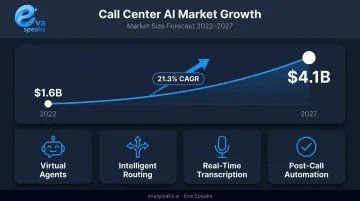
The investment behind this technology reflects its trajectory. According to MarketsandMarkets, the global call center AI market was valued at $1.6 billion in 2022 and is projected to reach $4.1 billion by 2027 — a 21.3% CAGR. Businesses deploying these capabilities today — AI call answering, intelligent routing, real-time transcription — are building on infrastructure that's already mature, not betting on what's coming.
See how AI call automation handles real call center scenarios. Explore AI Call Automation
5 Ways AI Is Making Call Center Agents Better, Not Obsolete
Real-Time Coaching and Agent Assist
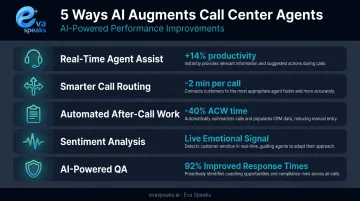
Agent assist tools listen to a live call and surface relevant information — knowledge base articles, suggested responses, compliance reminders — directly to the agent without any manual searching. The agent stays in the conversation instead of toggling between tabs or waiting on hold for a supervisor.
An NBER study of 5,179 customer support agents found that generative AI assistance increased productivity by nearly 14% on average. The gains were especially significant for newer agents, who performed closer to experienced colleagues when supported by AI suggestions.
EvaSpeaks builds this kind of support directly into call flows — real-time AI responses that change what agents can do mid-conversation, without requiring them to pause or search. EvaSpeaks is designed to operate without the complex infrastructure that large enterprise contact center platforms require, which is why it can be adopted by businesses that don't have a dedicated contact center team but still want to improve how AI and human agents work together.
Smarter, More Accurate Call Routing
Legacy IVR routing was essentially a guessing game — press 1 for billing, press 2 for technical support. AI-driven routing analyzes caller history, query type, and contextual signals to match callers with the right agent or self-service path before anyone picks up.
The operational impact is measurable. NICE reported that a state healthcare company using AI-powered routing achieved a two-minute reduction in average time per call — across thousands of daily calls, that adds up fast. Better routing also means agents receive calls they are actually equipped to handle, which reduces transfers, shortens handle times, and raises first-call resolution rates.
Automated After-Call Work
After-call documentation is one of the most time-consuming parts of an agent's day — and one of the easiest targets for automation. AI can generate call summaries, update CRM records, and flag follow-up actions within seconds of a call ending.
Five9 reported that TruConnect reduced after-call work by 40% using AI-powered automated notetaking and summarization. That time goes back to agents — meaning more calls handled, less cognitive load, and less administrative work piling up at end of shift.
Sentiment Analysis for Emotional Context
Real-time sentiment tools give agents a live signal on how a customer is feeling — detecting frustration, confusion, or relief from voice tone and word patterns. An agent who knows a caller's frustration is escalating can adjust their approach before the call deteriorates.
At scale, the same data becomes a management tool. Aggregated sentiment trends show supervisors which call types trigger the most frustration, which agents consistently de-escalate well, and where training gaps exist. Manual call monitoring samples too small a percentage of calls to surface these patterns reliably.
Scalable Quality Assurance and Coaching
Traditional QA reviews a small sample of calls — maybe 3-5% — and feeds back to agents days or weeks later. AI-powered QA can review every single call against a defined scorecard automatically.
HubSpot's 2024 State of Service data puts the impact in numbers:
- 92% of CRM leaders report AI improved customer-service response times
- 86% of leaders using AI said it had a positive impact on CSAT
Faster, broader QA coverage means agents get targeted feedback quickly — rather than waiting on periodic reviews that may not reflect their most recent work.
Watch a full AI call center interaction in real time. Watch AI Call Flow Demo
How AI Agents, Hybrid Teams, and Human-Only Centers Compare
Not every business needs the same solution. Here is how a fully AI-powered voice agent like EvaSpeaks, an AI-augmented hybrid model, and a traditional human-only call center stack up across the dimensions that matter most for operations and cost:
| AI Voice Agent (EvaSpeaks) | AI-Augmented Human (Hybrid) | Traditional Human Call Center | |
|---|---|---|---|
| Features | Full AI conversation, routing, 24/7, real-time CRM | Human agents + AI suggestions, sentiment analysis | Human agents, manual processes |
| Best-fit Business Size | SMB to mid-market, high-volume routine calls | Mid-market to enterprise | Any size |
| Key Strengths | Infinite scale, zero overages, consistent | Human for complex, AI for efficiency | Maximum empathy, complex situations |
| Implementation Complexity | Low - hours to deploy | Medium | None (hire) |
| Integration Capability | CRM, ticketing, scheduling native | CRM, major platforms | Manual or limited |
What AI Is Actually Replacing in the Call Center
Routine Interactions Are Already Automatable
AI is not replacing agents wholesale, but it is replacing tasks — and those tasks represent a significant share of daily call volume.
Categories where AI can now handle interactions end-to-end:
- Password resets and account authentication
- Order status and delivery inquiries
- Appointment scheduling and rescheduling
- FAQ responses (business hours, return policies, service details)
- Basic account management updates
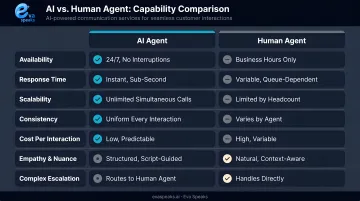
These are high-frequency, predictable interactions with clear outcomes. AI virtual agents built on LLMs can handle follow-up questions, update backend systems in real time, and escalate to a human when the interaction exceeds their scope. Tools like EvaSpeaks use customizable call-flow scripts and routing rules so businesses can define exactly which interaction types get handled autonomously and which ones escalate to a human agent — a configuration that can shift as needs change. This flexibility means businesses can start with a narrow automation scope — for example, after-hours calls only — and expand EvaSpeaks' role incrementally as they validate performance, rather than needing to commit to a full deployment upfront.
What the Projections Actually Say
The scale of AI's projected impact is real, even if the timeline is debated. Gartner projects that agentic AI will autonomously resolve 80% of common customer service issues by 2029, reducing operational costs by 30%. That projection carries an important qualifier, though: common issues. Today, only 14% of customer service issues are fully resolved in self-service, which shows how much ground still needs to be covered.
On workforce impact, the picture is less dire than many headlines suggest. Gartner found that 50% of organizations planning major workforce reductions due to AI are expected to abandon those plans by 2027, and a March 2025 poll of 163 customer service leaders found 95% intended to retain human agents.
The more accurate framing: as AI absorbs transactional volume, it frees smaller, more specialized human teams to focus on interactions that require judgment, empathy, and accountability. The role isn't disappearing — it's shifting toward higher-complexity work that AI can't yet replicate.
See how AI covers calls around the clock without extra staff. See How AI Handles After-Hours Calls
What Human Agents Still Do Better Than AI
Emotional and High-Stakes Interactions
Some calls require more than accurate information. Customers dealing with billing disputes, service failures, medical issues, or significant financial decisions need to feel heard — and that is a different problem than answering a question correctly.
64% of customers say they would prefer companies not use AI in customer service at all, according to Gartner. Only 17% are comfortable with an AI making financial decisions on their behalf, according to Salesforce. In high-stakes moments, trust is still earned through human judgment — not algorithmic response.
A peer-reviewed study published in the Journal of Retailing and Consumer Services found that consumers consistently rate chatbots as less understanding, less empathetic, and harder to deal with than human agents — even when the information quality is comparable.
The Edge Case Problem
AI performs well on high-frequency, predictable queries. It struggles with anything that falls outside its training distribution — unusual account histories, ambiguous multi-part requests, complaints involving regulatory or legal considerations, or situations where the right answer is genuinely unclear.
According to Gartner, 45% of customers who started in self-service said the company did not understand their specific intent, and 43% of self-service failures occurred because customers could not find relevant content. These are often the most consequential calls a business receives. Resolving them requires:
- Human reasoning applied to incomplete or conflicting information
- Improvisation when policy does not cover the situation
- Willingness to take real accountability for the outcome
Relationship and Trust Over Time
AI can surface a customer's interaction history, account value, and previous complaints in seconds. What it cannot do is build a genuine relationship. For high-value accounts and clients who have experienced service failures, the ongoing relationship work — retention conversations, proactive outreach, complaints resolved with real ownership — still depends on a human on the other end.
Want to map out the right human-AI split for your team? Talk to an AI Communication Expert
Ethical Concerns and Risks of AI in Call Centers
Voice Data and Privacy Regulations
AI call systems collect voice recordings, transcriptions, and in some cases biometric-level data. That creates real legal exposure.
Illinois BIPA explicitly defines voiceprints as biometric identifiers and requires written notice and consent before collection. Recent litigation has directly targeted AI transcription and speaker recognition tools, arguing they create biometric identifiers by attributing speech to specific individuals. A Whole Foods BIPA class action involving alleged unlawful voiceprint collection reached a preliminary settlement in 2023.
Eva Speaks addresses this through several specific practices:
- Stores data in U.S. data centers with industry-standard security
- Complies with state privacy laws including CCPA
- Allows customers to opt out of data use for AI model training by contacting privacy@evaspeaks.ai
ASR Bias and Unequal Service Quality
Speech recognition accuracy is not uniform across demographics. A PNAS study of five commercial ASR systems found an average word error rate of 0.35 for Black speakers versus 0.19 for white speakers — with over 23% of audio snippets from Black speakers producing error rates above 0.5, compared to just 1.6% for white speakers.
Deploying voice AI without demographic accuracy audits creates unequal service quality and potential legal exposure. The PNAS data makes that gap concrete, not hypothetical.
AI Disclosure and Transparency
72% of customers say it matters whether they're talking to AI or a human. That preference is now backed by law in several states. Utah's 2024 Artificial Intelligence Policy Act (S.B. 149) requires disclosure when AI interacts with people in regulated occupation contexts. California's S.B. 1001 requires disclosure for bots used to influence commercial interactions.
Eva Speaks' terms place responsibility for caller consents and privacy notices on the businesses using the platform. Disclosure practices need to be part of client configuration from the start, not added later.
Frequently Asked Questions
Is there an AI call center?
Yes — AI call centers exist and are increasingly common. They combine AI virtual agents for self-service, intelligent routing, and real-time agent assist tools, with human agents still handling complex escalations. Eva Speaks is one example of a platform offering AI-enabled call answering and routing for business clients.
What does agent assist AI do?
Agent assist AI listens to a live call and surfaces relevant knowledge base articles, suggested responses, and compliance reminders directly to the agent in real time. This eliminates manual searching during a call and helps agents respond faster and more accurately without putting customers on hold.
What types of calls should always go to a human agent?
Calls involving complaints, legal or billing disputes, emotionally distressed customers, and complex multi-step issues should route to humans. AI handles volume well, but these interactions require judgment, empathy, and accountability that automation can't reliably deliver.
Will AI replace call center agents?
AI is replacing specific task types — routine queries, call logging, basic routing — but not the agent role entirely. Complex, emotional, and high-stakes interactions still require human judgment. Gartner found 95% of customer service leaders intend to retain human agents, pointing toward a hybrid model rather than full replacement.
How does AI improve call center efficiency?
The main gains come from four areas:
- Automated summaries cut after-call work significantly
- Smarter routing reduces customer wait times
- Real-time agent support removes the need to put customers on hold
- AI-powered QA scales coaching without adding supervisory headcount
What skills do call center agents need as AI takes over routine tasks?
As AI absorbs transactional work, agents need stronger emotional intelligence, complex problem-solving, escalation handling, and proficiency working with AI tools. The role is moving toward interactions where human judgment, not scripted responses, determines the outcome.