The goals, tools, staffing models, and compliance requirements for each call type differ significantly. A customer service team built for inbound support will struggle with outbound sales targets. An outbound team optimized for cold prospecting won't naturally excel at complaint resolution. Getting this distinction right—and building the right infrastructure for each—has real operational and financial consequences.
This guide breaks down both call types, the metrics that matter for each, and how to decide which approach (or combination) fits your business.
Key Takeaways
- Inbound calls are customer-initiated; outbound calls are business-initiated. The direction shapes your strategy, staffing, and tools.
- Inbound focuses on reactive support; outbound drives proactive sales, lead generation, and follow-up.
- Key inbound metrics: FCR, CSAT, Average Speed of Answer. Key outbound metrics: contact rate, lead conversion rate, cost per acquisition.
- Most growing businesses need both: inbound to retain customers, outbound to acquire new ones.
- Eva Speaks handles both: automating routing and transcription for inbound, and providing customizable call-flow scripts for outbound agents.
Inbound vs. Outbound Calls: Quick Comparison
Who picks up the phone first determines far more than just call direction. It shapes the tools you need, the agents you hire, and the compliance obligations you carry.
| Dimension | Inbound | Outbound |
|---|---|---|
| Call Initiation | Customer contacts the business | Business contacts the customer or prospect |
| Primary Goal | Support, retention, resolution | Sales, lead generation, awareness |
| Approach | Reactive | Proactive |
| Key Technology | Call routing, IVR, transcription | Auto-dialers, predictive dialers, CRM lists |
| Core Agent Skill | Empathy, problem-solving | Persuasion, resilience |
| Primary KPIs | FCR, CSAT, Average Speed of Answer | Contact rate, conversion rate, cost per acquisition |
| Compliance Exposure | Lower (unless recording laws apply) | Higher—TCPA, TSR, Do Not Call Registry |
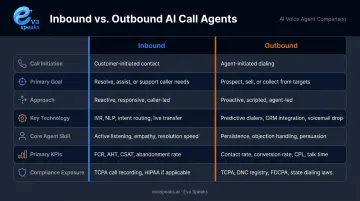
In short: inbound serves customers who already know you; outbound reaches people who don't yet.
What Are Inbound Calls?
Inbound calls are phone calls your customers or prospects initiate to reach your business. Your team is reactive by nature—agents can't predict the reason for a call unless it's pre-routed to a dedicated line.
Common Types of Inbound Calls
- Customer service inquiries – general questions about products, orders, or policies
- Technical support – troubleshooting issues that require guided resolution
- Inbound sales – interest-driven calls from prospects who've already engaged with your brand
- Billing and account inquiries – payment questions, subscription changes, account access
- Complaints – escalations requiring empathy and resolution authority
- Appointment scheduling – booking or rescheduling across service-based businesses
Metrics That Matter for Inbound
| Metric | What It Measures | Why It Matters |
|---|---|---|
| First Contact Resolution (FCR) | Issues resolved without a callback | Industry mean is 75%; below that signals agent training gaps |
| Average Speed of Answer (ASA) | Time before a live agent picks up | U.S. mean is 79 seconds; slower times drive abandonment |
| Call Abandonment Rate | Callers who hang up before being answered | U.S. mean is 7.1%; high rates indicate staffing or routing problems |
| CSAT | Post-call satisfaction score | Most-cited strategic KPI across contact centers |
Source: ContactBabel/RingCentral 2024 U.S. Contact Center Decision-Makers' Guide
These numbers have direct revenue consequences. 78% of consumers have abandoned a business after an unanswered call, and 82% will call a competitor instead. Every missed or mishandled inbound call is a lost customer.
Why Inbound Calls Still Drive Business
Phone isn't a legacy channel. According to ICMI, phone is the first-choice channel for urgent interactions for 49% of consumers, and preference for phone on complex inquiries has grown from 28% in 2018 to 47% in 2024. Phone calls are where customers go when stakes are high.
EvaSpeaks is built for exactly this pressure point. Its AI-enabled telephone answering handles incoming calls using real-time conversational AI, routing based on configurable scripts and office hours while capturing transcriptions for quality assurance. For businesses that can't staff a full call center, that means consistent inbound coverage without the overhead. EvaSpeaks also supports outbound use cases — appointment reminders, lead follow-ups — which makes it relevant across the full inbound-outbound call mix that most businesses manage.
Use Cases for Inbound Calls
Inbound call handling is most critical in these verticals:
- Insurance – 80% of inbound interactions happen via live-agent phone; policy questions and claims require human-level nuance
- Healthcare – 66% phone share; appointment scheduling, referrals, and medical inquiries demand accuracy and care
- Retail and distribution – 55% phone share; order tracking and returns still drive significant call volume despite e-commerce self-service
- Financial services – 51% phone share; account management and fraud inquiries require verified, secure communication
- SaaS and technology – 49% phone share; technical support complexity often exceeds what chat or email can resolve quickly
For teams that want to see how AI handles a high-stakes inbound call in one of these verticals, you can Watch AI Call Flow Demo.
What Are Outbound Calls?
Outbound calls are business-initiated—your agents or automated systems reach out to customers or prospects rather than waiting for them to call. The distinction between cold and warm outbound matters more than most teams realize.
Cold calls involve no prior relationship with the contact. Warm calls follow some previous engagement—a web inquiry, a prior purchase, or a marketing touchpoint. Warm calls consistently convert at higher rates; the prior touchpoint lowers resistance before the conversation even starts.
Common Types of Outbound Calls
- Sales and telemarketing – direct outreach to prospects with a specific product or offer
- Lead qualification – verifying interest and fit before routing to a senior rep
- Appointment setting – scheduling demos, consultations, or service visits
- Customer follow-up – checking in after a support interaction or recent purchase
- Market research and surveys – gathering feedback or validating product direction
- Renewal and retention campaigns – proactive outreach before contracts lapse
Metrics That Matter for Outbound
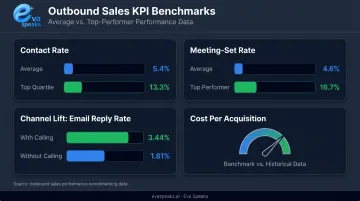
- Contact rate – the percentage of dials that result in a live pickup. Per Gong's analysis of 300M+ cold calls, the average connect rate is 5.4%, with top-quartile teams reaching 13.3%. A poor contact rate points to stale lists or bad timing.
- Meeting-set rate – averages 4.6% across all reps; top performers hit 16.7%
- Cost per acquisition (CPA) – total outbound spend divided by new customers acquired; benchmark this against your own historical data, since no reliable industry-wide figure exists
- Average handle time (AHT) – total time per call including wrap-up; lower isn't always better if resolution quality drops
- Channel lift – Gong found email reply rates hit 3.44% when paired with cold calling, versus 1.81% without it. Outbound calling doesn't just generate its own results—it raises the floor for every channel running alongside it.
Use Cases for Outbound Calls
Outbound works best when:
- B2B sales teams need to qualify pipeline before passing leads to account executives
- Real estate firms are following up on listing inquiries or open house attendance
- Subscription businesses run renewal campaigns before contract expiry
- Healthcare providers confirm upcoming appointments to reduce no-show rates
- SaaS companies conduct onboarding check-ins to improve early retention
Businesses looking to automate both inbound and outbound coverage can Explore AI Call Automation to see how Eva Speaks handles both directions.
Inbound vs. Outbound: Which Is Right for Your Business?
Most businesses don't need to choose one over the other—they need to understand which to prioritize now and how to build toward both.
Four Factors to Assess First
1. Business goals Retention-focused operations need inbound infrastructure. Growth-focused teams burning through a prospect list need outbound. If you're doing both, you need both.
2. Customer base maturity An established customer base expects responsive inbound support. A newer brand with unqualified leads and little brand recognition will lean heavily on outbound to build pipeline.
3. Team profile Inbound agents need empathy and fast problem-solving. Outbound reps need persistence and persuasion. These aren't the same skill set—and training programs should reflect that.
4. Compliance requirements Outbound calling carries significant regulatory exposure. The FTC's Telemarketing Sales Rule allows civil penalties up to $53,088 per violation, and TCPA violations carry $500 per call in statutory damages—with possible trebling for willful violations. Do-not-call list scrubbing, consent documentation, and opt-out processing are non-negotiable.
Situational Recommendations
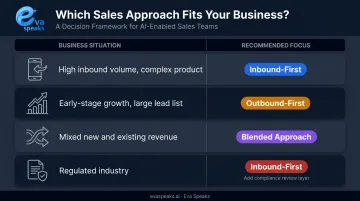
| Situation | Recommended Focus |
|---|---|
| High inbound volume, complex product, established customers | Inbound-first |
| Early-stage growth, large unconverted lead list | Outbound-first |
| Mixed revenue from both new and existing customers | Blended approach |
| Regulated industry (healthcare, finance, insurance) | Inbound-first with careful outbound compliance review |
The Blended Approach
A blended call center has agents handling both inbound and outbound depending on real-time volume. About 24% of U.S. contact centers operate as mixed inbound/outbound operations, according to ContactBabel's 2024 survey. The benefits are real: higher agent utilization during low-inbound periods, consolidated context, and fewer idle hours.
The tradeoff is training complexity. Agents need to shift mental modes between reactive problem-solving and proactive persuasion—often within the same shift. That takes more deliberate onboarding and performance management.
That complexity is where tooling makes a difference. Eva Speaks supports blended operations with customizable call-flow scripting, routing rules, and real-time AI transcription—so agents stay consistent whether they're fielding a support call or working a prospect list. Its third-party integrations keep inbound and outbound data in shared context, which reduces the handoff friction that typically slows blended teams down.
Here is how AI-powered, traditional blended, and human-only approaches compare for managing both inbound and outbound calls:
| AI Blended (EvaSpeaks) | Traditional Blended Dialer | Human-Only Call Team | |
|---|---|---|---|
| Features | AI inbound answering + outbound campaigns, CRM sync, 24/7 | ACD + predictive dialer, agent management | Human agents, full interaction |
| Best-fit Business Size | SMB to mid-market | Mid-market to enterprise call centers | Any size |
| Key Strengths | No missed inbound calls, outbound at scale, predictable cost | Proven CCaaS toolset | Human judgment, relationships |
| Implementation Complexity | Low - hours | Medium to High | None (hire) |
| Integration Capability | CRM, scheduling, EHR native | CRM via API | Manual |
Businesses evaluating a blended inbound and outbound AI setup can Request Live Demo to see how Eva Speaks handles both directions.
Conclusion
Inbound and outbound calling work together, not against each other. Inbound builds trust and retention; outbound drives new revenue and market reach. The right balance depends on your business stage, team capabilities, and compliance environment.
The infrastructure you build now—routing logic, agent training, CRM integration, and AI-enabled call handling—determines how efficiently you can scale either or both. Getting it right from the start is easier than retrofitting systems after volume outpaces capacity. Businesses that want this mapped to their specific inbound and outbound call mix can Get a Customized Workflow Recommendation.
If you're looking to improve how your business handles calls in either direction, Eva Speaks offers AI-powered tools for customizable routing, call scripting, and real-time transcription—built to support both inbound and outbound operations.
Frequently Asked Questions
What do inbound and outbound calls mean?
Inbound calls are customer-initiated—someone dials your business. Outbound calls are business-initiated—your team or system dials the customer or prospect. Who picks up the phone first is the core distinction, and it shapes everything from staffing to compliance obligations.
What are inbound and outbound call center services?
Inbound call center services handle customer support, technical help, and billing inquiries as they come in. Outbound services cover sales outreach, lead generation, appointment setting, and market research. Many providers now offer blended solutions that combine both within a single platform.
What are the best practices for handling inbound and outbound calls?
For inbound: prioritize fast routing, invest in agent training, and target first-contact resolution. For outbound: use warm call lists whenever possible, scrub against do-not-call registries, and equip agents with personalized, compliance-reviewed scripts.
What is a handled call?
A handled call is any call answered by an agent rather than abandoned or blocked. Handle time and resolution quality are the two primary indicators of whether it actually served its purpose — picking up is just the starting point.
What is the 80/20 rule in call centers?
The 80/20 rule is an industry service-level convention: answer 80% of inbound calls within 20 seconds. It's not a legal requirement, but centers that miss it consistently see higher abandonment rates and lower customer satisfaction scores.