Introduction
Missed calls cost businesses more than just leads — they erode customer trust and create operational gaps that compound over time. As call volumes climb and staffing constraints tighten, relying on human operators alone to manage inbound traffic is no longer practical for most businesses.
Gartner projects that by 2028, at least 70% of customers will use a conversational AI interface to start a customer service journey. That shift is already underway — and the systems driving it have moved well beyond rigid touch-tone IVR menus.
Today's automated call handling platforms combine natural language processing, intelligent routing, CRM integration, and compliance tooling to answer, analyze, and direct calls without a human operator in the loop.
The gap between a capable system and a poor one — in routing accuracy, compliance coverage, and integration depth — shows up directly in customer experience and operational costs.
This guide covers the six best platforms for 2026, how to evaluate them, and which use cases each one fits best. Teams ready to see AI call handling in action can Watch AI Call Flow Demo before reading the full platform breakdowns.
Key Takeaways
- Automated call handling systems use AI, IVR, and NLP to manage calls without manual operator involvement
- The best platforms combine 24/7 availability, CRM integration, compliance tools, and transparent pricing
- Eva Speaks, Synthflow AI, Smith.ai, Nextiva, Bland AI, and NICE CXone are the six standout systems for 2026
- Your best fit depends on call volume, compliance requirements, and whether you need AI-only, hybrid, or enterprise-scale infrastructure
- All six take distinct approaches: from LLM-native voice agents to full CCaaS platforms
What Is an Automated Call Handling System?
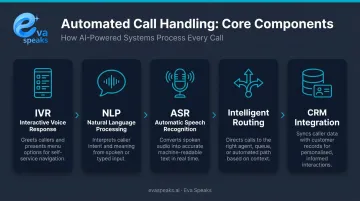
An automated call handling system is software that answers, analyzes, and routes incoming (and in some cases outgoing) calls without requiring a human operator for every interaction. Core components include:
- IVR (Interactive Voice Response): Presents callers with menu options to route them appropriately
- NLP (Natural Language Processing): Interprets conversational intent rather than just touch-tone input
- ASR (Automatic Speech Recognition): Converts spoken words into text the system can act on
- Intelligent routing: Directs calls based on caller intent, agent availability, or configured business rules
- CRM integration: Surfaces caller history and context before or during the call
The critical shift in modern systems is the move from rigid scripted menus to fluid, context-aware conversations. Older IVR forced callers to navigate fixed options. AI-powered platforms can understand what a caller actually wants, respond dynamically, and trigger downstream actions like scheduling, data capture, or escalation, without requiring callers to follow a script.
For businesses managing high call volumes, operating in regulated industries, or running after-hours coverage, that capability directly reduces missed calls, staffing costs, and caller drop-off.
Here is how AI-powered, IVR-based, and live answering automated call handling systems compare:
| AI-Powered (EvaSpeaks) | Legacy IVR System | Live Answering Service | |
|---|---|---|---|
| Features | Natural conversation, dynamic routing, CRM sync, 24/7 | DTMF menus, fixed routing, message recording | Human agents, message-taking, escalation |
| Best-fit Business Size | SMB to mid-market | Large enterprise | Any size |
| Key Strengths | No missed calls, consistent, instant CRM update | Predictable, widely deployed | Human empathy, complex situations |
| Implementation Complexity | Low - hours | High | Low |
| Integration Capability | CRM, scheduling, EHR native | Custom dev required | Manual or limited |
The 6 Best Automated Call Handling Systems for 2026
Selected based on AI capability, deployment ease, integration depth, compliance support, pricing transparency, and fit across business sizes.
Eva Speaks
Eva Speaks is an AI-powered call handling and transcription platform built for businesses that need LLM-integrated, configurable communication workflows. The platform delivers real-time AI responses, customizable call-flow scripting, and intelligent routing rules designed to simplify and automate inbound operations — with data stored in U.S. data centers and customer opt-out controls for AI model training.
What sets EvaSpeaks apart is its integration with large language models for context-aware call handling that goes beyond scripted menus. Businesses can configure routing rules, office hours, and call-flow scripts to match their specific operational needs — making it adaptable across a range of industries and use cases. EvaSpeaks is also notable for being accessible without a long enterprise procurement cycle: businesses can deploy it in days, not months, which is a meaningful difference when operational needs change quickly.
| Category | Details |
|---|---|
| Key Features | AI-enabled call handling, real-time transcription, LLM integration, customizable call-flow scripts and routing rules, web dashboard, mobile apps, and API access |
| Pricing | Contact Eva Speaks directly at evaspeaks.ai for current plan details |
| Best For | Businesses seeking AI-native, LLM-powered call handling with configurable routing and transcription workflows |
Businesses that want to test Eva Speaks against their own real call scenarios can Request Live Demo.
Synthflow AI
Synthflow AI is an enterprise-focused voice agent platform that automates inbound and outbound calls at scale. It serves healthcare, retail, financial services, and BPO sectors with a no-code builder and deep native integrations — and recently closed a $20M Series A in June 2025, reflecting strong investor confidence in enterprise AI voice automation.
Voice cloning via ElevenLabs, direct connections to HubSpot, Salesforce, Zapier, and Cal.com, and support for both US and EU hosting cover a wide range of enterprise deployment needs. Compliance coverage includes SOC 2, HIPAA, GDPR, ISO 27001, and PCI DSS.
| Category | Details |
|---|---|
| Key Features | AI voice agents, inbound/outbound calling, voice cloning, CRM integrations, real-time analytics, no-code builder |
| Pricing | Voice Engine at $0.09/min; enterprise/custom pricing available. Verify current tiers at synthflow.ai/pricing |
| Best For | Enterprises and mid-market teams needing scalable, compliant AI voice automation with deep integration capability |
Smith.ai
Smith.ai takes a hybrid approach — combining AI call handling with North American-based live virtual receptionists. It's purpose-built for small and mid-size businesses in legal, home services, healthcare, and professional services that need both automation efficiency and human judgment on complex calls.
The model works well in practice: AI handles routine inquiries and routing while live agents manage sensitive interactions, warm transfers with full context, lead intake, and appointment scheduling. It's one of the few platforms where you don't have to choose between automation and human touch.
| Category | Details |
|---|---|
| Key Features | AI receptionist, virtual receptionist, intelligent call routing, lead intake, warm transfers with context, CRM integration |
| Pricing | AI Receptionist from $95/month; Virtual Receptionist Starter at $300/month (30 calls). Verify at smith.ai/pricing |
| Best For | Small businesses and professional service firms wanting AI efficiency combined with human judgment for complex calls |
Nextiva
Nextiva is a unified communications platform that brings voice, video, chat, email, and AI together on a single system. Its XBert AI receptionist answers calls, texts, and chats 24/7 — handling appointment booking, lead capture, call summaries, and intelligent routing with conversation context passed on transfer. The broader platform carries a 99.999% uptime SLA.
For growing businesses that want one vendor instead of a stack of point solutions, Nextiva's all-in-one architecture eliminates the integration overhead that comes with managing separate tools. CRM integrations with Salesforce and HubSpot are verified on the XBert platform.
| Category | Details |
|---|---|
| Key Features | AI receptionist (XBert), IVR, intelligent call routing, omnichannel support, CRM integrations, 99.999% uptime |
| Pricing | Plans from $15/month; XBert AI at $99/month for the first 100 interactions, then $0.99 per interaction. See nextiva.com/nextiva-pricing |
| Best For | Growing businesses and enterprises wanting a fully unified communications and AI call handling platform |
Bland AI
Bland AI is a conversational voice platform built for organizations with compliance-heavy operations and high-volume calling needs. It supports inbound and outbound AI call handling with self-hosted and VPC deployment options — making it a strong fit for sales teams, support desks, clinics, and collections groups that need full audit trails.
Compliance tooling sets Bland apart from most competitors on this list: it provides DNC-list filtering, Blacklist Alliance integration, TCPA consent logging (date, time, method), role-based access to recordings, and certifications including SOC 2 Type II, HIPAA, GDPR, and PCI DSS — coverage that's hard to match at this price point.
| Category | Details |
|---|---|
| Key Features | Conversational AI voice agents, warm transfers with context, DNC management, TCPA consent logging, compliance certifications, IVR replacement |
| Pricing | Start: $0 platform fee + $0.14/min; Build: $299/month + $0.12/min; Scale: $499/month + $0.11/min; Enterprise: custom. See bland.ai/pricing |
| Best For | Businesses needing self-hosted, compliance-first AI call handling with strong audit capabilities and high-volume outbound support |
NICE CXone
NICE CXone is enterprise-grade Contact Center as a Service (CCaaS) — named a Gartner Magic Quadrant Leader for the 11th consecutive year in 2025. It's built for large enterprises, BPOs, and regulated industries that need the full stack: agentic AI, agent and supervisor copilots, workforce management, quality management, and interaction analytics across 100% of customer interactions.
No other platform on this list matches CXone's breadth. For organizations where CCaaS complexity and scale are requirements rather than options, 11 consecutive years at the top of Gartner's Magic Quadrant is the kind of track record that speaks for itself.
| Category | Details |
|---|---|
| Key Features | AI agents, IVR, omnichannel routing, workforce management, quality management, interaction analytics (100% of calls), outbound engagement |
| Pricing | Custom/quote-based. Package details at nice.com/websites/pricing |
| Best For | Large enterprises and contact centers needing a comprehensive, compliance-ready CCaaS platform with deep AI and workforce optimization capabilities |
Key Features to Look for in an Automated Call Handling System
Platforms vary widely in what they actually deliver. These four criteria separate the systems worth deploying from those that just check a box:
AI/NLP Intent Recognition
Rigid IVR menus frustrate callers and increase abandon rates. ICMI's 2025 research confirms that abandonment rate is the most tracked metric in contact centers (85% of organizations) — and poor IVR design is a primary driver. Modern AI systems that interpret natural language reduce this friction directly — and that improvement shows up in your abandonment numbers fast.
Intelligent Routing and CRM Integration
Look for routing logic that accounts for agent skills, real-time availability, caller intent, and time-of-day rules. CRM integration matters because it pulls up caller history before and during a call, reducing handle time and improving first-contact resolution. Without this connection, agents start every call cold — and callers notice.
Compliance and Security
For regulated industries, these features are non-negotiable:
- DNC list management and filtering
- TCPA-compliant consent logging (date, time, method)
- Call recording with role-based access controls
- Industry certifications: SOC 2, HIPAA, GDPR as appropriate
Analytics That Go Beyond Call Volume
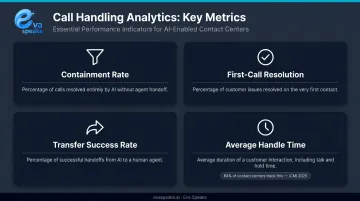
The best systems track metrics that reflect actual performance — not just total calls handled:
- Containment rate: Percentage of callers who resolve their issue without ever reaching a human agent
- First-call resolution: Whether issues are resolved in a single interaction
- Transfer success rate: Whether escalations land with the right agent — and with full context attached
- Average handle time: Tracked by 84% of contact centers per ICMI's 2025 data
You can See Industry Use Cases to explore how businesses in specific industries are tracking these metrics with AI call handling.
How We Chose the Best Automated Call Handling Systems
Evaluation Criteria
Each platform was assessed across six dimensions:
- AI capability and conversation quality — NLP depth, LLM integration, context retention
- Deployment ease — no-code vs. developer-required setup
- Integration ecosystem — CRM, calendar, telephony, and workflow tools
- Compliance certifications — SOC 2, HIPAA, GDPR, TCPA tooling
- Pricing transparency — clearly published tiers vs. opaque custom quotes
- Use case fit — SMB, mid-market, or enterprise; inbound, outbound, or blended
Common Selection Mistakes to Avoid
These four mistakes consistently trip up buyers at every company size:
- Upfront cost focus — per-minute and per-interaction fees often dwarf the platform fee at scale
- Ignoring implementation complexity — a no-code builder saves real time and money when developer resources aren't available
- Skipping compliance checks — a platform without HIPAA coverage creates legal exposure that no feature set can offset
- Trusting setup experience over performance data — how a platform deploys tells you little about how it performs at volume
Conclusion
The best automated call handling system is whichever one fits your actual operational profile — not the one with the longest feature list or the most recognizable name.
Match your profile to the right tier:
- SMBs needing affordable AI coverage with human backup — Smith.ai or Eva Speaks are natural starting points
- Mid-market teams requiring scalable AI voice automation with compliance depth — evaluate Synthflow AI and Bland AI carefully
- Businesses wanting a unified communications platform — Nextiva fits well
- Enterprises with full contact-center requirements — NICE CXone belongs in the conversation
Before committing to any platform, run a real pilot. Test routing accuracy, escalation logic, and CRM sync in live conditions — not just demos. Evaluate ongoing performance metrics rather than just setup experience.
The right system isn't the one that wins on paper — it's the one your team actually relies on six months after go-live. Operations teams that want to discuss which of the six platforms fits their specific call volume and compliance profile can Talk to an AI Communication Expert.
Frequently Asked Questions
What is an automated call handling system?
Software that uses AI, IVR, NLP, and routing logic to answer, analyze, and direct calls without human operator intervention. It handles routine inquiries automatically and escalates complex calls to live agents based on configured rules.
Is AI cold calling illegal in the USA?
The FCC's 2024 ruling classifies AI-generated voices as "artificial" under TCPA, meaning prior written consent is required for calls to cell phones; federal and state DNC registries must also be honored. Inbound AI call handling carries fewer restrictions, but consult legal counsel for your situation.
What features should I look for in an automated call handling system?
Prioritize AI/NLP intent recognition, intelligent call routing, CRM integration, compliance tools (DNC management, consent logging), call recording with access controls, and analytics. The right mix depends on your business size and industry requirements.
How much does an automated call handling system cost?
Pricing ranges widely — from $0 platform fees with per-minute charges (Bland AI starts at $0.14/min) to SMB plans around $95–$300/month (Smith.ai) to enterprise CCaaS on custom quotes (NICE CXone). Factor in per-minute fees, integration costs, and compliance add-ons when comparing total cost of ownership.
What is the difference between IVR and AI call handling?
Traditional IVR routes callers through touch-tone menus with fixed scripts. AI call handling uses NLP and LLMs to understand conversational intent, respond dynamically, and complete tasks like scheduling or data capture — without requiring callers to navigate rigid menu trees.
Can automated call handling systems integrate with CRM software?
Yes. Most modern platforms integrate with HubSpot, Salesforce, and other major CRMs, enabling real-time caller identification, automatic call logging, and post-call data sync. This reduces manual data entry and gives agents full context before picking up a transferred call.