Introduction
Front-desk staff at a busy primary care practice can field 200+ scheduling calls in a single day. Each call averages several minutes, hold times stack up, and any slip — a wrong provider, a missed authorization, a mis-keyed date — creates a billing problem that takes weeks to untangle.
Front-office turnover hit 40% in 2022 according to MGMA's Practice Operations report, meaning the staff who hold institutional knowledge about scheduling workflows are constantly cycling out.
At the same time, patients frustrated by long hold times or limited office hours are comparing you against providers who offer 24/7 digital access.
AI addresses both sides of that pressure by handling the high-volume, repetitive tasks so your staff can focus on work that genuinely requires human judgment.
This guide covers how AI works in patient scheduling, the specific problems it solves, measurable outcomes practices see, and what to evaluate before selecting a tool.
See how AI handles patient booking calls after hours. See How AI Handles After-Hours Calls
Key Takeaways
- Phone-based scheduling still dominates, creating bottlenecks that AI is built to absorb
- Predictive models identify no-show risk before it happens; automated reminders reduce no-shows by 7–9%
- AI automates booking, reminders, waitlist management, and insurance checks — no staff required
- 24/7 availability captures appointments that would otherwise be lost after hours
- Evaluate any AI scheduling tool on HIPAA compliance, EHR integration depth, and total cost of ownership
Why Traditional Patient Scheduling Breaks Down
The Digital Adoption Gap Is Still Wide
Most patients still schedule by phone. MGMA data shows 73% of medical group leaders report that 25% or fewer of their patients use digital self-scheduling — and portal-based scheduling only reached 13% of appointments as recently as 2022. That leaves the vast majority of booking activity flowing through the phone, where every appointment requires a staff member on the line.
When call volume spikes — flu season, a provider out sick, a new service added — there's no elastic capacity. Patients wait on hold. Staff rush and make errors. Some callers hang up and call a competitor.
The Financial Damage Adds Up Fast
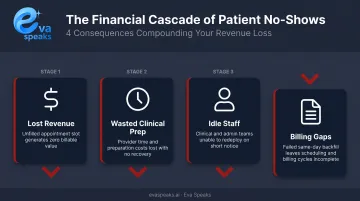
No-shows don't just waste a time slot. They create a cascade:
- Lost revenue from the unfilled appointment
- Wasted clinical prep time for the provider
- Idle staff who can't be redeployed on short notice
- Billing gaps when last-minute cancellations prevent same-day backfill
A 2023 peer-reviewed study cited missed appointments as costing the U.S. healthcare system more than $150 billion annually. For individual practices, the math is simpler: every no-show is revenue that can't be recovered once the slot passes.
Patient Experience Erodes Trust
Long hold times, scheduling mix-ups, and the inability to call after 5 PM aren't just operational problems. They're patient retention problems. When patients hit friction at the first touchpoint, many simply find a provider whose intake process works.
That friction often traces back to staff instability. Front-office turnover hit 40% in 2022, and experienced schedulers who know the protocols, the providers, and the practice management system take time to replace. Common signs the gap is showing:
- Longer average hold times
- More scheduling errors and double-bookings
- Inconsistent follow-up on cancellations
Watch how AI handles a real patient scheduling call. Watch AI Call Flow Demo
AI Scheduling vs. Traditional IVR vs. Human Staff: A Quick Comparison
Here is how AI-powered, IVR-based, and human staff approaches to patient scheduling compare:
| AI Scheduling (EvaSpeaks) | Traditional IVR Scheduling | Human Scheduling Staff | |
|---|---|---|---|
| Features | Natural language booking, rescheduling, reminders, EHR sync, 24/7 | DTMF menus, appointment reminders, hold queue | Full interaction, preference-based scheduling |
| Best-fit Business Size | Clinics to large health systems | Large hospital networks | Small to medium practices |
| Key Strengths | 24/7, no hold time, consistent, instant EHR update | Widely deployed, structured | Human empathy, complex requests |
| Implementation Complexity | Low - EHR integration | High - months | None (hire) |
| Integration Capability | Epic, Cerner, Athena, scheduling native | Custom dev required | Manual EHR entry |
How AI Improves Patient Scheduling: Core Mechanisms
Predictive Analytics and No-Show Risk Scoring
AI models analyze historical appointment data, patient demographics, appointment type, and behavioral patterns to forecast which patients are likely to miss their visit. A 2023 peer-reviewed machine learning study achieved 78% accuracy with a 0.76 F1 score for outpatient no-show prediction using a gradient boosting model.
This shifts scheduling from reactive to proactive. Instead of reacting to a no-show at 9 AM, the system flags high-risk appointments days in advance, enabling double-booking of those slots, targeted outreach, or waitlist activation before the problem occurs.
Intelligent Workflow Automation
Once a booking is made, AI takes over the downstream tasks that consume front-desk time:
- Sends multi-channel confirmations (SMS, email, voice)
- Triggers reminder sequences based on appointment risk level
- Monitors the schedule for cancellations and automatically contacts waitlisted patients
- Handles reschedule requests without requiring a return call
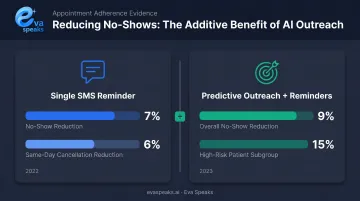
A 2022 randomized study found that a single targeted text reminder reduced primary care no-show likelihood by 7% and same-day cancellations by 6%. When combined with predictive outreach — identifying high-risk patients first — a 2023 quality improvement study showed a 9% overall reduction in no-shows, with a 15% reduction among Black patients, demonstrating that well-targeted reminders address equity gaps too.
Insurance Eligibility Checks at the Point of Booking
AI can run insurance eligibility verification and flag missing pre-authorizations during the booking process itself, before the patient ever arrives. This matters because Change Healthcare's 2022 Denials Index found that registration/eligibility issues accounted for 22% of claim denials and authorization/precertification failures for another 13% — across 441 million hospital claim remits.
Catching these at scheduling, rather than at check-in or post-visit billing, prevents downstream rework and accelerates time-to-payment.
NLP and LLM-Based Request Understanding
Natural language processing, specifically large language models, allows AI to understand what a patient is actually asking even when they don't use clinical language. A patient calling to "see someone about the lump I found" isn't using scheduling terminology. An LLM-powered system interprets that intent, matches it to the correct appointment type or protocol, and confirms the right slot.
This reduces misscheduled appointments, a common source of patient frustration and billing errors when the wrong procedure code gets attached to the visit.
Real-Time EHR Integration
All the accuracy gains from NLP and predictive analytics depend on one thing: live data. For automation to work without creating conflicts, the system must read and write directly to the EHR in real time, checking provider availability, enforcing scheduling rules, and confirming bookings simultaneously.
The difference between real-time bidirectional sync and nightly batch transfer is significant in practice. Batch sync means the AI is working with data that's hours old, which creates double-booking risks and scheduling gaps. HL7 FHIR standards define the Appointment, Schedule, and Slot resources that underpin modern EHR scheduling interoperability — ask any vendor specifically which standard their integration uses.
Ready to see it working for your clinic? Request Live Demo
Key Benefits of AI-Driven Patient Scheduling
Reduced No-Show Rates
Predictive risk scoring identifies at-risk patients before the appointment. Automated reminders follow. If a cancellation still occurs, waitlist automation fills the slot. Combined, these mechanisms address no-shows at every stage rather than reacting after the fact.
The data backs this up: targeted SMS reminders alone reduce no-shows by 7%; adding predictive outreach pushes that to a 9% overall reduction. Neither figure is a ceiling — practices with high baseline no-show rates have the most room to gain.
Staff Time Recaptured
AI automation removes routine scheduling tasks from the front desk entirely:
- Inbound booking calls handled autonomously return time to staff
- Automated reminder sequences eliminate manual follow-up calls
- Waitlist notifications replace outbound outreach one slot at a time
Scheduling automation at Contra Costa Health Services produced a 4.1% drop in inbound call volume and 5.2% less employee phone time. That result came from online scheduling optimization alone, not AI-native call handling — the impact of full AI automation runs deeper.
Staff freed from routine scheduling volume can focus on complex patient interactions: prior authorization follow-ups, insurance disputes, multi-provider care coordination, and the empathetic conversations that actually require a human.
24/7 Patient Access
Patients call outside office hours. They reschedule at 10 PM. They want to book on a Sunday. Under manual workflows, those calls go to voicemail — and many patients don't leave a message; they just call somewhere else.
AI-powered phone handling and scheduling portals remove the office-hours constraint entirely. EvaSpeaks, for example, provides an AI virtual receptionist that answers inbound scheduling calls around the clock, books directly into EHR systems including Epic, athenahealth, Dentrix, eClinicalWorks, and NextGen, and sends SMS or email confirmations — without a human agent on the line. EvaSpeaks' low infrastructure requirements also mean practices can adopt it without replacing their existing EHR or phone system — the AI layer connects to both through standard integrations, which is part of why it suits small and mid-sized practices that cannot absorb a full technology migration.
Revenue Cycle and Billing Accuracy
When AI assigns the correct appointment type, matches it to the right protocol, and verifies eligibility at booking, the downstream billing process starts with accurate data. Fewer mismatches mean fewer claim corrections and faster reimbursement.
Front-end accuracy at the scheduling stage reduces rework throughout the revenue cycle, cutting claim correction costs and shortening reimbursement timelines.
The Role of AI in Phone-Based Appointment Scheduling
Phone scheduling still dominates patient access, and the gap between call volume and available staff coverage is the core operational problem AI is designed to solve. MGMA identified patient phone access as a top priority for 2026 among medical group leaders — meaning the problem isn't improving on its own.
How AI-Powered Call Handling Works End-to-End
A conversational AI system answers inbound calls, understands patient intent in natural language, collects required information, checks real-time availability, and confirms bookings — all without a live agent. Complex calls or urgent matters route automatically to staff based on configurable rules.
Eva Speaks' AI virtual receptionist handles this entire workflow for healthcare practices. The system:
- Answers calls 24/7 and books directly into EHR scheduling systems
- Collects contact details, insurance information, and reason-for-visit during the call
- Checks availability in real time and offers appointment slots conversationally
- Sends SMS or email confirmations and automated reminders to reduce no-shows
- Routes urgent calls to on-call clinicians based on defined escalation rules
- Supports customizable scripts and routing rules per department or specialty — so a cardiology intake call flows differently than a routine follow-up
The platform is built on large language models combined with high-accuracy speech-to-text and text-to-speech, enabling natural-sounding patient conversations rather than rigid menu-driven phone trees.
Call Transcription and Structured Data Capture
Every call also generates a structured, searchable record — automatically. Rather than relying on handwritten notes or staff memory, AI transcription captures who said what, timestamps, appointment details, patient preferences, and follow-up tasks without any manual effort.
For Eva Speaks, those transcripts flow directly into the patient record. The platform integrates with EHR and practice management systems including:
- General practice: Epic, athenahealth, eClinicalWorks, NextGen, Dentrix
- Wellness and specialty: SimplePractice, WebPT, ChiroTouch
This eliminates manual data entry and creates an auditable record of every scheduling interaction — which matters for compliance and quality assurance in healthcare environments.
What to Look for in an AI Patient Scheduling Solution
Depth of EHR Integration
Ask vendors three specific questions:
- Is the integration real-time bidirectional sync or periodic batch transfer?
- Which FHIR resources does it support (Appointment, Schedule, Slot)?
- Is EHR connectivity included in the base price or billed as an add-on?
Shallow or batch-only integration creates data lag that generates scheduling conflicts and double-bookings — undermining the core value of the tool. Real-time sync built on HL7 FHIR standards isn't a nice-to-have — it's the minimum standard for a tool you can actually rely on.
HIPAA Compliance and Data Security
Once you've confirmed integration quality, turn to compliance. Any AI tool that touches patient scheduling data handles electronic protected health information (ePHI). Under HHS guidance, vendors that create, receive, maintain, or transmit ePHI on behalf of a covered entity are business associates — directly liable for HIPAA compliance.
Before deploying any tool, verify:
- BAA availability — the vendor should offer a Business Associate Agreement as standard
- Encryption — data encrypted in transit and at rest
- Access controls — role-based access with documented permissions
- Audit logging — a complete record of who accessed what and when
- U.S. data processing — where patient data is stored and processed
Eva Speaks, for example, processes all voice data in U.S.-based data centers and gives customers the option to opt out of data use for AI model training. Before deploying any vendor, request their HIPAA compliance documentation and confirm BAA availability upfront.
Total Cost of Ownership and Scalability
After vetting compliance, pressure-test the pricing. Most AI scheduling platforms use custom or volume-based pricing rather than published rates, and what gets quoted for year one often looks different at year two once add-ons accumulate.
Model costs across three scenarios before signing:
- Year one at current call volume and practice size
- Year two with projected growth
- Full build including SMS credits, additional users, EHR connector fees, and any implementation costs billed separately
Ask vendors specifically which features are included at the base tier versus billed as extras. Outbound calling credits, additional location support, and EHR integration fees are commonly billed separately.
Have questions about fit for your practice? Talk to an AI Communication Expert
Frequently Asked Questions
Is there a medical AI like ChatGPT?
Yes — healthcare-specific AI tools exist that are trained or tuned for clinical and administrative use cases, including scheduling, documentation, and decision support. Unlike general-purpose AI, these tools are built with HIPAA compliance and medical workflow context as foundational requirements from the start.
How does AI scheduling reduce patient no-shows?
AI identifies high-risk appointments using historical patterns, then triggers targeted reminders and enables easy rescheduling before the no-show occurs. When cancellations still happen, automated waitlist management fills the slot — minimizing revenue loss at each stage.
Is AI patient scheduling HIPAA compliant?
It can be — but compliance depends entirely on the vendor. Before deploying any AI scheduling tool with patient data, confirm:
- A Business Associate Agreement (BAA) is available
- Data is encrypted in transit and at rest
- Access is role-controlled with audit logging in place
Can AI fully replace human schedulers in healthcare?
AI handles high-volume routine tasks well: standard bookings, reminders, waitlist management, and eligibility checks. Complex situations — multi-provider coordination, sensitive patient conversations, unusual clinical requirements — still benefit from human involvement. In practice, AI augments schedulers rather than replacing them.
How long does implementation take for AI scheduling tools?
Standalone scheduling tools can go live in days to a few weeks. Platforms that integrate with an existing EHR or replace practice management systems typically require 4 to 12 weeks, depending on data migration complexity and practice size.
What is the ROI of AI patient scheduling?
ROI typically comes from three sources:
- Recovered revenue from reduced no-shows
- Staff hours freed from routine calls for higher-value work
- Billing accuracy gains from front-end eligibility verification
The actual return varies based on practice size and your baseline no-show rate.