The fix isn't more leads. It's better connectivity between the tools that capture them and the CRM that's supposed to work them.
According to Pied Piper's 2026 Internet Lead Effectiveness study, the average franchise dealership scored 71 out of 100 on internet lead responsiveness. Top performers like Napleton answered 90% of leads within one hour by email or text, with 3 in 4 callers reached within 15 minutes. The gap between average and top-performing stores comes down to integration infrastructure — not headcount.
This article breaks down the most impactful CRM integration categories available for dealerships today, what to look for in each, and how to sequence them for maximum lead conversion.
Key Takeaways
- CRM integrations unify lead sources, communication tools, inventory, and marketing platforms into a single workflow
- The highest ROI integrations: social lead ads, AI call handling, DMS sync, marketplace ingestion, and marketing automation
- Speed-to-lead is the single biggest conversion lever — top dealerships answer within 15 minutes; most don't come close
- Strong integrations provide real-time sync, contextual lead data, and no developer setup required
- Start with your highest-volume lead source and work outward from there
See how AI automation transforms automotive lead follow-up. Explore AI Call Automation
Why CRM Integrations Are the Backbone of Automotive Lead Generation
An automotive CRM integration is any technical connection between your dealership's CRM and an external platform that automatically passes, syncs, or acts on lead data — no manual exports, no copy-paste, no lag.
Without these connections, even a well-configured CRM stays a passive record-keeping tool — one that waits for your team to act rather than driving action automatically.
The Cost of Disconnected Systems
eLEND's 2025 dealer survey found 56% of dealers encounter data gaps between their CRM, DMS, and FMS at least 25% of the time — and 95% said better integrations would improve both efficiency and customer experience. These aren't minor inconveniences. Every gap is a lead that doesn't get followed up, a deal context that's missing, or a handoff that requires re-keying data.
The Speed-to-Lead Advantage
The first dealership to respond typically wins the appointment. Pied Piper's data shows top-performing groups responding to internet leads by email or text within one hour in 90% of cases, with phone outreach inside 15 minutes for most inquiries. Manual workflows can't hit those numbers at scale — automated integrations can, and that's exactly what the best-performing dealerships rely on.
What Integrations Actually Do
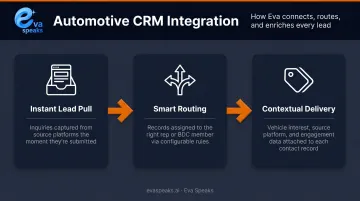
Those automated workflows rely on integrations handling three functions at once:
- Pull inquiries from source platforms into the CRM the moment they're submitted (no manual imports)
- Route records to the right rep or BDC team member based on configurable rules
- Attach vehicle interest, source platform, and engagement data to the contact record so the first outreach lands with context
Best Automotive CRM Integrations for Lead Generation
Every integration category below is evaluated on three criteria: how reliably it delivers lead data into the CRM, how much context it provides per lead, and how little manual effort it requires from your sales team.
Facebook and Instagram Lead Ads Integrations
Meta's Lead Ads format lets car shoppers submit their contact details without ever leaving Facebook or Instagram. The problem: without a direct CRM integration, those leads sit in the Ads Manager dashboard and require manual export , sometimes hours after submission.
A direct integration pushes leads into the CRM the moment someone submits the form. For automotive, timing matters. Adtaxi's 2024 Automotive Survey found 60% of buyers used social media during both the consideration and final decision phases, with Facebook cited as the most influential platform by 53% of recent purchasers. A lead sitting in an ads dashboard for two hours while a buyer is still actively researching is a lead your competitor will close.
| Attribute | Details |
|---|---|
| Key Features | Real-time lead sync from Facebook/Instagram Lead Ads to CRM, custom audience sync for retargeting, Conversions API for better attribution |
| Best For | Dealerships running active Meta paid campaigns who need instant lead routing to BDC or sales teams |
| Notable Platforms | LeadsBridge (supports VinSolutions, elead, DealerSocket, Zoho CRM), native Meta integrations via HubSpot |
AI-Powered Call and Communication Integrations
Phone remains the highest-converting inbound channel at most dealerships — and the most inconsistently handled. Missed calls, slow callbacks, and unlogged conversations create lost leads at every stage of the funnel.
AI-powered communication integrations automatically answer inbound calls, qualify buyers, log conversations to the CRM, and route the lead to the right rep — with no manual effort required.
Calldrip's 2026 study of 965,351 sales calls across 53 dealerships found the baseline appointment rate for lead-response calls was 27% — but rose to 44% when reps asked for the appointment, and 46% when they combined a trade-in inquiry with that ask. The same study found 55% of calls ended without an appointment ask at all. AI call scoring surfaces exactly these gaps.
Key capabilities that separate AI communication integrations from basic phone systems:
- Real-time call transcription and summarization logged to the CRM record automatically
- Smart routing rules based on caller intent, availability, department, or time of day
- Outbound follow-up triggered within minutes of a web form submission
- 24/7 coverage so after-hours leads are captured and qualified regardless of staffing
EvaSpeaks offers AI-enabled call handling built specifically for dealerships — covering inbound sales and service calls around the clock, qualifying buyers on vehicle interest and trade-in details, and logging full transcripts with structured fields to the CRM. The platform integrates with CDK, Dealertrack, and Reynolds & Reynolds. Outbound follow-up calls can be placed within minutes of a web form submission, and call-flow scripts are configured through the EvaSpeaks dashboard without developer involvement. The speed-to-lead data is compelling here: industry research shows qualification odds drop dramatically after 30 minutes, and EvaSpeaks' automated follow-up directly addresses that window without requiring a BDC agent to be available.
| Attribute | Details |
|---|---|
| Key Features | AI call handling and qualification, automatic call logging and transcription, configurable routing rules, outbound follow-up automation, 24/7 coverage |
| Best For | Dealerships with high inbound call volume, after-hours lead activity, or BDC teams struggling with missed call follow-up |
| Notable Platforms | Eva Speaks (AI call handling with DMS integration), GoTo Connect for Automotive (integrates with Tekion, VinSolutions, CDK eLeads), CarWars |
See it live working with your dealership's CRM. Request Live Demo
Here is how AI-native, CPaaS, and native DMS CRM integration approaches compare for automotive dealerships:
| AI + CRM Integration (EvaSpeaks) | CPaaS Custom Build | Native DMS CRM Module | |
|---|---|---|---|
| Features | Voice AI + real-time CRM push, DMS sync, 24/7 lead capture | Custom API workflows, any CRM | Built-in DMS CRM, basic call logs |
| Best-fit Business Size | Single rooftop to dealer groups | Engineering-heavy dealer groups | Any size using the same DMS |
| Key Strengths | No missed leads, real-time data, fast deploy | Maximum flexibility | Native integration, no extra cost |
| Implementation Complexity | Low - DMS connectors | High - developer required | Low |
| Integration Capability | CDK, Reynolds, Tekion, CRM native | Any system via custom code | DMS-native only |
DMS Integrations
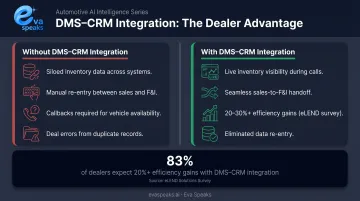
A CRM manages customer relationships. A DMS manages back-office operations — inventory, accounting, financing, and deal structure. When these systems don't communicate, front-office and back-office teams work from different versions of the same customer record.
A real-time DMS-to-CRM integration delivers several concrete gains:
- Live inventory visibility so reps can confirm availability, pricing, and trim options during the call
- Appointment momentum as conversations move forward instead of waiting on callbacks
- Eliminated re-entry between the sales desk and F&I, reducing deal errors and improving handoff quality
The eLEND survey puts numbers behind this: 83% of dealers expected efficiency gains above 20% from better integrations, and 31% expected gains of 30% or more. DMS-CRM connectivity is where most of that gain lives.
| Attribute | Details |
|---|---|
| Key Features | Real-time inventory sync, deal continuity between sales and F&I, automated customer record updates, shared data layer across departments |
| Best For | Franchise dealerships and dealer groups where front-office and back-office teams need to operate from the same customer record |
| Notable Platforms | Tekion (unified DMS + CRM), CDK Global, Reynolds & Reynolds ERA-IGNITE, DealerSocket |
Marketplace and OEM Lead Source Integrations
Cox Automotive's 2024 Car Buyer Journey Study found buyers visited an average of 4.1 websites, with 72% using third-party platforms and 58% using dealership sites. A large share of inbound leads originate from AutoTrader, Cars.com, Kelley Blue Book, and OEM portals — and without a direct CRM integration, those inquiries arrive by email and require manual entry before anyone can follow up.
Direct marketplace integrations remove that delay entirely. Each lead is automatically imported into the CRM, assigned to a rep, timestamped, and queued for follow-up before a competing store has opened the same notification email.
| Attribute | Details |
|---|---|
| Key Features | Automated lead import from marketplace portals, OEM certification compliance, lead source tagging for ROI tracking, immediate CRM routing |
| Best For | High-volume dealerships receiving leads from multiple third-party platforms who need centralized tracking and fast response |
| Notable Platforms | VinSolutions (native Cox Automotive data from AutoTrader, KBB, Dealer.com), DealerSocket (80+ OEM program certifications), ProMax (OEM-certified ILM) |
Marketing Automation and Email/SMS Integrations
Not every lead converts on first contact. Cox's 2024 study shows buyers spend an average of 14 hours and 19 minutes across their entire purchase journey — and 79% of mostly digital buyers were highly satisfied when they could pick up where they left off online. That continuity depends on automated nurture.
Email and SMS integrations let dealerships trigger personalized sequences based on lead source, vehicle interest, and engagement stage. A lead that submits a form on a truck listing but doesn't book an appointment doesn't need a generic email blast. They need follow-up that references the specific vehicle, offers a test drive, and adjusts based on whether they opened the last message.
Without this layer, unconverted leads are typically left untouched. With it, a cold lead from six weeks ago can resurface as an active opportunity the moment behavioral signals — a return visit to the vehicle page, an opened email — indicate renewed interest.
| Attribute | Details |
|---|---|
| Key Features | Automated email and SMS sequences, lead stage-based triggers, CRM field personalization, engagement tracking (opens, clicks, replies) |
| Best For | Dealerships with large lead databases or extended consideration cycles who need systematic nurture without manual rep involvement |
| Notable Platforms | HubSpot (native lead ad sync + email sequences), Zoho CRM (Blueprint workflow automation + Zia AI), DealerSocket (built-in marketing automation) |
Key Features to Look for in Any Automotive CRM Integration
Not all integrations are built the same. Before committing to any platform, evaluate these three factors:
Real-Time vs. Batch Sync
Some integrations push lead data the moment an action occurs. Others sync on a schedule — every 15 minutes, every hour, or nightly. Batch syncing erodes speed-to-lead performance gradually, and by the time conversion rates reflect the problem, the damage is already done. Require real-time sync as a baseline, not a premium feature.
Contextual Lead Delivery
A lead record with only a name and email address forces reps to start from zero on every call. A strong integration delivers the full picture upfront:
- Vehicle of interest
- Source platform
- Engagement history
- Qualifying data collected during the original interaction
With that context in hand, reps can open with a relevant conversation instead of a cold script.
Setup Simplicity and Ongoing Reliability
The best integrations are configured during vendor onboarding and require no in-house developers. They also maintain stable connectivity when CRM or source platforms update — a common failure point for older or less-maintained integrations. When a lead pipeline goes down, the signal isn't an error message. It's missed appointments and unreturned inquiries that quietly pile up.
How to Choose the Right CRM Integration Stack
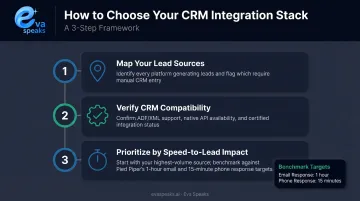
Step 1: Map Your Lead Sources
List every platform currently generating leads: social ads, marketplace sites, walk-ins, phone calls, website forms, OEM portals. Then identify which of those currently require manual entry into the CRM. Each manual entry point is a gap where leads go cold — and where automation delivers the fastest payoff.
Step 2: Verify CRM Compatibility
Not every integration works with every CRM. Before committing, confirm:
- ADF/XML lead delivery support (required for most automotive marketplace sources)
- Native API availability from the CRM vendor
- Certified integration status with each specific lead source
Step 3: Prioritize by Speed-to-Lead Impact
Dealerships with limited budgets should sequence integrations starting with their highest-volume lead source. Phone-heavy stores will see more immediate lift from an AI call handling integration than from a social ad sync. Marketplace-first stores should do the opposite — start where the volume is.
The Pied Piper benchmarks offer a useful calibration point: top-performing groups respond within one hour by email or text, and within 15 minutes by phone. Audit your current average response time against those benchmarks, then prioritize the integrations that close the biggest gaps first.
Want an integration stack designed for your dealership? Get a Customized Workflow Recommendation
Conclusion
A CRM without integrations is a contact database. Every lead that requires manual entry, delayed routing, or disconnected follow-up has a real chance of closing somewhere else.
The dealerships consistently winning appointments are the ones where lead data flows automatically from source to CRM, reps are notified in real time, and follow-up sequences engage buyers before they move on. That kind of system runs on integrations, not added staff.
Start with an honest audit: find where manual entry or delayed routing is happening today, then prioritize the integrations that fix your highest-friction handoffs first. For dealerships where phone is a primary lead channel, pairing an AI-powered communication platform like Eva Speaks with your CRM is a direct way to handle after-hours calls automatically - qualifying callers, booking appointments, and logging every interaction directly to your CRM without manual intervention.
See how AI handles your dealership calls after hours. See How AI Handles After-Hours Calls
Frequently Asked Questions
What is an automotive CRM integration?
An automotive CRM integration is a technical connection between a dealership's CRM and an external tool or platform that automatically passes, syncs, or acts on lead data. It eliminates manual data entry, cutting the gap between a lead's first touchpoint and a salesperson's first call.
How does CRM integration improve lead response times?
Integrated systems push lead data into the CRM the moment a form is submitted, a call is received, or a marketplace inquiry is sent. Sales and BDC teams get instant visibility and can begin outreach immediately.
What is the difference between a CRM and a DMS, and why does integration between them matter?
A CRM manages customer relationships and sales workflows; a DMS handles back-office operations like inventory, accounting, and financing. Integrating both gives sales teams live vehicle data during lead conversations and eliminates duplicate data entry between the sales desk and F&I.
Which lead generation platforms integrate best with automotive CRMs?
Facebook and Instagram Lead Ads, automotive marketplaces like AutoTrader and Cars.com, OEM portals, and inbound communication platforms with call handling and SMS capabilities are the highest-impact integration sources for most dealerships.
Do I need a developer to set up CRM integrations?
Most modern automotive CRM integrations are configured by the vendor during onboarding and do not require in-house technical resources. Setup complexity varies by platform, but implementation is typically managed as part of the vendor's standard onboarding process.
How do AI-powered communication integrations help generate more leads?
AI communication tools handle inbound calls 24/7, qualify buyers during the conversation, and log structured lead data directly to the CRM. Platforms like Eva Speaks also trigger outbound follow-up within minutes of a web form submission, so no inquiry goes unworked — even after hours.