Introduction
Every missed call is a potential customer handed to a competitor. For small businesses running lean teams, the phones don't stop during lunch breaks, staff meetings, or after 5 PM — but coverage does.
The good news: AI voice assistants have matured well beyond the frustrating phone trees of a decade ago. Modern platforms use large language models, real-time speech recognition, and CRM integrations to hold genuine conversations with callers. They qualify leads, book appointments, and route calls without a single staff member involved.
The global intelligent virtual assistant market was valued at $25.99 billion in 2025 and is projected to reach $328.88 billion by 2034. Small businesses are a growing part of that shift — 58% now report using generative AI, up from 40% just a year earlier.
This guide covers the five best AI voice assistants for small businesses in 2026 — how they compare and what to look for before you commit.
Key Takeaways
- AI voice assistants handle inbound calls, qualify leads, book appointments, and route callers around the clock — no extra headcount required
- The best SMB platforms offer easy setup, CRM integration, graceful human handoff, and transparent pricing
- Top picks for 2026: Eva Speaks, Aircall AI Voice Agent, Dialzara, Thoughtly, and Goodcall
- Per-minute AI voice agent costs range from $0.19 to $0.48/minute depending on platform and tier
- When evaluating options, prioritize natural language quality, CRM integration, compliance support, and human handoff reliability
What Is an AI Voice Assistant for Small Businesses?
An AI voice assistant for business is software built on three core technologies: speech-to-text (STT) to understand what a caller says, a large language model (LLM) to interpret their intent, and text-to-speech (TTS) to respond naturally.
Together, these components create a system that answers calls, handles FAQs, books appointments, qualifies leads, and routes callers — without a human on the other end.
This is categorically different from consumer tools like Siri, Alexa, or Google Assistant. Those are built for personal commands ("set a timer," "play music"). Business-focused AI voice platforms are built for call flows — they connect to CRMs, follow custom routing logic, and hand off to human agents with full context when needed.
Why Small Businesses Are Adopting Them Now
A few factors have accelerated adoption:
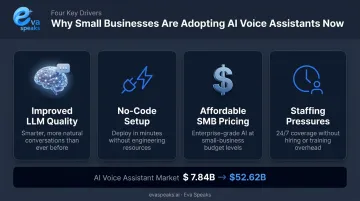
- LLM quality has improved dramatically, making conversations feel natural rather than scripted
- No-code setup options mean most platforms are live within days, not weeks
- Pricing has dropped to a range that works for SMB call volumes — as low as $29/month for entry-level plans
- Staffing pressures make 24/7 human coverage impractical for most small teams
The AI agents market is projected to grow from $7.84 billion in 2025 to $52.62 billion by 2030 — a 46.3% CAGR. For small businesses evaluating the technology now, that trajectory means more competition, more capable tools, and lower prices ahead.
Watch how AI voice works on a real small business call. Watch AI Call Flow Demo
Best AI Voice Assistants for Small Businesses in 2026
These five platforms were selected based on SMB suitability across five criteria:
- Ease of setup — no dedicated IT team required
- Natural language quality — handles real call variability, not just scripted flows
- CRM integration — connects to tools SMBs already use
- Pricing transparency — clear costs at each tier
- Practical call-flow handling — built for actual business use cases
Here is how the leading AI voice assistant platforms compare for small business use cases:
| EvaSpeaks | Dialzara | Aircall | |
|---|---|---|---|
| Best-fit Business Size | 1-50 person businesses | SMB | SMB to mid-market |
| Key Strengths | LLM-native voice AI, fast deploy, CRM-native | Simple setup, affordable | Integrated dialer + CRM |
| Implementation Complexity | Low - hours | Low | Low |
| Integration Capability | CRM, scheduling, EHR out-of-box | Basic integrations | CRM integrations |
Eva Speaks
Eva Speaks is an AI-powered communication platform headquartered in Hayward, CA, built for businesses that want tailored call handling without a custom development project. The platform centers on LLM integration and real-time AI responses. Configurable call-flow scripts and routing rules let businesses define exactly how each call type gets handled.
What distinguishes Eva Speaks is its combination of live transcription, intelligent routing, and LLM-driven responses that adapt to what a caller actually says, not just a scripted expectation. For small businesses fielding varied inbound call types, that flexibility matters.
| Feature | Details |
|---|---|
| Key Features | AI-enabled call handling, real-time transcription, customizable call-flow scripts, LLM integration, intelligent routing rules |
| Pricing | Subscription-based model; contact Eva Speaks directly at www.evaspeaks.ai for current plan details |
| Best For | Small businesses needing customizable, LLM-driven call automation with accurate transcription and flexible routing |
See Eva Speaks handling calls for your business live. Request Live Demo
Aircall AI Voice Agent
Aircall is a cloud-based business phone platform that has layered AI voice agent capabilities onto a well-established base. It's particularly strong for sales and support teams that already live inside HubSpot or Salesforce — the CRM integration is native, not an add-on.
AI Voice Agent supports both inbound and outbound calls autonomously, and includes conversation intelligence features like call summaries, sentiment analysis, and key topic recognition. Human handoff transfers full call context, so agents don't start from scratch.
| Feature | Details |
|---|---|
| Key Features | AI inbound/outbound calling, conversation intelligence, native CRM integrations (HubSpot, Salesforce, Zendesk, Pipedrive), human handoff with full transcript |
| Pricing | Base plans: Essentials $30/license/month, Professional $50/license/month (billed annually). AI Voice Agent: 50 free minutes/month, then from $0.19/min; pay-as-you-go from $0.39/min; prepaid bundles from $175 for 500 minutes |
| Best For | SMBs already using HubSpot or Salesforce that want voice AI embedded directly in their existing CRM workflow |
Dialzara
Dialzara is a purpose-built AI business phone agent for SMBs. Its virtual receptionist handles inbound calls, appointment booking, and lead intake — and it covers a wide range of industry verticals with specific call-handling logic for law firms, healthcare providers, real estate agents, and HVAC companies.
The pricing model is one of its clearest advantages: hybrid subscription with included minutes rather than purely pay-as-you-go, making costs predictable. Zapier integration opens connections to 5,000+ apps without any custom API work.
| Feature | Details |
|---|---|
| Key Features | AI receptionist, inbound/outbound voice agents, appointment scheduling, Zapier integration (5,000+ apps), 10-language support with auto-detection |
| Pricing | Business Lite $29/month (60 min included, $0.48/min overage); Business Pro $99/month (220 min); Business Plus $199/month (500 min); Business Elite $349/month (1,000 min). 7-day free trial available |
| Best For | Service-based small businesses in trades, healthcare, legal, or real estate that want predictable pricing and broad app integration |
Thoughtly
Thoughtly is a no-code AI voice agent platform built around revenue workflows — specifically outbound sales follow-up, inbound lead qualification, and real-time scheduling. Its visual workflow builder lets non-technical users design full voice conversation flows without writing code, removing a major barrier for small sales teams without dedicated developers.
Two-way CRM sync with HubSpot, Salesforce, Zoho, and others keeps contact records current automatically. Scheduling integrations cover Calendly, Acuity, Cal.com, and Mindbody for live appointment booking during calls.
| Feature | Details |
|---|---|
| Key Features | No-code visual voice workflow builder, real-time lead qualification, outbound call automation, two-way CRM sync, live scheduling integrations |
| Pricing | Flex plan starts at $500/month; Scale and Enterprise tiers are custom. 14-day free trial available (outbound calling restricted during trial) |
| Best For | Small sales teams and startups that prioritize outbound lead follow-up and need a no-code setup for voice automation |
Goodcall
Goodcall is designed specifically for local and brick-and-mortar small businesses — restaurants, salons, retailers, service providers. Getting started takes minutes: connect a Google listing, website, or basic business details, and you're live. It's the fastest path from zero to active AI call answering on this list.
The platform handles FAQ responses, caller intake, lead qualification, and scheduling — with integrations for Google Calendar, Outlook, and Microsoft Teams. It's built for business owners who need something working today, not a platform requiring ongoing configuration.
| Feature | Details |
|---|---|
| Key Features | AI call answering, FAQ handling via Skills, caller intake and lead qualification, Google Business Profile integration, Google Calendar and Outlook scheduling sync |
| Pricing | Starter $79/month per agent ($66 annual); Growth $129/month ($108 annual); Scale $249/month ($208 annual); Enterprise custom. 14-day free trial available |
| Best For | Local and brick-and-mortar businesses (restaurants, salons, retailers) that need fast, simple AI call answering with minimal setup |
How to Choose the Best AI Voice Assistant for Your Small Business
The most common mistakes SMBs make when evaluating these tools: defaulting to consumer assistants that weren't built for business call flows, underestimating how critical CRM integration is, and choosing platforms priced for enterprise call volumes. Five criteria separate tools worth deploying from ones that create more problems than they solve.
Natural Language Quality
Speech recognition accuracy and LLM reasoning quality directly shape caller experience. A system that loops callers back to the same menu or mishears industry terminology causes callers to hang up — often permanently.
Look for platforms that handle:
- Unscripted, free-form speech (not just expected responses)
- Regional accents and varied speech patterns
- Multi-turn conversations where context carries across several exchanges
Test with your actual industry vocabulary before committing.
CRM and Tool Integration
Without CRM integration, call data stays siloed — leads don't get logged, follow-up falls through, and the business case for automation disappears fast.
Check for native connections with your specific CRM (HubSpot, Salesforce, Zoho), calendar tools for appointment booking, and whether those integrations are available on your intended plan tier or locked behind higher pricing.
Pricing Model and Total Cost
Two dominant models exist:
| Model | How It Works | Best For |
|---|---|---|
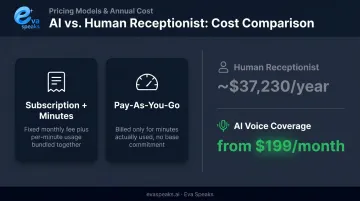
| Subscription + included minutes | Flat monthly fee with a set minute allotment and per-minute overage | Predictable call volumes |
| Pay-as-you-go | Per-minute or per-call billing with no fixed base | Highly variable call volumes |
Watch for add-on fees: CRM connectors, transcription access, human handoff features, and outbound calling are sometimes charged separately. The base plan price rarely tells the full story.
For reference, a human receptionist costs a median of $37,230 per year — AI voice coverage at even $199/month is a meaningful cost difference for after-hours and overflow handling.
Human Handoff and Escalation Logic
When a call escalates — an upset customer, a complex legal question, an emergency — the system should transfer to a human agent with the full conversation transcript and intent summary already attached. Without that context, the caller has to repeat everything from the start.
Ask vendors directly: what does the human agent see the moment a call transfers? The answer tells you a lot about how the system was designed.
Want a setup designed for how your small business handles calls? Get a Customized Workflow Recommendation
Compliance and Security
Call recording laws vary by state. Two-party (all-party) consent is required in California, Florida, Illinois, Pennsylvania, Washington, and several others — meaning both parties must consent before recording begins. Your AI voice platform needs to handle this disclosure automatically.
Additional considerations:
- CCPA applies to California businesses (or businesses serving California residents) collecting personal information
- GDPR applies if your business serves customers in the EU
- Confirm that stored call recordings and transcripts are encrypted and that data handling policies are documented
Ask vendors directly about their compliance features before signing up.
Conclusion
The right AI voice assistant for your small business isn't necessarily the one with the longest feature list. It's the one that handles your actual call volume, integrates with the tools you already use, and doesn't require a technical team to configure or maintain.
Before committing, run a real test: use the free trial, feed the system your industry's actual terminology, and simulate a call that requires human handoff. Those three tests will tell you more than any spec sheet.
If you're looking for an AI voice solution that combines LLM-powered call handling, real-time transcription, and fully customizable call flows, Eva Speaks handles all three — without the setup overhead most small teams can't afford. Because Eva Speaks is designed specifically for business use cases rather than consumer voice commands, it's built around the call-flow patterns small businesses actually experience: appointment booking, lead qualification, after-hours coverage, and intelligent routing — not "play music" or "set a timer." See how it works at www.evaspeaks.ai.
See how AI keeps small business calls covered after hours. See How AI Handles After-Hours Calls
Frequently Asked Questions
How much does an AI voice agent cost per minute?
Per-minute pricing ranges from roughly $0.19 to $0.48/minute depending on the platform and plan tier. Aircall's AI Voice Agent starts from $0.19/minute on prepaid bundles, while Dialzara's overage rates range from $0.35 to $0.48/minute. Many platforms also offer hybrid models with monthly included minutes to reduce effective per-minute costs.
Which AI voice assistant is best for small businesses?
It depends on your use case. Eva Speaks and Dialzara suit businesses needing customizable call flows; Aircall fits CRM-heavy teams using HubSpot or Salesforce; Thoughtly is built for outbound sales operations; Goodcall is the fastest option for local brick-and-mortar businesses. Ease of setup, CRM integration, and natural language quality are the deciding factors across all of them.
Can I use ChatGPT as a voice assistant?
ChatGPT is a conversational LLM, not a purpose-built business phone agent. While it can power voice features via API, it lacks the call routing, CRM sync, appointment booking, compliance disclosures, and human handoff features that dedicated SMB AI voice platforms provide out of the box.
Can AI actually help my small business?
Yes. AI voice tools deliver 24/7 call coverage, faster lead response, lower cost-per-contact, and automated scheduling — all without adding headcount. Modern platforms start at $29/month and don't require technical expertise to deploy.
What's the difference between an AI voice assistant and traditional IVR?
Traditional IVR forces callers to navigate rigid menus ("press 1 for sales"). AI voice assistants understand free-form speech, interpret intent using NLP and LLMs, take real actions like booking appointments or answering FAQs, and transfer calls with full context. The caller experience is fundamentally different.
Do AI voice assistants integrate with CRM software?
Most SMB-focused AI voice platforms offer native integrations with HubSpot, Salesforce, Zoho, and similar CRMs, syncing contact records, call transcripts, and activity logs automatically. Treat CRM integration as a firm requirement — without it, call data stays siloed and follow-through breaks down.