Introduction
Aesthetic clinics face a front-desk problem that most other businesses don't: their highest-value inquiries — Botox consultations, filler questions, laser treatment pricing — frequently arrive at 9 PM on a Saturday when nobody's there to answer. A missed call isn't just an inconvenience. At average medspa revenue of $1.4M annually across roughly 245 patient visits per month, every unanswered inquiry has a real dollar value attached to it.
AI virtual receptionists are gaining traction as a solution, with 31% of medical practices now focusing on AI or automation for scheduling according to a 2025 MGMA poll. Adoption doesn't make the decision straightforward, though. Real trade-offs exist: in empathy, compliance overhead, and patient fit.
This article breaks down both sides — measurable advantages and hard limitations — so clinic owners can make the call with full context. You can See How AI Handles After-Hours Calls to understand what after-hours AI coverage looks like for an aesthetic clinic specifically.
Key Takeaways
- AI virtual receptionists handle calls, bookings, and routine FAQs around the clock — so inquiries don't go to voicemail or a competitor
- They cost a fraction of a full-time receptionist once benefits, payroll taxes, and turnover are factored in
- The empathy gap is real — AI cannot reassure an anxious first-time filler patient the way a skilled human can
- HIPAA compliance requires active vetting; not every platform is built for healthcare data handling
- A hybrid model works best: AI manages routine volume while humans focus on high-touch consultations
What Is an AI Virtual Receptionist for Aesthetic Clinics?
An AI virtual receptionist is a software system that manages inbound calls using conversational AI — answering, routing, scheduling, and responding to common questions without a human operator on every call.
For aesthetic clinics specifically, these tools are configured around the actual questions patients ask: Botox pricing, treatment downtime, pre-care instructions, available appointment slots. Rather than replacing clinical staff, they function as a 24/7 front-desk extension — handling the administrative layer so your team can focus on in-room work.
Eva Speaks, for example, is designed around this workflow. Core capabilities include:
- Integrates with scheduling platforms used by med spas and wellness clinics (Mindbody, Booker, Vagaro, Boulevard)
- Manages the full appointment lifecycle — from initial booking through pre-visit reminders
- Routes complex consultations to a human staff member when needed
- Mirrors your clinic's communication style to maintain a consistent voice at every patient touchpoint
Key Advantages of AI Virtual Receptionists for Aesthetic Clinics
The advantages below focus on operational outcomes, not theoretical capability.
24/7 Availability Captures Leads That Would Otherwise Be Lost
Aesthetic inquiries don't follow business hours. Someone researching Botox after dinner or comparing laser treatment options on Sunday morning won't leave a voicemail — they'll call whoever answers.
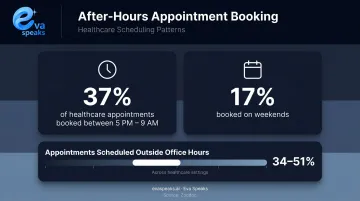
Zocdoc's booking data shows that 37% of all healthcare appointments are booked between 5 PM and 9 AM, with 17% booked on weekends. A separate review of self-scheduling studies found that between 34% and 51% of appointments across different healthcare settings were scheduled outside office hours. The pattern is consistent: a substantial share of patient demand happens when most clinic phones go unanswered.
AI handles these moments in real time — answering calls, providing treatment information, completing bookings — without any staff involvement.
KPIs this affects:
- After-hours booking rate
- Call answer rate
- Lead-to-consultation conversion rate
- Missed call volume
When this matters most: Clinics running seasonal promotions (holiday Botox specials, summer body contouring campaigns) that generate unpredictable call spikes. Also solo or small-team practices where continuous front-desk coverage simply isn't feasible.
Consistent, Error-Free Performance at Scale
A busy aesthetic clinic asks a lot of its front desk: managing phones while greeting walk-ins, confirming appointments, handling pre-care instructions, and prepping intake paperwork — often simultaneously. Under that load, mistakes happen.
Double-bookings, wrong appointment durations, and missed contraindication questions create real problems: wasted chair time, frustrated patients, and rescheduling friction.
AI doesn't get distracted. It applies the same intake logic, asks the same qualifying questions, and follows the same scheduling rules on call 500 as it does on call 1.
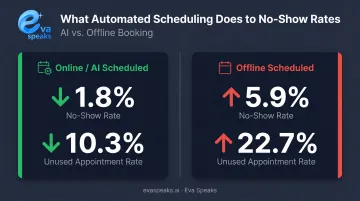
The consistency pays off in no-show rates: research from a private ophthalmology practice found that online-scheduled appointments had a 1.8% no-show rate versus 5.9% for offline bookings — tied directly to automated reminders and more accurate booking capture. The same study saw unused appointment rates drop from 22.7% to 10.3% after implementing digital scheduling.
AI-generated call transcripts add a second layer of value: a searchable record of every patient inquiry, reducing miscommunication and enabling better follow-up.
Metrics to watch:
- Scheduling error rate
- No-show rate
- First-call resolution rate
- Front-desk staff workload
When this matters most: Multi-location aesthetic practices and high-volume medspas where inconsistency across different staff members creates compounding problems over time. Clinics that want to see how AI scheduling consistency plays out in a real conversation can Watch AI Call Flow Demo.
Lower Overhead Without Sacrificing Coverage
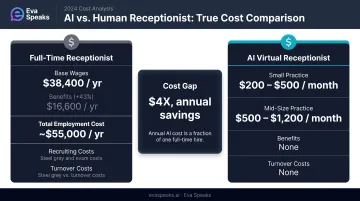
A full-time front-desk employee costs more than their salary. BLS data puts the 2024 median pay for healthcare receptionists at $18.47/hour — roughly $38,400/year in wages alone.
Benefits average 43% of wages for private-industry employees according to BLS compensation data, pushing the true annual cost closer to $55,000 — before recruiting, onboarding, or coverage during sick days and turnover.
AI virtual receptionists run on a flat monthly subscription — no benefits package, no turnover cost, no coverage gaps when someone calls in sick. Published pricing from healthcare-focused AI platforms ranges from roughly $200–$500/month for small practices (1–3 providers) to $500–$1,200/month for mid-size practices (4–10 providers), based on OhMD's 2026 pricing guide. Even at the higher end, annual cost is a fraction of a single full-time hire.
That cost difference represents real reinvestment capacity — toward marketing, equipment upgrades, or an additional treatment provider instead of administrative headcount.
KPIs this affects:
- Administrative cost per appointment
- Cost per booked consultation
- Overhead as a percentage of revenue
When this matters most: Growth-stage clinics managing tight margins, and practices scaling from one to multiple locations where hiring front-desk staff at every site isn't financially viable. Clinics that want a cost model built around their specific call volume and service mix can Get a Customized Workflow Recommendation.
Key Limitations to Consider Before Committing
These are real constraints — not reasons to avoid AI, but factors that determine how and where it should be deployed.
The Empathy Gap in Sensitive Consultations
Aesthetic patients are often emotionally invested in their decisions. Someone considering their first filler treatment, or exploring body contouring after significant weight loss, may need reassurance that no AI can provide.
The technology can answer factual questions accurately, but it cannot read hesitation in a caller's voice, adjust tone for someone who sounds anxious, or build the relational trust that drives consultation conversion for elective procedures. For emotionally nuanced calls, human handoff is still essential.
Complex, Multi-Variable Booking Scenarios
Not all aesthetic appointments are straightforward. Combination treatments, patients with contraindications, or consultations requiring clinical pre-screening involve decision trees that a poorly configured AI will mishandle.
This creates real risk when the system lacks well-designed escalation logic. A caller with a complex history who gets incorrectly booked wastes clinical time and erodes patient trust.
HIPAA Compliance and Data Handling
AI virtual receptionists that collect patient names, contact details, and appointment information related to healthcare services are handling protected health information (PHI) under HHS definitions. Any vendor hosting or accessing that data on behalf of your clinic qualifies as a business associate and requires a signed BAA. Not every platform is built with healthcare-grade compliance. Clinics must verify encryption standards, BAA availability, and secure call recording practices before deployment — which adds several weeks of vetting before you can go live.
Eva Speaks processes data in U.S. data centers with industry-standard security measures. Contact privacy@evaspeaks.ai for BAA and compliance documentation specific to your clinic's needs.
Patient Demographic Mismatch
Comfort with AI varies significantly by patient segment. Pew Research Center data found that 60% of U.S. adults would feel uncomfortable if their healthcare provider relied on AI for diagnosis and treatment. While that question targets clinical AI rather than reception, the broader wariness still applies — particularly for older demographics or patients at high-end clinics who expect white-glove human service. A poorly received AI interaction can generate negative reviews in a space where reputation is everything.
How the Three Reception Options Compare
Here is how an AI virtual receptionist, human receptionist, and traditional answering service compare for high-end aesthetic clinics:
| AI Virtual Receptionist (EvaSpeaks) | Human Receptionist | Traditional Answering Service | |
|---|---|---|---|
| Features | 24/7 AI calls, scheduling, consultation booking, Mindbody sync | Full interaction, personalized service, upselling | Message-taking, basic routing, limited hours |
| Best-fit Business Size | Solo to multi-location med spas | Boutique clinics | Practices with limited front desk gaps |
| Key Strengths | Never misses a booking inquiry, consistent tone, after-hours | White-glove, builds client relationships | Affordable, low commitment |
| Implementation Complexity | Low - Mindbody, Boulevard connectors | None (hire) | Low |
| Integration Capability | Mindbody, Jane App, Boulevard native | Manual entry | None or limited |
What Happens When Aesthetic Clinics Avoid AI Reception Entirely
The status quo has its own costs, and they compound quietly.
A front desk staffed only with humans will miss calls during treatments, lunch breaks, and after hours. Those callers don't wait — 46% of healthcare consumers would reconsider booking if they struggle to reach a provider's office, per Press Ganey's 2025 data. Patients who experience pre-appointment friction rate providers 13.1 points lower on likelihood to recommend than those who don't.
Beyond missed calls, staff stretched across phones, walk-ins, and paperwork simultaneously make the kinds of errors described above: double-bookings, missed instructions, inconsistent intake. Each error creates a downstream problem — rescheduling friction, patient frustration, wasted appointment slots.
Those operational gaps also carry a reputational cost. As more clinics invest in always-available communication, the ones that don't get perceived as less responsive and less organized — especially by younger patients who treat immediate digital access as a baseline expectation.
How to Get the Most Value from an AI Virtual Receptionist
Generic call-answering systems configured without aesthetic-specific logic will underperform. The difference between a system that books appointments and one that frustrates callers usually comes down to setup.
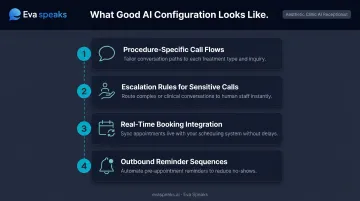
What good configuration looks like:
- Call flows built around the actual questions your patients ask (pricing ranges, downtime by procedure, what to expect at a first consultation)
- Clear escalation rules that route emotionally sensitive or clinically complex calls to human staff immediately
- Integration with your booking platform so appointments are confirmed in real time, not just logged as requests
- Outbound reminder sequences configured to reduce no-shows for high-value treatment bookings
Once your system is live, track these metrics to gauge whether it's working:
- Call answer rate before and after deployment
- After-hours booking conversions
- Escalation frequency (high escalation rates signal misconfigured call flows, not AI failure)
- No-show rate changes tied to automated reminder sequences
Eva Speaks lets aesthetic clinics configure call flows, escalation rules, and conversation goals through a dashboard without writing scripts. The AI adapts tone to match your brand voice — useful for clinics with premium positioning — and integrates with Mindbody, Vagaro, Boulevard, and other platforms commonly used by medspas and wellness clinics. For growth-stage clinics specifically, this deployment model matters — getting AI-quality call coverage in place doesn't require a lengthy IT project or a minimum contract volume, which makes it accessible at the stage where every missed inquiry has a direct cost impact.
That initial configuration, though, is a starting point. Review escalation logs monthly, refine call flows based on what callers actually ask, and update routing rules whenever your service menu changes. To see how this works for an aesthetic clinic environment, you can Request Live Demo.
Conclusion
AI virtual receptionists offer aesthetic clinics real, measurable advantages — better coverage, lower overhead, and more consistent scheduling performance. But the technology delivers its full value only when deployed with clear judgment about where it belongs and where it doesn't.
Routine volume is where AI earns its keep. Emotionally complex conversations — a patient anxious about a procedure, a complaint that needs careful handling — still belong with human staff. The clinics that get the most from this technology design that division on purpose: configuring the AI to excel at what it does, building clean escalation paths for what it doesn't, and monitoring performance regularly enough to keep both sides working well together.
Done right, that's not a workaround. It's how modern clinic operations are built to scale.
Frequently Asked Questions
What tasks can an AI virtual receptionist handle for an aesthetic clinic?
AI virtual receptionists handle appointment booking, treatment FAQs, cancellations, reschedules, and outbound reminders. For more complex inquiries — clinical pre-screening, emotionally sensitive consultations, or contraindication questions — the system routes calls to a human staff member.
How much does an AI virtual receptionist cost compared to hiring a front desk employee?
A full-time healthcare receptionist runs roughly $55,000 per year in wages and benefits. AI receptionist platforms for small-to-mid-size practices typically range from $200–$1,200/month — far less, even at the high end of that range.
Can an AI virtual receptionist be HIPAA-compliant?
Some platforms are built with HIPAA compliance in mind, including BAAs and data encryption. However, compliance is not automatic — clinics must vet vendors specifically for BAA availability, secure data storage, and call recording practices before deployment.
Will patients be put off by speaking to an AI instead of a person?
Patient comfort varies by demographic and context. Well-designed AI with natural conversation flow and easy escalation to humans works well for routine booking and scheduling. Emotionally sensitive consultations — body image concerns, post-procedure anxiety — convert better when a human answers.
How long does it take to set up an AI virtual receptionist for an aesthetic clinic?
Basic configuration typically takes days to a few weeks depending on call-flow complexity and the integrations required. Ongoing refinement — based on escalation frequency and booking data — is recommended after initial deployment.
Is a hybrid AI and human model better than fully automated reception for aesthetic clinics?
Yes, for most clinics. AI handles high-volume routine calls efficiently and consistently. Human staff handle emotionally nuanced consultations where trust and reassurance drive conversion. In practice, this split means fewer missed calls during off-hours and stronger close rates on consultations that actually need a personal touch.