A 2024 Gartner survey found that only 14% of customer service issues are fully resolved through self-service — and even "very simple" issues reached just 36% resolution. The same research found that 45% of customers who attempted self-service said the system didn't understand their intent. That's not a minor inconvenience — it's a direct driver of call abandonment, repeat contacts, and lost revenue.
For decision-makers weighing IVR against AI voice agents, the question isn't just about technology sophistication. It's about what happens when a customer needs something done — not just routed.
Key Takeaways
- Traditional IVR routes callers through preset keypad menus; AI voice agents understand natural speech and complete tasks autonomously
- AI voice agents handle 24/7 inbound calls, scale to peak demand without added headcount, and sync with CRMs live during the call
- IVR still works for simple, predictable routing with tight budgets; AI voice agents are better for revenue-sensitive, customer-facing calls
- IVR moves callers to the right place; AI agents resolve why they called in the first place
- Businesses switching to AI voice agents typically see lower abandonment, faster resolution, and lower staffing costs
AI Voice Agents vs Traditional IVR: Quick Comparison
| Factor | Traditional IVR | AI Voice Agents |
|---|---|---|
| Technology | Pre-recorded menus, DTMF keypad inputs | NLP + LLMs, interprets free-form speech and intent |
| Call Handling | Routes based on menu selection | Completes tasks: scheduling, policy questions, payment processing |
| Scalability | Add phone lines and staffing | Handles concurrent calls instantly, no added infrastructure |
| Customer Experience | Linear, repetitive, forces menu navigation | Conversational, context-aware, feels natural |
| Cost Structure | Lower upfront; high per-escalation cost | Higher setup investment; significantly lower cost-per-interaction at scale |
The customer experience and cost rows tell the real story. IVR creates friction at every step: callers repeat information across transfers, navigate menus that don't match their actual need, and frequently abandon before reaching resolution. AI voice agents cut through that by handling the full conversation — no transfers, no dead ends, no repeated context.
Watch how AI handles a real insurance renewal call vs IVR. Watch AI Call Flow Demo
What Are AI Voice Agents?
AI voice agents are autonomous phone systems that handle customer calls through natural spoken dialogue. Unlike IVR, they don't present a menu — they listen, interpret intent, and respond contextually based on what the caller actually needs.
How They Work
The technical pipeline involves three core components working in sequence during an active call:
- Speech-to-text (STT) — converts the caller's spoken words into text in real time
- Intent classification via NLP/LLM — interprets what the caller actually needs, not just the words used
- Text-to-speech (TTS) — delivers a natural-sounding response and executes any required actions (retrieving account data, confirming a booking, processing a payment)
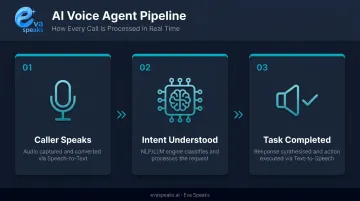
EvaSpeaks' platform uses this architecture — combining LLMs, TTS, and STT through third-party integrations — to deliver real-time AI responses during live call sessions. The system processes speech synchronously (within the same call session), so callers get answers before they hang up. EvaSpeaks is designed to be deployed without enterprise-level infrastructure commitments: businesses configure call flows through the admin dashboard and the platform handles the AI processing layer, which is why it represents a practical entry point for organizations moving away from legacy IVR.
The 24/7 and Scalability Advantage
The operational impact of always-on availability goes beyond answering calls after hours. During high-demand periods — insurance open enrollment, utility storm events, retail peak season — traditional systems either queue callers or require emergency staffing.
AI voice agents handle concurrent call spikes without any of that. Capacity scales to match demand automatically — no queue buildup, no overtime costs, no missed contacts.
What Businesses Get After Every Call
Because every interaction is transcribed, the system generates structured data from each conversation: call metadata, routing outcomes, transcriptions, and usage analytics. This creates an ongoing record that supports quality assurance and operational improvement. Traditional IVR systems don't produce any of it.
High-Impact Use Cases
- Resolves inbound inquiries: policy questions, account status, service details
- Books and confirms appointments without human involvement
- Handles after-hours calls with full service capability, not a voicemail
- Qualifies leads by screening inbound interest and capturing structured data
- Sends proactive outbound reminders for renewals, payments, and appointments
A concrete example: a customer calls at 11 PM to check on a policy renewal. With IVR, they hear "our office is closed — please call back during business hours." With an AI voice agent, they get a full, personalized answer, a payment confirmation, and a summary of next steps. One interaction resolves the issue; the other creates a repeat call — or a cancelled policy.
Hear what an AI renewal call actually sounds like. Listen to Sample AI Call
What Is Traditional IVR?
Traditional IVR (Interactive Voice Response) is a rule-based phone automation system. It plays pre-recorded audio menus, collects keypad inputs or limited voice commands, and routes callers to a department or agent based on what they selected.
That's the full extent of what it does.
Where IVR Falls Short
ContactBabel's 2024 US Contact Center Decision-Makers' Guide found that only 26% of calls were handled entirely through self-service without human intervention — and mean telephony self-service zero-out (callers abandoning the IVR to reach a human) sat at 32%. Nearly one in three callers gives up on the IVR before it can even complete its routing function.
The structural causes are straightforward:
- No language understanding — IVR can't interpret natural speech or varied phrasing
- Context loss between menus — callers repeat their information at every transfer
- Rigid menu trees — if the caller's need doesn't match a menu option, there's no path forward
- High maintenance overhead — updating scripts, routing logic, or menu options requires technical intervention each time
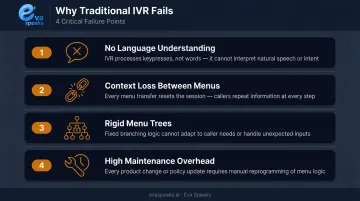
That last point compounds over time. As business needs change — new products, updated policies, new service tiers, seasonal campaigns — IVR scripts lag behind. Changes that should take an afternoon instead require IT scheduling and testing cycles.
Where IVR Still Has a Role
IVR isn't obsolete. It still serves a functional purpose when:
- Call flows are simple and highly predictable (store hours, basic account balance checks)
- The primary goal is routing to the right department, not resolving the issue
- Budget constraints make any AI investment premature
- Call volume is low and steady, with no peak demand risk
For those businesses, IVR works fine as an interim tool. The problem comes when companies extend that logic to calls involving billing disputes, service issues, or new customer inquiries — situations where a failed interaction has a direct cost.
AI Voice Agents vs IVR: Which One Is Right for Your Business?
The honest answer depends on what's actually happening on your calls.
Key Decision Factors
- Are callers asking questions that need a real conversation, or just pressing a number to reach a department?
- Will your customers tolerate a menu, or do they expect to speak naturally and get a resolution?
- Do you experience peak periods where call volume spikes unpredictably?
- For a renewal, a lead inquiry, or a claims intake — what does one abandoned call actually cost you?
The Real Cost of IVR
IVR looks cheaper upfront. But the total cost of ownership includes something the sticker price doesn't show: the cost of what doesn't get resolved.
ContactBabel's 2024 data puts the average live inbound call cost at $6.91, compared to $0.50–$0.90 for a telephony self-service session. The catch: with a 32% zero-out rate (callers pressing 0 to bypass the menu entirely), a significant share of IVR "sessions" end with a live-agent transfer anyway. Businesses end up paying for both the self-service layer and the escalation it failed to prevent.
Add repeat calls from unresolved issues, and the gap between IVR's apparent savings and its real cost narrows fast.
How AI Voice Agents and IVR Compare for Insurance Renewal Calls
Here is how AI voice agents and traditional IVR compare specifically for insurance renewal call scenarios:
| AI Voice Agent (EvaSpeaks) | Traditional IVR | |
|---|---|---|
| Features | Natural conversation, policy confirmation, payment redirect, CRM sync | DTMF menus, static renewal scripts, hold queue |
| Best-fit Business Size | Mid-size to large insurers, regional agencies | Large enterprise carriers |
| Key Strengths | High renewal containment, no caller frustration, 24/7 | Widely deployed, predictable |
| Implementation Complexity | Low - policy system API connectors | High - IT-dependent |
| Integration Capability | Policy management systems, CRM, payment portals | Custom dev required |
Situational Recommendation
That cost picture makes the decision more straightforward than it might seem.
Choose IVR if:
- Calls are simple and routing is the only goal
- Budget constraints make AI investment premature
- Call flows are stable and rarely need updating
Choose AI voice agents if:
- Calls require resolution, not just routing
- Customers expect conversational, personalized service
- Missed or mishandled calls directly cost you revenue
- You experience unpredictable call volume spikes
Transitioning Without Starting Over
Switching to AI voice agents doesn't require scrapping existing infrastructure on day one. Many businesses layer AI agents on top of their current phone systems, using configurable call-flow scripts and routing rules to migrate gradually. EvaSpeaks is designed for exactly this kind of gradual migration. Its LLM-powered call handling and customizable call-flow scripts let businesses deploy AI voice agents on top of their existing phone setup — no need to rebuild from scratch. This approach is also considerably lighter than enterprise contact center migrations, which typically involve months of configuration work and significant IT resources.
Want a migration plan that fits your existing IVR setup? Get a Customized Workflow Recommendation
Real-World Impact: What the Data Shows
The clearest evidence for AI voice agent ROI comes from documented IVR replacement cases.
One Omilia case study tracking a multinational financial services company's legacy IVR replacement reported:
- 21% increase in call containment
- 42% decrease in IVR talk time
- 90% task completion rate for banking transactions
- 96% semantic accuracy in understanding customer intent
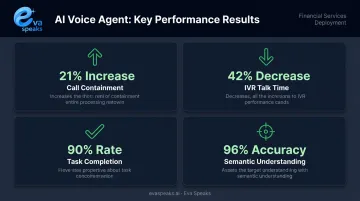
The company moved from a menu-based routing system to conversational AI — and the containment gain alone represents a significant reduction in live-agent escalation costs. With average live call costs at $6.91 per interaction, every call resolved autonomously is direct savings.
(Note: this case study is vendor-published and the company is anonymous — treat as directional evidence, not a universal benchmark.)
The Practical Takeaway
Businesses handling revenue-sensitive calls — renewals, lead qualification, service bookings, claims intake — consistently see stronger ROI from AI voice agents than from maintaining IVR. The math is straightforward: IVR routes callers to humans who resolve issues; AI agents resolve issues directly.
If your phone calls are moments where customers decide whether to stay, buy, or leave, routing them through a menu and hoping they don't abandon isn't a strategy. Eva Speaks builds AI call-handling services specifically for these high-stakes interactions — where the conversation itself is what converts, retains, or loses the customer.
Ready to see how it performs for your policy calls? Request Live Demo
Conclusion
IVR has a place in simple, low-complexity routing environments — that's still true. But for any business where the phone call is a revenue moment, the comparison isn't close. AI voice agents deliver better outcomes across customer satisfaction, cost efficiency, and scalability by doing something IVR was never designed to do: actually resolving what the caller needs.
The evidence across all three dimensions is consistent:
- Customer satisfaction improves when callers reach resolution without menu friction
- Cost efficiency increases as AI handles routine calls without added headcount
- Scalability comes standard — no staffing ramp required during high-volume periods
The real question is whether your current call volume, customer expectations, and the cost of missed interactions justify making the shift now or in phases. For most businesses handling customer-facing calls, waiting for a more convenient time means continuing to absorb preventable losses.
Frequently Asked Questions
What are the advantages of AI voice agents over IVR for insurance renewal calls?
AI voice agents handle renewal calls end-to-end — they confirm policy details, process payments, and answer coverage questions without a human agent involved. IVR can only route the caller to a department, so after-hours calls and high-volume periods result in abandonment rather than completed renewals.
How do AI voice agents differ from traditional IVR for insurance renewal calls?
The core difference is completion. IVR presents menu options and transfers the caller to a live agent, who then handles the transaction. AI voice agents use NLP to hold a full conversation, retrieve account data in real time, and complete the renewal without a transfer or hold time — the caller never has to repeat themselves.
Is IVR still relevant for insurance renewal calls?
IVR can still function as a basic routing layer, but it falls short for renewal calls specifically. Customers calling about renewals expect to act immediately — verify coverage, pay, and confirm — not queue for a human agent during business hours.
Can AI voice agents make outbound insurance renewal calls?
Yes. AI voice agents can initiate outbound calls at scale to remind policyholders of upcoming renewals, process payment during the call, and flag cross-sell opportunities. IVR systems have no outbound capability at all.
Is IVR considered AI?
Traditional IVR is not AI. It operates on pre-programmed rules and fixed menu logic — it doesn't learn, adapt, or understand language. AI voice agents use machine learning and NLP to interpret caller intent and improve accuracy over time, which is a different technology category entirely.