Introduction
High call volumes create a familiar problem: some agents handle back-to-back calls all day while others sit idle. The result is burnout for overloaded agents, inconsistent response times, and performance data too skewed to act on.
Round robin call routing directly addresses this by distributing incoming calls in a sequential, rotating order, so every agent in the pool receives roughly equal call volume over time.
If you manage a call center, run a support team, or handle inbound sales operations, this guide covers what round robin routing is, how it works step by step, how to configure it, and when a different approach makes more sense. Teams that want to see AI-powered intent-based routing as an alternative can Explore AI Call Automation before diving into the round robin mechanics.
Key Takeaways
- Round robin routing distributes incoming calls sequentially among agents in a continuous cycle — Agent A, then B, then C, then back to A.
- Used in call centers, sales teams, and support environments to prevent workload imbalance.
- Requires a defined agent queue, availability detection, and configured routing rules within an ACD or VoIP platform.
- Best for teams of similar skill levels handling uniform call types.
- Round robin has real limitations in high-complexity or specialized environments where equal distribution doesn't equal effective distribution.
What Is Round Robin Call Routing?
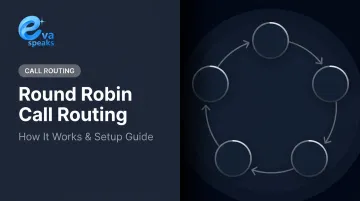
Round robin call routing is an inbound call distribution method that rotates incoming calls among a group of agents in a fixed, sequential order. Each agent receives roughly the same number of calls over time — not because the system tracks fairness in real time, but because the rotation pointer advances by one position with every call.
The goal is consistency: equal workload distribution, reduced idle time, and predictable call handling across the team. Unlike skills-based routing or speed-to-answer models, round robin doesn't prioritize expertise or availability — it distributes calls based on sequence alone.
How It Differs From Similar Routing Methods
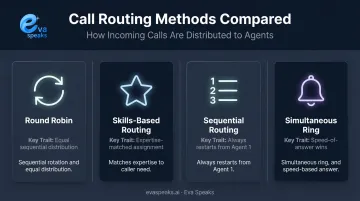
That sequential simplicity is what sets round robin apart. Here's how it compares to other common approaches:
| Routing Method | How It Works | Key Difference from Round Robin |
|---|---|---|
| Skills-based routing | Routes calls to the agent with the most relevant expertise | Skills-based prioritizes expertise; round robin ignores it entirely |
| Linear hunt (top-down) | Always starts from Agent 1 and works down the list | Round robin remembers where it left off; linear always restarts from the top |
| Ring all | Rings every available agent simultaneously | Round robin routes one at a time, in sequence; ring all rewards speed |
According to Genesys routing documentation, round robin searches for the first available agent, then bypasses that agent on the next interaction and picks the next available — looping back to the beginning after the last agent in the group.
How Round Robin Call Routing Works
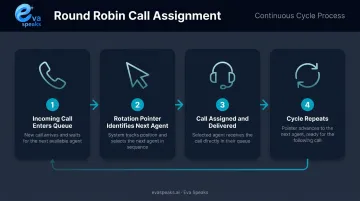
When a call enters the system, the routing engine checks the rotation order, identifies the next agent in line, verifies that agent's availability, and delivers the call. The pointer advances by one position. The next call starts from where the last one left off.
Three components make this work:
- A defined agent pool — an ordered list of agents assigned to the round robin group
- Availability detection — the system needs to know which agents are active, idle, or on another call
- Call assignment rules — what happens when the next agent in rotation is unavailable (skip to the next available agent, or hold until they're free)
The Assignment Process, Step by Step
- Incoming call enters the queue — The customer dials in, the system timestamps the call, and the routing engine begins the assignment process.
- Rotation pointer identifies the next agent — The engine checks the sequence and verifies that agent's availability before proceeding.
- Call is assigned and delivered — The system routes the call to the next available agent, then advances the pointer by one position.
- Cycle repeats — Once every agent has received a call, the sequence loops back to Agent 1. Distribution stays balanced across the full team.
Handling Unavailable Agents
If the next agent in rotation is busy or offline, behavior depends on configuration:
- Skip logic — the system bypasses that agent and moves to the next available one
- Hold logic — the call waits in queue until the designated agent becomes free
Avaya's circular hunt group, for example, searches specifically for an idle extension starting after the last call recipient. Microsoft Teams' round robin queue confirms that unavailable agents do not receive calls until they become available.
Under the hood, round robin routing runs inside Automatic Call Distributors (ACD) or PBX/VoIP platforms. Most implementations also sync with CRM tools, logging each assignment and surfacing distribution metrics so managers can audit the rotation and catch imbalances early.
How to Set Up Round Robin Call Routing
Before you configure anything, confirm your phone system, VoIP platform, or cloud communication tool supports queue-based routing or ACD functionality. Then register all agents in the system with defined availability statuses before touching any routing settings.
Step 1: Create the Agent Queue
- List all agents who should participate in the rotation
- Define their order within the round robin group
- Assign them to the routing configuration in your platform's settings
Step 2: Configure Call Assignment Rules
This is where most teams underinvest. Define:
- Skip unavailable agents automatically, or hold the call until they're free — choose one behavior and apply it consistently
- Set a maximum hold time that triggers an overflow action before callers abandon
- Route overflows to voicemail, a fallback queue, or an external number
- Enable queue announcements: hold music, estimated wait times, or position-in-queue messages
Step 3: Test the Configuration
Place multiple test calls in sequence and confirm:
- Calls rotate in the expected order
- Availability detection responds correctly when agents are marked busy or offline
- Overflow rules trigger at the configured hold time threshold
Platforms like EvaSpeaks can simplify this process — its call routing service lets teams configure agent pools, overflow handling, and call-flow scripts without manual PBX work. Because EvaSpeaks is cloud-hosted and does not require dedicated telephony hardware, adding a new agent to the rotation or adjusting overflow rules takes minutes through the dashboard rather than requiring an IT change request. Teams that want to see how round robin setup works inside Eva Speaks can Request Live Demo.
Key Benefits of Round Robin Call Routing
Workload Equity
Because calls rotate in equal turns, no single agent absorbs a disproportionate share of volume. Balanced distribution makes workload tracking cleaner and gives performance comparisons more validity across the team.
Faster Call Connection
With no single agent becoming a bottleneck, callers reach the next available agent more quickly. ContactBabel's 2021 US benchmarking report — based on 214 interviews with US contact centers — found that mean average speed of answer had reached 75 seconds, more than 150% higher than in 2009. That figure reflects industry-wide capacity issues, not routing logic — but list-order bias can make wait times worse than they need to be. Round robin removes that variable.
Cleaner Performance Data
When every agent handles a comparable share of calls, performance metrics become more meaningful. Handle time, first-call resolution (FCR), and CSAT scores are harder to evaluate fairly when one agent takes 60% of volume and another takes 10%. Round robin levels the playing field for those comparisons.
SQM Group research reports that each 1% improvement in first-call resolution corresponds to a 1% improvement in CSAT and a 1% reduction in operating costs. That correlation makes clean, per-agent FCR data worth tracking carefully.
Limitations and Misconceptions of Round Robin Call Routing
Equal Distribution Doesn't Mean Effective Distribution
This is the most common misconception. A new agent and a senior agent receiving the same call volume will produce very different outcomes — especially if the calls are complex. Round robin has no awareness of caller history, call complexity, agent skill level, or urgency. It just rotates.
First-call resolution data makes this concrete. The industry average FCR sits at 71%, with 80%+ considered world class. In teams with uneven agent skill, routing complex calls equally across all agents almost certainly pulls that number down.
High-Volume Bottlenecks
During peak periods, round robin's sequential structure can create delays if several agents in the rotation are simultaneously unavailable. Callers may wait longer than they would under a ring-all model. This is where supplemental routing logic helps:
- Overflow rules that trigger after a defined hold time
- IVR-based triage that categorizes calls before they enter the rotation
- AI-assisted call handling that pre-qualifies or deflects lower-priority contacts
AI-assisted handling — such as the conversational call management EvaSpeaks provides — can serve as that supplemental layer, managing initial caller interaction before routing decisions are made. In this role EvaSpeaks handles the preliminary intake and intent detection, so when an agent does take the call they already have context about why the caller reached out — a pattern that improves first-contact resolution without increasing handle time.
Using Round Robin by Default, Not by Design
One signal to watch for: a team using round robin simply because it was the default configuration, not because it was evaluated against alternatives. Teams with tiered support structures, SLA-driven response requirements, or highly varied call types should assess whether round robin alone meets their operational goals. In many cases, it needs to be paired with additional logic:
- Skills-based routing to match caller needs with agent expertise
- IVR triage to categorize calls before they enter the rotation
- Capacity-based overflow rules to handle spikes without queue buildup
Here is how round-robin, skills-based, and AI-intent-based routing compare for business call teams:
| AI Intent-Based (EvaSpeaks) | Skills-Based ACD | Round-Robin | |
|---|---|---|---|
| Routing Logic | Real-time intent detection, dynamic rules | Pre-defined agent skills, ACD match | Equal sequential distribution |
| Best-fit Business Size | SMB to mid-market | Mid-market to enterprise | Any size |
| Key Strengths | Adapts to caller intent, highest first-call resolution | Matches complexity to expertise | Simple, fair load distribution |
| Implementation Complexity | Low - no code | Medium | Low |
| Integration Capability | CRM, scheduling, EHR native | CRM via API | CRM via API |
You can Watch AI Call Flow Demo to see how AI intent-based routing handles a real inbound call compared to a static distribution model.
Conclusion
Round robin call routing is a reliable baseline strategy for teams that need workload fairness, predictable distribution, and consistent agent utilization. Its mechanics are well-defined, its configuration is handled natively on most modern VoIP and ACD platforms, and its benefits hold up — provided the team and call types are reasonably uniform.
Where it falls short is also predictable. Equal distribution doesn't account for skill, complexity, or volume spikes. Teams that understand these limitations and pair round robin with overflow rules, skill-based hybrid routing, or AI-assisted triage get consistent distribution without sacrificing flexibility when call complexity varies. Platforms like Eva Speaks support configurable routing rules that let you layer these strategies without rebuilding your call flow from scratch. Teams that want to explore how AI intent routing fits alongside their existing distribution setup can Talk to an AI Communication Expert.
Frequently Asked Questions
What is round robin call routing?
Round robin call routing is an inbound distribution method that routes incoming calls to agents one by one in a sequential, rotating order. Each agent receives an equal share of calls over time, with the system advancing the rotation pointer after every call assignment.
How is round robin routing different from skills-based routing?
Round robin distributes calls equally regardless of agent expertise; the next available agent in the rotation gets the call. Skills-based routing matches each call to the agent best qualified to handle it, making it better suited for teams with specialized roles or complex call types.
What happens when all agents are busy in a round robin system?
Behavior depends on configuration. The system can hold the caller in queue with music or announcements, skip to the next available agent, or trigger an overflow action such as voicemail, a fallback queue, or forwarding to an external number.
Can round robin call routing work for small businesses?
Yes. It works well for small teams handling uniform call types, preventing any one person from absorbing a disproportionate share of inbound volume. Most VoIP and cloud phone platforms, including Dialpad, Nextiva, Zoom Phone, and Microsoft Teams, support basic round robin queue setup natively.
What is weighted round robin call routing?
Weighted round robin is a variation where agents are assigned different call volumes based on capacity or seniority. A senior agent might receive two calls for every one that goes to a junior agent, allowing proportional rather than strictly equal distribution.
Does round robin routing work with remote or distributed teams?
It does, as long as agents are registered in the routing system with accurate availability statuses. Cloud-based VoIP and ACD platforms support remote agent participation natively, so physical location has no effect on the rotation logic.