Introduction
Litigation generates calls that cannot wait — court deadlines, outside counsel updates, witness scheduling, hold notifications to employees. For in-house legal teams, the challenge is ensuring the right person is available to receive them at the right moment, every time.
AI call routing is the automated process by which an AI system receives, analyzes, and directs inbound calls to the appropriate attorney, matter team, or workflow based on predefined rules and real-time language understanding. For a lean legal department — the ACC's 2024 benchmarking data shows a median of 11 staff, including 7 lawyers — manual triage simply does not scale when active litigation is generating calls across multiple matters simultaneously.
This guide covers how AI call routing works end-to-end in a litigation context, what privilege and compliance risks arise when AI handles legal communications, and when the technology is not the right tool at all.
Key Takeaways
- AI call routing uses LLM-powered logic to triage, direct, and log litigation calls without requiring attorney intervention at every step
- In-house teams gain faster response, consistent intake documentation, and better outside counsel coordination — all contingent on proper configuration
- Attorney-client privilege is not automatic when AI processes calls; enterprise data agreements are non-negotiable
- CIPA and ECPA create liability based on what an AI system is capable of doing, not solely what it recorded
- AI routing fits high-volume intake scenarios; it is inappropriate for settlement discussions, opposing counsel calls, or any communication requiring immediate attorney judgment
What AI Call Routing Actually Does in a Litigation Context
AI call routing intercepts inbound calls, uses natural language processing and LLM-based reasoning to classify caller intent and urgency, and then routes the call to the correct attorney, paralegal queue, or automated response, with a transcript logged to the matter record.
In a litigation environment, the goal is specific: ensure time-sensitive calls reach the right person, generate a documented intake record, and avoid unauthorized disclosures or missed escalations.
How It Differs From a Standard IVR
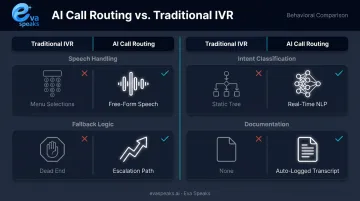
Traditional IVR systems follow static decision trees. Press 1 for billing, press 2 for support. They have no language comprehension and break down the moment a caller says something unexpected.
AI call routing handles free-form speech. A caller saying "I'm calling about the deposition scheduled for the Johnson matter on Thursday" can be classified, prioritized, and routed without the caller navigating a menu. No menu navigation. No attorney picking up a line just to figure out who should handle it.
That caller-facing simplicity is backed by a specific technical process. Platforms like Google Dialogflow CX assign intent detection confidence scores from 0.0 to 1.0, routing calls based on how closely the caller's language matches predefined intent categories. When confidence is low, the system doesn't guess — it either asks a clarifying question or escalates to a live person.
Key behavioral differences from traditional IVR:
- Handles free-form speech instead of requiring menu selections
- Classifies intent in real time based on what the caller actually says
- Triggers fallback logic when confidence thresholds aren't met
- Logs a transcript automatically to the matter record on every call
Here is how AI call routing compares to traditional IVR and human triage for in-house legal and litigation call flows:
| AI Call Routing (EvaSpeaks) | Traditional IVR Routing | Human Legal Receptionist | |
|---|---|---|---|
| Features | Intent detection, matter-based routing, privilege-aware logging | Static menu routing, extension dialing | Full screening, judgment, note-taking |
| Best-fit Business Size | Mid-size to large in-house legal teams | Large enterprises with IT | Any size legal team |
| Key Strengths | Consistent routing, audit logs, 24/7 | Familiar, structured | Attorney relationship management |
| Implementation Complexity | Low - configurable routing rules | High - IT-dependent | None (hire) |
| Integration Capability | Matter management, CRM, ticketing | Custom dev required | Manual entry |
Watch how AI routing handles real legal call flows. Watch AI Call Flow Demo
Why In-House Counsel Are Adopting AI Call Routing
The pressure on legal departments to handle more with less is measurable. According to the 2025 CLOC State of the Industry Report, 63% of legal departments identified resource bandwidth as a top challenge, and 66% ranked automating legal processes as a high priority for 2025. AI tool adoption nearly doubled — from 18% in 2023 to 30% by 2024 — and litigation communication is one of the clearest drivers of that shift.
Litigation specifically creates communication demands that manual routing cannot reliably handle:
- Court clerks and process servers calling with filing deadlines
- Outside counsel across time zones providing daily matter updates
- Employees responding to litigation hold notifications
- Witnesses and experts confirming or rescheduling deposition dates
- Internal business units seeking status updates on active matters
What Goes Wrong Without Structured Routing
Poor call routing creates direct legal exposure, not just operational friction:
- Calls reaching the wrong attorney cause delays and, in some cases, inappropriate responses that complicate the matter
- Court-ordered deadlines get missed when escalation paths are undefined
- Oral communications with witnesses or outside counsel go undocumented, creating gaps in the evidentiary record
- Inconsistent intake weakens litigation posture when discovery begins
Under FRCP 37(e), courts can sanction parties for failing to preserve electronically stored information when reasonable steps were not taken. Undocumented calls from outside counsel or witnesses can fall into this category.
How AI Call Routing Works: The End-to-End Process
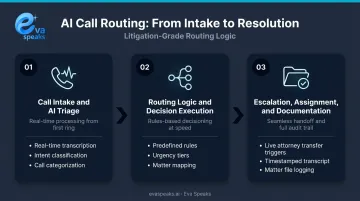
Step 1: Call Intake and AI Triage
The call enters the system and real-time transcription begins. The AI identifies caller intent through keyword detection and natural language understanding — classifying the call as, for example, an outside counsel status update, a litigation hold inquiry, a court notice, or a scheduling request. This classification determines all downstream behavior.
Platforms like EvaSpeaks use LLM integration alongside speech-to-text processing to handle free-form caller language, allowing legal teams to configure call-flow scripts and routing rules without requiring IT development work. This configuration-friendly approach is significant in the context of in-house legal departments, where IT resources are typically allocated to the business's core technology stack rather than communication tools — EvaSpeaks can be set up and maintained by legal operations staff directly.
Step 2: Routing Logic and Decision Execution
The system applies the in-house team's predefined rules. Typical litigation routing logic includes:
- Opposing counsel contact → supervising litigation counsel, direct transfer
- Court deadline-related calls → priority escalation, no queue
- Outside counsel coordination → paralegal or matter manager queue
- Litigation hold inquiries from employees → automated response or HR liaison
- Expert/witness scheduling → calendar coordinator or paralegal
Routing logic can be tiered by matter, urgency level, time of day, and caller identity. These rules must be updated as the matter moves through litigation phases — a discovery-era configuration will misroute trial preparation calls.
Step 3: Escalation, Attorney Assignment, and Documentation
Calls that exceed the AI's confidence threshold or trigger escalation keywords transfer immediately to a live attorney. Common triggers include:
- Settlement discussions — routed directly to lead litigation counsel
- Deposition scheduling or disputes — escalated with matter context attached
- Emergency injunction notices — immediate transfer, no queue
- Court-imposed deadline alerts — priority flag with timestamped receipt
Every call — whether completed by AI or escalated — generates a timestamped transcript and routing summary logged to the matter file. This audit trail proves communication was received, triaged, and handled appropriately — a direct defense against disputed oral communications in discovery.
Want routing built for your legal team's call structure? Get a Customized Workflow Recommendation
Privilege, Privacy, and Compliance Risks
AI call routing introduces three distinct legal exposure points for in-house teams: privilege erosion, statutory wiretapping liability, and inadvertent disclosure to third parties.
Attorney-Client Privilege Is Not Automatic
Privilege requires a confidential communication made for the purpose of legal advice. When an AI system processes that communication — transcribing it, storing it, potentially training on it — the confidentiality element becomes contestable.
Multiple law firm analyses of United States v. Heppner (S.D.N.Y., No. 1:25-cr-00503) describe a ruling where AI-processed communications on platforms with permissive data terms were found not to satisfy the confidentiality requirement. Secondary commentary from McDermott Will & Emery and Buchalter identifies it as a cautionary marker for enterprise data governance. In-house counsel should treat it accordingly — the data governance principle it signals is already reflected in other case law, regardless of whether primary order verification is complete.
CIPA and ECPA Create Capability-Based Liability
Under California Penal Code Section 632, recording a confidential communication without all-party consent is a violation — regardless of intent. The federal ECPA includes a one-party consent exception, but that exception does not apply when interception serves a tortious purpose.
Two recent cases clarify the exposure. Ambriz v. Google (N.D. Cal., No. 23-cv-05437-RFL) produced a February 2025 order denying Google's motion to dismiss based on allegations that Google Cloud Contact Center AI was capable of using call data for its own purposes — not that it definitively did. Taylor v. ConverseNow Technologies (N.D. Cal., No. 3:25-cv-00990-SI) similarly survived a motion to dismiss on CIPA grounds involving an AI call-handling platform.
The pattern: capability, not proven misuse is sufficient to sustain a CIPA claim. An AI call platform that could use call content for training purposes creates exposure even if you did not know it was doing so.
Specific Compliance Steps
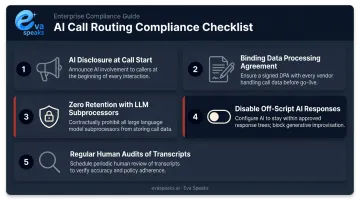
Every in-house legal team deploying AI call routing should verify the following:
- AI disclosure at call start — The system must announce it is an AI agent and that the call is recorded; this is a baseline requirement in all-party consent states (California, Florida, Illinois, Massachusetts, Pennsylvania, Washington, and others)
- Binding data processing agreement — Not just a privacy policy opt-out; a contractual prohibition on using call content for AI model training or third-party sharing
- Zero retention with underlying LLM providers — The AI vendor's subprocessors should have no right to retain or train on call content
- Disable off-script AI responses on sensitive litigation calls — Any generative feature that allows the AI to respond outside a defined script creates unpredictable disclosure risk
- Regular human audits of AI-routed call transcripts to verify routing decisions and catch privilege-sensitive content mishandled by the system
Apply these steps to any platform. Eva Speaks, for example, documents a customer opt-out from AI model training — but that is a customer-elected opt-out, not a default prohibition. In-house teams should request a binding Data Processing Agreement and confirm zero-retention terms with underlying LLM subprocessors before routing privilege-sensitive calls through any AI system.
Have questions about compliance and AI call handling? Talk to an AI Communication Expert
Second-Layer Privilege Risk: Inadvertent Disclosure
When outside counsel or employees share litigation strategy on calls processed by a non-enterprise AI tool, they may be making a disclosure to a third party — triggering privilege waiver. Legal teams should train all litigation stakeholders that AI-routed calls on approved platforms maintain privilege only when the platform has binding confidentiality protections and the communication has a clear legal purpose.
When AI Call Routing Works — and When It Does Not
Conditions That Drive Effectiveness
Routing accuracy depends on several factors in-house teams control directly:
- Script quality — Vague routing rules produce vague routing outcomes
- Escalation keyword specificity — Generic urgency terms miss context; litigation-specific terms (deposition date, injunction, hold notice) perform better
- Matter-to-attorney mapping completeness — Gaps in the mapping create misroutes
- Rule refresh cadence — Discovery-era rules will fail during trial preparation if not updated
Scenarios Where AI Routing Should Not Be Used
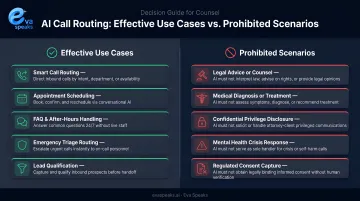
Some call types should always reach a live attorney without AI interception:
- Settlement discussions of any kind
- Joint defense communications
- Any direct contact from opposing counsel
- Calls from emotionally distressed witnesses or claimants
- Communications requiring real-time attorney judgment — privilege assertions, scope objections, consent decisions
Warning Signs That the System Is Operating Outside Its Effective Boundaries
- Routing logic has not been updated in 30+ days on an active matter
- Escalation rates are near zero — suggesting calls that should reach attorneys are being resolved by AI
- The same call type keeps looping without resolution
- No attorney has reviewed the routing configuration since the matter entered a new phase
Jurisdictional and Ethical Constraints
These operational failure points carry legal weight. At least 11 states require all-party consent for call recording, making the AI disclosure at call start a legal requirement — not just best practice.
Bar guidance reinforces this further. The ABA (Formal Opinion 512, 2024), the California State Bar, and the NYC Bar all identify supervision, confidentiality, and review of AI outputs as active ethical duties when lawyers deploy AI tools. No formal opinion has specifically addressed AI call intake as unauthorized practice of law, but the supervision obligations are unambiguous: attorneys remain responsible for what the AI handles on their behalf.
See how AI covers calls outside business hours for legal teams. See How AI Handles After-Hours Calls
Common Misconceptions
1. "AI call routing replaces attorney intake." It does not. It replaces manual administrative triage. Attorney judgment, privilege analysis, and professional responsibility apply to every routed matter. The AI handles logistics, not legal assessment.
2. "Transcripts are automatically privileged because they're internal." Privilege attaches to the substance and confidentiality of a communication: not its format or label. A transcript generated by an AI tool without appropriate enterprise data protections may be producible in discovery regardless of how it is stored or marked.
3. "Once configured, the system runs itself." Litigation matters evolve. Routing logic configured at intake becomes stale by discovery and wrong by trial. AI call routing requires ongoing maintenance tied to the litigation timeline. It is an operational process, not a one-time setup.
4. "Consumer AI tools are adequate for litigation call routing." Generic consumer tools are the highest-risk deployment scenario. They typically lack binding DPAs, do not prohibit model training on call content, and do not provide the binding confidentiality terms that privilege preservation requires.
Conclusion
AI call routing gives in-house counsel a structured, documented, and scalable process for managing the call volume litigation generates. The efficiency gains are concrete: reduced response latency, consistent intake documentation, and more reliable outside counsel coordination throughout a matter.
The risks are just as significant. Privilege breaches, privacy violations, and compliance failures from AI-handled legal communications are active litigation issues — courts are already examining them. In-house counsel who deploy AI call routing with proper enterprise data agreements, appropriately scoped escalation logic, and regular oversight will capture those efficiency gains. Those who treat it as set-and-forget infrastructure will accumulate evidentiary and regulatory exposure that compounds as the matter develops.
Configure it carefully, govern it consistently, and revisit your settings every time the matter changes scope.
Frequently Asked Questions
How are in-house legal teams using AI?
In-house teams are using AI for contract review, legal research, document drafting, matter intake, and communication management including call routing and transcription. The goal is doing more with the same team — particularly relevant given that the median legal department has just 11 staff.
What is AI call routing in the context of litigation?
AI call routing in litigation is an automated process where an AI system receives inbound calls related to active matters, classifies them by type and urgency using natural language understanding, and routes them to the correct attorney or queue, while generating a timestamped transcript for the matter file.
Does AI call routing create attorney-client privilege risks?
Yes. Secondary analyses of U.S. v. Heppner (S.D.N.Y.) identify AI-processed communications on platforms with loose data terms as potentially failing the confidentiality requirement for privilege. Enterprise platforms with binding zero-retention agreements and contractual prohibitions on model training significantly reduce this risk.
What privacy laws apply to AI call recording used in litigation?
CIPA and ECPA are the primary statutes. California's Section 632 requires all-party consent to record confidential communications. Cases like Ambriz v. Google and Taylor v. ConverseNow show that the capability to misuse call data — not proven misuse — can sustain a CIPA claim, making consent disclosures at call start a baseline requirement.
When should in-house counsel use direct attorney contact instead of AI call routing?
Settlement discussions, joint defense calls, direct contact from opposing counsel, and any communication requiring immediate attorney judgment should always bypass AI routing and reach a live attorney. These scenarios exceed what AI triage is designed to handle.