Introduction
Pricing an IVR system used to be straightforward. Now it's not — and that's causing real budget problems for businesses. The global IVR market reached $5.39 billion in 2025 and is projected to hit $7.07 billion by 2030, driven by the rapid shift from on-premise hardware to cloud and AI-powered deployments.
That shift has made IVR more accessible, but also harder to price. Cloud plans bundle IVR features into broader phone subscriptions. AI-native platforms charge per minute, per user, or per token. On-premise systems still require significant capital.
The result: businesses routinely overspend on features they don't need, or underbuild and pay for it in agent overhead.
This guide breaks down every cost component — from subscription tiers to hidden fees — so you can build a realistic IVR budget.
Key Takeaways
- Cloud IVR costs range from ~$15–$20/user/month (entry-level) to $200+/user/month (enterprise AI)
- On-premise IVR typically requires $50,000+ upfront in hardware, licensing, and customization
- Biggest cost drivers: deployment type, call volume, AI features, and integrations
- Lower monthly costs don't always win — high call volumes and AI features can shift the math toward on-premise
How Much Does an IVR System Cost?
IVR doesn't have a fixed price. The range spans from $15/user/month bundled into a basic cloud phone plan to $240+/user/month for enterprise contact center platforms with full AI capabilities. Two mistakes trip up most buyers: comparing only sticker prices, and overlooking total cost of ownership — setup fees, per-minute charges, and integration costs can significantly change the real number.
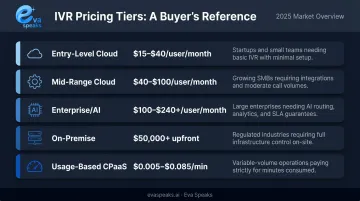
Here's how the three main pricing tiers break down:
| Tier | Typical Cost | Best For |
|---|---|---|
| Entry-level cloud IVR | $15–$40/user/month | SMBs, startups, low-to-moderate call volume |
| Mid-range cloud IVR | $40–$100/user/month | Growing teams, contact centers needing CRM integration |
| Enterprise / AI IVR | $100–$240+/user/month | Large enterprises, complex routing, high compliance needs |
| On-premise IVR | $50,000+ upfront | Organizations requiring on-site infrastructure control |
| Usage-based (CPaaS / pay-per-minute) | $0.005–$0.085/minute | Variable-volume businesses, developer-built IVR |
Entry-Level IVR
Entry-level plans bundle IVR into a broader VoIP subscription rather than selling it as a standalone product. Features typically include:
- Basic DTMF call routing with single or multi-level menus
- Standard greetings and voicemail
- Limited analytics and minimal third-party integrations
According to Business.com, entry-level plans with IVR start at $15–$20/user/month, with stronger multi-level IVR and analytics available in the $25–$40/user/month range.
This tier suits small businesses that need a professional call experience without committing to a full contact center platform.
Mid-Range IVR
Mid-range platforms add meaningful depth over entry-level options. Common features include:
- Multi-level IVR menus with visual call flow builders
- Call recording and voicemail transcription
- CRM and help desk integrations
- Call flow analytics and some AI-assisted routing
CloudTalk, for example, offers plans from $25–$49/user/month (billed annually) with 95+ integrations available on higher tiers.
This tier fits growing teams that need smarter routing and real visibility into call performance.
High-End / Enterprise IVR
Enterprise platforms are built for scale and compliance. Feature sets typically cover:
- AI-driven call routing and natural language processing
- Speech analytics and omnichannel support
- Workforce management tools and custom API development
Pricing reflects that scope: Genesys Cloud CX runs $75–$240/user/month; NICE CXone ranges from $71–$249/user/month.
AI-native solutions like EvaSpeaks go further — combining LLM integration, customizable call-flow scripts, and real-time AI responses to handle calls conversationally without rigid menu trees. EvaSpeaks sits in this tier but is designed to be accessible beyond large enterprise accounts: businesses can configure it through a dashboard interface without needing custom software development, which is one reason it appeals to organizations that want conversational AI without committing to a full contact center platform.
This tier is the right fit for large enterprises with complex routing logic, strict compliance requirements, or a need for genuine self-service automation beyond basic touch-tone menus. You can Watch AI Call Flow Demo to see how conversational AI handles a real inbound call without touch-tone navigation.
How the Three Main Options Compare on Total Cost of Ownership
Here is how entry-level IVR, enterprise IVR, and AI-native platforms compare on total cost of ownership:
| AI-Native (EvaSpeaks) | Entry-Level Cloud IVR | Enterprise On-Premise IVR | |
|---|---|---|---|
| Pricing Model | Flat monthly ~$99–$300, unlimited calls | $100–$500/month + per-minute | $50,000+ upfront + annual maintenance |
| Best-fit Business Size | SMB to mid-market | SMB | Large enterprise |
| Key Strengths | No overages, instant setup, conversational AI | Low entry cost | Full control, maximum features |
| Implementation Complexity | Low - hours | Low to Medium | High - months + IT team |
| Integration Capability | CRM, scheduling, EHR out-of-box | Limited, add-on cost | Custom dev required |
Key Factors That Affect IVR System Cost
Several compounding variables drive IVR pricing — and knowing which ones apply to your situation helps you avoid overpaying for features you won't use, or cutting corners on ones that matter.
Deployment Type
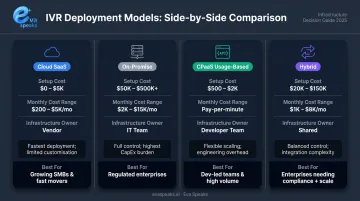
The deployment model is the single biggest cost driver:
- Cloud IVR (SaaS): Low setup costs ($0–$1,000), predictable monthly fees ($25–$100/month for standalone; $60–$200/agent/month for contact center platforms). Vendor manages infrastructure and updates.
- On-premise IVR: Hardware runs $10,000–$30,000; software licensing starts at $5,000+; customization and development adds $5,000–$50,000+. Total initial investment frequently exceeds $50,000.
- CPaaS (usage-based): $15–$50/user/month plus per-minute usage fees. Twilio charges $0.0085/min for inbound and $0.0140/min for outbound local calls — but adding AI virtual agents brings that to $0.085/min.
- Hybrid: Combines cloud and on-premise components. Hybrid IVR tends to fall between the two in cost but often carries additional integration expenses.
Organizations that switch from on-premise to cloud IVR report 25–40% lower total cost of ownership, largely due to eliminated hardware refresh cycles and reduced IT overhead. EvaSpeaks represents this cloud-hosted approach: there is no hardware to procure, no on-premise software to maintain, and call-flow scripts can be updated through the admin dashboard — all of which reduces infrastructure dependencies compared to self-hosted enterprise systems. You can See How AI Handles After-Hours Calls to understand how a cloud-hosted AI platform manages after-hours coverage without any manual toggling.
Call Volume and Number of Users
Pricing model choice directly affects cost predictability:
- Per-user pricing suits teams with steady headcount — costs are fixed and foreseeable
- Per-minute pricing suits businesses with irregular or low call volumes — you only pay for what you use
- The catch: At high call volumes, per-minute billing often exceeds what a flat subscription would cost. A business handling 50,000 minutes/month at $0.085/min pays $4,250 — potentially more than an equivalent flat-rate plan
AI Features and Customization
Once you've settled on a billing model, the next variable is feature tier. Basic DTMF IVR is the cheapest option — the jump to AI-powered NLP carries a real cost premium:
- Standard programmable voice: $0.0085–$0.0140/min
- Conversational AI with Dialogflow CX: $0.085/min
- GenAI features add-on: $0.00283/sec
- CloudTalk AI Voice Agents: from ~$109/month for 200 minutes; ~$384/month for 1,000 minutes (vendor pricing in EUR; USD equivalents approximate)
Deep customization — multi-language support, branded voice prompts, conditional call flow logic — adds both one-time setup fees and ongoing maintenance costs on top of base pricing.
Integration Requirements
Integrations rarely come free:
- Salesforce Voice integration via Aircall: $30/user/month on top of your base plan
- AI features (sentiment analysis, call summaries) on Salesforce Voice: $9/user/month additional
- CloudTalk includes 95+ standard integrations on Essential and Expert tiers; lower tiers require an upgrade
- Twilio-based custom integrations require developer hours — often the largest hidden cost for CPaaS deployments
Support and SLA Tier
Enterprise-grade support adds to total cost but matters considerably for regulated industries:
- Basic plans typically offer email/chat support only
- Premium tiers include guaranteed SLAs (99.9%+ uptime), dedicated account managers, and priority response
- Healthcare, finance, and legal businesses often require HIPAA or PCI-compliant configurations — these may be priced separately or restricted to higher-tier plans
Complete IVR Cost Breakdown
The monthly subscription is one line item. Here's the full picture:
| Cost Component | Type | What It Covers |
|---|---|---|
| Base subscription / license | Recurring (cloud) or one-time (on-premise) | Per-user monthly fee or server/software purchase |
| Implementation & configuration | One-time | Call flow design, prompt creation, routing rules, CRM connection — cloud runs $0–$1,000; on-premise runs $5,000–$50,000+ |
| Ongoing operational costs | Recurring | Per-user fees, per-minute charges, add-on AI modules, DID/telephony number fees |
| Maintenance & updates | Recurring (cloud = included; on-premise = extra) | IT staff, software update licenses, hardware refresh cycles |
| Compliance & certifications | Periodic | HIPAA, PCI, GDPR configurations — especially relevant for healthcare and financial services |
Cloud IVR consolidates most of these into the subscription. On-premise systems require budgeting each line separately, and IT labor costs frequently match or exceed the software expense over a 3–5 year horizon.
Low-Cost vs. High-Cost IVR — What's the Difference?
Both options route calls — but the gap in capability, scale, and long-term cost is significant. Here's how they stack up across the factors that matter most.
Functionality
- Fixed DTMF menus (press 1, press 2) with no flexibility — if a caller's need doesn't match the menu tree, they abandon the call. (Low-cost)
- Callers speak naturally; the system understands intent, handles common requests without agent involvement, and routes complex calls with context already captured. (High-cost)
Scalability and Reliability
- Suitable for low-to-moderate volumes; SLAs may not guarantee high uptime, and multi-level menu support is limited. (Low-cost)
- Built for enterprise scale with redundancy and failover; SLAs typically guarantee 99.9%+ uptime with dedicated support. (High-cost)
Long-Term ROI
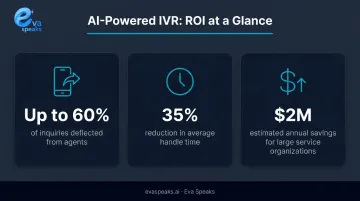
Financial institutions using conversational IVR deflect up to 60% of inquiries from agents and reduce average handle time by 35%. One large service organization saved an estimated $2 million annually after upgrading its IVR and achieved a 30% increase in first-call resolution.
Low-cost IVR looks cheaper upfront, but higher abandonment rates, more agent escalations, and limited analytics create operational costs that rarely show up in the initial budget. To see how Eva Speaks compares for your specific call volume, you can Request Live Demo.
How to Estimate the Right IVR Budget for Your Business
The goal isn't to find the cheapest IVR — it's to find the one that fits your call volume, customer experience goals, and operational structure.
Before Setting a Budget, Evaluate These Factors
Call volume and team size:
- Estimate your average monthly call volume
- Count the agents who will use the system
- This determines whether per-user or per-minute pricing saves you money
Required features vs. nice-to-haves:
- Essential: call routing, CRM integration, basic analytics
- Aspirational: AI NLP, sentiment analysis, omnichannel
- Map these before choosing a tier — aspiring to enterprise features you won't use for 18 months wastes budget now
Long-term cost of ownership:
- Add up implementation, integration, training, and maintenance — not just the monthly fee
- A $25/user/month plan with $30/user/month in integration add-ons can easily exceed a $50/user/month plan with integrations included
Common Budgeting Mistakes
- Only comparing subscription prices without accounting for per-minute overages, integration fees, or setup costs
- Over-specifying — selecting enterprise AI features when a well-configured mid-tier cloud IVR fully covers the need
- Choosing on price alone without checking reliability, compliance fit, or support quality — especially risky in healthcare, finance, or legal
These mistakes compound when evaluating AI-native platforms, where pricing structures differ significantly from traditional IVR tiers.
A Note on AI-Native IVR
AI-native platforms like Eva Speaks combine LLM integration, customizable call-flow scripts, and real-time response handling in a single system. The subscription cost is typically higher than a basic cloud IVR — but the comparison changes when you factor in avoided agent labor. A platform that resolves 30–40% more calls without human intervention can offset a meaningful portion of that premium. When evaluating AI-native options, calculate total cost including deflection savings, not just the monthly fee. If you want help building that calculation for your specific situation, you can Get a Customized Workflow Recommendation based on your actual call volume and feature needs.
Frequently Asked Questions
How much does an IVR system cost?
Cloud-based IVR typically ranges from $15–$20/user/month for basic plans to $200+/user/month for enterprise AI platforms. On-premise deployments often require $50,000+ upfront in hardware, licensing, and customization. Most SMBs access IVR as part of a broader cloud phone or contact center subscription.
What is IVR routing?
IVR routing directs callers to the appropriate agent, department, or self-service option based on their keypad inputs or spoken responses. Advanced systems use AI-driven intent recognition to interpret natural language and route calls dynamically, without requiring callers to navigate a fixed menu tree.
What is hosted IVR?
Hosted IVR (also called cloud-based IVR) runs on a third-party provider's servers rather than your own hardware. You access it via subscription, with no on-site infrastructure required. The vendor manages maintenance, updates, and uptime — typically at significantly lower upfront cost than on-premise alternatives.
What is the difference between on-premise and cloud-based IVR?
On-premise IVR requires purchasing, installing, and maintaining hardware and software in-house, giving you greater infrastructure control at a higher upfront cost. Cloud-based IVR runs on vendor servers via subscription with lower upfront cost, faster setup, and vendor-managed maintenance. Most businesses moving to cloud IVR report 25–40% lower total cost of ownership.
Does AI-powered IVR cost more than traditional IVR?
Yes — AI IVR carries a higher per-user or per-minute cost than basic DTMF systems. But the ROI case is strong: conversational IVR can deflect up to 60% of inquiries from agents and reduce average handle time by 35%, making the premium worthwhile for businesses handling 500+ calls per month.
Are there hidden costs to IVR systems?
Common hidden costs include:
- Implementation and call-flow configuration fees
- Per-minute overage charges on usage-based plans
- CRM and third-party integration fees
- Training and onboarding
- Ongoing IT maintenance and hardware refresh cycles (on-premise only)
Always calculate total cost of ownership, not just the subscription price.