Introduction
A high-priority lead calls during peak hours. They get transferred twice, wait through generic hold music, and hang up before reaching anyone useful. The culprit is almost always routing, not staffing.
Cloud-based call routing software solves this by automating how incoming calls move through your organization. Instead of relying on manual transfers and tribal knowledge about who handles what, the system directs callers to the right agent, queue, or department based on configurable rules, before a human even picks up.
According to Metrigy's 1H25 report, 50.4% of businesses using a phone system now run entirely on UCaaS — cloud routing isn't a niche upgrade anymore. It's the standard.
This article breaks down what cloud call routing actually is, compares the top platforms available in 2026, and explains how to choose one based on business outcomes rather than a spec-sheet comparison.
See how cloud-based routing works on a live call. Watch AI Call Flow Demo
Key Takeaways
- Cloud-based call routing uses VoIP to direct calls automatically based on rules like agent availability, skills, time of day, or caller intent
- Core routing types: round robin, cascade, skills-based, simultaneous ring, and idle time, each suited to a different team structure
- Pricing ranges from $15–$75+/user/month depending on AI features, routing complexity, and plan tier
- Eva Speaks leads for AI-first call handling with LLM integration and customizable routing scripts
- RingCentral suits high-volume enterprises; CloudTalk fits growing global teams
- Prioritize routing flexibility, CRM integration depth, and whether AI features are included in base plans or billed separately
What Is Cloud-Based Call Routing Software?
Cloud-based call routing is a phone management system hosted over the internet (VoIP) that automatically directs incoming calls to the right agent, queue, or department. No hardware or on-site PBX is required, and routing rules can be updated instantly from any browser.
The Five Core Routing Types
Each routing strategy fits a different operational model:
| Routing Type | How It Works | Best For |
|---|---|---|
| Simultaneous ring | All agents ring at once; first to answer wins | Small teams where speed matters most |
| Cascade / fixed order | Agents ring one at a time in a set sequence | Teams with a clear agent hierarchy |
| Round robin | Calls rotate evenly across agents | Sales teams distributing leads fairly |
| Idle time / longest idle | Rings the agent who's been free the longest | Busy support teams with variable call lengths |
| Skills-based | Routes based on defined agent competencies | Support teams handling specialized topics |
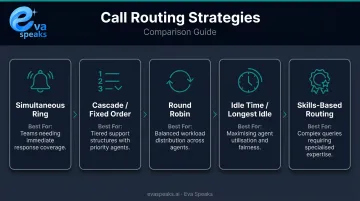
AI-powered platforms take this further by interpreting what a caller actually says, routing based on intent rather than which number they pressed in a menu.
These capabilities are standard expectations, not extras. Gartner's UCaaS category definition classifies IVR, hunt groups, auto attendants, and call transfer as core components of cloud communication platforms.
Best Cloud-Based Call Routing Software Compared (2026)
These five platforms were evaluated across six criteria:
- Routing strategy variety and configurability
- AI capabilities (native vs. add-on)
- CRM integration depth
- Pricing transparency
- Uptime reliability
- Scalability across business sizes
Eva Speaks
Eva Speaks is a Hayward, CA-based AI communication platform built for businesses that want intelligent, automated call handling without building a traditional call center. The platform integrates with large language models (LLMs) alongside text-to-speech (TTS) and speech-to-text (STT) technologies to handle calls, generate transcriptions, and execute customizable routing scripts in real time.
The core differentiator: EvaSpeaks operates beyond rule-based routing. Its conversational AI handles incoming calls, interprets caller needs, and routes accordingly, making it a fit for businesses that need consistent, 24/7 call coverage without adding headcount. EvaSpeaks is also designed to integrate with existing phone infrastructure rather than replace it — businesses can connect it to their current number and start receiving AI-handled calls without a platform migration. Customers configure call-flow scripts, routing rules, and office hours to match their operational structure, with support for third-party platform integrations.
| Feature | Details |
|---|---|
| Key Features | AI-enabled call handling and transcription, LLM integration with TTS/STT, customizable call-flow scripts, routing rule configuration, real-time AI responses |
| Pricing | Contact Eva Speaks for current pricing at evaspeaks.ai |
| Best For | US businesses seeking AI-first communication with customizable routing and automated call handling |
RingCentral
RingCentral has been in the cloud communications market since 1999 — one of the longest track records in UCaaS. Its RingEX platform combines voice, video, SMS, and team chat with enterprise-grade routing, including a drag-and-drop visual editor supporting up to 250 IVR voice menus per account.
The platform backs its reliability with a published 99.999% uptime SLA (less than six minutes of downtime per year), which matters for high-volume operations where missed calls translate directly to lost revenue.
| Feature | Details |
|---|---|
| Key Features | Multi-level IVR (up to 250 menus), advanced call routing, call recording, AI summaries and transcription, 200-participant video meetings, CRM integrations |
| Pricing | Core: $20/user/mo · Advanced: $25/user/mo · Ultra: $35/user/mo (annual billing; AI Receptionist available as add-on) |
| Best For | Mid-to-large enterprises needing unified communication with robust routing and proven uptime |
CloudTalk
CloudTalk launched in 2016 and now serves over 4,000 businesses with local number coverage across 160+ countries. Its Call Flow Designer offers more than 20 routing options, and its AI voice agent product — CeTe — handles inbound and outbound calls in 60+ languages with real-time escalation to human agents when needed.
G2 currently shows 1,750+ user reviews for CloudTalk, with consistent recognition for ease of use and call quality among SMBs.
| Feature | Details |
|---|---|
| Key Features | Call Flow Designer (20+ routing options), AI voice agents (CeTe, 60+ languages), skills-based and round robin routing, real-time analytics, CRM integrations (HubSpot, Salesforce, Pipedrive), local numbers in 160+ countries |
| Pricing | Starter: €25/user/mo · Essential: €29/user/mo · Expert: €49/user/mo (Euro-denominated; annual billing — 14-day free trial available) |
| Best For | SMBs and growing sales/support teams scaling globally with complex call flow requirements |
Dialpad
Founded in 2011, Dialpad includes AI transcription and call summaries across every plan at no extra cost — a meaningful distinction in a market where AI features are often billed as premium add-ons. The platform supports four routing strategies at the department level: fixed order, round robin, longest idle, and simultaneous.
AI features cover live coaching during calls, post-call summaries, and transcription in 9 languages including Spanish, French, Japanese, and German.
| Feature | Details |
|---|---|
| Key Features | Four routing types per department, AI transcription and summaries (all plans), multi-level IVR, CRM integrations (Pro plan), real-time analytics, local numbers in 70+ countries |
| Pricing | Standard: $15/user/mo · Pro: $25/user/mo (annual billing) |
| Best For | Mid-size teams wanting flexible routing with built-in AI at no additional cost |
Nextiva
Nextiva serves 100,000+ businesses and covers voice, video, SMS, team chat, and virtual faxing under one platform. Its sequential and simultaneous ring groups handle call distribution, while the XBert AI Receptionist manages 24/7 autonomous call handling at $99/month for up to 100 interactions (additional interactions at $0.99 each).
HIPAA-compliant virtual faxing and 24/7 customer support on every plan make Nextiva a natural fit for healthcare, legal, and professional services teams with strict compliance requirements.
| Feature | Details |
|---|---|
| Key Features | Sequential and simultaneous ring groups, multi-level auto attendant, XBert AI Receptionist (add-on), voicemail transcription, HIPAA-compliant virtual faxing, video conferencing, CRM integrations |
| Pricing | Core: $15/user/mo · Engage: $25/user/mo · Scale: $75/user/mo (annual; XBert add-on: $99/mo per 100 interactions) |
| Best For | Healthcare, legal, and professional services teams with compliance needs and multi-channel requirements |
Want routing configured for your call types? Get a Customized Workflow Recommendation
Here is how AI-native, traditional cloud, and on-premise call routing solutions compare:
| AI-Native Cloud (EvaSpeaks) | Traditional Cloud Routing | On-Premise Routing | |
|---|---|---|---|
| Features | Conversational AI routing, intent detection, real-time rules | ACD, skill-based routing, IVR | Fixed dial plans, limited flexibility |
| Best-fit Business Size | SMB to mid-market | Mid-market to enterprise | Large enterprise with IT resources |
| Key Strengths | Easy to update, no IT team needed, scales instantly | Proven, robust features | Maximum control |
| Implementation Complexity | Low - no-code, hours | Medium - weeks | High - months |
| Integration Capability | CRM, scheduling, EHR native | CRM via API, varies | Custom dev required |
How to Choose the Right Call Routing Platform
The most common mistake buyers make: evaluating platforms on feature count rather than routing outcomes. A long checklist often leads to an overcomplicated system that reproduces the same missed-call problems as legacy PBX — just with a new interface.
Start With These Questions
Before comparing vendor screenshots, answer these first:
- Which routing strategies does your team actually need — and at which plan tier are they available?
- Is AI included or an add-on? Dialpad includes it in every plan. Nextiva and CloudTalk charge separately for AI agents.
- How deep are the CRM integrations? Surface-level integrations that only log calls add little value. Look for bi-directional data sync.
- What's the uptime guarantee? RingCentral publishes a 99.999% SLA. Others vary — check the fine print before signing.
Key Evaluation Criteria
Metrigy's 2024 research confirms that reliability and service quality remain the top decision factor for IT leaders selecting collaboration platforms — not AI novelty. That priority order should anchor your evaluation.
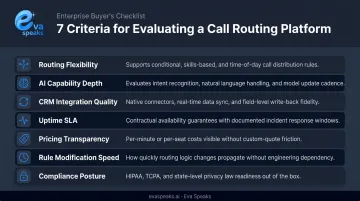
Rank platforms against these factors:
- Routing flexibility: how many strategies are supported, and at which plan level
- AI capability depth: native vs. bolt-on, and what it actually does (transcription vs. full call handling)
- CRM integration quality: which systems, at which tier, and how deeply data syncs both ways
- Uptime SLA — published guarantee versus informal assurance
- Pricing transparency — total cost including add-ons, not just the base per-user rate
- How quickly routing rules can be modified without IT involvement
- Compliance posture: encryption standards, HIPAA attestation, and GDPR coverage where relevant
Two factors often underweighted at the shortlist stage: whether real-time analytics surface actionable data (not just call volume counts), and whether vendor support hours align with your team's — not just business hours in their time zone.
See how other businesses are using cloud call routing. See Industry Use Cases
Conclusion
Choosing a cloud-based call routing platform is an operational decision with real business consequences. The right system reduces missed calls, eliminates manual transfers, and gives managers real visibility into how every call is handled — in real time.
Before committing, test the platform against your actual call flows, not polished vendor demos. Prioritize routing flexibility, CRM integration depth, and total cost including AI add-ons.
For businesses that want AI-first call handling built around customizable routing scripts and real-time conversational AI, Eva Speaks is built specifically for that use case — visit evaspeaks.ai to see how the platform handles your specific call flows.
Frequently Asked Questions
How much does a VoIP phone system cost for a small business?
Most small business VoIP plans run $15–$35/user/month on annual billing. G2 puts the typical range at $25–$35 per line monthly, with entry-level plans from Dialpad and Nextiva starting at $15/user/month. Costs increase with AI features, international numbers, and CRM integrations.
How much does an AI phone system cost?
AI-enabled business phone plans generally run $25–$75+/user/month. Some platforms include AI features like transcription and summaries in base plans — Dialpad does — while others charge separately. Nextiva's XBert AI Receptionist is $99/month per 100 interactions, and CloudTalk's AI agent starts at €99/month (approx. $109/month) as an add-on.
Is a cloud phone better for remote work?
Yes — cloud phone systems are designed for distributed teams. Calls route to any device over the internet using the same logic and analytics regardless of where agents are located. There's no on-site hardware dependency, and routing rules apply uniformly across home offices, offices, and mobile workers.
What is an AI business phone system?
An AI business phone system uses artificial intelligence to automate call handling, routing, and transcription. Unlike basic IVR menus that follow rigid scripts, AI systems interpret caller intent and respond dynamically — handling more scenarios autonomously without a human agent.
Can an AI receptionist handle calls?
Yes. AI receptionists can greet callers, answer common questions, take messages, route calls, and in some cases book appointments — operating around the clock without additional staffing. Platforms like Eva Speaks, Nextiva (XBert), and CloudTalk (CeTe) all offer AI receptionist functionality with varying degrees of customization.
What is a multi-line phone system?
A multi-line phone system allows multiple calls to be handled simultaneously across a single business number or multiple lines. Cloud-based versions manage this through virtual queues and routing rules — no physical hardware required — distributing volume automatically based on the business's configured routing strategy.