Introduction
Running a small business means wearing a dozen hats at once. When a customer calls and no one picks up, that's not just a missed call. It's a missed sale and, often, a lost customer relationship.
Large enterprises have had an answer to this problem for years: sophisticated call center technology with intelligent routing, 24/7 coverage, and real-time analytics. For most small businesses, that infrastructure was simply out of reach — the cost and complexity made it a non-starter.
AI-powered VoIP is closing that gap, putting enterprise-grade communication capabilities within reach of businesses with five employees or fifty. Smart call handling, automated routing, live transcription, and sentiment analysis are no longer premium add-ons reserved for large contact centers.
This guide breaks down what AI actually does inside a modern VoIP system, why it matters for small business owners specifically, and how to evaluate whether it's the right move for your operation.
Key Takeaways
- AI-powered VoIP goes beyond basic calling with smart routing, virtual assistants, transcription, and sentiment analysis built in
- Small businesses gain 24/7 call coverage and faster customer resolution without hiring additional staff
- AI adoption among small businesses surged 41% in 2025, with most users reporting measurable savings in time and money
- Modern platforms are built for non-technical users, with setup that requires no IT expertise or specialized hardware
Why Small Businesses Need AI-Powered VoIP Now
For years, there's been a real gap between how large companies handle customer calls and how small businesses manage. Enterprise contact centers use predictive analytics, skills-based routing, and round-the-clock staffing. Small businesses answer the phone when someone's available — and hope for the best when they're not.
That gap has direct consequences. According to Qualtrics and ServiceNow research, 43% of U.S. adults are at least somewhat likely to switch brands after a single bad customer service interaction, and 54% will hang up after five to ten minutes on hold. Poor customer experiences put an estimated $4.7 trillion in global annual revenue at risk each year.
The Staffing Reality
Small business owners and their teams are already stretched. Answering every call, following up consistently, and analyzing call data requires dedicated resources that most SMBs simply don't have.
AI handles these tasks without adding headcount:
- Answers common FAQs without tying up staff
- Routes calls to the right person automatically
- Captures messages and call data for follow-up
- Frees the team for work that actually requires a human
The Adoption Signal Is Clear
Small businesses are responding. A 2025 Thryv survey of 540 SMB decision-makers found AI use among small businesses jumped from 39% to 55% in a single year — a 41% increase. Among businesses with 10 to 100 employees, adoption rose from 47% to 68%.
The outcomes back up the investment. Salesforce's 2024 SMB survey found that among SMBs already using AI:
- 91% said AI boosts revenue
- 86% reported improved margins
- 87% said AI helps them scale operations
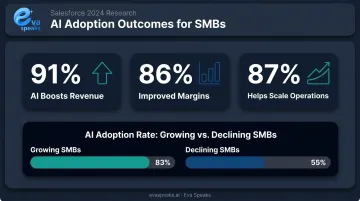
Growing businesses had higher AI adoption (83%) than declining ones (55%). For small businesses evaluating VoIP upgrades, that gap in outcomes is exactly where AI-powered communication tools are making the difference.
Key AI Capabilities Reshaping Small Business VoIP
AI-Powered Call Handling and Virtual Assistants
Traditional IVR menus ("Press 1 for sales, press 2 for billing") are a dead end for callers who don't fit neatly into predefined options. AI virtual assistants work differently.
Using natural language processing (NLP), they interpret what a caller actually says. A caller asking "I need to reschedule my appointment" doesn't need to navigate a menu — the system understands the intent and acts on it. As IBM notes, NLP-based natural language understanding converts spoken requests into structured data that the system can act on, rather than forcing callers through rigid menu trees.
The practical applications for small businesses include:
- Answering frequently asked questions without staff involvement
- Booking or modifying appointments
- Capturing caller details and routing messages to the right person
- Escalating complex or sensitive calls to a human agent when needed
24/7 availability is where this capability pays off most for small businesses. No front desk staff after 5pm? An AI call handling system keeps responding. Eva Speaks, for example, provides AI-enabled call answering with real-time AI responses and configurable call-flow scripts, allowing businesses to set up exactly how calls are handled — no technical background required.
Intelligent Routing, Transcription, and Analytics
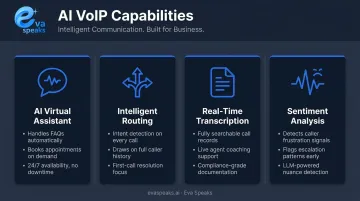
Beyond call handling, AI reshapes how calls are directed and analyzed. Static menu-based routing sends every caller through the same path regardless of context. AI routing evaluates intent, caller history, and available resources to connect the right caller with the right person on the first try. EvaSpeaks illustrates this in practice: rather than requiring a business to build a complex routing tree, the platform uses LLM integration to interpret what a caller is asking and route accordingly — a much lighter lift compared to enterprise contact center platforms that require dedicated IT staff to configure and maintain.
NICE describes AI call routing as using real-time data, intent detection, and predictive models rather than fixed rules — fewer transfers, shorter wait times, and less caller frustration.
Real-time transcription converts calls to searchable text as they happen. This gives small businesses capabilities that previously required a dedicated QA team:
- Review conversations for service quality
- Coach employees using actual call examples
- Maintain records for compliance purposes
- Search past calls when a customer references a previous interaction
Aircall's 2023 SMB research found that 71% of employees believed transcribing and recording calls would improve the value of phone calls, and AI was expected to save 25% of the time currently spent on manual transcription and note-taking.
Sentiment analysis adds another dimension. NLP-based emotion detection identifies when a caller's tone shifts toward frustration, allowing staff to adjust their approach mid-call or flag patterns across multiple interactions. Platforms that integrate large language models (LLMs) can deliver more contextually aware responses during live calls. Eva Speaks uses this approach to catch nuance that simpler rule-based systems miss entirely.
Watch how AI-enhanced VoIP handles a real small business call. Watch AI Call Flow Demo
Real Business Benefits: From Customer Experience to Cost Savings
Better Customer Experiences at Every Touchpoint
Inconsistent service is one of the most common small business pain points. Whether a caller reaches an experienced team member or a newer employee, the experience varies. AI-powered call flows create consistency: every caller gets a professional, structured interaction regardless of time, day, or staffing level.
AI routing and virtual assistants also improve first-call resolution. When callers reach the right person immediately — without being transferred twice — they spend less time waiting and more time getting their issue resolved.
The stakes for getting this wrong are high. The same Qualtrics research found that 80% of customers had switched brands due to poor customer experience, and poor CX puts an estimated $4.7 trillion in global annual revenue at risk each year.
Measurable Efficiency and Cost Gains
The efficiency gains from AI VoIP aren't theoretical. SMB employees in Aircall's research reported spending an average of 20.8 hours per workweek on administrative tasks — with AI expected to cut manual data entry time by 28% and transcription time by 25%.
Those time savings translate directly to the bottom line. Thryv's 2024 survey found that among small businesses already using AI:
- More than half expected $500 to $2,000 in monthly savings
- 73% cited potential time savings of up to 20 hours per month
Looking further ahead, Gartner forecasts that by 2029, agentic AI will autonomously resolve 80% of common customer service issues without human involvement, contributing to a 30% reduction in operational costs. Platforms like EvaSpeaks are already moving in this direction — handling inbound call answering, AI routing, and call transcription as a bundled service that small businesses can configure without specialized technical teams, which is why the industry trend favors this kind of accessible AI deployment over monolithic systems.
Those cost reductions assume the calls happening are legitimate — and that's where fraud protection matters. The Communications Fraud Control Association reported that telecom fraud increased 12% in 2023, with estimated global losses of $38.95 billion — roughly 2.5% of total telecom revenues. AI anomaly detection continuously monitors call patterns for unusual spikes, suspicious routing behavior, or irregular access attempts. Rule-based systems catch known threats; AI catches the ones that don't match any prior pattern.
See how AI covers your calls after business hours. See How AI Handles After-Hours Calls
How AI-Enhanced VoIP Compares to Standard VoIP and Traditional Landlines
Here is how AI-enhanced VoIP, standard VoIP, and traditional landline compare for small business communications:
| AI-Enhanced VoIP (EvaSpeaks) | Standard VoIP (RingCentral, Ooma) | Traditional Landline | |
|---|---|---|---|
| Features | AI answers calls, routes, schedules, CRM sync, 24/7 | VoIP calling, voicemail, basic IVR | Fixed-line calling, voicemail |
| Best-fit Business Size | 1-50 person businesses | Any size | Very small businesses |
| Key Strengths | No missed calls, AI handles overflow, predictable | Flexible, mobile-ready, feature-rich | Reliable, no internet required |
| Implementation Complexity | Low - hours | Low to Medium | Low |
| Integration Capability | CRM, scheduling, EHR native | Varies by provider | None or limited |
Getting Started: How Small Businesses Can Adopt AI VoIP
The most common mistake SMBs make when adopting new technology is trying to use everything at once. AI VoIP works better as a phased rollout.
Step 1: Identify Your Biggest Pain Point
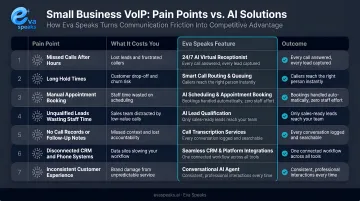
Start by mapping your current communication problems to specific AI capabilities:
| Pain Point | AI VoIP Feature to Prioritize |
|---|---|
| Missed calls after hours | 24/7 AI call handling |
| Callers reaching the wrong person | Intelligent call routing |
| Inconsistent service quality | Customizable call-flow scripts |
| Staff time lost to manual follow-up | Automated transcription + summaries |
| No visibility into call performance | Analytics and call recording |
Step 2: Know What to Look for in a Platform
When evaluating AI VoIP options, focus on:
- Ease of setup — can a non-technical owner configure call flows without outside help?
- Customizable routing rules — can you define when AI handles a call versus escalating to staff?
- LLM integration — platforms built on large language models handle conversational nuance better than simpler rule-based systems
- CRM or scheduling integrations — does it connect with tools you're already using?
- Transparent pricing — is it clear what you get at each tier?
Step 3: Reframe What AI Actually Does
A common concern is that AI replaces human interaction. It doesn't — at least not the interactions that matter. AI takes on the repetitive work — fielding the same FAQ repeatedly, routing calls to the right person, capturing messages after hours. That frees your staff to focus on conversations that actually require judgment, empathy, or expertise.
Want VoIP and AI configured for your small business? Get a Customized Workflow Recommendation
What's Next: The Future of AI in Small Business Communications
The capabilities available today are just the starting point. Several developments are worth watching:
- Real-time voice translation — serving multilingual customers without hiring multilingual staff
- Deeper CRM automation — AI auto-populating customer records and suggesting follow-up actions after every call
- Predictive call volume forecasting — helping small teams staff appropriately before a busy period hits
- Autonomous system optimization — routing rules and service configurations that self-adjust based on performance data, with minimal manual input
Gartner forecasts that by 2028, at least 70% of customers will start their service journey through a conversational AI interface. That shift will happen whether small businesses are ready for it or not.
That customer behavior shift is already showing up in business results. Salesforce research found that growing SMBs had significantly higher AI adoption (83%) than declining ones (55%) — and the businesses using AI reported stronger revenue, better margins, and greater capacity to scale. AI VoIP is no longer just a competitive edge; it's becoming the baseline expectation. The window for early adoption is narrowing.
Frequently Asked Questions
What is AI-powered VoIP and how is it different from regular VoIP?
Traditional VoIP converts voice calls over the internet instead of analog phone lines. AI-powered VoIP layers intelligent automation on top — smart routing, virtual assistants, live transcription, and sentiment analysis — with systems that learn from call data and improve over time.
Is AI VoIP affordable for small businesses?
Modern AI VoIP platforms are built for SMB budgets, typically offered as monthly per-user subscriptions. For context, the U.S. Bureau of Labor Statistics reports the median hourly wage for receptionists was $17.90 in May 2024. AI call handling typically costs a fraction of that equivalent staffing expense.
Can AI VoIP replace a human receptionist for my small business?
AI handles routine tasks well: answering FAQs, routing calls, booking appointments, capturing messages. Complex, sensitive, or relationship-driven conversations are escalated to human staff.
What are the most useful AI VoIP features for small businesses?
The highest-impact features for most SMBs are 24/7 AI call handling, intelligent routing, real-time transcription, and sentiment analysis. Which matters most depends on your biggest challenge: missed calls, inconsistent service, or time lost to manual follow-up.
How does AI improve call quality in a VoIP system?
AI continuously monitors network performance metrics and applies noise cancellation and bandwidth optimization in real time. This reduces call drops, background noise, and audio disruptions before they affect the caller's experience.
How difficult is it to set up AI VoIP for a small business?
Most modern platforms, including Eva Speaks, are built for non-technical users. Call-flow scripts, routing rules, and office hours are all configurable without IT expertise, and most small businesses are operational within days of signing up.