Introduction
Yes — AI receptionists can book dental appointments. Not just take a message and hope someone calls back, but confirm a slot, update the schedule, and complete the booking before the call ends.
Dental front desks are stretched across check-ins, payments, insurance questions, and in-person patients — the phone loses that competition constantly. The ADA has flagged that practices missing more than 20% of incoming calls risk losing those patients to competitors, with some high-volume offices losing 30–50% of initial prospective contacts.
Every unanswered call is a patient who may book somewhere else — and that's exactly the gap AI receptionists are built to close.
This guide covers how AI receptionists work for dental offices, what they can and can't do, what genuine scheduling integration looks like, and how to evaluate vendors before committing.
TLDR: Key Takeaways
- AI receptionists can book, reschedule, and cancel appointments directly — no callback required
- They work 24/7, covering peak hours, lunch breaks, evenings, and weekends
- Real-time PMS integration determines whether the AI actually books appointments or just takes messages
- They handle routine call volume so your front desk can focus on patients in the room
- Pricing starts well under $100/month, compared to $43,450 annual mean wages for dental office receptionists
Why Dental Practices Miss So Many Calls
A dental receptionist fielding a call while checking in a patient, processing a payment, and answering a billing question from someone at the window isn't ignoring the phone on purpose. The phone is just the easiest thing to defer. Voicemail exists, so the call feels recoverable — even when it isn't.
The timing makes it worse. Peak call windows tend to cluster at the same times the front desk is at maximum capacity: Monday mornings after a weekend of dental discomfort, the lunch hour when working patients have a free moment, and late afternoon before closing. These are also the hours with the least staff bandwidth.
The ADA notes that a phone call is still typically the first point of contact a prospective patient has with a practice — and advises answering by the third ring. For many practices, that's a standard they can't consistently meet.
Those missed calls carry a real cost. The ADA's Health Policy Institute reported average annual per-patient dental expenditures of $685, with higher-utilization patients reaching $1,624 per year. Multiply that across a patient relationship of 10–20 years, and a single unanswered call from a prospective new patient represents a substantial lost revenue opportunity.
Add to this that approximately 62% of dentists surveyed by the ADA Health Policy Institute in late 2024 named staffing shortages as their top challenge for 2025. Adding headcount to solve the problem isn't as straightforward as it once was — which is exactly where AI call handling enters the picture.
Can AI Receptionists Book Dental Appointments?
Yes — but there's a distinction worth understanding before you buy anything.
An AI receptionist connected to your live scheduling system can confirm an appointment before the call ends. One that is not connected can only take a message, which still requires a human to call the patient back. That defeats the purpose.
What a Real Booking Call Looks Like
Here's what end-to-end resolution looks like in practice:
- AI answers the call — immediately, no hold time
- Verifies the caller — returning patient or new patient intake
- Identifies the appointment type — cleaning, new patient exam, cosmetic consult, emergency
- Checks live availability — against the correct provider's schedule in real time
- Offers specific slots — not "we'll call you back with options"
- Confirms the patient's choice — and updates the schedule immediately
- Sends a confirmation — by text or email before the call ends
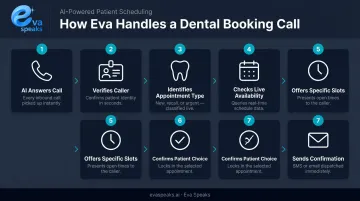
No callback. No voicemail stack for staff to work through Monday morning.
What Types of Calls AI Can Handle
A well-configured dental AI receptionist handles:
- New patient bookings
- Routine cleaning and hygiene appointments
- Cosmetic consultation scheduling
- Rescheduling and cancellations
- Emergency inquiry intake and triage
- Insurance and hours inquiries
The AI follows the practice's own routing rules — not a generic script. If a new patient needs a specific hygienist, if cosmetic consults require a 90-minute block, or if emergencies always go to a specific provider first, those rules are configurable.
Cancellations and Rescheduling
Cancellations are one of the call types where consistent policy enforcement matters most. When a patient calls to cancel, the AI can:
- Explain the practice's cancellation policy clearly
- Apply short-notice fee terms if applicable
- Process the cancellation and free the slot
- Offer to reschedule in the same call
- Flag the team if follow-up is needed
Every caller gets the same policy, explained the same way. No front desk staff member has to have an awkward conversation about a $50 short-notice fee for the fourth time that week.
Eva Speaks supports this kind of structured call handling through real-time AI responses and configurable call-flow scripts. Practices define how each call type is routed and resolved, including which scenarios escalate to a human. This configurability is particularly useful for dental offices with distinct protocols for different call types — a new patient inquiry, an emergency, and a recall reminder each follow a different script and escalation path, all managed from a single platform without needing separate systems. You can Watch AI Call Flow Demo to see how a dental AI receptionist handles a scheduling call from start to finish.
What Else Can an AI Receptionist Do for Your Dental Office?
Emergency Call Triage
After-hours dental emergencies don't follow a schedule. AI receptionists can handle these calls by asking triage questions through natural conversation — not a press-1-for-emergency menu — then routing based on what the patient describes.
Depending on urgency and the protocols the practice configures in advance, the AI can:
- Book an available emergency slot
- Connect the patient to an on-call provider
- Advise the patient to go to urgent care or an emergency room
The key is that the practice defines those thresholds upfront. The AI executes consistently at 2 a.m. on a Sunday with the same logic it applies at 9 a.m. on a Tuesday.
Appointment Reminders and No-Show Reduction
Automated reminders meaningfully reduce missed appointments. The research bears this out:
- A peer-reviewed study found no-show rates of 23.5% with SMS plus voice reminders, versus 38.1% with voice reminders alone
- A large 2022 study across nearly 159,000 visits found that a second automated text reminder reduced no-shows by 7% in primary care and 11% in mental health settings
Those numbers translate directly to revenue. AI receptionists handle outbound reminder calls proactively, and if a patient needs to reschedule, that happens in the same call — no front desk involvement required.
Patient Recall and Waitlist Management
Two outbound functions most practices underuse:
- Recall outreach — contacting patients who are overdue for a check-up and booking them back in automatically, without staff manually working through a recall list
- Waitlist fills — when a cancellation opens a slot, the AI contacts waitlisted patients immediately and fills the gap before it costs the practice revenue
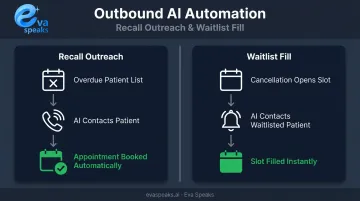
Both run without staff involvement, turning cancellations and overdue recalls into booked appointments rather than lost revenue. You can See How AI Handles After-Hours Calls to understand how after-hours dental calls are handled without any staff on duty.
Answering Common Patient Questions
Many inbound dental calls don't require booking at all. Patients call to ask about:
- Office hours and location
- Accepted insurance plans
- Fees for common procedures
- What to expect from a specific treatment
AI receptionists answer these accurately based on the practice's own information — and offer to book a consultation when the patient is ready to take the next step.
How AI Receptionists Connect to Dental Practice Management Software
The most common failure point in AI receptionist evaluations is integration depth. An AI that can read your calendar but cannot write to it cannot confirm a booking — and without both, you don't have a scheduling tool, you have a glorified voicemail.
What Deep PMS Integration Actually Means
A surface-level sync that pulls contact data is not scheduling integration. Real integration means the AI can:
- Check real-time availability — not a cached snapshot from two hours ago
- Respect provider-specific booking rules — Dr. Chen only does new patient exams on Tuesday afternoons
- Apply the correct cancellation policy for each patient type
- Create new patient records when a first-time caller books
- Log call summaries so the front desk opens a completed record, not a voicemail
The front desk team should never have to manually re-check what the AI said with what's actually in the system.
Questions to Ask Any Vendor
When evaluating AI receptionist vendors, these are the questions that separate genuine integrations from checkbox claims:
| Question | Why It Matters |
|---|---|
| Can the AI confirm a booking before the call ends? | Tests actual write access, not just sync |
| Which PMS versions are supported? | Not all integrations cover every release |
| Does it read live data or a cached snapshot? | Cached schedules create double-booking risk |
| Can it create new patient records? | Essential for new patient call resolution |
| What happens if the booking attempt fails? | Escalation path matters |
Major US platforms: Dentrix (used by more than 35,000 dental teams), Eaglesoft (nearly 30,000 users), and Open Dental. Some AI receptionist vendors publish integration claims for these platforms — but the depth varies. Verify read/write permissions and supported versions before signing anything. Practices that want to test a live booking scenario with their actual PMS can Request Live Demo.
How AI, Human Staff, and Online Booking Software Compare
Here is how an AI receptionist, human front desk staff, and online booking software compare for dental appointment scheduling:
| AI Receptionist (EvaSpeaks) | Human Front Desk | Online Booking Software | |
|---|---|---|---|
| Features | Voice calls, scheduling, reminders, PMS sync, 24/7 | Full patient interaction, treatment coordination | Self-service booking, no voice |
| Best-fit Business Size | Solo to multi-location dental practices | Any size | Tech-savvy patients, smaller practices |
| Key Strengths | Never miss a call, after-hours booking, zero overages | Human warmth, complex scheduling | Patient self-service, no labor |
| Implementation Complexity | Low - Dentrix, Eaglesoft native | None (hire) | Low |
| Integration Capability | Dentrix, Eaglesoft, Curve, Open Dental | Manual entry | Varies by tool |
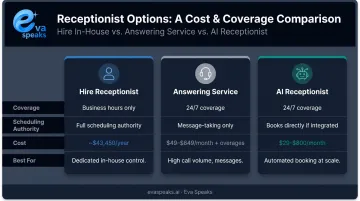
AI Receptionist vs. Answering Service vs. Hiring More Staff
| Option | Coverage | Scheduling Authority | Approximate Cost |
|---|---|---|---|
| Hire receptionist | Business hours only | Full | $43,450/year mean wage (dental offices) |
| Answering service | 24/7 possible | Message-taking only | $49–$649/month + per-minute overages |
| AI receptionist | 24/7 | Books directly (if integrated) | $29–$800/month depending on volume |
The Case for Each
Hiring more staff solves daytime capacity and gives you someone who can handle anything — but it doesn't cover evenings, weekends, or the lunch hour. With 62% of dentists citing staffing shortages as their top challenge for 2025, finding and keeping reliable front desk staff is harder than the salary figure suggests.
Answering services add human coverage without adding headcount. They work well for practices handling complex or sensitive conversations, or where patients strongly prefer a human voice. The limitation: every call still requires a follow-up. The appointment isn't confirmed until someone from your team calls the patient back — and at higher call volumes, costs climb quickly.
AI receptionists resolve calls on the spot and handle multiple simultaneous lines without added headcount. Costs run well below either staffing alternative. The trade-off is setup time upfront — you'll need to configure it with your specific scheduling rules, policies, and escalation logic before it runs reliably.
What AI Is Not Replacing
The front desk team still owns:
- Face-to-face patient interactions
- Complex clinical conversations
- Sensitive complaints and difficult patient situations
- Tasks requiring real-time human judgment
AI handles the routine, high-volume calls that currently interrupt that work. Dental practices weighing the build-versus-buy decision for AI reception can Talk to an AI Communication Expert to understand what a configured dental workflow looks like.
What to Look for in a Dental AI Receptionist
Not every AI receptionist is built for healthcare — and dental practices have specific requirements that generic systems rarely meet. These four criteria separate capable dental AI from a call-handling shortcut.
Real-Time Scheduling Integration
This is the single most important criterion.
Ask vendors directly: can the AI confirm a booking before the call ends, or does it route to a callback queue? Run a demo call. If the vendor can't demonstrate a live booking in a test environment, assume the answer is no.
Dental-Specific Call Handling
Generic call systems are not built for dental workflows. Look for:
- Support for treatment plan context and provider continuity preferences
- Emergency triage protocols
- Cancellation policy enforcement
- New patient intake flows
Ask whether configuration requires developer involvement or can be completed during onboarding.
Compliance and Data Security
Patient calls contain protected health information. Any AI receptionist used in a dental setting must address HIPAA compliance directly.
Under HIPAA, a vendor that creates, receives, maintains, or transmits PHI on behalf of a covered entity is a business associate — and the relationship must be formalized with a Business Associate Agreement (BAA). A vendor that won't provide a signed BAA is a vendor you cannot use.
Key questions for any vendor:
- Do you provide a signed BAA?
- Where is PHI stored and for how long?
- What encryption standards are applied to call recordings and transcripts?
- Can we opt out of data use for AI model training?
Eva Speaks stores data in US-based data centers, applies encryption to call recordings and transcripts, and gives customers the option to opt out of data inclusion in AI model training — contact privacy@evaspeaks.ai to request this.
Transparency and Human Handoff
Security requirements don't end at data storage — they extend to how calls are handled when the AI reaches its limits.
The practice team should be able to review every call, transcript, and action taken. There should be a clear escalation path for calls the AI cannot handle, with enough context passed to the human so the patient doesn't have to repeat themselves.
Eva Speaks supports this through LLM-powered call handling and configurable routing rules, letting practices define which scenarios escalate and what call context carries through to the human agent.
Frequently Asked Questions
What can an AI receptionist do for a dental office?
Most AI receptionists cover the full scheduling workflow and beyond:
- Books, reschedules, and cancels appointments directly
- Handles emergency call triage based on your protocols
- Sends appointment reminders and manages patient recall
- Handles waitlist outreach when slots open up
- Answers common questions about hours, fees, and insurance
- Updates your practice management system in real time
Will patients know they're talking to an AI?
Modern AI receptionists use natural language that sounds conversational rather than robotic. Most patients don't notice, and those who do still prefer a helpful response to waiting on hold or reaching voicemail.
Can an AI receptionist handle dental emergencies?
Yes, when configured with the practice's emergency protocols. The AI can assess urgency through natural conversation, book an available emergency slot, connect the patient to an on-call provider, or advise them to seek immediate care — all based on rules the practice defines in advance.
Does an AI receptionist integrate with Dentrix or Eaglesoft?
Several vendors support major US dental PMS platforms, but integration depth varies. Verify whether the AI can confirm bookings directly or only sync contact data. Ask specifically about read/write permissions and which software versions are supported.
Will an AI receptionist replace my front desk staff?
No. AI handles routine, high-volume scheduling calls so the team can focus on in-person patient care, complex conversations, and tasks that require human judgment. It adds capacity without eliminating the role.
How much does a dental AI receptionist cost?
Pricing generally runs $29–$800/month depending on call volume. Traditional answering services cost $49–$649/month plus per-minute overages, and a full-time front desk hire averages $43,450/year. The better question: what's one additional patient per month worth over their lifetime with your practice?