But healthcare is not a forgiving environment for cutting corners on vendor selection. Every AI platform that touches patient data must operate under strict HIPAA requirements: signed Business Associate Agreements, PHI encryption, limited data retention, and subprocessor coverage across every layer of the technology stack.
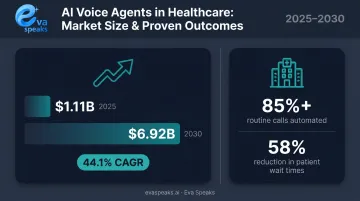
The stakes are substantial. According to MarketsandMarkets, the AI agents in healthcare market was valued at $1.11 billion in 2025 and is projected to reach $6.92 billion by 2030 — a 44.1% CAGR. That trajectory reflects both the opportunity and the urgency of getting vendor selection right.
This article covers the 10 best HIPAA-compliant AI voice agent platforms for healthcare in 2025–2026.
Key Takeaways
- HIPAA-compliant AI voice agents automate patient scheduling, intake, reminders, and follow-up while protecting PHI
- True compliance requires a signed BAA with verified subprocessor coverage across ASR, LLM, TTS, and telephony layers
- The 10 platforms below vary by use case: enterprise health systems, specialty clinics, small practices, and behavioral health each have different best-fit options
- Key evaluation criteria: EHR integration depth, real-time latency, medical ASR accuracy, pricing model, and BAA availability
- Eva Speaks suits businesses that need configurable, LLM-integrated call handling built on HIPAA-aligned infrastructure
What Are HIPAA-Compliant AI Voice Agents for Healthcare?
AI voice agents in healthcare are software systems that combine speech recognition (ASR), large language models (LLMs), and text-to-speech (TTS) to handle patient-facing phone interactions autonomously — with a human handoff available when needed.
Common use cases include:
- Appointment scheduling and confirmations
- Patient intake and pre-visit data collection
- Post-discharge follow-up calls
- Medication reminders
- FAQ resolution and after-hours support
What "HIPAA-Compliant" Actually Means
This is where many buyers run into trouble. HHS/OCR explicitly states that it does not certify any vendor or product as "HIPAA compliant." No official certification exists. What matters is whether a vendor:
- Signs a Business Associate Agreement (BAA) covering permitted PHI uses
- Encrypts PHI in transit and at rest
- Limits data retention and prohibits unauthorized uses
- Requires subprocessor flow-down — meaning every downstream vendor (ASR provider, LLM, TTS, telephony carrier) is also covered under a BAA or equivalent agreement
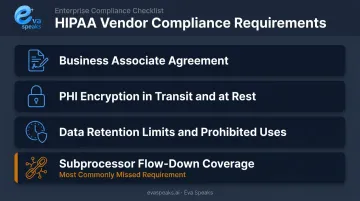
That last point is where most platforms fall short. A vendor that signs a BAA but routes your patient audio through an uncovered ASR subprocessor has left a compliance gap that your organization is responsible for.
See how AI handles patient communication at scale. Explore AI Call Automation
With that compliance baseline in mind, the 10 platforms below were evaluated on BAA coverage (including subprocessors), EHR integration depth, real-time voice accuracy, deployment speed, and documented healthcare use cases.
10 Best HIPAA-Compliant AI Voice Agents for Healthcare
1. Eva Speaks
EvaSpeaks is a US-based AI communication platform providing healthcare organizations with real-time AI call handling, transcription, and customizable call-flow automation built on LLM integration. Its strength lies in configurable call-flow scripts and routing rules — healthcare practices can tailor patient interactions without deep technical overhead. In an industry where patient communication trends are increasingly moving toward 24/7 availability and self-service scheduling, EvaSpeaks addresses the front-desk access gap without requiring practices to invest in enterprise-grade contact center infrastructure.
Eva Speaks stores data in US data centers, applies encryption and access controls, and allows customers to opt out of having their data used for AI model training by contacting privacy@evaspeaks.ai. For HIPAA-specific documentation including BAA availability and subprocessor coverage details, contact the team directly.
| Feature | Detail |
|---|---|
| Key Features | AI inbound/outbound call handling, real-time transcription, LLM integration, configurable call-flow scripts and routing rules |
| HIPAA Compliance | HIPAA-aligned infrastructure; BAA availability — contact Eva Speaks to verify subprocessor coverage for ASR, LLM, and telephony layers |
| Pricing | Contact Eva Speaks for pricing tailored to practice size and call volume |
Best for: Businesses and healthcare practices seeking configurable, LLM-powered voice handling with US-based data infrastructure.
See Eva Speaks in action for your patient call flows. Request Live Demo
2. Telnyx Voice AI
Telnyx is a full-stack carrier infrastructure provider that co-locates ASR, LLM inference, TTS, and telephony on its own private carrier network — eliminating the multi-vendor BAA exposure common in stitched-together platforms. Telnyx holds SOC 2 Type II, ISO 27001, and PCI DSS certifications and offers HIPAA-eligible infrastructure under a single BAA with subprocessor flow-down.
Published pricing starts at $0.08/minute for Voice AI agents. For IT leaders focused on compliance architecture and global scale, Telnyx consolidates what is typically three separate vendor relationships into one.
| Feature | Detail |
|---|---|
| Key Features | Full-stack voice AI (ASR + LLM + TTS + telephony), global PoPs, usage-based pricing, EHR-ready API |
| HIPAA Compliance | HIPAA-eligible; BAA available with subprocessor flow-down; SOC 2 Type II and ISO 27001 certified |
| Pricing | Usage-based; approximately $0.08/min (verify current rates on Telnyx pricing page) |
Best for: IT leaders prioritizing compliance architecture simplicity and global scalability.
3. Prosper AI
Prosper AI is a platform built specifically for patient-access workflows — scheduling, eligibility checks, prior authorization, claims follow-up, and billing. It connects to 80+ EHR and practice management systems including Epic, athenahealth, and Cerner, with no-code call-flow customization and SOC 2 Type II compliance.
| Feature | Detail |
|---|---|
| Key Features | 80+ EHR/PM integrations, no-code call-flow builder, prior auth automation, billing workflows |
| HIPAA Compliance | HIPAA-eligible; BAA available; SOC 2 Type II — request subprocessor list for telephony/speech layers |
| Pricing | Contact sales |
Best for: Hospitals and medical groups needing deep patient-access workflow automation with broad EHR coverage.
4. Hyro
Hyro is an enterprise-grade healthcare voice AI platform designed for large health systems handling high call volumes across multiple service lines. It models complete patient journeys so a single call can move through intake, eligibility, and scheduling without losing context.
Hyro reports automating 85%+ of routine patient calls and deploying within 3 days, with a documented case study showing Tampa General Hospital reduced wait times by 58% after implementation. Official Epic and Cerner integrations are available.
| Feature | Detail |
|---|---|
| Key Features | Prebuilt hospital-system intake workflows, Epic/Cerner integration, multilingual support, patient journey orchestration |
| HIPAA Compliance | HIPAA-eligible; BAA available; production deployments at named US health systems |
| Pricing | Contact sales (enterprise) |
Best for: Large health systems with complex multi-service-line workflows requiring end-to-end patient journey automation.
5. Retell AI
Retell AI is a mid-market voice agent builder with a drag-and-drop interface, custom LLM support, and published per-minute pricing ranging from $0.07 to $0.31/minute. It offers a HIPAA-eligible tier with BAA availability — healthcare teams can deploy within weeks rather than months.
| Feature | Detail |
|---|---|
| Key Features | Drag-and-drop builder, custom LLM support, multilingual TTS, appointment booking and follow-up workflows |
| HIPAA Compliance | HIPAA-eligible tier; BAA available — confirm telephony subprocessor BAA coverage before deployment |
| Pricing | $0.07–$0.31/min pay-as-you-go; Enterprise custom |
Best for: Mid-market practices wanting fast deployment, model flexibility, and transparent usage-based pricing.
6. Assort Health
Assort Health is a specialty-focused AI scheduling platform built for ambulatory groups in orthopedics, dental, and ophthalmology. Its specialty-specific scheduling intelligence handles complex provider availability rules that horizontal platforms routinely struggle with — including acute injury triage, post-op global periods, and multi-location routing. The platform reports 150M+ patient interactions processed.
| Feature | Detail |
|---|---|
| Key Features | Specialty-specific scheduling logic (ortho, dental, ophthalmology), multi-location routing, patient-access automation |
| HIPAA Compliance | HIPAA-eligible; BAA language present in customer agreements — request call-path architecture details for full subprocessor clarity |
| Pricing | Contact sales |
Best for: Specialty ambulatory groups where scheduling logic complexity directly impacts clinical throughput.
7. Synthflow
Synthflow is a no-code voice agent builder targeting small practices and independent clinics without engineering resources. Front-desk managers can build appointment reminder and intake call flows without IT involvement, making it the fastest path to a first deployment for simple, well-defined use cases.
Key capabilities:
- No-code call-flow builder for reminders and basic intake
- Tiered monthly platform fees with usage-based billing
- HIPAA-eligible tier with BAA available on certain plans — confirm data retention and model training-use defaults before signing
Best for: Small practices and independent clinics needing fast deployment for reminders and basic intake without engineering resources.
8. CloudTalk AI
CloudTalk is a CCaaS (Contact Center as a Service) platform whose Alex AI Voice Agent extends existing contact center infrastructure with conversational AI for scheduling, medication reminders, and patient intake. A key differentiator: conversation memory persists across multiple patient interactions, which is a meaningful upgrade over standard IVR replacements. Existing CloudTalk customers can typically go live in 1–2 weeks.
| Feature | Detail |
|---|---|
| Key Features | Native CCaaS integration, persistent conversation context, appointment scheduling, medication reminders |
| HIPAA Compliance | HIPAA-eligible; BAA available; SOC 2 Type II |
| Pricing | Per-seat plus AI usage add-on |
Best for: Multi-location practices already on the CloudTalk CCaaS stack seeking fast AI capability extension.
9. PolyAI
PolyAI is an enterprise contact center voice AI platform with support for 75+ languages and native dialect fluency — making it a standout option for health systems serving non-English-majority patient populations at high concurrent call volumes. Healthcare use cases include appointment management, FAQ handling, call routing, billing, and patient triage.
| Feature | Detail |
|---|---|
| Key Features | 75+ languages with native fluency, high concurrent call volume, enterprise contact center integration, appointment and billing workflows |
| HIPAA Compliance | HIPAA-eligible; BAA available |
| Pricing | Contact sales (enterprise) |
Best for: Large health systems with multilingual patient populations requiring high-volume concurrent call handling.
10. Callin.io
Callin.io is a clinically oriented AI voice platform focused on between-session patient support — post-visit follow-up, medication adherence, and chronic condition check-ins. Its narrow focus on clinical outcomes rather than administrative access makes it effective for behavioral health programs and chronic care coordinators who need to supplement care at scale.
| Feature | Detail |
|---|---|
| Key Features | Post-visit follow-up calls, medication adherence reminders, chronic care check-ins, behavioral health templates |
| HIPAA Compliance | HIPAA-eligible; BAA available |
| Pricing | Contact sales |
Best for: Behavioral health programs and chronic disease management teams supplementing clinical care between appointments.
How Leading Platforms Compare at Scale
Here is how the leading voice AI platforms for patient communications compare at scale:
| EvaSpeaks | Luma Health | Nuance (Microsoft) | |
|---|---|---|---|
| Best-fit Business Size | Clinics to health systems | Clinics to mid-size practices | Large enterprise health systems |
| Key Strengths | LLM-native, fast deploy, full voice conversation | Strong patient engagement workflows | Deep EHR integration, brand trust |
| Implementation Complexity | Low - weeks | Low to Medium | High - months |
| Integration Capability | Epic, Cerner, Athena, scheduling native | Major EHR, patient portals | Deep Epic/Cerner, custom |
Key Features to Look for in a HIPAA-Compliant AI Voice Agent
BAA and Subprocessor Coverage
A signed BAA is the compliance baseline, but it covers far less than most buyers assume. Per HHS Business Associate Contract guidance, the BAA must require downstream subcontractors to meet the same restrictions.
That means coverage must flow down to every ASR, LLM, TTS, and telephony subprocessor in the call path — not just the vendor you're signing with directly.
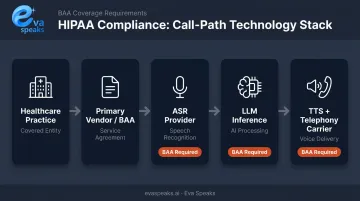
Before signing, ask specifically:
- Which subprocessors handle patient audio and transcription data?
- Is each covered under a BAA or equivalent data protection agreement?
- What are the default PHI retention periods, and can they be shortened?
- Is patient audio used to train AI models, and how is the opt-out enforced?
EHR Integration Depth
Read-only FHIR access (checking provider availability) is a different capability than bidirectional write-back (booking appointments, updating patient records). ONC data shows that hospital FHIR-based API adoption reached 74% of outpatient settings by 2022, yet API availability alone does not guarantee deep scheduling integration.
Ask vendors specifically:
- Does the integration support read, write, or both?
- Which scheduling actions can the AI complete autonomously in Epic, Cerner, or athenahealth?
- What happens when the EHR is unavailable during a live call?
Voice Accuracy and Call Latency
Generic ASR models underperform on medical terminology. A 2024 JAMIA Open study found AWS General Transcribe had a 59% average word error rate on healthcare speech, with significant accuracy gaps across patient accents and dialects. Healthcare-tuned models performed better on medical proper nouns but worse overall on general speech.
When evaluating platforms:
- Test ASR on a representative set of medication names, anatomy terms, and ICD-10 phrasing from your actual patient population
- Request p99 latency data from production traffic — not synthetic benchmarks
- Ask specifically about dialect and accent performance, particularly for diverse patient populations
Watch a real patient AI call from start to finish. Watch AI Call Flow Demo
How We Chose These AI Voice Agents
These platforms were assessed across five criteria: HIPAA/BAA readiness, EHR integration depth, ASR accuracy on medical vocabulary, real-time call latency, and pricing transparency. Selection was also weighted by healthcare-specific use case fit: enterprise, specialty, and small practice each have meaningfully different requirements.
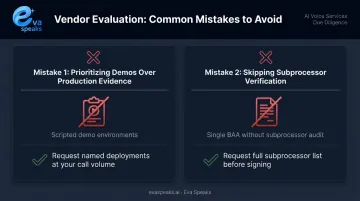
Two common mistakes buyers make during evaluation:
- Prioritizing demos over production evidence. A smooth demo on a happy-path script tells you little. Ask for named deployments at your call volume and use case complexity.
- Skipping subprocessor verification. A primary vendor BAA without confirmed subprocessor flow-down leaves real compliance gaps. Request the full subprocessor list before contract signature.
Platforms that could not demonstrate a production customer at relevant scale were noted accordingly. Vendor-reported deployment timelines, accuracy claims, and outcome statistics are starting points for your own due diligence, not independently verified facts.
Conclusion
Selecting a HIPAA-compliant AI voice agent is a compliance, operations, and patient experience decision — not just a technology purchase. The right platform depends on your organization's size, call volume, EHR environment, and the specific workflows you need to automate.
Before committing, evaluate vendors carefully:
- Request demos using real patient-workflow scenarios, not just the vendor's preferred scripts
- Ask for production latency and uptime data from live deployments
- Verify that every layer of the technology stack is covered under a BAA
For healthcare businesses seeking an AI communication platform with configurable call flows, LLM integration, and HIPAA-aligned infrastructure, Eva Speaks is built for exactly that — contact the team to see how it maps to your patient communication workflows.
Have questions about deploying voice AI in your facility? Talk to an AI Communication Expert
Frequently Asked Questions
What is a Business Associate Agreement (BAA) and why does it matter for AI voice agents?
A BAA is a legally required contract under HIPAA between a covered entity (your practice) and any vendor that processes PHI on your behalf. Without one — covering both the primary vendor and all downstream subprocessors — your organization bears direct regulatory and liability exposure for any breach or unauthorized PHI disclosure.
Can AI voice agents integrate with EHR systems like Epic or Cerner?
Many platforms offer EHR integration, but depth varies significantly. Read-only access (checking availability) is very different from bidirectional write-back (booking appointments, updating records). Ask vendors specifically which scheduling actions their integration supports in your EHR before evaluating further.
How much do HIPAA-compliant AI voice agents for healthcare cost?
Pricing ranges from usage-based models (approximately $0.07–$0.31 per minute covering STT/TTS/inference) to per-seat CCaaS add-ons to enterprise "contact sales" arrangements. Clarify what is included versus excluded — telephony minutes, transcription storage, and human handoff are frequently separate line items.
Can AI voice agents accurately understand medical terminology and diverse patient accents?
Performance varies. Healthcare-tuned ASR models outperform generic models on medication names and anatomy — but research has found high error rates across platforms on real healthcare speech, with notable accuracy gaps across patient demographics. Always test vendors on your own patient population's vocabulary and accent mix.
How long does it take to deploy an AI voice agent in a healthcare setting?
Timelines vary widely: no-code platforms can go live in days, existing CCaaS customers typically take 1–2 weeks, and enterprise deployments with deep EHR write-back can run several weeks. Scheduling logic complexity and integration depth are the main drivers.
Can AI voice agents handle after-hours patient calls without human staff?
Yes — 24/7 availability is a primary benefit. AI voice agents answer every inbound call, resolve routine requests like scheduling and reminders, and route urgent cases to on-call staff. That eliminates the missed-call and voicemail problem that affects most after-hours coverage.