Introduction
The US Hispanic population reached 65.2 million as of July 2023 — over 19% of the country — with projected buying power of $2.8 trillion by 2026 according to Nielsen. For businesses still operating English-only phone support, that's not a niche gap. It's a revenue leak.
The stakes are real. ACTFL's employer research found that 1 in 4 US employers report losing business due to foreign-language skill gaps, with 85% of language-reliant businesses depending on Spanish. Meanwhile, industries like healthcare, legal, and real estate face compounding consequences when callers can't communicate clearly.
Bilingual answering services directly address that gap — without the overhead of hiring and training multilingual staff. This guide covers the top providers in 2026 and the key factors that separate a strong fit from an expensive mistake.
Key Takeaways
- Bilingual answering services handle inbound calls (and sometimes SMS/chat) in English and Spanish — via human agents, AI systems, or both
- The US Hispanic market represents a $2.8T buying power opportunity; English-only support means missed sales and lost customers
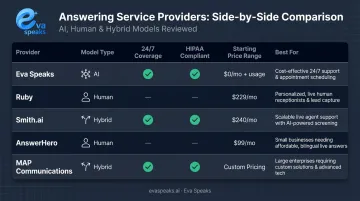
- Top 2026 providers span AI-first (Eva Speaks), human-led (Ruby), and hybrid models (Smith.ai, AnswerHero, MAP Communications)
- What to look for: language fluency depth, 24/7 availability, CRM integrations, HIPAA compliance, and pricing transparency
- AI-powered services offer lower per-interaction costs and greater scalability
- Human services deliver higher emotional nuance for sensitive or complex calls
What Is a Bilingual Answering Service?
A bilingual answering service is a communication solution that handles inbound customer calls in two or more languages — allowing businesses to serve linguistically diverse callers without losing leads or leaving callers without support. In the US market, English and Spanish is the standard pairing, though some platforms extend further.
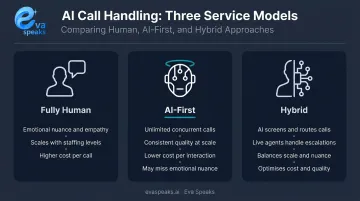
The Three Operating Models
| Model | How It Works | Best For |
|---|---|---|
| Fully Human | Live receptionists fluent in both languages | High-sensitivity calls, complex intake |
| AI-First | Automated agents powered by LLMs handle all interactions | High-volume, cost-predictable coverage |
| Hybrid | AI screens and routes; live agents handle escalations | Businesses needing both scale and nuance |
Each model involves real tradeoffs. Human services deliver emotional nuance but scale with staffing — meaning cost per call rises with volume. AI services handle unlimited simultaneous calls at consistent quality, but can miss nuance in sensitive or unusual calls. Hybrid models aim to balance scale with nuance.
Here is how bilingual AI, human bilingual agents, and basic auto-attendants compare for businesses serving English and Spanish callers:
| Bilingual AI (EvaSpeaks) | Human Bilingual Agents | Basic Auto-Attendant | |
|---|---|---|---|
| Features | Auto language detection, full conversation in both languages, booking | Human empathy, nuanced language | Pre-recorded prompts only |
| Best-fit Business Size | SMB to mid-market | Any, especially sensitive industries | Very small businesses |
| Key Strengths | Instant language switch, 24/7, no staffing gaps | Natural conversation, cultural nuance | Low cost |
| Implementation Complexity | Low - auto language detection built in | Medium - sourcing qualified agents | None |
| Integration Capability | CRM, scheduling systems | Manual or limited | None |
See how AI handles multilingual call flows in real time. Watch AI Call Flow Demo
Industries With the Highest Stakes
Language barriers carry different weight depending on the sector. The consequences of a miscommunication in a legal consultation are very different from a missed appointment reminder.
High-stakes industries include:
- Healthcare: The AMA Journal of Ethics reports 25 million US patients have limited English proficiency, and LEP patients face higher rates of medical errors when communication fails
- Legal services: Case details, deadlines, and intake information must be captured precisely — approximations create liability
- Real estate: Callers discussing offers, contracts, or financial terms need exact, confident communication to move forward
- Financial services: Clients discussing accounts or transactions expect accuracy and confidentiality in their preferred language
Top Bilingual Answering Services for Business Growth in 2026
Each service on this list was evaluated across seven criteria:
- Language quality and bilingual depth
- 24/7 availability and coverage reliability
- Technology capability (AI, hybrid, or human-led)
- CRM integration depth
- Compliance standards (HIPAA, privacy)
- Pricing transparency
- Real-world business impact
Both AI-native and human-led models are represented.
Eva Speaks
Eva Speaks is an AI-powered communication platform built for businesses seeking scalable bilingual call handling without the staffing constraints of traditional answering services. The platform integrates with large language models (LLMs), text-to-speech (TTS), and speech-to-text (STT) technologies to deliver contextually aware, natural-sounding responses — going beyond scripted IVR to handle dynamic caller conversations.
Key differentiators include customizable call-flow scripts, routing rules configurable by office hours and department, and call transcription for post-call review and quality analysis. Businesses can tailor interaction logic to their brand voice and operational workflows. As bilingual service needs grow alongside the US Hispanic market, EvaSpeaks addresses the trend by providing AI-handled conversations that are not constrained by shift-based staffing — a bilingual caller at 9 PM receives the same quality of service as one calling at noon.
| Attribute | Details |
|---|---|
| Key Features | LLM-backed bilingual call handling, real-time AI responses, customizable call-flow scripts, call transcription, intelligent routing rules |
| Availability | 24/7 AI-powered coverage with no hold times or staffing gaps |
| Best For | Businesses seeking scalable, AI-first bilingual communication without per-minute costs |
See Eva Speaks live with your own callers. Request Live Demo
Ruby
Ruby is a premium virtual receptionist service with 20+ years of experience, trusted by over 15,000 small businesses. Its US-based human receptionists receive 120 hours of training in empathy and conflict resolution — making Ruby a strong fit for businesses where every caller interaction reflects directly on brand reputation.
Spanish support is included at no additional charge across all plans. The service covers appointment scheduling, lead capture, payment processing, and spam filtering, with HIPAA-compliant messaging for healthcare and legal clients.
| Attribute | Details |
|---|---|
| Key Features | 24/7 live bilingual answering, appointment scheduling, lead capture, spam filtering, HIPAA-compliant messaging |
| Pricing | Per-receptionist-minute billing; entry-level plans start at $245/month for 50 minutes — verify current pricing at ruby.com before committing |
| Best For | Small to mid-sized businesses requiring premium, human-first brand representation on every call |
Smith.ai
Smith.ai operates a hybrid model: AI-powered screening combined with live North America-based receptionists fluent in Spanish. The platform serves 5,000+ businesses and is well-established in legal, healthcare, and professional services.
Standout capabilities include a dedicated Spanish phone line option, outbound lead follow-up in Spanish, AI-powered live chat and SMS translation, full call recording and transcription, and a centralized analytics dashboard. The integration library spans 7,000+ platforms.
| Attribute | Details |
|---|---|
| Key Features | AI + live agent hybrid, Spanish-dedicated line, outbound follow-up, call recording/transcription, 7,000+ CRM integrations |
| Pricing | Per-call billing; Starter plans around $285–$300/month for 30 calls — confirm current tiers at smith.ai |
| Best For | Professional service firms (legal, medical) needing detailed intake workflows and bilingual lead qualification |
AnswerHero
AnswerHero's standout differentiator: every agent on the team is bilingual English-Spanish. Callers aren't routed to a separate "Spanish line" — any agent handles both languages natively from the first ring.
The service runs 24/7/365 with no contracts and no setup fees. Key capabilities include:
- Message taking, lead capture, and appointment scheduling
- Call patching, after-hours, and overflow support
- HIPAA-compliant messaging with CRM integrations for healthcare, legal, and real estate
- AI-only plan starting at $19/month for lower-volume use cases
| Attribute | Details |
|---|---|
| Key Features | 100% bilingual agent team, HIPAA-compliant messaging, appointment scheduling, lead capture, CRM integration, overflow/after-hours coverage |
| Pricing | Flexible no-contract plans; Starter at $79/month for 50 minutes, Pro at $279/month for 250 minutes — verify current tiers at answerhero.com |
| Best For | Regulated-industry businesses (healthcare, legal) needing bilingual live agents with industry-specific training and contract-free flexibility |
MAP Communications
MAP Communications has been operating since 1991 — over 30 years as an employee-owned answering service. The model emphasizes operational transparency: clients get access to a secure online portal for real-time call monitoring and script management, with account managers guiding onboarding and customization.
No long-term contracts, fully customizable scripts, and scalable plans make MAP a practical choice for both growing businesses and larger enterprises managing variable call volumes.
| Attribute | Details |
|---|---|
| Key Features | 24/7 live bilingual answering, secure client portal, real-time call monitoring, customizable scripts, HIPAA-compliant protocols |
| Pricing | Flexible tiered plans; month-to-month with additional minutes at $1.37/min — verify full tier structure at mapcommunications.com |
| Best For | Growing businesses and enterprises needing scalable, contract-free bilingual answering with full call visibility |
How to Choose the Right Bilingual Answering Service
The most common mistake businesses make is selecting a provider based on price or brand recognition alone, without checking whether the service model actually fits their call volume, industry requirements, and customer sensitivity.
What to Evaluate
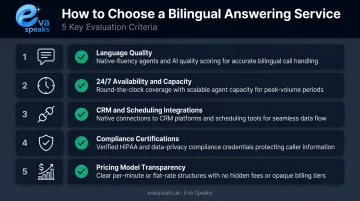
Language quality is the first filter. "Bilingual" on a website can mean anything from native-fluency agents to a third-party interpreter patched in mid-call. Ask specifically whether agents are native or near-native Spanish speakers, not just conversationally capable.
Beyond fluency, the criteria that matter most:
- 24/7 availability and concurrent call capacity: confirm the service can absorb your peak volume without queuing callers
- CRM and scheduling integrations: verify it connects to the tools your team already uses
- Compliance certifications: HIPAA is required for healthcare and legal contexts; ask specifically about Business Associate Agreements (BAAs)
- Pricing model transparency: per-minute and per-call rates escalate quickly at scale; flat-rate or AI-based tiers offer more predictable costs
- Industry-specific experience: generic call scripts don't hold up for medical intake or legal consultation workflows
Want a recommendation for your specific business? Get a Customized Workflow Recommendation
AI vs. Human: What the Assessment Looks Like
Evaluation looks different depending on the service model:
- AI-powered services: test LLM quality and context retention. Can the system handle multi-turn conversations, or does it stall on anything off-script?
- Human agent services: training rigor and turnover rate matter as much as fluency. A high-turnover call center erodes quality no matter what the service promises.
- Hybrid services: both sets of criteria apply; assess each layer independently.
Knowing which model fits your workflow before you start the evaluation saves time and prevents mismatched contracts.
Conclusion
In 2026, bilingual answering capability isn't a premium add-on — it's a basic requirement for any US business serving a diverse customer base. With 65.2 million Hispanic Americans and a Spanish-speaking population that Census data shows represents 62% of all non-English home-language speakers, failing to accommodate Spanish-speaking callers means leaving measurable revenue on the table.
Before committing to a provider, request demos, review sample call handling in both languages, and calculate what missed bilingual calls currently cost your business. Evaluate scalability, cost predictability, and integration depth — not just the monthly headline price.
If those evaluation criteria point toward an AI-first approach, Eva Speaks offers LLM-powered natural conversations, real-time responses, and fully customizable call flows — without per-minute billing — as a direct alternative to traditional human answering services.
See how businesses like yours are using bilingual AI. See Industry Use Cases
Frequently Asked Questions
How much does a virtual phone answering service cost?
Human answering services typically use per-minute or per-call billing, with plans ranging from roughly $79–$285/month for entry-level packages. AI-powered platforms often use flat-rate SaaS tiers starting as low as $19–$99/month, which tend to be more cost-predictable as call volume grows.
What is a bilingual answering service?
A bilingual answering service handles inbound calls professionally in two or more languages — typically English and Spanish in the US market. Services are available via human receptionists, AI agents, or hybrid models, so callers always reach someone who speaks their language.
What languages do bilingual answering services typically support?
English and Spanish are the standard pairing in the US, given that Spanish speakers make up roughly 62% of all non-English home-language speakers nationally, according to U.S. Census Bureau data. Some AI platforms extend to additional languages; confirm whether a provider offers native-level fluency or conversational coverage before selecting.
Can a bilingual answering service integrate with my existing CRM or scheduling tools?
Most modern providers — especially hybrid and AI platforms — offer native or API-based integrations with tools like Salesforce, HubSpot, and Zoho, plus calendar and scheduling platforms. Integration depth varies by plan tier, so confirm compatibility during the sales process.
Is a bilingual answering service HIPAA-compliant?
Not automatically. Healthcare and legal businesses must specifically verify that a provider offers HIPAA-compliant messaging, secure data handling, and signed Business Associate Agreements (BAAs). Confirm this before signing — don't assume it from general privacy policy language.
What is the difference between an AI bilingual answering service and a human one?
AI services offer 24/7 coverage, unlimited concurrent calls, consistent fluency, and lower per-interaction costs at scale. Human services handle emotional nuance and complex situations more reliably but are subject to staffing constraints and per-minute cost variability. Hybrid models use AI for routine calls and route complex ones to live agents.