Introduction
A DUI arrest happens at 11 PM on a Friday. A car accident occurs Sunday morning. A spouse is served divorce papers during lunch. Legal emergencies don't schedule themselves around business hours — and the clients dealing with them won't wait until Monday to find representation.
Most law firms already know they're missing after-hours calls. What they underestimate is the compounding cost. According to CallRail's 2025 legal industry analysis, the legal industry carries a 28% missed-call rate — second only to healthcare across all benchmarked industries. At an average lead cost of $649 per inbound call, that's not an inconvenience. It's a revenue leak.
This article breaks down the specific operational advantages of 24/7 call handling and intake — with measurable outcomes across lead conversion, attorney efficiency, and client retention.
Key Takeaways
- Law firms miss roughly 1 in 4 inbound calls, and most of those callers contact a competitor next
- Legal clients shop around: 55.1% contact 2–3 firms, and 40% move on if they don't hear back within 24 hours
- 24/7 call handling captures leads after hours, runs structured intake, and books consultations with no attorney involvement required
- Consistent intake processes improve conversion rates and free up staff time
- AI virtual receptionists like Eva Speaks handle calls around the clock, making full coverage practical for solo attorneys and small firms alike — you can See How AI Handles After-Hours Calls to understand exactly how that works in a law firm context.
What Is 24/7 Call Handling and Intake for Law Firms?
A 24/7 call handling and intake service answers inbound calls on a law firm's behalf, screens callers, collects case information, and schedules consultations — every hour of every day, including evenings, weekends, and holidays.
Think of it as a front-desk layer between a ringing phone and a billable attorney: first contact gets handled, and attorneys receive qualified leads.
More than an administrative convenience, the intake step is where potential clients decide whether to hire a firm or move on. A caller who reaches someone professional and prepared is far more likely to book a consultation than one who reaches voicemail. That first impression sets the tone for the entire client relationship.
That's where technology has expanded what's possible. Modern solutions range from human virtual receptionists to AI-powered platforms. EvaSpeaks, for example, uses large language models and customizable call-flow logic to handle practice-area-specific intake — gathering case details, qualifying callers, and booking consultations directly into case management systems like Clio, MyCase, and PracticePanther — around the clock, without a human operator on duty. The industry trend supports this shift: Clio's 2024 research found that callers who spoke with someone were nearly 8x more likely to recommend the firm than those who reached voicemail — which is exactly the outcome EvaSpeaks prevents when it answers every call immediately.
Key Advantages of 24/7 Call Handling for Law Firms
Each advantage below connects directly to measurable outcomes law firms track: lead conversion, revenue per case, attorney utilization, and client satisfaction.
Advantage 1: Capture Every Lead, Not Just Business-Hours Leads
When a prospective client calls after hours and hits voicemail, they don't wait. They call the next firm on Google's results page.
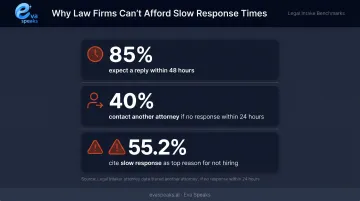
Martindale-Avvo's 2024 Legal Consumer Report quantifies the risk: 85% of legal consumers expect a reply within 48 hours, and 40% will contact another attorney if they don't hear back within 24 hours. Slow response is also the leading reason consumers don't hire a firm, cited by 55.2% of respondents.
24/7 call handling changes this dynamic entirely. Every inbound call, regardless of when it arrives, is answered by a live or AI-powered agent who can qualify the caller and begin intake immediately.
Why this matters financially:
- Each unanswered call represents wasted ad spend — CallRail puts the average law firm lead cost at $649
- In practice areas like personal injury or criminal defense, a single retained case can be worth tens of thousands of dollars — far exceeding any annual cost of an answering service
- Firms running paid search or Local Service Ads generate leads around the clock; those leads need to be answered around the clock
KPIs this improves:
- After-hours lead capture rate
- Call-to-consultation conversion rate
- Cost per acquired client
- Marketing ROI from paid campaigns
When it matters most: Solo or small practices without full reception staff, firms running paid advertising, and practice areas with time-sensitive emergencies like DUI, domestic disputes, or accidents.
Advantage 2: Structured Intake That Converts Callers Into Retained Clients
Availability gets the call answered. What converts that caller into a retained client is what happens in the first 60 seconds of the conversation.
Clio's 2024 secret-shopper study, summarized by 2Civility, found that callers who spoke with someone by phone were more than 3x as likely to recommend the firm compared to the average across all contact methods — and nearly 8x as likely as those who received only a voicemail follow-up. First contact has a direct effect on both conversion and referrals.
A structured intake process captures the right information, sets expectations, and books a consultation before the caller hangs up. Scheduling during the live call is critical — follow-up attempts the next business day lose a measurable percentage of prospects who have already moved on.
What a well-configured intake process covers:
- Caller name, contact information, and preferred callback method
- Case type and urgency
- Qualifying information specific to the practice area (accident date, charges filed, opposing party details)
- Conflict-check data where integrated
- Consultation scheduling in real time
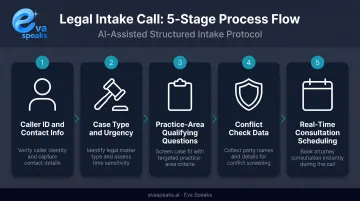
Eva Speaks supports practice-area-specific call-flow scripts — covering personal injury, criminal defense, family law, immigration, estate planning, and more — with intake data flowing automatically into Clio, MyCase, or PracticePanther. Conflict-checking is available where system integration supports it.
KPIs this improves:
- Consultation booking rate
- Lead-to-client conversion rate
- Client satisfaction scores
- First-contact resolution rate
When it matters most: High-volume firms where intake throughput directly affects caseload; practices that have invested in advertising but see low conversion from inbound calls; emotionally sensitive cases where the first 60 seconds on the phone set the tone for everything that follows. You can Watch AI Call Flow Demo to see how a structured AI intake conversation unfolds in real time.
Comparing 24/7 Call Handling Options for Law Firms
Here is how AI-powered, hybrid live+AI, and traditional 24/7 answering service models compare for law firm call handling and intake:
| AI-Native (EvaSpeaks) | Hybrid (AI + Live Agents) | 24/7 Live Legal Answering | |
|---|---|---|---|
| Features | 24/7 AI intake, conflict pre-screening, Clio sync, instant CRM push | AI triage + human escalation for complex/distressed callers | Human agents, legal training, 24/7 availability |
| Best-fit Business Size | Solo to mid-size firms | Growing practices | Firms with high-stakes inbound calls |
| Pricing Model | Flat monthly, unlimited | Per-minute + AI tier | Per-minute |
| Key Strengths | Zero missed leads, consistent, predictable cost | Human fallback for sensitive situations | Full human empathy and judgment |
| Implementation Complexity | Low - Clio/MyCase connectors | Low to Medium | Low |
| Integration Capability | Clio, MyCase, PracticePanther native | Varies | Manual or limited |
Advantage 3: Operational Efficiency Without Adding Headcount
Staffing a full-time receptionist costs more than most firms calculate. Per BLS data from May 2024:
- Median receptionist wage: $17.90/hour (~$37,232/year)
- With benefits at ~30% of total compensation: $53,113/year loaded cost
- That figure excludes office space, equipment, recruiting, training, and coverage gaps
That covers one shift — not evenings, weekends, or holidays. 24/7 call handling offloads this burden without adding payroll. AI-powered solutions like Eva Speaks allow firms to configure routing rules, escalation paths, and intake scripts once — then let the system handle volume consistently, at any hour, without supervision.
The attorney time equation is equally important:
- Clio's 2025 Legal Trends Report shows average lawyer utilization sits at just 38% — roughly 5 unbilled hours in an 8-hour day
- Average collection rates are even lower: 2.4 billable hours per day at the firm level
- Attorney hourly rates range from $196/hour in lower-cost states to $456–$460/hour for bankruptcy and corporate litigation
Every hour an attorney spends on phone triage, checking voicemails, or screening cold callers is a direct cost. Redirecting that time toward billable work has an immediate, measurable impact on revenue.
During high-volume periods — post-campaign launches, seasonal intake spikes — AI-powered handling absorbs additional call volume without added cost or lag time.
KPIs this improves:
- Attorney billable hours recovered
- Cost per handled call
- Call abandonment rate
- Administrative time as a percentage of total hours
What Happens When 24/7 Call Handling Is Ignored
Skipping 24/7 call coverage doesn't just mean missed calls — it means missed cases, wasted budget, and a firm that can't scale:
- Lost leads go directly to competitors — callers in distress don't leave voicemails and wait; they call the next firm
- Wasted marketing spend — every unanswered paid lead is money lost twice: ad cost plus case value
- Reputation damage — slow response is the top hiring deterrent according to Martindale-Avvo, and nearly 70% of consumers rely on online reviews when choosing an attorney
- Attorney burnout — the ABA reported in 2024 that 86% of lawyers already work outside normal business hours; piling after-hours phone duty onto that load worsens a profession already reporting 52% burnout rates
- Scaling becomes impossible — a firm cannot grow its caseload if its intake process breaks down every evening and weekend
If you're ready to address any of these gaps for your firm, you can Talk to an AI Communication Expert about what a 24/7 call handling setup would look like in practice.
How to Get the Most Value from 24/7 Call Handling
24/7 call handling delivers its strongest ROI when treated as a core operational system. That means configuring it thoughtfully and reviewing outcomes regularly.
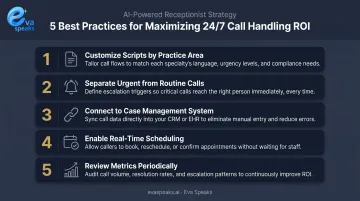
To maximize results:
- Customize scripts by practice area — a personal injury intake needs different questions than an estate planning call; specificity builds caller confidence and captures better data
- Separate urgent from routine calls — Eva Speaks, for example, automatically routes after-hours emergency criminal defense calls to on-call attorneys so nothing urgent waits until morning
- Connect to your case management system — pushing intake data directly into Clio, MyCase, or PracticePanther eliminates manual re-entry and keeps every record linked to the right file
- Enable real-time scheduling — booking consultations during the intake call is significantly more effective than follow-up attempts the next day
- Review metrics periodically — call volume by hour, intake completion rate, and consultation booking rate reveal where scripts or routing need adjustment
Firms that implement these steps consistently are seeing real results: growing firms use automation at nearly 3x the rate of shrinking firms, according to Clio's 2025 data. The firms pulling ahead aren't doing more — they're handling more calls without adding headcount. To see how this approach applies to your firm's specific intake workflows, you can Request Live Demo.
Conclusion
24/7 call handling and intake isn't a feature reserved for large firms with large budgets. It's a measurable business system — one that directly affects how many leads convert, how efficiently attorneys spend their time, and how clients perceive the firm from their very first interaction.
Capturing more after-hours leads, running consistent intake, and controlling communication overhead without adding headcount — these aren't isolated wins. Together, they allow a firm to grow its caseload and reputation at the same time.
The one caveat: this isn't a passive system you configure once and walk away from. As call volume shifts, practice areas evolve, or team structure changes, scripts and routing rules need periodic review. The firms that treat intake as an ongoing operational discipline — not a one-time setup — are the ones that see the most consistent growth in qualified caseloads. An AI-powered intake platform like Eva Speaks makes that discipline easier to maintain — handling the volume, capturing the data, and adapting as the firm grows.
Frequently Asked Questions
Why are some law firms open 24 hours?
Legal emergencies — arrests, accidents, custody disputes — happen at any hour. Firms in criminal defense and personal injury stay reachable around the clock because missing an urgent after-hours call usually means losing that client to a competitor who answered.
What is a legal intake service?
A legal intake service handles the initial client-facing call on a firm's behalf — collecting case details, screening for conflicts, and scheduling a consultation. Attorneys receive qualified, ready-to-engage leads rather than cold voicemails to sort through.
What types of law firms benefit most from 24/7 call handling?
Practice areas with time-sensitive situations — criminal defense, personal injury, family law, immigration — benefit most. Any firm running paid advertising or operating without full-time reception staff will also see material gains in lead capture and conversion rates.
How much does a 24/7 legal answering or call handling service typically cost?
Human-staffed legal answering services typically run $250–$1,725/month depending on call volume. AI-powered options start around $95/month for lower-volume plans. Either is a fraction of the $53,000+ fully loaded annual cost of a full-time receptionist — with broader coverage hours.
Can a call handling service give legal advice on behalf of my firm?
No. Reputable services are trained strictly for intake and scheduling. Agents use scripts with clear disclaimers and collect only the information needed to route or book a consultation, keeping the firm protected from unauthorized practice of law exposure.
How is AI-powered call handling different from a traditional answering service?
AI-powered call handling uses large language models and customizable call-flow logic to respond in real time, 24/7 — no rotating human staff required. The result is greater consistency, faster response times, and lower per-call cost, which is especially valuable for firms with high or unpredictable inbound volume.