Introduction
Running customer support as a small business is a constant balancing act. Customers expect fast, helpful responses at any hour — but hiring a full support team isn't realistic when you're working with a lean budget and a small headcount.
That gap is exactly where conversational AI support platforms deliver real value. Instead of staffing for every possible inquiry, small businesses can deploy AI-powered tools that handle repetitive questions on autopilot, route complex issues to the right person, and keep support running around the clock — without adding payroll.
According to a February 2025 MarketsandMarkets report, the AI for customer service market was valued at $12.06 billion in 2024 and is projected to reach $47.82 billion by 2030 — a 25.8% annual growth rate. Small businesses that adopt these tools now are gaining a measurable edge over those still relying on manual support alone.
This guide covers the top conversational AI support platforms for small businesses, what to look for when choosing one, and how to match the right tool to the channels your customers actually use.
Key Takeaways
- Conversational AI platforms use NLP and machine learning to automate customer interactions across chat, email, SMS, and voice
- They enable 24/7 support, faster responses, and higher inquiry volume — without adding staff
- Evaluate platforms on setup ease, pricing, omnichannel reach, and CRM integration
- Top platforms covered: Tidio, Freshchat, Zendesk, Intercom, and Ada
- Phone-first businesses can also consider Eva Speaks for AI-powered call handling and transcription
What Is a Conversational AI Support Platform?
Not all chatbots are the same. As IBM explains, basic chatbots simulate conversation through fixed decision trees — they follow a script. Conversational AI platforms go further: they use natural language processing (NLP) and machine learning to understand customer intent, maintain context across a conversation, and improve over time. Many platforms combine both — rule-based logic for predictable queries, AI for everything else.
For small businesses, the practical difference matters. A rule-based bot breaks the moment a customer phrases something unexpectedly. A conversational AI platform handles variation, asks clarifying questions, and routes intelligently when it can't resolve something.
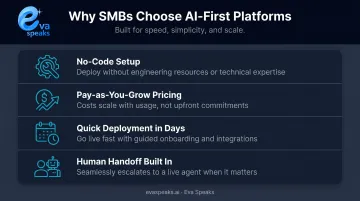
What makes these platforms SMB-friendly:
- No-code or low-code setup — no developer required
- Pay-as-you-grow pricing, not large upfront fees
- Quick deployment, often measured in days rather than months
- Human handoff built in, so AI handles volume while your team handles complexity
The platforms below were evaluated on those factors: deployment simplicity, pricing transparency, omnichannel capability, AI quality, and real-world fit for small to medium businesses. Small businesses that want to see a phone-first AI platform before evaluating the full list can Request Live Demo for Eva Speaks.
Top Conversational AI Support Platforms for Small Businesses
Five platforms stand out for small businesses evaluating conversational AI support tools — each with a distinct strength, price point, and ideal use case. The summaries below cover what each platform does well, where it falls short, and who it's best suited for.
Tidio
Tidio is built specifically for small businesses and e-commerce operators. Its unified inbox pulls together chat, email, and Facebook Messenger into one dashboard — useful when you're a small team managing multiple channels.
The standout feature is Lyro, Tidio's AI agent. Lyro trains on your own business content and handles common queries autonomously. According to Tidio, Lyro achieves a 67% average resolution rate and comes with a 50% resolution guarantee. It also connects natively with Zendesk, Intercom, Salesforce, and 20+ other platforms.
| Feature | Details |
|---|---|
| Key Features | Lyro AI agent, live chat, email and Messenger integration, automated flows, visitor tracking, sales automation triggers |
| Pricing | Free plan available (50 billable conversations/month); paid plans start at approximately $24.17/month billed annually — verify current pricing |
| Best For | Small e-commerce businesses and service providers wanting a fast, affordable AI chatbot with live chat fallback |
With over 1,900 reviews on G2 and a 4.6/5 rating, Tidio has the strongest third-party usability evidence of any platform on this list for small businesses specifically.
If your team also needs CRM functionality baked in — not just chat — Freshchat is worth a closer look.
Freshchat (Freshworks)
Freshchat is Freshworks' AI messaging product — part of a broader suite that includes Freshdesk (ticketing) and Freshsales (CRM). Its AI agent, Freddy, handles repetitive and backend-action queries autonomously: processing refunds, updating orders, verifying account details.
The unified agent workspace blends bot and human interactions in one view, which shortens onboarding time considerably. If you're already using another Freshworks product, adding Freshchat is a natural extension.
| Feature | Details |
|---|---|
| Key Features | Freddy AI agent, all-channel inbox, bot-to-human handoff, Freshworks ecosystem integration, built-in reporting, multilingual support |
| Pricing | Free plan for up to 10 agents; Growth plan at approximately $19/agent/month — verify current pricing |
| Best For | Cost-conscious small businesses that want an all-in-one customer service and CRM suite without a steep learning curve |
The free plan for up to 10 agents makes Freshchat one of the most accessible entry points on this list.
For businesses anticipating rapid growth and needing a platform that scales well beyond startup size, Zendesk covers more ground.
Zendesk
Zendesk is the most widely recognized platform on this list, and its pricing reflects that. But the entry point is more accessible than many expect: the Support Team plan starts at $19/agent/month (billed annually), covering email, ticketing, routing, automations, and prebuilt analytics.
Its AI layer handles intent detection, sentiment analysis, and automatic ticket routing — it can suggest relevant help articles to agents mid-conversation and classify support requests before a human ever touches them.
| Feature | Details |
|---|---|
| Key Features | AI chatbots, sentiment detection, omnichannel ticket routing, self-service portal builder, reporting and analytics, 1,000+ app integrations |
| Pricing | Support Team from $19/agent/month; Suite plans from $55/agent/month — verify current pricing |
| Best For | Small businesses expecting significant growth that need a scalable, feature-rich platform they won't outgrow quickly |
Zendesk carries over 6,900 G2 reviews with a 4.3/5 rating. The platform suits small businesses graduating from a shared inbox into structured ticketing and routing.
Teams in SaaS or subscription models — where long customer relationships and proactive engagement matter — should consider Intercom next.
Intercom
Intercom's AI agent, Fin, draws from your existing knowledge base to answer customer questions without human involvement. Intercom publishes a specific resolution figure: Fin resolves up to 65% of queries end-to-end, with the average resolution rate increasing 1% every month as it learns.
The platform also maintains full conversation history, so agents picking up escalated conversations always have context. This matters particularly for SaaS businesses and subscription models where customer relationships span months or years.
| Feature | Details |
|---|---|
| Key Features | Fin AI agent, business messenger, proactive messaging, conversation history, lead qualification, multilingual support, CRM data integration |
| Pricing | Essential plan from $29/seat/month; Fin AI also available from $0.99/outcome — verify current pricing |
| Best For | Startups and SaaS-model small businesses prioritizing proactive engagement, lead qualification, and high autonomous resolution rates |
One caveat: Intercom's pricing has both seat and outcome-based components. Check your monthly conversation volume first — the dual pricing structure can add up quickly for high-traffic teams.
For businesses with very high ticket volume whose primary goal is maximizing automation, Ada takes that further than any other platform here.
Ada
Ada takes an automation-first position: its AI agents are designed to resolve as large a share of incoming tickets as possible without human involvement. Ada claims autonomous resolution of up to 83% of support issues, using customer data to personalize responses at scale.
Ada's platform covers voice, messaging, and email channels, with integrations into major help desks.
| Feature | Details |
|---|---|
| Key Features | Automation-first AI agents, customer data personalization, brand voice controls, analytics dashboard, helpdesk integrations, voice and messaging channels |
| Pricing | Custom pricing — no published tiers; contact Ada directly for a quote |
| Best For | SMBs and mid-market businesses whose primary goal is maximizing automated ticket resolution while maintaining consistent brand voice |
Important caveat: Ada's pricing page notes the platform is best suited for companies handling at least 300,000 annual customer service conversations. Very small businesses should verify whether Ada fits their volume before investing time in an evaluation. For a different kind of AI support — one built around voice calls rather than chat — you can Watch AI Call Flow Demo to see how phone-first AI handles a live customer interaction.
AI Automation vs. Traditional Support: How the Options Compare
Here is how AI-powered automation, basic chatbots, and traditional human support compare for small business customer service:
| AI Voice + Automation (EvaSpeaks) | Basic Chatbot / Help Widget | Human Support Staff | |
|---|---|---|---|
| Features | Voice calls, scheduling, 24/7, CRM sync | FAQ deflection, text chat | Full service, adaptive |
| Best-fit Business Size | 1-50 person businesses | Any size | Any size |
| Key Strengths | Answers calls humans miss, 24/7, no overages | Self-service, low cost | Full interaction quality |
| Implementation Complexity | Low - hours | Low | None (hire) |
| Integration Capability | CRM, scheduling, calendar native | Limited | Manual |
How to Choose the Right Conversational AI Support Platform
Start With Your Primary Channel
YouGov's March 2025 survey found that nearly **70% of Americans use phone support**, while 63% use email. But preference data tells a different story: only 35% prefer phone and 23% prefer email. Channel usage and channel preference diverge considerably — which means platform selection should start with where your customers actually contact you, not where the industry average lands.
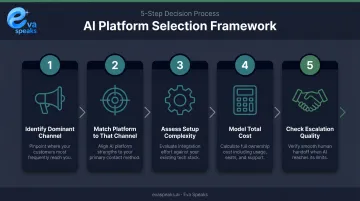
The right selection framework:
- Identify your dominant channel — phone, chat, email, or social
- Match the platform to that channel first — then evaluate secondary channels
- Assess setup complexity — can a non-technical team member manage it?
- Model total cost — include seat fees, AI usage billing, and any outcome-based charges
- Check escalation quality — how cleanly does the AI hand off to a human?
Avoid the Enterprise Trap
A common mistake: choosing a platform based on brand recognition rather than fit. A tool built for a 200-person contact center will overwhelm a five-person team with configuration complexity and pricing that doesn't scale down cleanly.
Tidio and Freshchat publish free entry plans that let you test before committing. Zendesk's ticketing entry point is the right step-up when you're ready for structured routing. Intercom and Ada require more cost modeling before they make sense for very small teams.
When Phone Is Your Primary Channel
Chat-first platforms assume most customer contact happens on a website or in-app. For businesses where phone remains the dominant channel — healthcare practices, law firms, automotive dealerships, property management companies — that assumption doesn't hold.
Eva Speaks is built specifically for this case — a voice-first AI system designed around phone as the primary channel, not a secondary add-on. Core capabilities include:
- Answers every inbound call 24/7 and qualifies leads during the conversation
- Books appointments directly into integrated calendar and scheduling systems
- Produces structured transcripts with speaker labels and extracted data
- Routes calls based on configurable logic: caller intent, business hours, department availability, and VIP status
- Integrates natively with Salesforce, HubSpot, and GoHighLevel, plus industry-specific platforms like Epic and athenahealth (healthcare), CDK and Dealertrack (automotive), and AppFolio and Yardi (property management)
For businesses in those verticals, the phone channel is where most customer relationships start — and that's where the platform focus needs to be. One practical consideration for small businesses evaluating Eva Speaks: unlike enterprise contact center platforms that require per-seat licensing and minimum agent counts, Eva Speaks is designed to scale down as well as up — it works for a three-person healthcare practice with the same configurability as a larger multi-location operation. Small businesses that want to explore this further can Talk to an AI Communication Expert about how phone-first AI fits their specific support channel.
Conclusion
The right conversational AI platform is the one that fits how your customers reach you, can be managed without a dedicated IT team, and grows with your business at the pace you set. Brand recognition is a weak selection criterion; practical channel alignment is a strong one.
Start with a free trial on one or two platforms that match your primary support channel. Measure response time and resolution rate at the 30-day mark. Expand from there once you know what's working — trying to automate everything at once rarely produces clean results.
If your 30-day review shows that missed calls or slow phone response are the main friction points, that's the channel worth addressing first. Eva Speaks provides AI-powered call handling and transcription that fits inside your existing workflows — no rip-and-replace required. Reach out to see how Eva handles your calls and keeps your team free for the work that moves the business forward. You can also See Industry Use Cases to explore how small businesses in your vertical are using AI phone support today.
Frequently Asked Questions
What is a conversational AI support platform?
It's software that uses NLP and machine learning to understand customer messages and respond automatically across channels like chat, SMS, and voice. Unlike basic rule-based chatbots, conversational AI platforms maintain context across a conversation and improve through continuous learning.
How do you automate customer support with AI?
Start by identifying your most repetitive inquiry types, then choose a platform that matches your primary support channel. Connect it to your existing knowledge base or CRM, and monitor resolution rates weekly to sharpen accuracy.
How can AI automation help small businesses?
AI automation handles routine queries 24/7 without adding headcount, reduces response times, and keeps answers consistent. It works best on high-volume, repetitive tasks, leaving your team available for complex or sensitive issues that need human judgment.
What should small businesses look for when choosing an AI support platform?
Prioritize ease of setup without technical expertise, pricing that scales with your usage, omnichannel support across your primary channel, and AI that can resolve queries without constant human intervention. Start with the channel where most of your customer contacts happen.
Can conversational AI replace human customer support agents?
No — and it shouldn't try to. Conversational AI handles repetitive, predictable queries autonomously, but complex, emotional, or high-stakes situations still require human judgment. The most effective setups combine both.
How much does a conversational AI support platform cost for small businesses?
Entry-level platforms offer free plans or start around $19–$29/month, while advanced platforms like Ada use custom pricing. Factor in the time your team saves, not just the subscription cost, to get an accurate picture of value.