This guide walks through exactly what to gather before you start, three structured audit methods, and how to interpret findings so you can confirm compliance before problems surface in production.
Watch how AI handles a compliant, fully logged call flow. Watch AI Call Flow Demo
Key Takeaways
- TCPA/FCC consent rules, state recording laws, HIPAA, PCI-DSS, and GDPR/CCPA can all apply to the same call at once
- Audits cover three workstreams: disclosure and consent flows, data handling and PII protection, and security controls with audit trails
- Findings fall into three tiers — fully compliant, minor gaps, and material violations — each requiring a different response
- Common failures: happy-path testing only, consent disclosures that break on transfers, and treating audits as one-time events
- Audit before launch, quarterly thereafter, and after any model update, integration change, or relevant regulatory development
What You Need Before Starting Your AI Phone Agent Audit
Gathering the right people, access permissions, and documentation before the audit begins determines whether findings are actionable or incomplete.
Audit Stakeholders and Access
Pull together a cross-functional team with system access before day one:
- Legal: consent flows, disclosure scripts, data retention policies
- Security: encryption configurations, access controls, vendor certifications
- Engineering: system architecture, third-party integrations, data flow mapping
- Operations: call flow scripts, monitoring dashboards, call transfer logic
Each team member needs appropriate system access confirmed in advance. An audit stalled on access requests produces incomplete findings.
Documentation and Tools Required
Collect these before the audit begins:
- Call flow diagrams and scripts (including transfer paths, not just the main inbound flow)
- Sample call transcripts and recordings across call types
- Consent records with timestamps and phone numbers covered
- Vendor contracts and any signed Business Associate Agreements (BAAs)
- Encryption certificates and configuration documentation
- Access control role definitions and current permission lists
Platforms with built-in call transcription and logging (such as Eva Speaks) generate structured call records that serve directly as audit evidence, reducing manual collection effort. Confirm what format those records export in and whether they carry timestamps suitable for compliance documentation. Eva Speaks also supports configurable call-flow scripts that can embed consent disclosures directly into the routing logic, so compliance requirements are enforced at the system level rather than depending on individual agent behavior.
Not all call systems handle regulatory compliance the same way. Here is how AI phone agents, traditional IVR, and human agents compare on compliance capabilities and audit trail readiness before you scope your audit:
| AI Phone Agent (EvaSpeaks) | Traditional IVR | Human Agent | |
|---|---|---|---|
| Features | Full transcript, call recording, intent logs, HIPAA/GDPR-ready | Call recordings, basic logs | Manual notes, recording dependent on setup |
| Best-fit Business Size | Regulated SMBs to large enterprises | Large regulated enterprises | Any size |
| Key Strengths | Complete audit trail, consistent, tamper-evident logs | Proven compliance in telecom | Human judgment for exceptions |
| Implementation Complexity | Low - compliance built-in | High | None (hire + train) |
| Integration Capability | CRM, EHR, compliance reporting tools native | Custom dev | Manual |
With documentation in hand, the next step is confirming the scope your audit actually needs to cover. Two preconditions determine that scope:
- Which regulations apply based on your industry vertical and caller geography. A healthcare provider calling California residents faces HIPAA, TCPA, and California's all-party recording consent requirement simultaneously.
- A complete data flow map showing where voice data enters, moves, and exits your system—including every third-party that touches it.
Key Regulatory Requirements Your AI Phone Agent Must Meet
Multiple regulations can apply to the same call. Knowing exactly which rules govern your deployment prevents audit blind spots.
TCPA, FCC Rules, and State Recording Laws
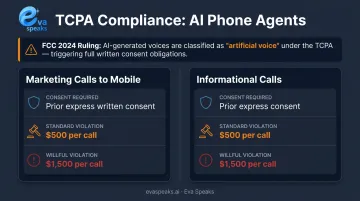
The FCC's February 2024 ruling is unambiguous: AI-generated voices qualify as "artificial voice" under the TCPA. That means:
- Marketing calls to mobile phones require prior express written consent
- Informational calls require prior express consent
- Standard violations: $500 per call; willful violations: up to $1,500 per call under 47 U.S.C. § 227
For call recording, the one-party vs. all-party consent distinction matters. The RCFP identifies at least 11 core all-party consent states, with California, Florida, and Illinois among the most actively enforced. Build a state-by-state consent matrix rather than relying on a single national count—state laws vary by context and communication type.
A critical audit point: a disclosure at call initiation does not automatically extend to a transferred segment. If the AI agent receives a transferred call mid-session and a fresh recording consent was not captured for that interaction specifically, that recording may be non-compliant regardless of what happened at call start.
Industry-Specific Regulations
Telecom rules set the floor. Industry-specific regulations layer additional obligations on top—and often carry steeper penalties.
HIPAA applies whenever voice recordings or transcripts contain individually identifiable patient information. Under 45 CFR 160.103, those recordings and transcripts are Protected Health Information (PHI). Requirements include:
- Encrypted storage and transmission
- Minimum-necessary data access controls
- Signed BAAs with every vendor that touches PHI—LLM provider, cloud host, analytics platform, transcription service
- Six-year retention for required Security Rule documentation
HHS OCR announced in November 2024 that PIH Health paid $600,000 to resolve HIPAA violations stemming from a phishing attack that exposed unsecured ePHI.
PCI-DSS v4.0.1 governs any agent that processes payments or discusses account details. Requirements 3.3.1, 3.4.1, and 3.5.1 collectively require that sensitive authentication data not be retained after authorization and that PANs be rendered unreadable wherever stored—including recordings, transcripts, and logs. Pausing or suppressing recording during card number entry is a common control used to satisfy these requirements.
Financial services firms face separate retention mandates: FINRA Rule 4511 and SEC Rule 17a-4 both govern voice communication records and carry their own audit requirements.
Data Privacy Laws
GDPR applies if your agent handles calls involving EU residents. GDPR Article 12 requires responding to data access or deletion requests within one month. A Data Protection Authority fined a bank €100,000 in November 2025 specifically over customers' access to data in telephone order recordings.
CCPA treats voice recordings and transcripts as personal information when they identify or can be linked to a California consumer. Both frameworks stack on top of telecom regulations—not instead of them.
How to Conduct the Compliance Audit
A complete compliance audit runs three parallel workstreams. Each examines a different failure surface—because most violations aren't caught by a single review layer, and front-end testing never surfaces backend data gaps.
Method 1: Disclosure and Consent Flow Audit
Goal: Verify that every call identifies the agent as AI, captures legally required consent, and delivers recording notices at the correct moment—not just somewhere in the call.
Access needed: Call flow scripts, sample transcripts, consent logs with timestamps, jurisdiction mapping for all caller locations.
Steps:
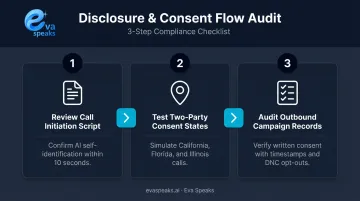
- Review the call initiation script — Confirm the AI self-identification disclosure fires within the first 10 seconds. Language must be explicit; "virtual assistant" does not satisfy the FCC's artificial voice standard.
- Test consent capture from two-party consent states — Simulate calls from California, Florida, and Illinois. Verify the agent pauses recording until affirmative consent is given and handles a refusal without blocking service.
- Audit outbound campaign records — Confirm prior express written consent records exist with timestamps, phone numbers covered, and documented signature. Cross-reference against the do-not-call list to verify opt-outs are applied in real time.
This method surfaces front-end compliance failures—the most common source of TCPA violations. Backend data handling and security gaps require Methods 2 and 3.
Method 2: Data Handling and PII Audit
Goal: Confirm that call data—recordings, transcripts, logs, and derived analytics—is encrypted, retained only as long as required, and purged completely when the retention period expires.
Access needed: Storage configuration settings, encryption certificates, vendor contracts and BAAs, data flow diagram.
Steps:
- Map every location where voice data lands — Primary database, analytics warehouse, CRM, backup storage, and every third-party LLM or transcription provider. Confirm each location has a defined retention period and an automated purge workflow.
- Verify encryption standards — AES-256 at rest and TLS 1.2/1.3 in transit for all pipeline components. Confirm the LLM provider and other third parties do not store prompts or completions for model training without a signed data processing agreement.
- Scan for exposed PII — Run automated scanning or manual spot checks of transcripts and API payloads for credit card numbers, Social Security numbers, and patient identifiers. Confirm redaction triggers before data reaches analytics dashboards or logs accessible to engineering teams.
This method catches backend data leakage that front-end testing never surfaces. Request storage configurations and vendor agreements before the audit starts—they often take time to obtain.
Want a compliance-ready AI setup for your use case? Get a Customized Workflow Recommendation
Method 3: Security Controls and Audit Trail Review
Goal: Verify that access to call data is role-restricted, every access event is logged in tamper-evident audit trails, and vendor certifications are current and cover your specific use case.
Access needed: RBAC configuration, audit log exports, vendor trust center documentation, incident response plan.
Steps:
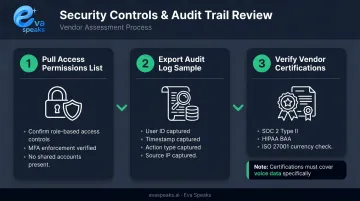
- Pull the current access permissions list — Confirm access to recordings and transcripts is limited to job-appropriate roles. Verify no shared accounts exist and that multi-factor authentication is enforced for admin consoles.
- Export a sample of audit log entries — Verify they capture user ID, timestamp, action type, source IP, and outcome for every access to call data. Confirm logs are stored in append-only or cryptographically chained storage and retained for the required period.
- Verify vendor certifications — SOC 2 Type II, HIPAA BAA if applicable, ISO 27001. Confirm certifications are current and specifically cover voice data processing—a certification that excludes your data category does not satisfy the requirement.
This method validates the accountability infrastructure regulators request first during an inquiry. One caveat: certifications must be re-verified after contract renewals or platform updates. A SOC 2 report from 18 months ago covering a prior platform version is not sufficient.
How to Interpret Your Audit Findings
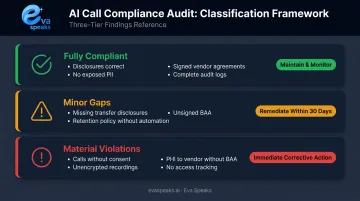
Misreading audit results—treating a minor gap as acceptable or failing to recognize a material violation—leads to either unnecessary delays or continued exposure. The three-tier framework below helps you categorize findings and act on them decisively.
Fully Compliant
All three methods pass when:
- Disclosures fire at the correct moment on every call path, including transfers and outbound
- No PII appears in unredacted logs or third-party payloads
- All vendors have signed agreements and current certifications
- Audit logs are complete, tamper-evident, and cover the required retention period
Next step: Document the results, set a calendar reminder for the next scheduled audit, and set up monitoring alerts for regulatory changes.
Minor Gaps
These don't constitute an active violation but require remediation:
- A disclosure that fires correctly on inbound calls but is missing on transferred calls
- A retention policy that exists but lacks an automated enforcement mechanism
- A vendor with a compliant product but an unsigned BAA
Next step: Assign owners, set 30–60 day remediation deadlines, and retest the specific failure point before the deadline. Remediation shouldn't wait for the next full audit cycle — close gaps as they're confirmed.
Material Violations
These indicate active regulatory exposure requiring immediate action:
- Calls made to mobile phones without documented consent
- Recordings stored without encryption
- PHI flowing to a vendor with no BAA
- Audit logs showing no access tracking
Immediate action required: Immediately halt the affected call flows or data pipeline, notify legal counsel, remediate the root cause before resuming, and assess whether you've triggered a regulatory disclosure obligation.
Common Compliance Audit Mistakes to Avoid
Happy-Path Testing Only
Most compliance failures surface on edge-case call paths, not the standard inbound flow QA teams typically test. Run adversarial scenarios that trigger:
- Call transfers mid-session
- Mid-call opt-out requests
- Outbound consent failures
- Calls originating from two-party consent states
- Calls where the caller provides sensitive data (card numbers, patient information)
If your test suite doesn't include these paths, your audit results don't reflect production risk.
Static Consent Logic That Breaks on Transfers
A consent disclosure at the start of an inbound call does not automatically extend to an AI agent that receives a transferred call mid-session. If the original consent was not obtained for the AI interaction specifically, recording that transferred segment may be non-compliant regardless of what happened at call initiation.
Audit every transfer path as an independent consent event.
Treating the Audit as a One-Time Event
Compliance requirements shift — sometimes mid-deployment. The FCC's February 2024 ruling, for instance, was a mid-cycle regulatory change that retroactively affected already-deployed agents. Model updates, new integrations, and feature additions each introduce new compliance failure surfaces. Run audits:
- Before the first production call
- After any model update, new third-party integration, or feature change
- On a scheduled quarterly basis
- After any relevant regulatory development
Have compliance questions about AI call agents? Talk to an AI Communication Expert
Ongoing Compliance Best Practices
Build Compliance Into Call-Flow Design From the Start
Configure call-flow scripts and routing rules to include non-skippable disclosure and consent prompts at the conversation level. Platforms like Eva Speaks allow these protections to be built directly into call routing logic, so every call variant inherits the same requirements automatically. Layering compliance checks on afterward is less reliable and significantly harder to audit.
Deploy Continuous Monitoring Alongside Periodic Audits
Periodic audits alone won't catch issues fast enough in a live call environment. Automated monitoring should run continuously and flag problems in near real-time. Key signals to track include:
- Consent rate drops below established thresholds
- PII appearing in call logs or transcripts
- Unauthorized data access patterns across integrations
Pair this with immutable audit trail records that link pre-launch test results to live call data, so you can trace your compliance posture over time and demonstrate it to regulators if needed.
Frequently Asked Questions
How is AI used in regulatory compliance?
AI tools automate compliance monitoring tasks—scanning call transcripts for required disclosures, flagging PII in logs, and tracking consent records at scale. At the same time, AI phone agents themselves are subject to regulation and require structured audits to confirm they operate within legal requirements.
How often should AI phone agents be audited for compliance?
Run a full audit before the first production call, then on a quarterly schedule. Trigger an immediate audit after any of the following:
- Model update or LLM change
- New third-party integration
- Feature change affecting call flows
- Relevant regulatory update
What regulations apply to AI phone agents in the United States?
The primary frameworks include:
- TCPA and FCC rules — consent and disclosure requirements
- Call recording laws — one-party vs. all-party consent varies by state
- HIPAA — applies to healthcare deployments
- PCI-DSS — required for payment-related interactions
- CCPA and other state privacy laws — data handling and consumer rights
These can—and frequently do—apply simultaneously to the same call.
What did the FCC's 2024 ruling change for AI phone agents?
The FCC's February 2024 declaratory ruling (FCC 24-17) classified AI-generated voices as "artificial voice" under the TCPA. All AI phone agent calls are now subject to the same consent and disclosure requirements previously applied to robocalls and prerecorded messages, regardless of how natural the voice sounds.
Does HIPAA compliance require a Business Associate Agreement with my AI phone vendor?
Yes. Every vendor that stores, processes, or transmits Protected Health Information must have a signed BAA before PHI flows to them. This includes:
- AI voice platform
- LLM provider
- Cloud host
- Analytics tool
The absence of a BAA constitutes a HIPAA violation regardless of the vendor's actual security posture.
What should I do if my AI phone agent fails a compliance audit?
Halt the affected call flows or data pipeline immediately. Notify legal counsel to assess whether a regulatory disclosure obligation has been triggered. Remediate the specific failure point and retest before resuming. Documenting the failure without halting operations is not sufficient—resume only after full remediation and retesting.