Introduction
Most businesses don't lose customers because of bad products — they lose them because nobody picked up the phone. A missed call from a new prospect rarely becomes a second attempt. According to CallRail, 28% of business calls go unanswered, and the callers who don't get through typically don't wait around.
Basic call forwarding has existed for decades. Dial a code, redirect calls to another number — straightforward, but limited. Smart call forwarding is the rules-based evolution: routing calls automatically based on conditions like time of day, agent availability, or department — without any manual intervention.
What follows is a practical breakdown of how smart call forwarding works, where it pays off, and how to set it up so it actually holds up under daily business pressure.
Key Takeaways
- Smart call forwarding routes calls based on conditions — time, availability, caller type — not just a single destination number
- It directly reduces missed calls, speeds up resolution, and improves customer experience without adding staff
- Fewer than 3% of callers sent to voicemail leave a message — making proper routing essential, not optional
- Poorly configured or absent forwarding creates compounding problems as call volume grows
- Regular configuration reviews keep routing rules aligned with how your business actually operates
What Is Smart Call Forwarding
Smart call forwarding is a call routing mechanism that automatically redirects incoming calls based on pre-set conditions — such as time of day, agent availability, call volume, or caller type — rather than routing every call to a single number.
It's typically deployed within:
- VoIP and cloud-based phone systems
- Virtual phone platforms with IVR or call flow builders
- Contact center software with condition-based routing logic
- AI-powered communication platforms that combine routing rules with real-time call handling
Basic call forwarding — like dialing *72 on a landline — routes every call the same way, regardless of when it comes in or who's calling. It can't tell the difference between a lunchtime call and a 3 AM inquiry, or a sales prospect and an existing customer. Smart call forwarding adds the logic layer: separate paths for "agent busy," "no answer," "after hours," and "specific caller type."
That distinction is what turns a simple redirect into a reliable, context-aware routing system.
Watch how smart call forwarding works on a real call. Watch AI Call Flow Demo
Here is how smart AI-powered call forwarding compares to basic call forwarding and UCaaS call routing:
| AI Smart Forwarding (EvaSpeaks) | UCaaS Call Routing (RingCentral) | Basic Call Forwarding | |
|---|---|---|---|
| Features | AI answers first, routes based on intent, 24/7 AI cover on overflow | Unified routing rules, voicemail, ring groups | Simple number-to-number redirect |
| Best-fit Business Size | SMB to mid-market | Any size | Very small businesses |
| Key Strengths | AI handles overflow so no call is missed, CRM sync | Full feature set, unified comms | Zero setup cost |
| Implementation Complexity | Low | Low to Medium | None |
| Integration Capability | CRM, scheduling native | UCaaS ecosystem | None |
Key Advantages of Smart Call Forwarding
Cutting Missed Calls and Lost Revenue
A missed call from a new prospect is almost always a lost opportunity. Invoca reports that fewer than 3% of callers sent to voicemail leave a message — meaning the overwhelming majority of unanswered calls simply disappear. No callback, no lead, no revenue.
Smart call forwarding eliminates coverage gaps by ensuring every call has a defined destination:
- Time-based rules route calls to on-call staff after hours automatically
- Simultaneous ring sends calls to multiple agents at once, so the first available picks up
- No-answer forwarding kicks in after a set number of rings, redirecting to a backup number or voicemail-to-text
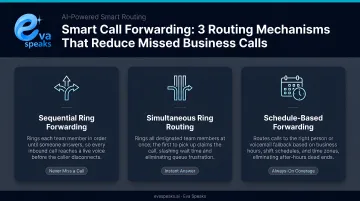
This works without manual intervention. A sales rep leaves early — calls route to a colleague. A public holiday hits — after-hours routing activates on schedule.
Where this matters most: Sales teams, healthcare scheduling, legal intake, real estate — any environment where a single missed call has direct revenue or relationship consequences.
KPIs impacted: Call answer rate, missed call rate, lead response time, inbound conversion rate.
See how AI keeps your calls covered after hours. See How AI Handles After-Hours Calls
Faster Resolution and Better Customer Experience
Answering a call is only half the equation. Getting the caller to the right person — fast — is what determines whether the experience is good or frustrating.
Smart forwarding removes the intermediate steps. A caller pressing "1 for support" reaches a support agent directly, not a general inbox that re-routes manually. A call outside business hours goes to an after-hours team or a self-service option, rather than ringing indefinitely.
SQM Group's FCR benchmarking data shows the average first call resolution rate across contact centers sits at 71%, and every 1% improvement in FCR corresponds to a 1% improvement in customer satisfaction. Intelligent routing directly moves that number — every unnecessary transfer is a barrier to resolution.
Every unnecessary transfer adds:
- Handle time for the agent
- Wait time for the caller
- A higher probability the caller gives up or calls back frustrated
Where this matters most: Multi-department businesses, tiered support teams, and any operation where callers have varying needs that require different expertise.
KPIs impacted: First call resolution rate, average handle time, CSAT score, call transfer rate.
Operational Flexibility Without Adding Headcount
Smart call forwarding lets businesses expand coverage — across hours, locations, or team size — by adjusting routing rules rather than hiring more staff. The coverage gap gets closed through configuration, not a new hire.
Practically, this looks like:
- Holiday schedules that activate and deactivate automatically
- After-hours routing to a backup team or AI-assisted answering layer
- Simultaneous ring across remote or distributed staff
- Condition-based rules that update instantly — no hardware changes, no IT ticket
For businesses using AI-powered platforms like EvaSpeaks, this extends further. When no live agent is available, LLM-integrated call handling can answer calls in real time, capture caller intent, respond to common questions, and escalate when human involvement is needed — rather than dropping calls to voicemail. EvaSpeaks is specifically designed to deploy quickly and integrate with existing phone infrastructure without requiring the kind of heavy IT lift that enterprise call center platforms demand — which is why it suits growing businesses looking to expand coverage without proportional overhead.
The operational argument: rule changes are instant. A business can update routing for a staff absence or seasonal volume spike in minutes, from a web dashboard. Compare that to the lead time, cost, and training overhead of adding a full-time call handler.
Best fit: Growing SMBs, remote and distributed teams, businesses with seasonal spikes, and operations spanning multiple time zones.
KPIs impacted: Cost per call handled, team utilization rate, after-hours coverage rate.
See it handling your calls live. Request Live Demo
What Happens When Smart Call Forwarding Is Missing
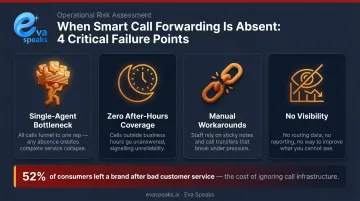
The most common failure pattern is simple: all calls go to one number, or there's no forwarding at all. That works fine for a two-person team. Once volume picks up, the whole setup starts showing cracks.
Operational consequences of absent or poorly configured forwarding:
- Single-agent bottlenecks — one person absorbs all volume during busy periods, creating hold times and dropped calls
- Zero after-hours coverage — overnight leads and urgent customer issues hit voicemail or ring out entirely
- Manual workarounds — forwarding to personal cell phones, asking customers to "call back tomorrow" — both unprofessional and inconsistent
- No visibility — in basic setups, there's no missed call log, no alert, no follow-up trigger; businesses don't know what they're losing
PwC's 2025 Customer Experience Survey found that 52% of consumers stopped using or buying from a brand because of a bad customer service experience. That's not limited to phone calls, but consistently missing or mishandling inbound calls is exactly the kind of friction that drives customers away.
These issues don't shrink as a business grows — they compound. A team handling 20 calls a day can muddle through with poor routing. Scale that to 200 calls, and broken forwarding becomes a real operational liability.
How to Get the Most Value from Smart Call Forwarding
Smart call forwarding only works well when the routing logic reflects how the business actually operates — not an out-of-the-box default. Before touching any settings, map the real call scenarios: after-hours, agent busy, high-volume periods, department-specific needs.
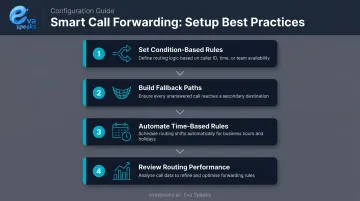
Four Core Best Practices
1. Set condition-based rules, not just unconditional forwarding
Configure separate routing paths for every likely call state: busy, no answer, after hours, offline. Each scenario should have a defined destination — not a single number that handles everything.
2. Build fallback paths into every routing chain
Every path needs a final fallback. Whether that's voicemail-to-text, an after-hours team, or an AI-assisted answering layer — no call should terminate without a defined response path. If the chain ends in a dead ring, you've just replicated the problem smart forwarding is supposed to solve.
3. Automate time-based rules
Link forwarding rules to your business hours calendar so they activate and deactivate automatically. The biggest risk with manual routing isn't misconfiguration — it's forgetting to update it during holidays, coverage changes, or staff absences.
4. Review routing performance regularly
Smart forwarding is a living system. Monthly reviews of missed call reports, transfer rates, and answer rates reveal which routing rules are working and which need adjustment. Routing logic that worked for a 10-person team often needs updating at 25.
Beyond Rule-Based Routing
For businesses that want more than conditional forwarding, AI-powered call handling adds a layer that rules alone can't provide. Eva Speaks uses real-time AI and customizable call-flow scripts to handle unattended calls actively rather than routing them to voicemail. The AI engages the caller, answers common questions, captures intent, and escalates to a live agent when needed.
Together, smart routing rules and AI-assisted handling close coverage gaps without adding headcount on standby.
Want to talk through the right forwarding setup for your team? Talk to an AI Communication Expert
Frequently Asked Questions
What do call forwarding codes like *#21#, *#61#, *#62#, *#67#, *#73#, and *#002# do?
These are USSD/MMI codes used to check or manage call forwarding settings on mobile networks. Standard 3GPP codes cover scenarios like unconditional forwarding (*#21#), no-answer (*#61#), unreachable (*#62#), and busy (*#67#), while *#002# deactivates all conditional forwarding. Note that *#73# is not a standard 3GPP code — U.S. carriers like AT&T and Verizon use *73 instead, and exact codes vary by carrier.
Is call forwarding available in the Philippines?
Call forwarding is available in the Philippines. DITO Telecommunity officially references the feature in its help center. For Globe and Smart, codes and availability vary by plan — check directly with your carrier or configure forwarding through your device settings.
What is the difference between smart call forwarding and basic call forwarding?
Basic call forwarding unconditionally redirects all calls to a single number regardless of context. Smart call forwarding uses condition-based rules — time of day, agent availability, caller type, call volume — to route each call to the most appropriate destination, reducing missed calls and improving the caller experience.
Can smart call forwarding be configured to work automatically after business hours?
Yes. Most VoIP and cloud phone systems support time-based rules that activate after-hours routing automatically — directing calls to an on-call team, voicemail-to-text, or an AI-assisted answering service. No manual toggle is required once the schedule is configured.
How does smart call forwarding help reduce missed calls?
It eliminates coverage gaps by defining a routing path for every call scenario. When an agent is busy, unavailable, or off the clock, the call automatically routes to a backup destination rather than ringing out. There's no reliance on someone remembering to update settings.
What features should I look for in a smart call forwarding solution?
Key features to evaluate: condition-based routing (busy, no-answer, time-of-day), simultaneous ring, voicemail-to-text fallback, call logs and analytics, and rule management that doesn't require IT support. For businesses with after-hours gaps or high call volume, AI-assisted handling that engages callers when no agent is available should be a priority.