Introduction
You've heard it hundreds of times: "Press 1 for Sales, Press 2 for Support." That familiar prompt is IVR — and while every customer has experienced it, most businesses barely scratch the surface of what the technology can do.
Interactive Voice Response is often a caller's first impression of your business. Get it right, and callers reach the right place fast. Get it wrong, and research from Verint shows nearly 3 in 5 consumers have had frustrating IVR experiences — too many prompts, no clear path to a human, no resolution.
The IVR market is valued at $5.39 billion in 2025 and projected to reach $7.07 billion by 2030, according to Mordor Intelligence. That growth reflects something real: voice remains the preferred support channel for complex issues, and businesses are investing to meet that demand.
This guide breaks down how IVR works, the different types available, the business case for investing in it, and how AI-powered IVR is changing caller expectations — and what businesses can do about it. Those ready to move beyond legacy IVR can Explore AI Call Automation to see what a conversational AI alternative looks like.
Key Takeaways
- IVR automates inbound call handling through voice prompts, keypad input, and speech recognition
- Modern systems handle self-service, personalization, and AI-driven responses — not just basic menu routing
- Key benefits: 24/7 availability, lower costs, faster routing, and actionable call analytics
- AI-powered IVR is replacing traditional DTMF systems, handling natural speech instead of keypad inputs
- Cloud-based IVR now dominates, holding 62.48% of market share in 2024
What Is an IVR System?
Interactive Voice Response (IVR) is an automated telephony technology that answers inbound calls, interacts with callers through pre-recorded prompts or text-to-speech, and collects input via keypad presses or spoken commands — routing callers to the right destination or enabling them to self-serve without a live agent.
Core Functions
An IVR system handles more than call routing:
- Answers and routes calls to the appropriate department or agent queue
- Enables self-service for common tasks like balance checks, appointment scheduling, and order status
- Collects caller data before the interaction begins, so agents have context when they pick up
- Integrates with backend systems to deliver personalized, account-specific responses
How IVR Differs from Related Technologies
IVR is frequently confused with adjacent call-handling tools. Here's a quick distinction:
| Technology | What It Does |
|---|---|
| IVR | Interacts with callers via voice prompts and input capture |
| Auto-Attendant | Simple one-way greeting and routing — no interaction layer |
| ACD (Auto Call Distributor) | Manages call queues in the background; works alongside IVR |
| CTI (Computer Telephony Integration) | Syncs phone data to agent screens for context delivery |
These systems typically run together: IVR captures caller intent, ACD distributes the call, and CTI surfaces the data to the agent.
Which Industries Use IVR Most
Banking, financial services, and insurance (BFSI) held 29.68% of IVR market share in 2024 — the largest segment by far. Healthcare is growing fastest at a 6.73% CAGR, driven by demand for 24/7 patient access. Other heavy adopters include retail, utilities, government, and logistics — all industries where high call volumes and repetitive inquiries make automation valuable.
How Does an IVR System Work?
IVR follows a predictable sequence from the moment a call arrives to the moment it resolves.
Step 1 — Call Initiation and Greeting
The IVR answers automatically and plays a welcome message. Most systems offer language selection before presenting the main menu. This first moment sets the tone for the entire interaction.
Step 2 — Menu Navigation and Input Capture
The system presents options and captures caller responses through one of two methods:
- DTMF (Dual-Tone Multi-Frequency): Callers press numbers on their keypad — the original and still most common method
- ASR (Automatic Speech Recognition): Callers speak their selection, allowing for more flexible, natural navigation
Multi-level menus let businesses create granular routing paths. Pressing 3 for Billing, then 1 for payment questions, for example, narrows the caller to exactly the right destination without requiring a live agent.
Step 3 — Routing and Self-Service
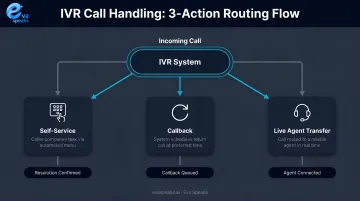
Based on the caller's input, the IVR takes one of three actions:
- Routes to a live agent queue or specific department
- Launches a self-service flow (balance check, order status, prescription refill)
- Offers a callback option so callers don't have to wait on hold
Step 4 — Error Handling and Escalation
Well-designed IVR systems plan for failure. When a caller inputs something invalid or goes silent, the system should:
- Repeat the menu options clearly
- Offer a direct path to a live agent ("Press 0 at any time")
- Automatically escalate after repeated failed attempts
The cost of ignoring this is real. An eGain survey of 500 consumers found 60% tried to zero out very often or often, and 67% spent 5+ minutes trying to get an answer from IVR before escalating. Agent escape paths are a baseline requirement, not a nice-to-have.
Step 5 — Analytics and Data Logging
Modern IVR platforms log call volume, menu selection patterns, drop-off points, and resolution rates. Businesses that review these logs regularly can act on what the data shows — specifically:
- Which menu options confuse callers or cause drop-offs
- Where self-service flows break down before resolution
- Where staffing gaps are creating queue bottlenecks
These patterns are easiest to spot with structured analytics — and you can Watch AI Call Flow Demo to see how an AI-powered IVR replacement generates cleaner call data from the start.
Types of IVR Systems
Touch-Tone (DTMF) IVR
The classic format. Callers press numbers to navigate a pre-mapped menu. It's straightforward to deploy and cost-effective, but inflexible — callers must fit their needs into the options available, not the other way around.
Speech-Based and Natural Language IVR
Uses ASR and natural language processing (NLP) to interpret spoken input. Instead of "Press 3 for billing," the system can ask "How can I help you today?" and understand a wide range of responses.
Two approaches exist within this category:
- Directed dialogue: Structured verbal prompts with expected responses ("Say 'billing' or 'account'")
- Open-ended NLP: Callers speak naturally and the system interprets intent from context
Open-ended NLP dramatically reduces menu complexity, though it requires more sophisticated underlying technology to work reliably.
Outbound IVR
Rather than waiting for calls to arrive, outbound IVR initiates them. Common applications include appointment reminders, payment alerts, survey collection, and emergency notifications. Hawaiian Electric used outbound IVR to handle over 6,500 emergency communications calls with an average call time of just over one minute.
Cloud-Based vs. On-Premise IVR
- Cloud-based: Hosted externally, lower upfront cost, faster deployment, VoIP-based — now the dominant choice at 62.48% market share
- On-premise: Local hardware, higher initial investment, IT-managed, preferred by organizations with strict data control requirements
For most businesses, cloud IVR is the practical starting point — and understanding which system type fits your needs shapes every deployment decision that follows.
Key Benefits of IVR for Businesses
24/7 Availability Without Full Staffing
Callers can access self-service options, leave structured voicemails, or request callbacks at any hour — without requiring a live agent on duty. IVR handles this around the clock. For businesses with global customers or after-hours demand, that coverage alone justifies implementation.
Lower Costs Through Call Deflection
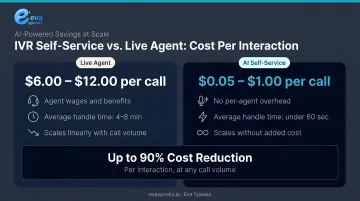
According to NICE, self-service IVR accounts for 73% of contact center traffic. The cost difference is significant: live-agent interactions cost $6 to $12 each (per Forrester data cited by NICE), while automated interactions run approximately $0.25.
Real-world outcomes from NICE-documented cases show how quickly those savings compound:
- One organization eliminated more than 40,000 calls per year by adding a single ACH payment option to their IVR menu
- Another found that each 1 percentage point of added IVR containment eliminated 980,000 calls and saved more than $5.5 million in operational costs
Improved Agent Efficiency
By collecting caller intent and relevant account information before routing, IVR gives agents immediate context. Callers don't repeat themselves. Agents skip the intake phase and move directly to resolution. That compression in handle time adds up across thousands of daily interactions.
Scalability Without Headcount Increases
Seasonal surges, product launches, and service outages can overwhelm staffed teams. IVR absorbs that load without degradation. The FedPoint case (NICE) illustrates this directly: their seasonal contact center scales to 1,500 agents, with IVR containment rising from 28.5% to 33.9% and average answer speed improving from 35 seconds to 15 seconds.
Data-Driven Optimization
IVR analytics reveal exactly where your call flows succeed or fail — which options callers select most, where they abandon, and which self-service paths resolve without escalation. This feedback loop is what allows businesses to improve over time, not simply deploy and move on. For businesses that want to see how AI-powered IVR handles after-hours traffic where traditional IVR fails most, you can See How AI Handles After-Hours Calls.
Traditional IVR vs. AI-Powered IVR: What's Changed
The Limitations of Legacy DTMF Systems
Traditional touch-tone IVR works on fixed logic. Callers must navigate pre-mapped menus, guess which option fits their need, and hope the menu is organized around their thinking — not the company's internal structure. When it doesn't match, callers get stuck, abandon, or zero out in frustration.
McKinsey reports that 70% of companies have IVR containment rates of 30% or less — meaning 70 out of 100 callers who enter the IVR end up talking to a live agent anyway. That's an expensive outcome when the system exists to reduce exactly that.
What AI-Powered IVR Changes
Modern IVR systems integrate large language models (LLMs), natural language processing, and real-time data connections to deliver genuinely conversational experiences. The differences show up fast in practice:
- The system understands natural speech, not just mapped keywords
- Intent recognition accuracy now reaches nearly 95% with conversational AI engines, per Mordor Intelligence
- Financial institutions using AI IVR deflect up to 60% of inquiries from live agents
- Next-generation IVR can deliver a 5x improvement in customer satisfaction scores and reduce live-agent calls by more than 10% (McKinsey)
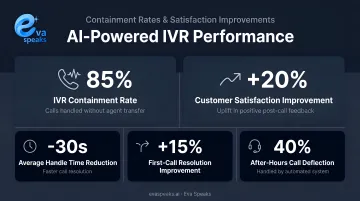
Those outcomes depend on how the underlying system is built. Eva Speaks, for example, combines LLM integration with configurable call-flow scripts — processing caller speech through speech-to-text and text-to-speech pipelines in real time. Businesses can configure routing rules, office hours, and call-flow logic to match their specific operations without rebuilding from scratch. Unlike legacy on-premise IVR platforms that require significant infrastructure investment and IT involvement, Eva Speaks deploys without heavy infrastructure requirements, making AI-powered IVR accessible to businesses that don't have a dedicated telecom engineering team.
Gartner data reinforces where the market is heading: 85% of customer service leaders plan to explore or pilot customer-facing conversational GenAI in 2025.
Here is how EvaSpeaks compares to legacy IVR systems across the dimensions that matter most for deployment decisions.
| Dimension | Legacy IVR | EvaSpeaks |
|---|---|---|
| Key Strengths | Reliable DTMF routing for simple, high-volume menus | LLM-driven natural conversation, context-aware routing |
| Best-fit Business Size | Large enterprises with dedicated telecom teams | SMBs to enterprise - no telecom engineering required |
| Implementation Complexity | Significant setup, hardware provisioning, IT involvement | Configurable call-flow scripts, deploys without heavy infrastructure |
| Integration Capability | Limited to in-house telephony systems | Connects to CRM, scheduling, EHR, and telephony APIs |
Traditional IVR vs. AI IVR: A Direct Comparison
| Dimension | Traditional IVR | AI-Powered IVR |
|---|---|---|
| User Input Method | Keypad presses (DTMF) | Natural speech, open-ended language |
| Flexibility | Fixed, pre-mapped menus | Dynamic, adapts to caller intent |
| Personalization | None or limited | Account-aware, context-driven responses |
| Resolution Speed | Depends on menu depth | Faster — resolves intent in fewer steps |
Businesses that want to discuss which IVR replacement path fits their existing infrastructure can Talk to an AI Communication Expert.
Frequently Asked Questions
How does an Interactive Voice Response (IVR) system work?
IVR answers inbound calls automatically, presents voice-prompted menu options, and captures caller input through keypad presses or spoken commands. Based on that input, it routes the caller to a self-service flow or live agent queue — without human involvement in the process.
What is the purpose of an IVR system?
IVR's core purpose is handling high call volumes efficiently. It automates routine inquiries, routes callers accurately, and provides 24/7 self-service access — reducing costs for businesses and wait times for customers.
What are the advantages of IVR?
Key benefits include:
- Round-the-clock availability with no staffing required
- Lower cost-per-interaction through call deflection
- Faster, more accurate routing to the right agent or queue
- Improved agent efficiency through pre-call data collection
- Analytics that help businesses refine call flows over time
What are the types of IVR systems?
The main types are touch-tone (DTMF), speech-based/natural language, outbound IVR, and cloud-based vs. on-premise deployments. AI-powered conversational IVR is the fastest-growing variant, combining NLP and LLMs for open-ended caller interactions.
How much does an IVR system cost?
Cloud-based IVR pricing varies by vendor and model. Entry-level platforms like CloudTalk start at around $25/user/month, while enterprise platforms like Genesys Cloud CX start at $75/user/month. Twilio's usage-based model charges $0.0085/min for inbound calls, with conversational AI features at $0.085/min. Most businesses pay based on a combination of per-user licensing and usage volume.
Is IVR still relevant today?
Phone remains the preferred channel for urgent or complex issues — IVR handles twice as many interactions as live-agent calls. AI-powered IVR has addressed most of the historical frustrations with rigid menus, making the technology more capable and customer-friendly than at any point in its history.