Introduction
Healthcare front-desk teams are stretched thin. Staff answer the same scheduling questions dozens of times a day, patients sit on hold waiting for simple answers, and administrative burnout is driving turnover that makes the problem worse.
According to MGMA, some patients make as many as five calls per scheduled appointment — and front-office staff turnover hit 40% in 2022, creating a cycle that's hard to break.
AI voice agents handle the repetitive, high-volume phone tasks that drain staff capacity — freeing your team for work that actually requires human judgment. When a patient calls to reschedule an appointment at 7 PM, that's not a clinical moment. It's a logistics problem software can solve.
This guide gives healthcare administrators a clear picture of all of it: what AI voice agents actually are, why adoption is accelerating, where they deliver the most value, what HIPAA compliance really demands, and how to choose the right platform for your organization. Healthcare teams that want to see AI voice handling in action before reading further can Request Live Demo.
Key Takeaways
- AI voice agents handle natural spoken conversations — not rigid IVR menus — and can book appointments, collect intake data, and answer billing questions without staff involvement
- Front-office turnover at 40% and rising call volumes make automation a staffing necessity
- The conversational AI in healthcare market is projected to grow from $18.83B to $59.12B by 2030
- HIPAA compliance requires a BAA covering every vendor in the call path: ASR, LLM, TTS, and telephony
- Start with a focused pilot on scheduling or reminders; measure containment rate and no-show reduction before expanding
What Are AI Voice Agents in Healthcare?
Beyond the Phone Tree
An AI voice agent is a software system that holds spoken conversations with patients over the phone — understanding what they say and responding in plain conversational language, without requiring them to press 1 for scheduling or 2 for billing. That's the fundamental difference from traditional IVR systems, which trap callers in rigid menus regardless of what they actually need.
Three technologies work together under the hood:
- Automatic Speech Recognition (ASR) converts the patient's spoken words into text
- Natural Language Understanding (NLU) (powered by large language models) interprets what the patient wants
- Text-to-Speech (TTS) converts the agent's response back into natural-sounding speech
The result is a multi-turn conversation that adapts to what the caller actually says.
What a Typical Interaction Looks Like
Consider a patient calling to reschedule a follow-up appointment. The voice agent answers immediately, identifies the caller by name and date of birth, checks availability in the EHR scheduling system, offers two or three open slots, confirms the patient's choice, and sends a confirmation via SMS — all without any staff involvement. The entire interaction takes under two minutes, and the appointment is booked directly into the practice's system.
That same workflow — call answered, record found, appointment confirmed — repeats identically at 2 a.m. or during a Monday morning rush.
What Separates Healthcare-Specific Voice Agents
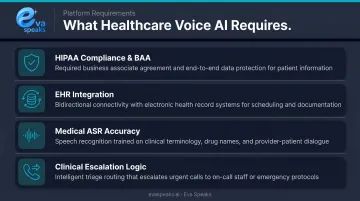
General-purpose voice assistants aren't built for healthcare. Healthcare-specific platforms require:
- HIPAA compliance and signed Business Associate Agreements
- EHR integration to actually read availability and write bookings back to the system
- Medical terminology accuracy in ASR — generic models misrecognize medication names and anatomical terms
- Clinical escalation logic that routes potentially urgent calls to a human clinician immediately
One clarification on terminology: "voice bot," "IVR," "conversational AI," and "virtual assistant" get used interchangeably, but they describe very different capabilities. AI voice agents handle structured, repetitive workflows well — they are not replacements for clinical judgment, and no credible platform claims otherwise.
Why Healthcare Organizations Are Adopting AI Voice Agents Now
The Staffing Math Doesn't Work Anymore
Front-office turnover at 40% annually means many practices are perpetually training new staff on call-handling tasks. Health system call center agents churn at rates as high as 38% per year, according to HFMA — and call centers are typically treated as cost centers, not revenue drivers, even though their performance directly affects clinician utilization and patient retention.
Where is that phone time actually going? MGMA data shows staff phone time breaks down roughly as:
- 45% on eligibility and prior authorization
- 31% on scheduling
- 9% on intake
- 6% on prescription refills
The majority of those calls follow predictable, repeatable patterns — precisely the workflows where automation delivers the most immediate ROI.
Patients Are Already Voting With Their Feet
Staffing gaps don't stay internal — patients feel them immediately. McKinsey's 2025 consumer research found that when patients hit scheduling friction, 27% waited for their preferred doctor — but another 27% simply scheduled with a new provider. Poor phone access creates a patient retention problem with direct revenue consequences.
The Market Signal
Frost & Sullivan estimates the global conversational AI in healthcare market is already at scale:
- $18.83 billion in 2025
- $59.12 billion projected by 2030
- 25.7% CAGR driven by patient engagement, contact center automation, and revenue cycle workflows
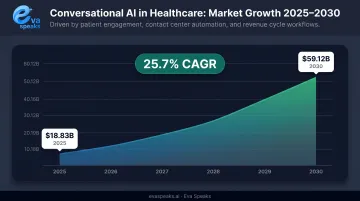
That trajectory reflects active deployment across real health systems — not pilot programs. To see what an AI-powered healthcare scheduling call looks like in real time, you can Watch AI Call Flow Demo.
Key Use Cases for AI Voice Agents in Healthcare
The highest-impact use cases share a common trait: high-volume, repetitive phone interactions that follow predictable patterns but still require some conversational flexibility. That combination is precisely what modern voice AI is designed to handle.
Appointment Scheduling and Management
Scheduling is the most common entry point for healthcare voice AI — and for good reason. The workflows are predictable (book, confirm, reschedule, cancel), the integration path with EHR scheduling systems is well-defined, and the ROI is measurable almost immediately.
MGMA reports a 5% no-show rate and 11.26% cancellation rate for single-specialty practices. A systematic review of appointment reminders found they increased attendance with a pooled relative risk of 1.11 — and AI-assisted scheduling models have shown up to a 34% reduction in missed appointments, according to McKinsey.
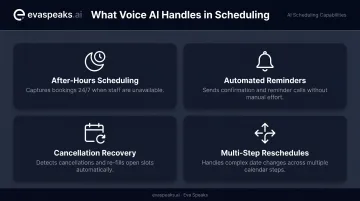
Beyond basic booking, voice agents can handle:
- After-hours scheduling requests that previously required answering services
- Automated reminders sent via call, SMS, or email
- Cancellation recovery — filling open slots from a waitlist
- Multi-step reschedules without requiring a callback
Platforms like EvaSpeaks support bidirectional scheduling integrations with Epic, athenahealth, Dentrix, eClinicalWorks, and NextGen — meaning the agent doesn't just read availability, it actually writes the appointment back to your system during the call. This bidirectional write-back capability is one of the features that separates truly useful AI voice agents from systems that can only surface information — and it's available on EvaSpeaks without requiring a dedicated integration engineering project.
Patient Intake and Triage Support
Voice agents can collect reason for visit, insurance details, and demographic updates before the patient ever speaks to a staff member. That information flows directly into the patient record, giving clinical staff a complete picture at check-in rather than capturing it manually at the front desk.
Triage support — capturing symptoms and routing to the appropriate care level — requires a higher bar. Symptom-checker accuracy studies show significant variation across platforms, and any implementation touching clinical urgency assessment must include well-defined escalation rules that route potentially urgent scenarios immediately to a licensed clinician.
Post-Discharge Follow-Up and Outreach
Post-discharge follow-up calls improve outcomes, but clinical staff rarely have capacity to execute them consistently at volume. A systematic review of 83 studies found outpatient follow-up within 30 days of discharge was associated with a 32% relative risk reduction in readmissions for selected patient populations.
Outbound AI voice agents can conduct these calls at scale:
- Checking on medication adherence and flagging potential complications
- Confirming follow-up appointments before the window closes
- Escalating concerning responses to the care team in real time
Worth noting: evidence for universal benefit is mixed. Follow-up programs deliver the strongest results when targeted to high-risk patient populations rather than applied across the board.
Billing and Administrative Inquiries
Eligibility and prior authorization alone account for 45% of staff phone time at most practices. Voice agents can verify patient identity, explain charges, confirm insurance coverage, and route complex disputes to a billing specialist — clearing the queue of routine questions so staff can focus on cases that actually require human judgment. Healthcare organizations that want a recommendation mapped to their specific call mix can Get a Customized Workflow Recommendation.
How AI Voice Agents Compare to IVR and Human Staff
Not every phone-handling approach is equally suited to healthcare front-desk work. Here is how AI voice agents stack up against traditional IVR systems and human clinical staff across the dimensions that matter most for high-volume healthcare call workflows:
| AI Voice Agent (EvaSpeaks) | Traditional Healthcare IVR | Human Clinical Staff | |
|---|---|---|---|
| Features | Natural language, scheduling, billing queries, EHR sync, 24/7 | DTMF menus, appointment reminders, hold queue | Full interaction, clinical judgment, care coordination |
| Best-fit Business Size | Clinics to large health systems | Enterprise health networks | Any size |
| Key Strengths | 24/7, zero hold time, consistent, HIPAA-compliant | Proven, predictable | Empathy, complex clinical decisions |
| Implementation Complexity | Low - EHR connectors | High - IT-dependent | None (hire) |
| Integration Capability | Epic, Cerner, Athena native | Custom dev required | Manual entry |
HIPAA Compliance and Security: What to Demand from Any Platform
BAAs Are Non-Negotiable
HIPAA compliance is the legal floor, not an optional add-on. Any platform that handles Protected Health Information (PHI) in voice conversations qualifies as a business associate under HHS's definition. That definition covers demographic data related to health, healthcare provision, or payment whenever it identifies an individual.
That means you need a signed Business Associate Agreement (BAA) — not just with the primary vendor, but with every subprocessor in the call path: ASR, LLM, TTS, and telephony.
A BAA that covers the platform provider but not their cloud hosting or AI model provider leaves a compliance gap. Make sure the agreement explicitly extends to every third party that touches your data.
Security Capabilities to Verify
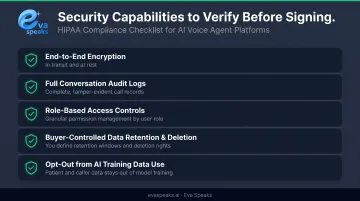
Before signing any contract, confirm these capabilities exist:
- End-to-end encryption of voice data in transit and at rest
- Full audit logs of every conversation
- Role-based access controls for transcript and record access
- Data retention policies the buyer controls, including the ability to delete PHI
- Option to opt out of subprocessor use of your data for model training
For EvaSpeaks healthcare clients, voice data is processed in U.S. data centers, transcripts include speaker labels and timestamps, and clients can opt out of AI training data use by contacting privacy@evaspeaks.ai. This data governance structure aligns with the industry-wide trend toward more transparent AI practices in healthcare — a trend driven by both patient expectations and regulatory guidance from bodies like HHS and the AMA.
Key Due Diligence Questions for Vendors
Ask every vendor these questions before evaluation proceeds:
- Where is voice data processed and stored?
- Will you sign a BAA that covers all subprocessors?
- Can we set custom data retention periods and request PHI deletion?
- Who within your organization has access to call transcripts?
- What is your incident response timeline if a breach is detected?
Consent, Disclosure, and TCPA
Most US states require disclosure when a caller is interacting with an AI system. The FCC confirmed in 2024 that TCPA restrictions on artificial or prerecorded voice calls apply to AI-generated voices. For outbound healthcare calls, FCC rules limit AI/prerecorded calls to one per day and three per week per patient, with mandatory opt-out mechanisms and strict exclusions for billing and debt-collection content.
Compliant platforms build AI disclosure and opt-out paths into the call flow. Platforms that offload consent management entirely to the customer create real compliance exposure. Healthcare organizations that want to discuss HIPAA compliance and TCPA requirements for AI voice agents specifically can Talk to an AI Communication Expert.
How to Evaluate and Choose an AI Voice Agent for Your Healthcare Organization
Five Criteria That Matter for Healthcare
| Criterion | What to Verify |
|---|---|
| Conversational quality | Does the demo feel natural, or are there long pauses and robotic responses? |
| Medical ASR accuracy | Has the ASR been tested on medical terminology? Generic models show WER of 8–10% on clinical conversations — medication names fare worse |
| EHR integration depth | Read-only availability vs. true bidirectional write-back — know which you're getting |
| HIPAA and BAA readiness | BAA covering all subprocessors, encryption, audit logs, retention controls |
| Pricing transparency | All-in cost at realistic call volumes, including telephony, storage, and handoff fees |
Matching Scale to Platform
Large health systems typically need enterprise platforms with deep EHR integrations and managed deployment teams. Independent practices and specialty clinics often benefit more from platforms with flexible, customizable call-flow configurations that don't require IT departments to stand up.
For organizations in that second category, Eva Speaks is one platform worth evaluating. It handles inbound scheduling and intake alongside outbound reminders and follow-up calls, with integrations across Epic, athenahealth, Dentrix, eClinicalWorks, and NextGen — without requiring enterprise-level IT infrastructure to deploy.
Evaluate Failure Modes, Not Just the Demo
Every vendor's demo shows the happy path. The real test is how the agent handles things that go wrong:
- Ask to hear escalation recordings where the agent couldn't resolve the call
- Ask what happens when speech is unclear or the caller goes off-script
- Verify that conversation context is fully preserved and passed to the human agent during handoff — not just transferred as a cold call
Best Practices for a Successful Deployment
Start focused. A single high-volume, lower-risk use case — appointment scheduling or reminder calls — is the right starting point. A focused pilot generates the metrics you need to justify broader rollout. It also catches configuration issues before they reach complex workflows.
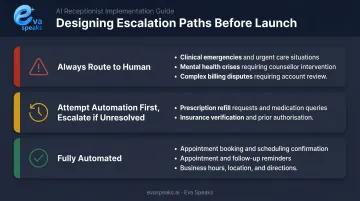
Design escalation paths before launch. Define three categories before go-live:
- Always route to a human — clinical emergencies, mental health crises, complex billing disputes
- Attempt automation first, escalate if unresolved — prescription refill requests, insurance verification
- Fully automated — appointment booking, reminder confirmation, general hours and directions
Every call should open with a clear AI disclosure and an easy path to reach a staff member.
Treat deployment as a continuous process, not a launch event. Track these metrics from day one:
- Containment rate — calls fully resolved without human transfer
- Call completion rate — callers who stayed through to a resolved outcome
- Escalation rate by call type — which categories are falling through most often
- No-show rate — a direct output measure for scheduling use cases
Review these numbers weekly early on. When containment rate stabilizes and escalation patterns narrow, that's the signal to retrain the agent on edge cases and expand into the next use case.
Frequently Asked Questions
What is an AI voice agent in healthcare?
An AI voice agent is a software system that handles patient and staff phone interactions through natural spoken conversation — covering scheduling, billing inquiries, and patient outreach — rather than routing callers through numbered IVR menus. It understands what callers say, responds in kind, and sustains the conversation across multiple turns.
How do AI voice agents differ from traditional IVR systems?
Traditional IVR systems require callers to navigate fixed menus by pressing numbers. AI voice agents understand natural language, adapt to what the caller actually says, and can handle multi-turn conversations — so a patient can say "I need to move my appointment to next week" and the agent handles it without a menu.
Are AI voice agents HIPAA compliant?
Compliance depends entirely on the platform and its configuration. Verify that any vendor handling PHI will sign a BAA covering all subprocessors, encrypts data in transit and at rest, maintains audit logs, and gives you manageable retention controls.
Can AI voice agents integrate with EHR systems like Epic or Cerner?
Many platforms offer EHR integrations, but depth varies widely. Read-only access to check availability is very different from bidirectional write-back that books appointments, updates records, or creates intake notes. Verify exactly what the integration supports before committing.
What tasks can AI voice agents handle in healthcare?
Common use cases include appointment scheduling and reminders, pre-visit intake collection, post-discharge follow-up calls, billing inquiry routing, and prescription refill requests. Clinical decision-making should always involve a licensed clinician; voice agents handle the logistics, not the medicine.
How much do AI voice agents for healthcare cost?
Pricing models range from per-minute usage billing to monthly subscriptions to enterprise contracts. Ask vendors for all-in pricing at your realistic call volumes and clarify what's billed separately. Telephony minutes, ASR, LLM inference, storage, and human handoff fees can each add to the total.