The challenge isn't recognizing that routine calls can be automated. Most operations leaders already know that. The real problem is knowing which metrics actually tell you whether your AI voice agent is performing — and what benchmark numbers you should be measuring against.
This article covers the four core KPIs for routine call automation, what current industry data shows about AI performance on each, and how to use these numbers to build a credible business case.
Key Takeaways
- AI voice agents achieve 70–85%+ containment rates on routine call types — most common inquiries never reach a human agent
- Human agents average 513 seconds per service call; every 1,000 calls AI contains saves roughly 142 agent hours
- Phone interactions cost $7.16 each; AI voice platforms run $0.07–$0.31 per minute depending on the stack
- The 2024 average FCR rate across call centers was 69% — AI's instant data access and consistent logic pushes routine-call FCR higher
- Most teams see measurable containment gains within 4–8 weeks by tuning call flows with real call data
What Qualifies as a "Routine Call"?
Routine calls share three traits: predictable caller intent, structured resolution paths, and minimal judgment required. These are the calls worth automating first.
Common categories include:
- Appointment scheduling and rescheduling
- Order and account status checks
- Billing inquiries and payment processing
- FAQs about hours, services, and policies
- Prescription refill requests
- Basic troubleshooting (password resets, account access)
SQM Group's 2024 call center benchmark data classifies inquiries, account maintenance, orders, and billing as low-to-moderate complexity call types — exactly the categories where AI voice agents perform best.
Why These Calls Are Automation Targets
Routine calls cost significant money to staff — agents must be available even when the resolution logic is entirely repeatable. The caller's need is predictable, the answer comes from a finite knowledge base, and resolution doesn't require empathy or situational judgment. That combination makes automation both practical and cost-effective.
Complex calls — multi-issue escalations, emotionally charged complaints, high-stakes decisions — still belong to human agents. The point of automation is to stop spending human-agent capacity on calls that never needed it. This hybrid model is what makes the metrics below meaningful: you're measuring how effectively AI absorbs the routine tier so agents can focus where their judgment actually matters.
How the Options Compare
Not every solution handles routine calls the same way. Here is how AI voice agents, traditional IVR, and human agents stack up across the factors that matter most for routine call handling:
| AI Voice Agent (EvaSpeaks) | Traditional IVR | Human Agents | |
|---|---|---|---|
| Features | Natural conversation, full routine containment, CRM sync | DTMF menus, FAQ routing, voicemail | Full interaction, judgment, escalation |
| Best-fit Call Types | Scheduling, FAQs, status checks, basic intake | Simple balance checks, menu navigation | Complex, emotional, exception-heavy |
| Key Strengths | High containment, 24/7, zero overages | Low cost for simple tasks | Empathy, edge cases |
| Implementation Complexity | Low | High | None (hire) |
| Integration Capability | CRM, EHR, scheduling native | Custom dev required | Manual |
See how AI automates the routine calls filling your queue. Explore AI Call Automation
Key Metrics for Measuring Routine Call Handling Performance
Four metrics define whether your AI voice agent is actually performing on routine calls. Here's what each measures and what the benchmark data shows.
Call Containment Rate
Definition: The percentage of routine calls fully resolved by the AI without escalation to a human agent.
This is the headline metric. Containment rate directly answers the question: how much call volume is your AI actually absorbing?
Benchmark targets:
- Well-configured deployments: 70–85%+ containment on routine call types
- Best-in-class, narrow call flows: 90%+ containment is achievable
- Verint's 2024 telecom case study reported 80% containment specifically for billing calls and 50%+ overall across 7 million annual calls
What drives containment rates up or down? ContactBabel's 2025 Self-Service report found that 71% of voice self-service abandonments occur when the system's functionality doesn't match caller needs. That's a call-flow design and knowledge base quality problem — not an AI capability problem. Deployments that invest in accurate intent mapping and thorough knowledge bases tend to hit the upper end of the containment range.
First Call Resolution (FCR)
Definition: The percentage of calls resolved on first contact without a callback, transfer, or follow-up.
For routine calls, FCR should be high regardless of whether a human or AI handles them. Low FCR means callers are calling back — which doubles your cost per issue.
SQM Group's 2024 benchmark puts the industry average FCR at 69%, with world-class performance defined as 80%+. For context, every 1 percentage point improvement in FCR translates to approximately $286,000 in annual savings for a typical midsize call center.
AI voice agents support high FCR on routine calls through instant data access — no hold time while an agent looks up an account, no transfer to a colleague for a basic policy question. The resolution logic is consistent every time, which eliminates the variability that causes repeat calls in human-staffed environments.
Average Handle Time (AHT)
Definition: Total time spent on a call, including hold and wrap-up.
AHT is a cost multiplier. Every extra minute of handle time repeats across every call — so on 10,000 monthly routine calls, a 2-minute difference in AHT is 20,000 agent-minutes per month.
ContactBabel's 2025 US Contact Center Decision-Makers' Guide reports 513 seconds (about 8.5 minutes) as the 2024 average service call duration for human agents. Every 1,000 routine calls AI contains avoids 513,000 seconds — roughly 142.5 live-agent hours — of phone handling time.
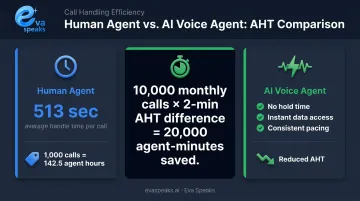
AI reduces AHT on routine calls by eliminating hold time for information lookup, following consistent call-flow pacing, and instantly accessing CRM or account data without manual search.
CSAT and Cost Per Interaction
Definition: CSAT measures caller satisfaction; cost per interaction measures the fully loaded cost of resolving one call.
For routine calls, CSAT is driven by speed and resolution. Callers checking an order status or scheduling an appointment want the answer fast, not small talk. AI delivers with zero queue time and immediate resolution — which is why CSAT scores for AI-handled routine calls are competitive with, and often exceed, human-handled equivalents for the same call types.
The cost picture is equally clear — the gap between human and AI handling is significant and widens with volume.
| Handling Method | Cost Per Interaction |
|---|---|
| Human phone agent | $7.16 (ContactBabel, 2025) |
| AI voice self-service | ~$0.15 (ContactBabel, 2025) |
| AI platform (per minute) | $0.07–$0.31 depending on stack |
At $7.16 per human-handled call versus $0.15 for self-service, the math is straightforward. On 5,000 routine calls monthly, that's a potential difference of $35,050 per month in handling costs — before accounting for overhead, staffing, or after-call work.
See it live handling your highest-volume call types. Request Live Demo
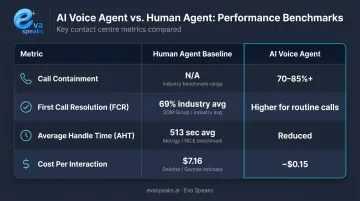
AI Voice Agents vs. Baseline: What the Data Shows
Here's how the benchmark data lines up across the four metrics:
| Metric | Human Agent Baseline | AI Voice Agent |
|---|---|---|
| Call Containment | N/A (all calls reach humans) | 70–85%+ routine calls; 80%+ for specific types (Verint, 2024) |
| FCR | 69% industry average (SQM, 2024) | Higher for routine calls via instant data access |
| AHT | 513 sec service avg (ContactBabel, 2025) | Reduced — no hold, consistent pacing |
| Cost Per Interaction | $7.16 phone avg (ContactBabel, 2025) | ~$0.15 self-service; $0.07–$0.31/min platform cost |
The Scale Effect on AHT
The 513-second human baseline becomes significant at volume. A business handling 5,000 routine calls monthly that achieves 75% containment offloads 3,750 calls to AI. At 513 seconds each, that's 533,000 seconds — roughly 890 agent hours — avoided per month. At a median U.S. customer service wage of $20.59/hour, that's approximately $18,300 in labor hours monthly, before overhead.
The Containment Threshold
The Verint telecom case is the clearest real-world example of what well-deployed AI voice self-service can achieve: 3.5 million calls contained out of 7 million annual, producing $10.5 million in annual savings. That's 50% containment across a mixed call environment, with 80% on billing specifically — a well-defined, structured call type.
Containment rates are highest where call flows are narrowly defined and knowledge bases are complete. Broad, loosely defined implementations consistently produce lower numbers. In practice, the metric tells you as much about deployment quality as it does about the AI itself.
Watch how AI handles a real routine call from start to finish. Watch AI Call Flow Demo
ROI Metrics: The Business Case for Automating Routine Calls
Staffing Cost Reduction
The math on routine call automation is direct: fewer routine calls reaching human agents means lower staffing requirements for handling that volume.
Metrigy's AI for Business Success 2024-25 study — surveying 697 global companies — found companies using contact-center AI hired 89% fewer agents than they otherwise would have, with 56% citing reduced hiring need as the top AI impact.
McKinsey's 2025 contact center analysis puts the longer-term projection at 40–50% fewer agents handling 20–30% more calls than today's volumes.
For operations still building the case internally, the calculation is straightforward:
- Take your current routine call volume by type
- Apply a conservative 65–75% containment estimate
- Multiply contained calls by average AHT
- Apply your fully loaded agent hourly cost
- Compare to the platform's per-minute rate
Scalability Without Proportional Headcount
Human staffing is linear — more calls require more agents. AI voice agents don't scale that way. When call volume spikes seasonally, post-campaign, or during a product launch, AI absorbs the increase without proportional cost growth.
This also addresses the staffing strain problem that burdens human-run contact centers. Metrigy data shows contact-center agent turnover climbed from 21.8% in 2022 to 28.1% in 2023, with projections reaching 31.2% in 2024. High turnover inflates recruiting and training costs — costs that AI doesn't carry.
Where Eva Speaks Fits
Eva Speaks routes and resolves routine inbound calls in real time, using LLM-based processing against configurable scripts and rules. The platform gives operations direct control over:
- Routing logic and escalation paths
- Office hours and call-flow branching
- Post-deployment tuning based on transcript data
These are the configuration levers research ties directly to containment rate and FCR improvements. Eva Speaks captures call recordings and transcripts for quality assurance — the raw material for refining call flows after deployment, not just at launch. For teams that want to improve containment rates without overhauling their existing phone infrastructure, Eva Speaks is designed to layer on top of existing systems — using call forwarding from a current business number rather than requiring a new carrier relationship or phone system migration.
How to Track and Continuously Improve Your Routine Call Metrics
Step 1: Establish Your Baseline Before Deployment
You can't measure ROI without a pre-deployment benchmark. Before going live, document:
- Call volume by type (scheduling, billing, status, FAQs — broken out separately)
- Current AHT for each routine call type
- FCR rate for your team
- Cost per interaction (fully loaded, not just base wage)
- Escalation rate for calls that bounce between agents or require callbacks
This baseline is your comparison point. Without it, improvements are anecdotal.
Step 2: Set Up a Post-Deployment Monitoring Cadence
Track these metrics weekly for the first 8 weeks, then monthly:
- Containment rate (by call type, not just overall)
- FCR rate
- AHT (AI-handled vs. escalated)
- Escalation rate
- CSAT scores on AI-handled calls
Review the lowest-performing call transcripts — not the averages. Failed containments reveal exactly where the AI is hitting knowledge gaps or misrouting intent. That's where tuning effort pays off fastest.
Step 3: Use Call Data to Tune Performance
The first 4–8 weeks after deployment are where containment rates move most. The improvement loop looks like this:
- Identify failed containments — note the specific failure reason (wrong intent detected, missing answer, routing error)
- Patch knowledge base gaps — add the missing answers, not just the topics
- Revise call-flow scripts for call types with high escalation rates
- Adjust routing rules where callers are landing in the wrong flow
- Retest and remeasure containment rate after each change cycle
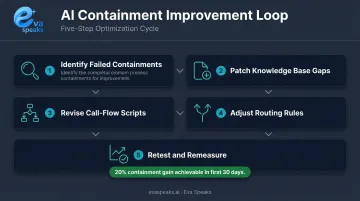
Industry deployment data shows AI voice agents can achieve a 20% increase in containment within the first 30 days after deploying an optimized flow. That gain comes almost entirely from deliberate tuning — not from the AI improving passively on its own. The teams that hit those numbers fast are the ones reviewing transcripts weekly and iterating on specific failure points, not waiting for quarterly reviews.
Have questions about the right containment threshold for your calls? Talk to an AI Communication Expert
Frequently Asked Questions
Can AI automate repetitive tasks?
Yes. AI voice agents are specifically built for repetitive, predictable call types such as FAQs, appointment scheduling, status checks, and billing inquiries. Containment rates are highest when calls have structured inputs and clear resolution paths.
How much does an AI voice agent cost per minute?
Current market rates range from roughly $0.07 to $0.31 per minute depending on the platform and whether LLM, STT, TTS, and telephony are bundled. Compare that to a $7.16 average cost per human phone interaction — the cost gap widens fast at any meaningful call volume.
What types of calls are considered routine for AI voice agents?
The most common categories include appointment scheduling, order and account status inquiries, billing questions, general FAQs, prescription refill requests, and basic troubleshooting — call types that make up a large share of inbound volume for most businesses.
What is a good call containment rate for AI voice agents?
Well-configured AI voice agents typically achieve 70–85%+ containment on routine call types. Narrow, well-defined call flows (like billing) can exceed 90%. Initial deployments often start lower and improve through the first 4–8 weeks of tuning based on real call data.
What happens when an AI voice agent can't resolve a routine call?
The AI escalates to a human agent via warm handoff, passing the caller's context and conversation transcript so the customer doesn't need to repeat themselves. Well-designed escalation paths keep CSAT high even when containment fails , keeping the caller experience intact.
How should I measure ROI from AI voice agents?
Start with the cost gap: $7.16 per human phone interaction vs. AI platform rates. Then multiply agent hours avoided (using your containment rate and average AHT) by your fully loaded labor cost. For most operations with meaningful routine call volume, that math shows payback within the first few months.