Introduction
Silicon Valley businesses don't operate like the rest of the country. Labor costs are higher, customers are more demanding, and competitors move faster. When a customer calls and waits three minutes to navigate a touch-tone menu, they notice — and they remember.
AI call handling has moved well past the old IVR model. Today's systems use large language models to understand what callers actually mean, resolve issues mid-conversation, and hand off to human agents when the situation calls for judgment. The result is a phone experience that handles real conversations — not just menu selections.
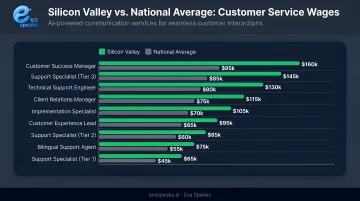
For Silicon Valley companies — whether SaaS, fintech, healthtech, or e-commerce — that capability matters strategically. According to Zendesk's CX Trends 2026, 74% of consumers expect 24/7 customer service availability, and 88% expect faster response times than the prior year. Meeting those expectations with human-only staffing in a region where customer service wages average $61,230 annually in San Jose isn't sustainable.
This article covers the three dominant trends reshaping AI call handling, what's driving adoption specifically in Silicon Valley, and where the technology is headed next.
Key Takeaways
- AI call handling has shifted from rigid IVR menus to LLM-powered voice agents capable of natural, multi-turn conversation
- The current landscape is shaped by conversational voice AI, 24/7 autonomous handling with smart escalation, and deep CRM integration
- Silicon Valley's high labor costs, tech-literate customers, and dense compliance requirements are driving adoption faster than anywhere else in the US
- Measurable outcomes include sharply reduced wait times, lower cost-per-interaction, and redeployment of human agents toward high-value work
- Watch for agentic AI, proactive outbound calling, and tightening FCC/CCPA requirements in the next two to three years
Trend 1: From Legacy IVR to LLM-Powered Conversational Voice AI
What Changed and Why It Matters
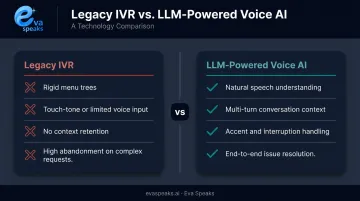
Traditional IVR systems work through rigid logic trees. Press 1 for billing, press 2 for support, say "yes" or "no" at the right moment. The system doesn't understand language — it matches inputs to predetermined branches.
LLM-powered voice agents work differently. Unlike IVR, they:
- Process natural speech and infer intent from context
- Handle synonyms, accents, and mid-sentence corrections
- Manage interruptions and sustain multi-turn conversations
A caller who says "I need to push back my Thursday thing" gets understood and resolved in one exchange. Under legacy IVR, that same request would require the caller to navigate a five-level menu — and probably still fail.
Gartner predicts that at least 70% of customers will use a conversational AI interface to start their customer service journey by 2028. For Silicon Valley companies already serving tech-literate customers, that transition is happening faster.
Real-World Impact
The Audibel hearing care network deployed a voice AI assistant and reported:
- 44% reduction in call abandonment
- 87% reduction in wait times
- 88% reduction in spam calls
- 2% increase in appointment volume
Before deployment, wait times ran 10–15 minutes with abandonment rates near 46%. Those aren't edge-case improvements — they reflect what happens when callers can just say what they need and get a direct response.
Configurable AI Call Flows for Changing Business Rules
Eva Speaks integrates LLMs with text-to-speech (TTS) and speech-to-text (STT) technologies to deliver real-time conversational AI during inbound calls.
The platform supports customizable call-flow scripts and routing rules, so businesses can configure greetings, intent handling, and escalation paths without rebuilding the system from the ground up. For fast-moving Silicon Valley environments where business rules shift frequently, that flexibility is practical rather than optional. You can Watch AI Call Flow Demo to see how LLM-powered conversation handling differs from a traditional IVR experience.
Trend 2: 24/7 Autonomous Call Handling with Intelligent Human Escalation
The Full-Call Workflow
The shift isn't just toward smarter greetings. AI systems now handle complete call workflows — authentication, intent resolution, FAQ responses, scheduling, and follow-up — without a human agent present, at any hour.
The upgrade from earlier automation comes down to escalation logic. Sentiment analysis and confidence thresholds flag calls that are emotionally charged or outside the AI's resolution scope, then transfer to a human agent with full conversation context intact.
The practical result: human agents handle exceptions and high-stakes conversations, not the 200th account balance inquiry of the day.
Where Silicon Valley Industries Are Deploying This
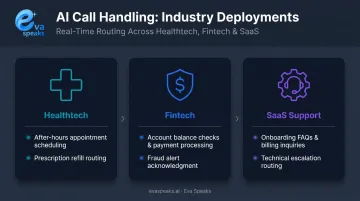
- Healthtech platforms use AI for after-hours appointment scheduling and prescription refill routing — situations where a patient needs a response at 11 PM but a human agent isn't available
- Fintech companies deploy voice AI for account balance checks, payment processing, and fraud alert acknowledgment — high-frequency, low-complexity calls that consume disproportionate agent time
- SaaS support teams use AI to handle common onboarding questions, billing inquiries, and feature navigation requests before routing technical escalations to specialists
Why This Matters Financially
Forrester's Total Economic Impact study of PolyAI found enterprise voice AI deployments delivered 391% ROI with payback in under six months. Forrester also found the average cost of a human-handled customer inquiry runs $5.61 per interaction. AI-handled calls at scale reduce that figure substantially — and they don't require overtime, benefits, or recruitment.
Gartner forecasts that agentic AI will autonomously resolve 80% of common customer service issues by 2029, alongside a 30% reduction in operational costs. Those projections aren't guaranteed, but the cost trajectory is clear enough that businesses waiting for certainty before acting may find themselves behind.
Eva Speaks supports autonomous 24/7 call handling through its AI-enabled answering service, with configurable call-flow scripts and routing rules that let businesses define when and how calls escalate to human teams. For Silicon Valley companies specifically, this matters because business rules change frequently — new product lines, revised escalation policies, updated routing logic — and a platform where those changes can be made through configuration rather than engineering tickets is meaningfully faster to iterate on. To see what 24/7 autonomous call handling looks like when a call arrives at 11 PM, you can See How AI Handles After-Hours Calls.
Trend 3: Deep Tech Stack Integration for Personalized Call Experiences
Standalone call-answering AI solves a narrow problem. AI that knows who's calling before the conversation begins solves a much bigger one.
The third major trend is connecting voice AI directly into CRMs, calendars, ticketing systems, billing platforms, and order management tools. When a caller's account tier, recent order status, and support history are pulled before the first sentence ends, the AI can skip authentication steps, acknowledge context, and resolve issues faster.
What This Looks Like in Practice
- An e-commerce caller asking about a delayed shipment gets a live status update pulled from the order system, with no transfer required
- A professional services firm's AI authenticates the caller, checks appointment availability, and completes the booking or reschedule on its own
- A fintech company's AI detects a high-value account tier and routes the call to a dedicated specialist rather than the general queue
Platforms like Genesys and Salesforce have built this integration architecture into their contact center products, with Salesforce's Service Cloud Voice and Genesys CX Cloud both offering CRM-embedded call handling. The pattern is becoming standard, not premium.
This shift changes what AI call handling is actually for. Better first-call resolution means fewer repeat contacts. Personalized interactions improve retention. And every AI-handled call generates structured data — caller intent, resolution type, friction points — that feeds product and operations teams with signal they wouldn't otherwise capture.
Eva Speaks connects this pattern directly to its platform: customizable routing rules and LLM-backed call handling can be tied into the business tools already managing customer data, so context travels with the call rather than getting re-established from scratch. Silicon Valley teams that want this integration mapped to their specific CRM and telephony stack can Get a Customized Workflow Recommendation.
Here is how AI-powered call handling compares to traditional business phone systems for Silicon Valley and tech-forward companies:
| AI Call Handling (EvaSpeaks) | Cloud PBX / UCaaS | Traditional On-Premise PBX | |
|---|---|---|---|
| Features | Conversational AI, dynamic routing, real-time CRM sync | VoIP calls, basic routing, voicemail | Fixed extensions, voicemail, basic IVR |
| Best-fit Business Size | Startups to scaling tech companies | Any size | Large enterprise |
| Key Strengths | No missed calls, instant setup, zero overages | Familiar, full feature set | Full control, no internet dependency |
| Implementation Complexity | Low - hours to deploy | Low to Medium | High |
| Integration Capability | CRM, scheduling, Slack, APIs | Native UCaaS integrations | Custom dev required |
What's Driving AI Call Handling Adoption in Silicon Valley
Silicon Valley's AI call handling adoption isn't accidental. Three converging pressures explain why the region moves faster than most — and why those same forces are spreading nationally.
Labor Economics
BLS wage data shows the cost gap clearly:
| Geography | Annual Mean Wage (Customer Service Reps) |
|---|---|
| National Average | $46,100 |
| California | $51,040 |
| San Francisco Bay Area | $59,150 |
| San Jose / Silicon Valley | $61,230 |
Add the BLS-reported benefits load of 29.9% of compensation costs, and the fully-loaded cost of a Silicon Valley customer service representative exceeds $79,000 annually. That math compresses ROI timelines significantly — AI call handling pays back faster here than in virtually any other U.S. market.
Customer Expectations
Silicon Valley serves consumers and business clients who've been using digital-first products for years. Hold times and clunky menu navigation don't register as minor inconveniences here — they register as product failures.
That context shapes what businesses must deliver:
- 24/7 availability: 74% of consumers expect round-the-clock access — not as a preference, but as a baseline
- Immediate responses: Callers expect answers in seconds, not minutes
- Consistent experience: Every interaction should feel as polished as the company's app or website
Regulatory Pressure
Both FCC and California-specific rules are pushing businesses toward purpose-built compliance:
- FCC 24-17 (February 2024) confirmed AI-generated voices fall under TCPA restrictions — outbound AI calls require the same consent framework as traditional robocalls
- CCPA defines personal information to include audio, voice data, and AI training data from call interactions — covering far more than most businesses initially assume
Businesses running off-the-shelf or unconfigured AI voice tools carry real compliance exposure under both frameworks.
Purpose-built platforms handle this differently. Eva Speaks addresses CCPA requirements directly: data is stored in U.S. data centers, customers can opt out of AI model training, and California residents retain rights to access, delete, correct, and port their personal information. Companies that want to understand how Eva Speaks handles CCPA and FCC compliance for their specific use case can Talk to an AI Communication Expert.
How AI Call Handling Is Transforming Customer Service Operations
Operational Impact
AI systems now absorb the first layer of every inbound call — routing, FAQ resolution, and scheduling — without proportional infrastructure costs. The Audibel case study quantifies what that looks like operationally: 87% wait time reduction and 44% abandonment reduction from a single voice AI deployment. AI systems also handle hundreds of concurrent calls without queue buildup — a capacity ceiling that human staffing simply cannot match.
Business Impact
The financial case extends beyond labor substitution. Every AI-handled call generates structured data: what callers asked, where the conversation stalled, which issues recur most frequently. That data feeds directly into:
- Product teams identifying friction points before they become churn
- Operations reviews tracking resolution gaps by call type
- Marketing understanding demand patterns without additional research spend
McKinsey projects that AI agents could increase total customer care conversation volume tenfold over five years — not by replacing human relationships, but by making personalized outreach economically viable at scale.
Workforce Impact
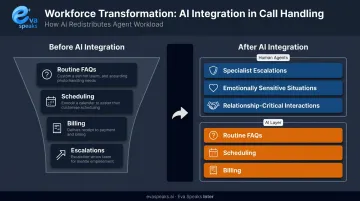
According to Metrigy's 2024 research, contact center AI is already reducing hiring needs and reshaping agent responsibilities. The emerging model centers on role redefinition, not workforce reduction. Human agents move toward specialist escalation — emotionally sensitive situations, complex problem-solving, and relationship-critical interactions that require judgment rather than script-following.
That shift demands upskilling investment and deliberate role redesign. Companies that build for it early avoid both operational gaps and the retention pressure that comes as agent expectations evolve.
Future Signals for AI Call Handling in Silicon Valley
Agentic AI: Multi-Step Automation
Today's voice AI handles individual tasks. The next generation handles workflows. Verifying an account, processing a refund, and scheduling a follow-up call — all within a single interaction, without a human touchpoint. Gartner identifies this as a defining shift toward "agentic AI," and forecasts it becomes the standard expectation in enterprise call handling by 2026–2029.
That said, Gartner also predicts over 40% of agentic AI projects will be canceled by end of 2027 due to unclear business value, cost overruns, or inadequate risk controls. Start with narrow, high-volume call types before expanding scope.
Proactive Outbound AI
Rather than waiting for inbound calls, AI systems will increasingly initiate outreach — appointment reminders, payment due alerts, service interruption notifications, and renewal prompts. Eva Speaks' real-time AI response architecture supports low-latency outbound interactions, though any outbound AI calling program requires careful TCPA compliance planning under FCC 24-17. That regulatory pressure is intensifying across the board.
Tightening Regulatory Requirements
The FCC has proposed transparency rules specifically for AI-generated calls and texts, including definitional clarity and disclosure requirements. California's AI transparency legislation is similarly expected to tighten. Businesses that build compliance into their AI call systems now will adapt faster than those bolting it on after the fact.
Frequently Asked Questions
Can AI handle phone calls?
Yes. Modern AI systems handle inbound and outbound calls autonomously using natural language processing and large language models, handling inquiries, scheduling appointments, processing transactions, and routing to human agents when needed. Deployments today span enterprise call centers down to single-location small businesses.
What is the difference between AI call handling and traditional IVR?
Traditional IVR routes callers through rigid, pre-set menus using touch tones or limited voice commands. AI call handling understands free-form natural language, maintains conversation context across turns, and resolves issues end-to-end without requiring callers to follow a script.
How does AI call handling reduce operational costs?
AI handles high volumes of routine calls simultaneously without staffing, overtime, or training costs — reducing cost-per-interaction significantly compared to human agents. In Silicon Valley, where fully-loaded agent costs exceed $79,000 annually, that cost differential compounds quickly at scale.
What industries in Silicon Valley are adopting AI call handling fastest?
Fintech, healthtech, SaaS, and e-commerce lead adoption — driven by high call volumes, complex authentication needs, and customer bases that expect instant, digital-first service. Healthcare scheduling and fintech self-service are currently the most widely deployed use cases.
How do AI call handling systems integrate with existing CRM platforms?
Modern platforms connect to CRMs like Salesforce and HubSpot via APIs, enabling real-time data pull during calls, automatic call summary logging, and bidirectional record updates without manual entry. Eva Speaks supports these integrations directly, letting businesses link their existing tools to its AI communication platform without rebuilding workflows.
What should businesses look for when choosing an AI call handling solution?
Key selection criteria:
- LLM integration for natural language quality
- Customizable call-flow scripting and routing rules
- CRM and calendar integrations
- Sentiment-triggered escalation to human agents
- CCPA and FCC compliance architecture
- Real-time analytics on call volume, resolution rates, and escalation frequency