Introduction
Every dealership has a version of the same problem. A customer calls to check on their vehicle — the service advisor puts them on hold, checks the system, and reads back information that was accurate three hours ago. The car is actually ready. It's been ready since noon. Nobody sent the notification.
That disconnect — between what the DMS knows and what your front-line team can actually act on — costs real money. Misquoted trade-in values, inventory searches returning vehicles that shipped last night, service slots booked that a tech is already working. These aren't edge cases. They're daily friction.
AI platforms that connect directly to dealership DMS systems with real-time data sync are built to eliminate that friction. What follows breaks down how they work, where they fall short, and what dealerships need to verify before committing to any vendor.
Key Takeaways
- The DMS is the operational truth of your dealership; AI platforms are only as useful as the data they can access
- Real-time sync enables proactive service communications — pickup alerts, status updates — the moment a repair order changes
- Batch data pulls mean outdated information reaches customers — wrong statuses, missed alerts, eroded trust
- Evaluate vendors on update latency, write-back capability, and which DMS systems they're actually certified to support
- Before signing, ask the vendor to demonstrate a live data transaction during the demo — not a logo slide
DMS vs. CRM: Getting the Foundation Right
These two systems are not interchangeable, and confusing them is where most AI integration projects break down.
A DMS (Dealer Management System) is the operational backbone — it manages inventory, repair orders, parts, accounting, and service workflows. A CRM manages customer relationships: emails, calls, leads, follow-up sequences. If the CRM is the dealership's memory of customer history, the DMS is its nervous system for daily operations.
The practical distinction matters because DMS is where a repair order opens and closes. CRM is where a follow-up email triggers. When an AI platform only integrates with the CRM, it misses the live operational signals — which vehicle is actually available, whether a service bay is full, when a job is done.
The DMS Market Is Concentrated
Per a 2023 federal court opinion, CDK Global and Reynolds & Reynolds together control 70% of the U.S. franchise dealership DMS market. The historical record from that same case shows CDK held roughly 50% and Reynolds approximately 31% of the market as of 2013.
CDK's position has only solidified since. Automotive News reported in 2025 that CDK Global has "long dominated" the sector.
The other significant players are Tekion and Dealertrack (a Cox Automotive brand). Each has a distinct integration architecture:
- CDK Global — access via the Fortellis API directory; third parties apply through CDK's Approved Partner program
- Reynolds & Reynolds — requires completion of the Reynolds Certified Interface (RCI) program for specific applications and data components
- Dealertrack — supports 275+ certified vendors via Opentrack integration; Cox also maintains the DMS+ Service API for repair order and appointment access
- Tekion — native API ecosystem via the Automotive Partner Cloud (APC), governed by a formal API License and Data Sharing Agreement
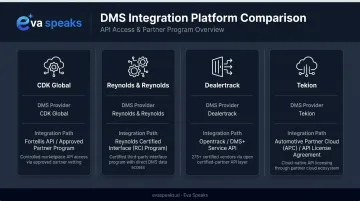
This matters directly for AI vendor selection. Generic API calls to these systems often get throttled or break entirely after software updates. Certified integrations, built through the official partner programs above, are more stable and more secure. Any AI vendor that can't name their certification program at each DMS provider hasn't done the foundational work to support a real dealership deployment.
See how AI automation transforms dealership operations. Explore AI Call Automation
Why Real-Time DMS Data Is a Competitive Necessity
The Stale Data Tax
When an AI platform pulls DMS data on a scheduled batch basis — say, every few hours — the gap between system reality and what the AI knows creates direct customer-facing errors:
- Quoting a vehicle that sold last night
- Sending a pickup notification two hours after the car was ready
- Booking a service time slot a tech already filled
J.D. Power's 2024 Customer Service Index study found that 68% of service customers prefer text updates, and satisfaction scores increase by 31 points when advisors provide richer, timely updates like photos or videos with multi-point inspections. The baseline for what customers expect from service communication is rising — and lagged data directly undercuts it.
Service Lane: The Clearest ROI Case
The service lane is the highest-frequency customer touchpoint at most dealerships. According to Cox Automotive's 2025 Service Industry Study, average dealer service and parts revenue hit approximately $9.23M — up 33% over eight years — yet dealer share of total service visits actually fell from 33% to 29%. J.D. Power's same 2024 study points to why: 35% of mass-market customers who chose aftermarket service did so for immediate availability, with average appointment wait times of 5.2 days at franchised dealers. Customers are leaving for faster options.
When repair order status updates the moment a technician closes a job, an AI platform can notify the customer that their vehicle is ready — without any service advisor involvement. That single use case alone reduces unnecessary inbound calls and creates the kind of low-effort experience that keeps customers returning.
Multi-Location Complexity
Stale data gets harder to manage at scale. A dealer group with multiple rooftops needs every location's inventory and service capacity visible in one place — because an AI handling a call at Location A shouldn't be blind to availability at Location B. Without real-time DMS sync across locations, cross-location call handling breaks down and callers get transferred unnecessarily.
See how AI keeps your service line covered after closing. See How AI Handles After-Hours Calls
What Real-Time AI-DMS Integration Actually Enables
Proactive Service Communications
With live repair order access, an AI platform can send status updates at each service stage — vehicle received, diagnosis complete, parts ordered, repair done, ready for pickup — without a service advisor manually triggering each one. This turns a reactive call center into a proactive notification system.
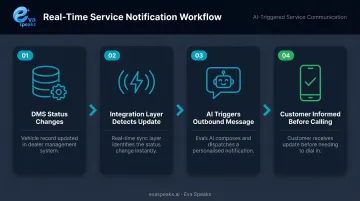
The practical workflow looks like this:
- DMS status changes
- Integration layer detects the update
- AI triggers the appropriate outbound text or voice message
- Customer is informed before they think to call
Live Inventory and Availability Handling
AI-powered sales agents with real-time inventory access can accurately answer availability questions 24/7. AI tools relying on a nightly inventory feed are a different story — by 9 AM, that data may already be wrong after overnight trades or dealer transfers.
When an AI knows which specific units have been sitting longest, it can prioritize outreach to customers most likely to buy that model. The result is urgency-based campaigns built on actual lot data, not guesswork.
Appointment Booking That Reflects True Capacity
Real-time integration with the DMS service scheduler means an AI booking an appointment can see actual technician availability and open time slots — not an estimate based on yesterday's grid. This prevents double-booking and reduces no-shows because the confirmed time is accurate when the customer receives it.
Key Features That Define a True Real-Time DMS Integration
Not all "real-time" claims hold up under scrutiny. Before signing a contract, evaluate vendors on four concrete criteria:
Update Latency
There's a meaningful difference between:
- Real-time (sub-minute): Enables immediate action — pickup notifications, live inventory checks during a call
- Near-real-time (1-5 minutes): Acceptable for most service communications
- Batch sync (hourly or nightly): Creates operational risk for any customer-facing use case
No major DMS provider publicly publishes a latency benchmark in seconds or minutes — so ask vendors to demonstrate this live rather than relying on marketing copy.
Write-Back Capability
A genuine bidirectional integration means the AI can write back to the DMS, not just read from it. Without write-back access, the AI can surface information but can't complete transactions — no repair order creation, no customer record updates, no interaction logging.
Write-back permissions are frequently the sticking point in vendor negotiations. DMS providers control what third parties can modify, and some data objects are protected. Confirm exactly which write-back capabilities are included before assuming full bidirectional functionality.
Certified vs. Unofficial Integrations
Certified integrations — built through Reynolds RCI, CDK's Fortellis/Approved Partner program, Dealertrack's Opentrack, or Tekion's APC — are validated for proper data delivery, display, and compatibility with future DMS updates. Per Reynolds' documentation, certified status validates that data is not misused and that the integration remains compatible when the DMS releases major software updates.
Unofficial integrations using screen-scraping or workarounds are common among smaller vendors. They work until the DMS updates its interface — then they break without notice.
To verify certification: Contact the DMS provider directly and ask whether the AI vendor appears on their certified third-party list. For Reynolds, that list is publicly accessible.
Data Scope and Security
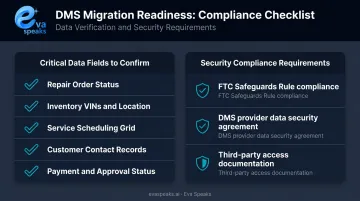
Real-time sync is only useful if it covers the right fields. Critical data types to confirm are covered:
- Repair order status
- Inventory VINs and location
- Service scheduling grid
- Customer contact records
- Payment and approval status
Security compliance is equally non-negotiable. Dealership customer data falls under the FTC Safeguards Rule, as documented by NADA, and DMS providers have strict requirements governing third-party access. Ask any AI vendor for documentation confirming compliance with their DMS provider's data security agreement before granting access.
Watch how an AI dealership call flow works in real time. Watch AI Call Flow Demo
Leading AI Platforms Built for Dealership DMS Integration
AI platforms serving dealerships generally fall into three categories, each with a different integration architecture:
1. Full DMS platforms with embedded AI
Tekion's ARC platform is the clearest example — it natively unites DMS, CRM, service lane tools, payments, and analytics on a single AI-native system. There's no integration gap because everything operates within one platform. CDK's AI capabilities, including AIVA (documented as an AI virtual assistant for lead engagement via email and SMS), operate within CDK's own ecosystem.
2. CRM-adjacent AI platforms with DMS data bridges
VinSolutions (Cox Automotive) has publicly documented DMS certifications across CDK, Reynolds & Reynolds, Autosoft, and Dealertrack. Salesforce Automotive Cloud operates in this space as well, though specific DMS certifications for that platform weren't verifiable in public documentation.
3. Communication-layer AI platforms
This category handles customer-facing voice and messaging — inbound call handling, appointment reminders, service status notifications — and layers on top of whatever DMS and CRM the dealer already uses.
EvaSpeaks falls into this third category. The platform provides AI-enabled call handling with real-time conversational AI, customizable call-flow scripts powered by LLMs, and third-party integration capabilities.
When connected to DMS data, this type of platform upgrades inbound call handling from a scripted IVR experience into an informed interaction. EvaSpeaks is structured to layer on top of existing dealership infrastructure rather than replace it, which reduces the implementation scope compared to full DMS or contact center migrations — a meaningful advantage for stores that want to improve call handling quickly rather than wait for a large technology project. The AI can access current vehicle status, service availability, and customer history rather than routing callers through static menus.
The right choice depends on what's already in place:
- Dealers running CDK will find the least friction staying within that ecosystem.
- Dealers adding a communication-first AI layer on top of an existing DMS can benefit from platforms like Eva Speaks that bring LLM-powered conversation handling to every inbound call.
Want to see it working with your DMS? Request Live Demo
How Real-Time AI + DMS Integration Compares to Legacy Approaches
Not all integration strategies deliver the same operational outcome. Here is how the three main approaches stack up for dealerships evaluating a move toward AI-assisted call handling and service communications:
| AI + Real-Time DMS (EvaSpeaks) | Batch-Sync DMS Integration | Manual Look-Up | |
|---|---|---|---|
| Features | Live vehicle/inventory data, instant routing, CRM sync, AI conversation | Scheduled data pulls, overnight sync | Staff checks DMS manually per call |
| Best-fit Business Size | Single-rooftop to dealer groups | Large multi-location groups | Small independent dealers |
| Key Strengths | Real-time accuracy, no stale data, fast customer resolution | Familiar, widely used | Human judgment |
| Implementation Complexity | Low - CDK/Reynolds connectors | Medium - IT project | None |
| Integration Capability | CDK, Reynolds, Tekion, Dealertrack native | Via OEM/middleware | None |
EvaSpeaks is designed to layer onto existing dealership infrastructure - meaning the implementation complexity stays low regardless of which major DMS is already in place.
How to Vet a Vendor's DMS Integration Depth
Five Questions to Ask Any AI Vendor
- Which DMS platforms do you have certified integrations with — and can you show documentation from the DMS provider confirming your certification status?
- What is your average data latency from a DMS update to an AI action or response?
- Does your integration support write-back, or is it read-only? Which specific data objects can you write to?
- What happens if the DMS goes offline or releases an API update — do workflows fail, pause, or fall back gracefully?
- Who holds liability if a customer receives incorrect information due to a sync failure?
The Live Demo Test
Before signing, request a specific demonstration: have a technician close a repair order in the DMS during the demo and time how long it takes for the AI to reflect that change. This single test reveals more about actual integration depth than any sales presentation.
A vendor who declines or can't arrange this likely lacks a live DMS environment — which points to surface-level integration, not a certified one.
Implementation Timeline
Deeper integrations take longer to deploy. Timelines generally break down like this:
- Surface-level read-only connections: Live in days
- Full bidirectional certified integrations: 4–12 weeks, depending on the DMS provider's certification process and the vendor's existing approval status
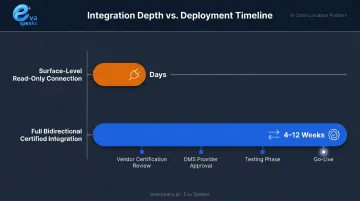
Request a written implementation timeline with milestones before contract signing — and factor that window into any go-live plans.
Frequently Asked Questions
What is real-time DMS integration for dealerships?
Real-time DMS integration means an AI platform connects to the dealership's Dealer Management System and pulls live updates — inventory changes, repair order status, scheduling availability — as they happen, not on a nightly or delayed sync. AI-driven actions then reflect the actual current state of operations, not data that's hours old.
How can car dealerships use AI?
Dealerships apply AI primarily to automate customer communications (service updates, appointment reminders), handle inbound calls and leads around the clock, book service appointments, and surface actionable insights from DMS and CRM data for sales and service teams.
Is a DMS the same as a CRM?
No. A DMS manages operational dealership functions — inventory, repair orders, parts, accounting. A CRM manages customer relationships and sales follow-up. They serve different purposes and perform best together when an AI layer connects them.
How does AI integrate into a CRM?
AI connects to a CRM via API, enabling it to read customer records, log interactions, trigger follow-up sequences, update lead scores, and pull real-time DMS data — giving the AI both operational context and customer history in a single view.
What software do dealerships use for service?
The most widely used platforms are CDK Global, Reynolds & Reynolds, Tekion, and Dealertrack. Most dealerships layer specialized service scheduling, AI communication tools, and customer notification systems on top of their core DMS.
What are the risks of poor DMS integration in an AI platform?
The main failure modes are stale data causing the AI to give customers incorrect information, broken integrations after DMS software updates, and read-only access preventing the AI from completing tasks like booking appointments or updating records.