Introduction
Picture this: a customer calls your company, says "I need help with my invoice," and within seconds they're speaking to someone in billing — not transferred twice, not put on hold. That seamless handoff isn't magic. It's SIP call routing handling the logic that connects each call to the right person.
Most businesses running VoIP phone systems rely on SIP routing every time a call is made or received, yet few understand what's actually happening under the hood. That gap matters, because how you configure routing directly affects call quality, cost, and customer experience.
This guide covers what SIP call routing is, how it works technically, the main routing methods businesses use, and the real benefits and challenges of getting it right. It also looks at how AI-powered platforms like Eva Speaks are pushing routing logic well beyond traditional rule sets.
TLDR: Key Takeaways
- SIP routing directs VoIP calls across IP networks using proxy servers and configurable rules
- Routing decisions can be based on cost, time of day, geography, load, or failover needs
- Unlike fixed PSTN circuits, SIP routing is software-defined and easily updated
- Businesses switching to SIP trunking report 25% to 65% cost savings over legacy PRI lines
- AI-enhanced routing adds real-time, intent-based decision-making on top of standard SIP logic — Eva Speaks offers customizable call-flow scripts that do exactly this
Watch how AI-driven call flows work from start to finish. Watch AI Call Flow Demo
What Is SIP Call Routing?
SIP (Session Initiation Protocol) is an application-layer signaling protocol used to initiate, manage, and terminate real-time communication sessions over IP networks. IETF RFC 3261 defines it as a control protocol for "creating, modifying, and terminating sessions" — covering voice, video, and messaging.
SIP call routing is how a VoIP system determines the best path to connect a call — from the originating party to the recipient, through one or more network nodes. Understanding how that routing differs from traditional telephony is where the real picture starts to form.
SIP vs. Traditional PSTN Routing
The contrast with traditional telephony is significant:
| Feature | PSTN Routing | SIP Routing |
|---|---|---|
| Technology | Circuit-switched | Packet-switched |
| Infrastructure | Fixed physical lines | Software-defined |
| Route selection | Static, predetermined | Dynamic, rule-based |
| Scalability | Hardware-dependent | Configurable in software |
| Cost model | Per-circuit pricing | Per-channel or usage-based |
The Core Components
Four components handle routing in every SIP system:
- SIP User Agents (UAs) — endpoints like desk phones or softphones that send and receive SIP requests
- SIP Proxy Servers — intermediaries that forward requests and enforce routing policies
- Registrar Servers — track where each user is currently located on the network
- Redirect Servers — return alternate destination addresses when a call needs to be pointed elsewhere
Each component plays a distinct role — and how they're configured directly shapes call quality, reliability, and cost across the entire system.
How SIP Call Routing Works: Step-by-Step
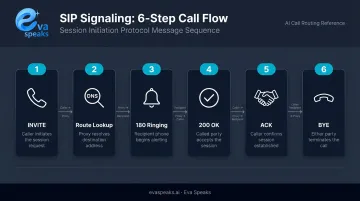
Here's what actually happens when someone dials a number on a SIP system — from first signal to final hangup.
The SIP Signaling Sequence
- INVITE — The caller's SIP User Agent sends an INVITE request to the SIP proxy server, signaling the start of a new session
- Route lookup — The proxy consults DNS or a registrar/location server to find the destination, then forwards the INVITE based on configured routing rules
- 180 Ringing — The destination device sends this provisional response back through the chain, indicating the call is alerting
- 200 OK — When the recipient answers, a 200 OK travels back to the caller
- ACK — The caller's UA sends an acknowledgment, formally establishing the session
- BYE — When either party hangs up, a BYE request closes the session cleanly
SIP Signaling vs. RTP Media
SIP only handles signaling. The actual voice conversation travels over RTP (Real-Time Transport Protocol), a completely separate path that runs directly between endpoints once the session is established. SIP sets up and tears down the call; RTP carries what you hear.
The SIP Trapezoid
When two proxy servers are involved (one for the caller's domain, one for the recipient's), the INVITE travels through both proxies to locate the destination. Once connected, media flows directly between the endpoints, bypassing both proxies entirely. RFC 3261 calls this the SIP Trapezoid topology. It's the standard architecture for inter-domain SIP calls.
Types of SIP Call Routing Methods
SIP routing isn't one-size-fits-all. Businesses configure routing rules based on their specific operational needs. The six primary methods:
Least-Cost Routing (LCR)
LCR automatically selects the carrier or route offering the lowest per-minute cost for each call. It's especially valuable for businesses making high volumes of long-distance or international calls.
According to a 2026 Mordor Intelligence analysis, SIP trunks using least-cost routing can reduce legacy international tariffs by 40% to 70%. For any business with significant outbound call volume, LCR alone can justify a SIP migration.
Time-Based and Geographic Routing
Time-based routing directs calls to different endpoints depending on when the call arrives:
- Business hours → live agents
- After hours → voicemail or an answering service
- Holidays → a custom message or emergency line
Geographic routing sends calls to the nearest or most appropriate agent or office based on the caller's location. This reduces latency and improves local service quality — particularly relevant for businesses with multiple regional offices.
Failover and Load Balancing Routing
Failover routing is your safety net. If a primary route or endpoint goes down due to network issues or hardware failure, the system automatically reroutes the call to a secondary path — no dropped calls, no dead air.
Load balancing routing distributes incoming calls evenly across multiple endpoints or servers. This prevents any single server from becoming a bottleneck during peak call periods, maintaining consistent call quality at every endpoint.
AI-Based and Skills-Based Routing
Skills-based routing moves beyond simple destination rules. Calls are directed to the agent or department best qualified to handle a specific inquiry, based on factors like:
- Language spoken by the caller
- Agent expertise or product knowledge
- Account tier or customer history
- Department-specific inquiry type
SQM Group research found that intelligent skills-based routing improves First Call Resolution by 5% to 15%, with specialized agents consistently outperforming generalists on FCR.
AI-enhanced routing builds on this by analyzing caller intent in real time. Platforms like Eva Speaks combine customizable call-flow scripts with conversational AI — using LLMs, speech-to-text, and text-to-speech — to route calls based on what a caller actually says. The system interprets intent, not just the dialed number, which means routing decisions adapt dynamically to each conversation.
Here is how traditional SIP routing approaches compare to AI-powered SIP routing:
| AI-Powered (EvaSpeaks) | Skills-Based Legacy SIP | Basic PSTN/SIP Routing | |
|---|---|---|---|
| Features | Conversational AI routing, intent detection, real-time adaptation | Rule-based skill matching, ACD | Static dial plans, DTMF menus |
| Best-fit Business Size | SMB to mid-market | Mid-market to enterprise | Any size |
| Key Strengths | No caller effort, intelligent overflow | Matches callers to best agents | Simple, low-cost |
| Implementation Complexity | Low - no-code, hours | Medium - weeks | Low |
| Integration Capability | CRM, scheduling, EHR | CRM via API | Limited |
See how AI takes SIP routing even further. Explore AI Call Automation
Benefits of SIP Call Routing for Businesses
Cost Efficiency
SIP routing eliminates dedicated circuits. Combine that with LCR, and the savings are substantial. Mordor Intelligence's 2026 forecast data puts the range at 25% to 65% savings over legacy PRI/ISDN lines for businesses making the switch to SIP trunking.
Beyond per-minute rates, SIP channels can be purchased in flexible increments — unlike TDM-based PRI blocks that bundle 23 channels regardless of whether you need them all.
Flexibility and Scalability
Routing rules live in software. Adding a new office, a new department, or a new after-hours policy doesn't require a hardware change or a technician on-site. Updates happen at the configuration level — open a satellite office on Monday, and its call routing can be live the same day.
Improved Reliability
Failover routing and load balancing together eliminate single points of failure. If one carrier goes down or one server gets overloaded, calls reroute automatically. For customer-facing operations where a missed call has real revenue implications, that automatic rerouting directly protects revenue.
Key reliability capabilities SIP routing provides:
- Automatic failover — reroutes calls instantly when a carrier or server fails
- Load balancing — distributes call volume across multiple paths to prevent congestion
- Geographic redundancy — routes through backup data centers if a primary location goes offline
Want routing configured for your specific call types? Get a Customized Workflow Recommendation
Common SIP Routing Challenges and How to Solve Them
Latency, Jitter, and Packet Loss
SIP calls travel over IP networks, so network quality directly affects call clarity. Cisco's IOS XE documentation (citing ITU-T G.114) sets the maximum desired one-way delay at 150 ms — beyond that, conversations become awkward with talk-over effects.
The fix: Quality of Service (QoS) configurations that prioritize SIP and RTP traffic over other data on the network. Without QoS, a large file download on the same network can degrade call quality in real time.
Codec Mismatches and Interoperability
Different SIP devices support different audio codecs — G.711, G.729, and others. When two endpoints don't share a common codec, calls can fail outright or audio quality degrades significantly.
SIP proxies and media gateways handle codec negotiation and transcoding during session setup. Ensuring your SIP infrastructure supports transcoding between common codecs prevents most interoperability issues before they reach users.
Security Vulnerabilities
SIP infrastructure is a known attack vector. Common threats include:
- INVITE flooding — overwhelming a SIP server with unauthorized session requests
- Toll fraud — hijacking SIP credentials to make expensive calls at your expense
- Eavesdropping — intercepting unencrypted SIP signaling or RTP media
The CFCA reported that global telecom fraud reached $38.95 billion in losses in 2023 — a 12% increase from 2021.
Effective mitigation covers three areas:
- SIP-aware firewalls — filter malicious traffic before it reaches your SIP server
- TLS encryption — secures SIP signaling in transit (mandated for proxy servers under RFC 3261)
- SRTP encryption — protects the media stream itself
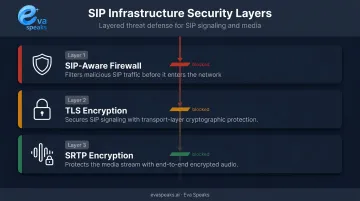
Cisco's UCM security documentation recommends deploying TLS and SRTP together. Without both, media encryption keys can be exposed through unencrypted signaling.
Best Practices for Optimizing SIP Call Routing
Routing configurations that made sense 18 months ago may now be suboptimal or costing more than necessary. Carrier rates shift, offices move, and teams restructure — so auditing your routing rules on a regular cadence isn't optional, it's maintenance.
Build redundancy at every layer:
- Use multiple SIP carriers (multi-homing) so no single carrier failure takes down all outbound calls
- Configure failover routes for every primary destination
- Ensure geographic redundancy in your SIP infrastructure for disaster recovery
Static rules based on phone numbers and time windows have real limits. Platforms like Eva Speaks layer AI and LLM-powered call-flow logic on top of traditional SIP infrastructure, routing calls based on what callers actually say and what they actually need — not just which number they dialed.
That shift is already underway. Gartner predicts that by 2028, at least 70% of customers will start their service journey through a conversational AI interface. Building routing logic that handles natural language inputs now means less re-architecture later. For businesses that want to move in this direction without replacing their existing carrier or SIP infrastructure, platforms like Eva Speaks can apply AI-powered call-flow logic on top of a standard SIP setup — routing calls based on spoken intent rather than dialed numbers, without requiring a full network redesign.
Have questions about your current phone setup? Talk to an AI Communication Expert
Frequently Asked Questions
What is SIP routing?
SIP routing is the process by which a SIP-based VoIP system selects the best network path to connect a call from caller to recipient. It uses proxy servers and configurable rules to forward SIP INVITE requests toward the destination endpoint.
What is a SIP call?
A SIP call is a voice or video call made using the Session Initiation Protocol over an IP network. SIP handles the signaling — setup, management, and teardown — while RTP carries the actual audio or video stream between endpoints.
What is an example of a SIP phone?
Hardware IP phones include the Yealink SIP-T54W and Cisco Desk Phone 9800 series. Software-based softphones include Zoiper 5 and CounterPath Bria Mobile, as well as Microsoft Teams with SIP Gateway integration.
What is the difference between SIP and VoIP?
VoIP is the broad category for making calls over IP networks. SIP is one specific protocol used within VoIP systems to handle call signaling and session management. In short: every SIP call is a VoIP call, but not every VoIP call uses SIP.
How does SIP call routing differ from traditional phone routing?
Traditional PSTN routing uses fixed, circuit-switched paths tied to physical infrastructure. SIP routing is software-defined and packet-switched: it selects routes dynamically based on cost, geography, availability, or custom business rules, without requiring hardware changes.
What is least-cost routing in VoIP?
Least-cost routing (LCR) automatically selects the cheapest available carrier for each outbound call. It's especially useful for businesses with high call volumes or frequent international calls — routing decisions alone can cut international costs by 40% to 70%.