Introduction
According to Canary Technologies, reported by Hotel Dive, 40% of calls to hotel front desks go unanswered. That's not a minor operational gap — each unanswered call is a reservation that didn't happen, a guest who booked through an OTA instead, and commission that came out of your margin.
The phone channel is also more valuable than many operators assume. Revinate's 2026 Hospitality Benchmark Report puts the voice channel at 4x the average stay value of other booking channels — meaning the caller you missed wasn't just any prospect.
Large language models and voice AI now make it possible to hold full reservation conversations — handling availability questions, quoting rates, taking bookings — without a human agent on the line. This guide breaks down what these systems are, how they work, what features actually matter, and how to start implementing one at your property.
Key Takeaways
- AI call handling systems answer hotel reservation calls 24/7 using voice AI and LLMs, with no human agent needed for routine inquiries.
- They handle availability checks, rate quotes, booking capture, and upsells through direct PMS or booking engine integration.
- Critical features: natural language understanding, PMS/booking engine integration, customizable routing rules, and call analytics.
- Hotels typically see reduced call abandonment, lower staff workload on repetitive calls, and measurable direct booking gains.
What Is an AI Call Handling System for Hotels?
An AI call handling system is software that answers inbound phone calls, interprets what the caller says, and responds — handling the same tasks a front desk agent would manage over the phone. The core technologies are natural language processing (NLP) and large language models, which allow the system to understand spoken intent and reply in ways that fit the conversation.
How It Differs from Traditional IVR
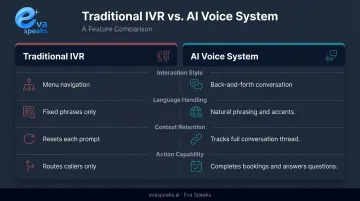
Most hotels already use some form of IVR — the "press 1 for reservations, press 2 for the front desk" systems that callers frequently abandon. IVR follows rigid, pre-programmed menus with no ability to deviate, handle unexpected phrasing, or answer a follow-up question. AI voice systems were built specifically to solve that problem.
Modern AI voice systems work differently:
- They engage in back-and-forth conversation, not menu navigation
- They understand natural phrasing, including variations and accents
- They retain context across the call — if a guest asks about a king room, then asks about parking, the system tracks both
- They can complete actions (make a booking, confirm a rate) rather than just routing the caller
Fully Autonomous vs. Hybrid Deployment
Hotels typically choose between two models:
| Model | How It Works | Best For |
|---|---|---|
| Fully Autonomous | AI handles the call start to finish | After-hours coverage, routine reservation and inquiry calls |
| Hybrid | AI handles intake; escalates complex calls to a human agent | Properties with complex group bookings, VIP guests, or high service-tier expectations |
Most properties benefit from starting with a hybrid model: it limits risk while letting AI handle the bulk of routine calls, freeing staff for higher-touch interactions.
Why Hotels Are Adopting AI Call Handling Systems
The Revenue Math on Missed Calls
The voice channel is not a legacy channel. Phone reservations carry an ADR 30% or more higher than other booking channels, according to PhocusWire. A caller who can't reach your hotel has two options: book with a competitor, or go through an OTA and cost you 15–30% in commission on that same reservation.
AI eliminates that revenue leak entirely by ensuring every inbound call gets answered — whether it arrives at 2 PM or 2 AM.
After-Hours and Peak-Period Gaps
Front desk teams can't scale on demand. Calls that arrive during peak check-in periods, weekend evenings, or overnight hours often go unanswered or sit on hold until the caller gives up. AI handles these gaps without additional headcount.
Staff Efficiency
Not every call requires skilled reservations expertise. Callers asking about check-in times, pet policies, parking rates, or breakfast hours consume front desk bandwidth that could go toward higher-value interactions. DialogShift reports two useful benchmarks for hotel operations:
- Recurring informational questions account for approximately 40% of total call volume
- AI-handled calls can reduce staff call volume by up to 70%
The practical result: your team handles the calls that actually need human judgment. Everything else runs without staff involvement.
Direct Booking Uplift
Speed and accuracy on the phone convert hesitant callers into bookings. A caller who gets immediate availability and rate confirmation is far more likely to book on the spot than one who's placed on hold, transferred, or told to check the website. Booking-intent inbound calls converted at 49–53% in Revinate's 2025–2026 benchmark data — a conversion rate that depends entirely on the call being answered in the first place.
Together, these factors explain why AI call handling has moved from a novelty to a revenue operations decision for hotels of all sizes.
See how AI handles overnight and peak-hour hotel calls. See How AI Handles After-Hours Calls
Key Features of an Effective Hotel AI Call Handling System
Natural Language Understanding and Conversation Flow
Guests don't ask clean, single-sentence questions. They follow up, interrupt, and change their minds mid-call. The NLP layer needs to handle all of that without losing context.
What to evaluate:
- Latency: Pauses above 1.5 seconds degrade the caller experience noticeably, according to Cresta's engineering research on real-time voice AI. Target systems with sub-300ms response latency.
- Interruption handling: Can the caller cut in mid-sentence and have the system adjust?
- Contextual memory: Does the system track the full conversation, or does each exchange start fresh?
PMS and Booking Engine Integration
This is the most important technical criterion. An AI system that can't access live availability and pricing can't answer the one question every reservation caller asks: "Do you have a room available for these dates at this rate?"
Deep integration enables the AI to:
- Pull real-time room availability and rate data
- Process bookings directly — preventing overbooking
- Recognize returning guests when CRM data is connected
- Surface relevant upsell options based on what's actually available
Request a live integration demo, not a feature list. Ask the vendor to show live availability pulling from a real PMS — if they can't demo it, assume it isn't there.
Customizable Call-Flow Scripts and Routing Rules
Even a well-integrated system fails if it handles every hotel identically. Different properties have different policies, escalation thresholds, and upsell priorities — a system running fixed, generic scripts won't reflect your brand or catch your specific edge cases.
Platforms like Eva Speaks offer configurable call-flow scripts and routing rules — letting hotels define how calls are handled, what prompts trigger a human transfer, and how the AI represents the property. Without it, the AI may route a complaint-prone caller through a standard booking flow, or fail to flag a situation that requires a manager.
Multilingual Support and Analytics
Multilingual support is no longer a premium add-on — it's a baseline expectation, with international visitation to the U.S. forecast to reach 96.7 million by 2029. Modern AI voice systems typically support 25–30 languages natively; some exceed 50.
Call analytics turn every interaction into usable data. Look for platforms that provide:
- Searchable transcripts for quality review
- Conversion rate tracking by call type
- Identification of recurring questions your knowledge base should address
- Escalation patterns that reveal gaps in AI coverage
Watch how an AI-powered hotel call flow actually runs. Watch AI Call Flow Demo
How AI Call Handling Works in Hotel Reservations
From Inbound Call to Resolved Inquiry
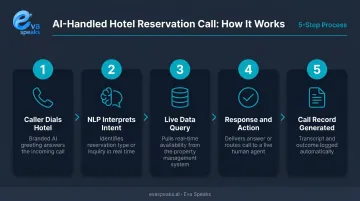
Here's what the end-to-end call flow looks like in practice:
- Caller dials the hotel — the AI answers with a branded greeting, typically within one ring
- NLP engine interprets intent — the system identifies whether the caller wants to make a reservation, ask about rates, check a policy, or something else
- Live data query — the AI pings the connected PMS or booking engine for real-time availability and rates
- Response and action — the AI delivers an accurate answer, then either completes the booking or routes to a human agent if the request falls outside its configured scope
- Call record generated — transcript and outcome data are logged automatically
What makes this work at scale is the LLM layer underneath. Unlike scripted bots that break on unexpected phrasing, LLMs generate contextually appropriate responses in real time — adapting to unusual requests and multi-part questions without losing the thread of the conversation. That flexibility is what allows the system to handle the full range of a reservation call, not just the predictable ones.
Handling Reservations and Upselling
During a reservation call, the AI walks the caller through availability, room options, and rates — all live from the booking engine. Once reservation intent is confirmed, the system can move into upsell territory: room upgrades, early check-in, late check-out, or amenity packages, based on what's available.
The Golden Nugget Hotels case is a useful benchmark: their PolyAI voice assistant automated 34% of hotel reservation calls, equivalent to three days of agent time per week, and averaged over 300 completed reservations per week within two months of launch — with 87% of calls fully automated.
Those numbers reflect a system that had been properly integrated with the hotel's booking engine and configured for its specific call mix — which is what separates a high-performing deployment from one that plateaus at basic intent recognition.
How to Choose the Right AI Call Handling System
Match the System to Your Property Type
A 30-room boutique property and a 400-room conference hotel have fundamentally different requirements. Before evaluating vendors, clarify:
- Daily call volume — how many inbound calls do you currently receive?
- Call complexity — are most calls routine rate/availability inquiries, or do you regularly handle group bookings and complex itineraries?
- Existing tech stack — which PMS and booking engine are you running, and does the AI vendor have a working integration for them?
- Autonomy level — do you need full overnight coverage, or primarily overflow support during peak hours?
Integration Depth Over Feature Count
A platform with impressive AI features but shallow PMS integration will fail at the most basic task. Prioritize vendors who can demonstrate:
- Real-time availability and rate pulls during a live test call
- Actual booking completion (not just intent capture)
- Confirmed integration with your specific PMS platform
- Configurable call-flow scripts and routing rules that map to your property's escalation logic
When evaluating any vendor — including Eva Speaks — ask them to walk through a live test call against your actual PMS before committing. Eva Speaks is designed to be configured by hotel operations teams rather than requiring dedicated IT resources, which reduces the implementation burden for properties that don't have in-house technical staff to manage a complex deployment.
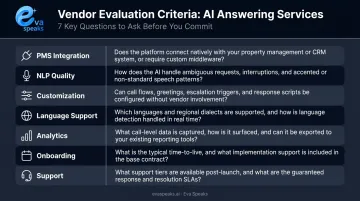
Once you've confirmed integration depth, use this checklist to compare vendors side by side.
Vendor Evaluation Checklist
| Criterion | What to Ask |
|---|---|
| PMS integration | Which platforms? Is it real-time? |
| NLP quality | Test call quality across accent variations and complex questions |
| Customization | Can you configure escalation triggers, upsell prompts, and routing rules? |
| Language support | How many languages? Is detection automatic? |
| Analytics | What metrics are captured per call? Is there a dashboard? |
| Onboarding | How is property knowledge loaded? What's the go-live timeline? |
| Support | What ongoing support is available after launch? |
See how it works for your property before you commit. Request Live Demo
How the Main Options Compare
Here is how AI call handling, traditional PMS-integrated IVR, and human-only front desk compare for hotel reservations:
| AI Call Handling (EvaSpeaks) | PMS-Integrated IVR | Human Front Desk | |
|---|---|---|---|
| Features | Natural conversation, reservations, upsell, 24/7 routing | Automated reservations, hold queue | Full guest interaction, adaptive |
| Best-fit Business Size | Boutique to mid-size hotel groups | Large chains with IT resources | Small properties |
| Key Strengths | No missed reservations, zero hold time, consistent | Widely deployed, PMS native | Human hospitality touch |
| Implementation Complexity | Low - PMS API connectors | High - IT-dependent | None |
| Integration Capability | Opera, Cloudbeds, booking platforms | Native PMS, limited else | Manual entry |
Implementing AI Call Handling at Your Hotel: Getting Started
Start Narrow, Then Expand
Don't replace all inbound call handling on day one. Begin with a contained use case:
- After-hours coverage — lowest risk, immediate value, no displacement of existing staff
- Overflow during peak periods — handles the calls that would otherwise ring unanswered
This approach limits exposure if the AI needs tuning, lets your team observe real call handling, and builds confidence before broader rollout.
Load Your Property Knowledge Base Carefully
AI accuracy is only as good as what it knows. Before going live, configure:
- Room types, descriptions, and occupancy limits
- Rate structures and seasonal pricing
- Check-in/check-out times
- Cancellation and modification policies
- Parking details and fees
- Pet policies
- Amenity information (pool, gym, restaurant hours)
- Escalation triggers — which request types should transfer to a human agent
With your knowledge base in place, the next step is measuring whether it's working.
Track Performance From the First Week
Define your KPIs before launch and review them weekly in the first month:
- Call answer rate: Are 100% of inbound calls being picked up?
- Call-to-booking conversion rate: How many answered calls result in a reservation?
- Escalation rate — what percentage of calls transfer to a human agent?
- Average handle time — how long does a typical AI-handled call take?
- Guest satisfaction: Post-call survey scores for AI-handled interactions
Use call transcripts to identify recurring questions the AI isn't handling well, then refine your knowledge base and call-flow logic based on patterns you find in the first 30 days.
Want to discuss your hotel's specific call challenges? Talk to an AI Communication Expert
Frequently Asked Questions
Can I use AI to answer my hotel's phone calls?
Yes. Modern AI voice systems connect to your existing phone line and answer inbound calls in real time using natural language — no human agent required for routine inquiries. They can handle availability questions, rate quotes, and reservation capture around the clock.
Which AI is best for hotel booking?
The right system depends on your property size, PMS/booking engine, and typical call complexity. Evaluate options based on integration depth, natural language quality, and customization flexibility rather than brand recognition alone.
How can AI be used in hotels?
AI applications in hotels span phone call handling and reservations, website and WhatsApp chat, check-in automation, upselling, and post-stay follow-up. Voice and call handling tends to deliver the fastest measurable ROI because it directly addresses missed bookings.
What software do hotel receptionists use?
Front desk teams typically work with a PMS (such as Opera, Cloudbeds, or Mews), a booking engine, a CRM, and various communication tools. AI call handling systems layer on top of these — integrating with existing software rather than replacing it.
Will guests know they're talking to an AI?
Modern voice AI sounds increasingly natural, but transparency is the right practice. Disclosing AI use at the start of a call is recommended, and 58% of guests believe AI can improve their hotel stay, so most callers accept it positively when the interaction is smooth.
How much does an AI call handling system cost for hotels?
Pricing varies by provider and call volume — common models include monthly subscriptions and per-minute rates. Most solutions run well below the cost of traditional call center outsourcing. Contact Eva Speaks directly for pricing, and compare it against your current missed-booking revenue to gauge ROI.