Introduction
Every morning, front desk staff at medical practices across the country sit down to a ringing phone and a full voicemail queue — before they've had a chance to open their scheduling system. By mid-morning, hold times stretch past five minutes. By afternoon, calls go unanswered.
This isn't a staffing failure. It's a volume problem.
A VHA study tracking over 252,000 patients across 285 facilities found that even after significant operational improvements, call abandonment rates sat at 8.3% — well above the target of 5%. In high-volume specialty practices, the picture is more strained: one urology practice handled nearly 300,000 inbound calls in a single year.
IVR often gets dismissed as clunky "press 1 for appointments" technology. That reputation belongs to legacy systems. Modern healthcare IVR — especially when paired with AI — measurably reduces costs, eases staff workload, and keeps patients from hitting a dead end when they call.
This article covers the practical advantages of IVR for healthcare: how it works, what outcomes it actually drives, and where it makes the biggest difference.
Watch how a modern AI call flow handles patient requests. Watch AI Call Flow Demo
Key Takeaways
- IVR automates routine patient calls, freeing staff for complex, high-value interactions
- Healthcare IVR supports 24/7 patient access without adding headcount or after-hours staffing costs
- Consistent, scripted call flows reduce HIPAA exposure from variable live-agent interactions
- Practices without IVR face higher abandonment rates, staff burnout, and limited capacity to scale
- IVR performance improves over time when call flows are tracked against clear KPIs and updated regularly
What Is IVR in Healthcare?
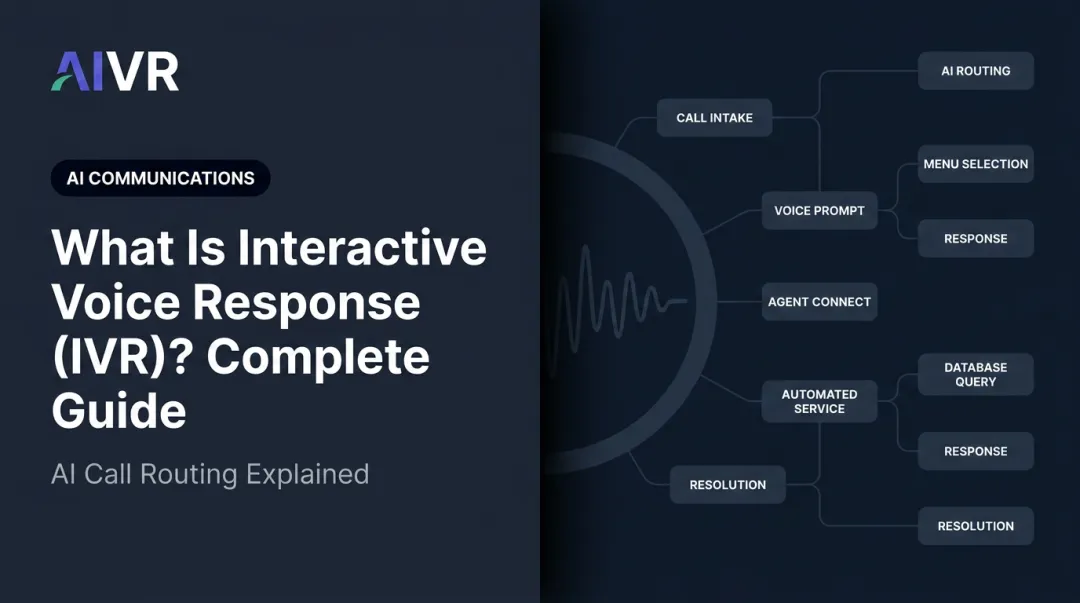
Healthcare IVR (Interactive Voice Response) is an automated telephony system that interacts with callers through pre-recorded prompts, responding to voice or keypad inputs to handle routine patient requests — without requiring a live agent.
In a medical practice, that means handling:
- Appointment scheduling and confirmations
- Prescription refill requests
- Lab result status inquiries
- Billing questions and payment prompts
- After-hours call routing to on-call providers
- General information (hours, directions, insurance accepted)
The key distinction between IVR and a simple phone menu is outcome. IVR resolves requests, not just routes them. A patient who calls at 10 p.m. to confirm tomorrow's appointment gets that confirmation without a callback, a voicemail, or staff overtime.
Platforms like Eva Speaks go further by integrating LLMs, text-to-speech, and speech-to-text to move beyond fixed menu trees. Rather than forcing callers through rigid DTMF options, AI-enhanced IVR can interpret natural language, respond conversationally, apply configurable routing rules, and let practices update call flows without rebuilding them from scratch.
What makes IVR valuable in healthcare is the friction it removes between patients and the care they need.
Here is how traditional IVR, AI-enhanced IVR, and human-only front desks compare for healthcare call handling:
| AI-Enhanced IVR (EvaSpeaks) | Legacy Healthcare IVR | Human Front Desk Only | |
|---|---|---|---|
| Features | Natural language, scheduling, triage routing, EHR sync | DTMF menus, appointment reminders, hold queues | Full patient interaction, adaptive |
| Best-fit Business Size | Clinics to large health systems | Enterprise health systems | Small practices |
| Key Strengths | 24/7, no hold time, consistent | Widely deployed, familiar | Human empathy, complex situations |
| Implementation Complexity | Low - native EHR connectors | High - months + IT team | None (hire) |
| Integration Capability | Epic, Cerner, scheduling tools | Custom dev required | Manual entry |
Key Advantages of IVR for Healthcare
The advantages below are grounded in operational and financial outcomes that practice administrators actually track: cost per call, staff utilization, call abandonment, and patient satisfaction. Each one connects to metrics that matter to healthcare operators trying to run sustainable practices.
Advantage 1: 24/7 Patient Access Without Additional Staffing Costs
Most practices operate on an 8-to-5 schedule. Patient needs don't.
Healthcare IVR allows patients to reach the practice and complete routine requests at any hour — evenings, weekends, holidays — without requiring on-call or after-hours staff for non-urgent inquiries. The system handles high-frequency, low-complexity calls automatically while routing genuinely urgent after-hours contacts to the appropriate on-call provider.
The access gap this closes is significant. Research published in Health Affairs found that one in five people trying to reach a provider after hours found it somewhat or very difficult. That same research found patients with easier after-hours access had meaningfully lower ED utilization — 30.4% vs. 37.7% — and far lower rates of unmet medical need (6.1% vs. 13.7%).
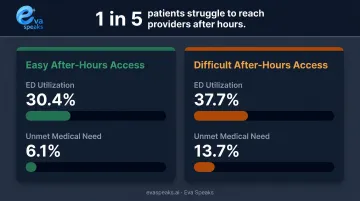
Automated after-hours coverage replaces what would otherwise require an answering service or expanded staff, directly reducing labor expense per interaction. Calls that resolve without staff involvement carry a fraction of the cost of those that require live handling.
KPIs impacted:
- After-hours call containment rate
- Cost per call
- Staff overtime hours
- Call abandonment rate during off-peak hours
- Patient access satisfaction score
When this matters most: Mental health practices managing crisis triage, multi-location networks with complex after-hours routing, and practices serving patient populations with limited availability during standard business hours — hourly workers, shift employees, caregivers.
See how AI keeps patient calls covered after hours. See How AI Handles After-Hours Calls
Advantage 2: Reduced Administrative Burden and Operational Cost Savings
Front desk staff in healthcare settings field the same requests dozens of times a day. Appointment confirmations. Refill requests. Hours of operation. Insurance questions. Each call is low-complexity, but the cumulative volume is substantial.
IVR offloads these high-frequency, repetitive tasks — reducing the number of calls that require human handling and allowing administrative teams to focus on billing issues, complex scheduling, and in-person patient interactions.
The administrative burden in healthcare is well-documented. According to MGMA's 2026 poll of 294 practice leaders, the most time-intensive phone-related front-office tasks are eligibility and prior authorization (45%), scheduling (31%), intake (9%), and prescription refills (6%).
None of these require clinical judgment. They require time — and IVR can capture and route them before they ever reach a staff member.
The burnout connection is direct. When staff spend the majority of their day handling repetitive phone tasks under high volume, retention suffers. MGMA reported front-office support staff turnover reached 40% in 2022. Every call IVR contains is one fewer repetitive transaction eroding that retention.
KPIs impacted:
- Average handle time (AHT)
- Cost per call
- Staff utilization rate
- Calls escalated to live agents
- Employee satisfaction and retention
When this matters most: Practices handling high daily call volumes and those in rapid growth phases where hiring lags behind demand. One useful benchmark: MGMA noted some systems had phone wait times that "routinely exceed an hour" at the start of the week — a clear signal that volume has outpaced staffing capacity.
Advantage 3: Consistent, Compliant, and Scalable Patient Communication
Every live agent interaction introduces a variable: training level, stress, call volume pressure, tenure. On a Monday morning with six calls holding, communication quality degrades — sometimes with compliance consequences.
IVR eliminates that variable. Call flow scripts and routing rules are defined in advance, reviewed for consistency, and applied identically across every interaction — whether the practice handles 20 calls or 200 on a given day.
On the compliance side, HHS HIPAA guidance permits incidental PHI disclosures only when reasonable safeguards are in place. In 2021, OCR received over 34,000 new HIPAA complaints, with Impermissible Uses and Disclosures and inadequate Safeguards ranking among the top resolved issues. Pre-approved IVR scripts with secure identity verification workflows reduce the improvisation that creates exposure in high-pressure live-agent scenarios.
Scalability follows the same logic. As a practice adds locations, providers, or call volume, IVR scales without proportional cost increases. A staffed front desk that handles 80 calls per day needs more people to handle 160 — an IVR-backed system doesn't. Platforms like Eva Speaks support configurable call-flow scripts and routing rules that can be updated without rebuilding the entire system, which matters for growing practices where workflows evolve quickly. This flexibility also addresses one of the more common complaints about legacy IVR deployments — that changing a menu option or routing rule requires vendor involvement and a ticket queue. Eva Speaks puts that control directly in the hands of practice administrators.
KPIs impacted:
- Call abandonment rate
- HIPAA incident rate
- Patient satisfaction score (CSAT)
- Call consistency score
- Scalability cost per additional call handled
When this matters most: Multi-location practices, healthcare networks managing diverse patient populations, and practices with high staff turnover where training gaps create direct communication inconsistency.
See it live with your own call scenarios. Request Live Demo
What Happens When Healthcare IVR Is Missing or Ignored
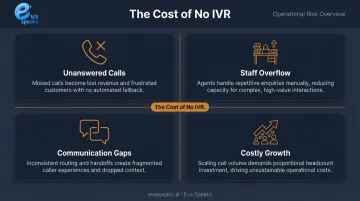
Practices that defer IVR implementation don't avoid the problem — they absorb it through operational drag:
- Calls go unanswered. During peak hours and after hours, volume spikes produce abandonment. Patients who can't reach the practice don't always call back — they find a provider who picks up. No-shows and missed appointments cost U.S. healthcare an estimated $150 billion annually, and unanswered calls are a contributing access point.
- Staff absorb the overflow. When all calls route to live agents, routine requests crowd out complex ones. Scheduling errors increase. Data entry suffers under volume pressure. Burnout accelerates.
- Communication quality fluctuates. Without standardized call flows, patient experience depends entirely on who answers and how they're doing that day. That inconsistency compounds into CSAT score erosion and compliance exposure over time.
- Growth becomes operationally expensive. Every increase in call volume triggers a hiring conversation. Without IVR, communication capacity scales with headcount — not efficiency.
Some patients call a clinic as many as five times per appointment scheduled, according to MGMA. That's not a patient behavior problem. It's an access gap that automated systems are built to close.
How to Get the Most Value from Healthcare IVR
IVR doesn't deliver value by default — it delivers value when configured with intention and monitored against results.
Three practices consistently separate high-performing IVR implementations from underperforming ones:
Get the containment split right. Not every call belongs in IVR. Appointment scheduling, prescription refill requests, and hours inquiries are strong automation candidates. Complex billing disputes, clinical questions, and distressed callers are not. Misconfiguring this split — sending patients to IVR when they expect a person — is the most common reason practices underperform against benchmarks.
Track performance monthly. Monitor call containment rate, abandonment rate, and patient satisfaction on a consistent cadence. A rising abandonment rate often signals a script that's too long, a confusing menu option, or a routing rule sending patients in circles. Catching these early prevents compounding friction.
Verify integration depth before committing to a platform. IVR connected to EHRs and scheduling systems in real time delivers substantially better results than standalone IVR with no data context. A system that confirms a patient's appointment live is far more valuable than one that only offers to take a message.
Want a configuration designed for your clinic? Get a Customized Workflow Recommendation
Conclusion
The core value of healthcare IVR is operational: it extends access without expanding headcount, reduces per-call costs, standardizes communication, and creates the conditions for a practice to scale without proportional expense increases.
Those advantages don't arrive fully formed at deployment. They compound as call flows are refined, staff redirect freed capacity toward higher-value work, and patient access friction decreases. Practices that treat IVR as an ongoing operational discipline — rather than a one-time technology install — see stronger returns over time.
For most healthcare operators, the practical decision isn't whether IVR delivers value — it's how quickly the practice can get a well-configured system in place before call volume, staffing costs, or patient experience gaps become harder to manage.
Frequently Asked Questions
What is an IVR in healthcare?
A healthcare IVR is an automated telephone system that interacts with patients via pre-recorded prompts and keypad or voice inputs. It handles routine requests — appointment scheduling, prescription refills, lab result inquiries — without requiring a live agent.
What is an example of interactive voice response in healthcare?
A patient calls after hours. The IVR confirms their identity, processes a prescription refill request, and routes an urgent symptom concern to the on-call provider — all without human staff involvement.
Is IVR still relevant today?
Yes. Modern IVR has moved well beyond rigid phone menus, incorporating AI, natural language processing, and EHR integration. It remains one of the most cost-effective tools for managing call volume and extending patient access in healthcare.
What is an AI voice bot for healthcare?
An AI voice bot is an advanced form of IVR that uses natural language processing and machine learning to understand patient queries conversationally — no menu navigation required. Instead of pressing 2 for appointments, a patient simply says what they need.
Are IVR and VRU the same thing?
Yes. IVR (Interactive Voice Response) and VRU (Voice Response Unit) refer to the same class of automated phone technology. VRU is an older term that appears less frequently in current usage.
Is healthcare IVR HIPAA compliant?
Yes, when properly configured with secure identity verification, encrypted data handling, and pre-approved call scripts. Before deployment, verify that the platform supports a Business Associate Agreement and covers all interactions involving protected health information.