Two solutions dominate the conversation: AI receptionists and virtual (human) receptionists. Both promise to fix the problem. Both can, under the right conditions. But they work differently, cost differently, and fail differently — and picking the wrong one for your clinic's patient mix creates new headaches instead of solving existing ones.
This guide breaks down how each model works, where each fits, and how to decide which is right for your practice.
Key Takeaways
- AI receptionists are software platforms using NLP and LLMs to handle calls, schedule appointments, and route inquiries 24/7
- Virtual receptionists are trained humans working remotely on your clinic's behalf — people, not software
- AI costs less and scales without limit; human services handle emotional nuance and edge cases better
- Both models require a signed BAA if they touch patient health information — no exceptions
- Most growing clinics are moving toward a hybrid model: AI for volume, humans for complexity
AI Receptionist vs Virtual Receptionist: Quick Comparison
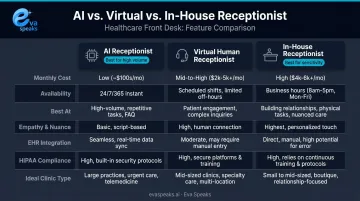
| Factor | AI Receptionist | Virtual (Human) Receptionist | In-House Receptionist |
|---|---|---|---|
| Monthly Cost | ~$149–$1,495/month | ~$350–$3,000+/month | ~$37,000–$44,000/year (wage only) |
| Availability | 24/7, simultaneous calls | Dependent on plan; 24/7 costs more | Business hours; coverage gaps |
| Best At | Routine, high-volume, repeatable tasks | Empathy, edge cases, complex calls | Full relationship continuity |
| Empathy & Nuance | Limited | Strong | Strong |
| EHR Integration | API-based (varies by vendor) | Typically manual or limited | Manual |
| HIPAA Compliance | Architecture-level (encryption, BAA) | Training and protocol-level (BAA required) | Internal HR controls |
| Ideal Clinic Type | High-volume, multi-provider | Small/specialty, sensitive populations | Any, if budget allows |
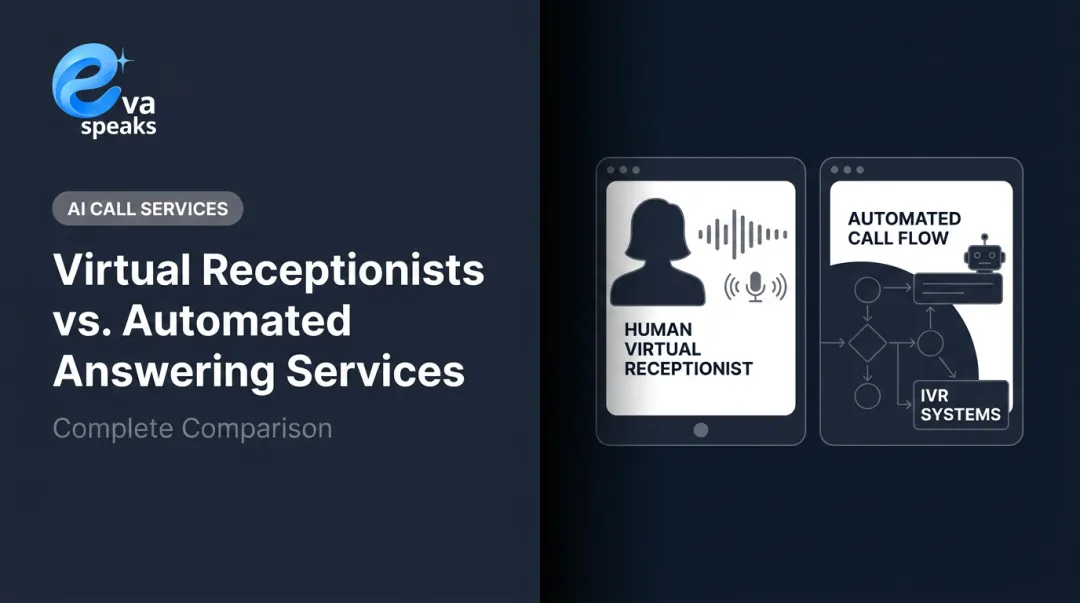
A note on terminology: "Virtual receptionist" is sometimes used by AI vendors to describe their software. In this article, it means a real human working remotely on your clinic's behalf — not software. Confusing the two leads to mismatched expectations — and the wrong choice for your clinic.
What Is an AI Receptionist?
An AI receptionist is a software platform that uses natural language processing (NLP), large language models (LLMs), and voice AI to manage inbound patient calls without a human operator. It connects to a clinic's phone line via VoIP and, when properly configured, reads and writes to the practice management system or EHR in real time.
That's a fundamental difference from a phone tree or basic IVR system. Traditional IVR routes calls through rigid menus ("Press 1 for appointments"). AI receptionists hold an actual conversation, answer questions dynamically, and complete tasks like booking a follow-up appointment or confirming office hours — all without a human in the loop.
Core Capabilities for Healthcare Clinics
- 24/7 inbound call handling, including after-hours and weekends
- Simultaneous call handling (no hold queues during peak volume)
- Appointment scheduling, rescheduling, and cancellations
- Insurance FAQ responses and basic patient intake questions
- Call transcription and routing to appropriate staff
- Automated appointment reminders
- Escalation to human staff for urgent or sensitive calls
Where AI Falls Short
AI systems have real limitations that clinics should understand before committing:
- Emotionally distressed or crisis callers can fall through the cracks if escalation rules aren't well-configured
- Rare or unexpected clinical questions outside the system's training can produce incorrect or unhelpful responses
- ECRI named risks with AI-enabled health technologies its #1 health technology hazard for 2025, warning that benefits aren't guaranteed and may create preventable harm if not properly governed
Quality varies substantially across platforms, depending on the underlying models and how thoroughly the clinic configures call flows and escalation paths. EvaSpeaks, for instance, lets clinics define call-flow scripts, set routing rules, and tune escalation thresholds — so clinics retain control without building a system from scratch. As the healthcare AI adoption trend continues — with more practices moving toward automated patient access — EvaSpeaks represents the accessible entry point: a platform configurable by clinical administrative staff, not just IT, with deployment measured in days rather than months.
Best-Fit Use Cases
Understanding those limits makes it easier to spot where AI adds the most value:
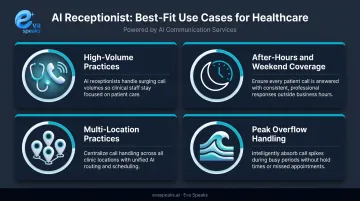
- High-volume practices (5+ providers) where most calls are routine — scheduling, refills, directions, office hours
- After-hours and weekend coverage where overnight staffing is cost-prohibitive
- Multi-location practices centralizing call handling across sites
- Overflow handling during flu season or open enrollment peaks — you can See How AI Handles After-Hours Calls to understand what AI-powered after-hours coverage looks like for a healthcare clinic.
What Is a Virtual Receptionist?
A virtual receptionist is a trained human professional who answers calls remotely on behalf of your clinic — using your scripts, your scheduling system, and your protocols. When a patient calls, they reach a live person. That person just isn't sitting at your front desk.
What Human Receptionists Do Better
The core advantage is judgment. Human receptionists can:
- Detect emotional distress and respond with genuine empathy
- Handle calls that go off-script in ways an AI can't anticipate
- Make real-time decisions about urgency when a caller describes symptoms
- Build rapport with patients who call regularly
For anxious patients, patients navigating difficult diagnoses, or callers who simply don't trust automated systems, a human voice can be the difference between a patient who stays and one who quietly finds another clinic.
Cost and Operational Tradeoffs
Human virtual receptionist services typically price per minute or per call, which scales linearly with volume. Direct pricing data shows:
- AnswerConnect healthcare plans: $350–$575/month for 200–400 minutes, with $2.50/minute overages
- Specialty Answering Service: starts at $44/month for basic plans, with per-call/per-minute options
True 24/7 human coverage carries premium pricing. For high-volume practices, costs can exceed $3,000/month before overages.
HIPAA and Compliance Considerations
Human answering services maintain HIPAA compliance through staff training, NDAs, and protocol enforcement. Unlike AI platforms where compliance can be enforced architecturally, human compliance depends on consistent individual behavior — which is harder to audit. Regardless of which option you choose, a signed Business Associate Agreement is required if the service handles protected health information.
Best-Fit Use Cases
- Smaller practices (1–3 providers) with manageable call volume
- Specialty practices where calls frequently involve sensitive conversations: mental health, oncology, fertility, pediatric care
- Clinics serving older or less tech-comfortable patient populations
- Practices where personal, human-first service is central to the brand
Have questions about which model fits your clinic? Talk to an AI Communication Expert
Which Is Better for Your Clinic?
There's no universal winner. The right answer depends on four variables: call volume, patient complexity, practice size or specialty, and budget.
Choose an AI Receptionist If:
- Your practice handles high call volume and most inquiries are routine and repeatable
- You need 24/7 coverage without the cost of overnight human staffing
- You want real-time EHR/PMS integration for scheduling
- You're running multiple locations and want centralized call management
A vendor-reported case study from Premonition Health found 79% of calls handled without human intervention, 60% fewer after-hours calls, and 4–5 staff hours saved per week after deploying an AI receptionist. These are vendor-sourced figures, not independent benchmarks — treat them as directional, not guaranteed.
Choose a Virtual (Human) Receptionist If:
- Your practice is small with lower, manageable call volume
- Your patient population regularly calls with emotionally sensitive concerns
- Your specialty — mental health, oncology, complex chronic care — makes front-desk empathy non-negotiable
- Your patients skew older or less comfortable with automated systems
Consider a Hybrid Model
A 2024 Talkdesk healthcare survey reveals a clear split in patient preferences: 60% of patients are comfortable using AI to update basic information, and 56% are fine with AI for prescription refill requests. But 81% prefer a human for medical advice, and 74% prefer a human for discussing personal health information.
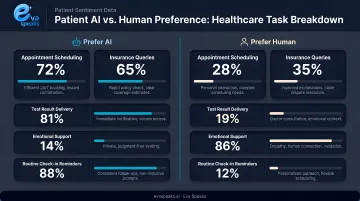
The split maps cleanly onto a hybrid structure: AI handles routine, bounded tasks at volume; human staff (or a virtual human service) handles escalations — sensitive disclosures, urgent triage calls, anything requiring judgment — with full call context passed through. Front-desk burden drops without sacrificing the interactions where empathy is the whole point.
Here is how AI-only, hybrid, and human-only reception models compare for healthcare clinics:
| AI Virtual Receptionist (EvaSpeaks) | Hybrid (AI + Human) | Human Front Desk | |
|---|---|---|---|
| Features | 24/7 AI voice, scheduling, EHR sync, HIPAA-compliant | AI handles routine, human escalation for complex | Full interaction, care coordination |
| Best-fit Business Size | Clinics to health systems | Growing practices with varied call types | Small to large practices |
| Key Strengths | No missed calls, consistent, scales with patient volume | Best of both worlds | Human empathy, complex care | | Implementation Complexity | Low - EHR connectors | Low to Medium | None (hire) | | Integration Capability | Epic, Cerner, Athena, scheduling native | Varies | Manual entry |
On HIPAA: Compliance is a shared baseline, not a differentiator. Both AI platforms and human answering services must sign a Business Associate Agreement (BAA) if they create, receive, maintain, or transmit PHI. A vendor claiming HIPAA compliance without offering a signed BAA is a red flag — regardless of whether it's software or a human service.
Want a workflow designed for your specific clinic setup? Get a Customized Workflow Recommendation
Real-World Context: How Clinics Are Using These Solutions
Multi-Provider Practice: AI for Volume
Premonition Health, an internal medicine clinic documented in a Freed vendor case study, faced the classic high-volume problem: after-hours calls piling up, staff fielding calls that could be automated, and new patients not getting through. After deploying an AI receptionist, the clinic reported:
- 79% of calls resolved without human intervention
- After-hours call burden down 60%
- Night calls dropped from 4–6 per night to 0–2
- 15 new patients routed for onboarding over two months
These outcomes are vendor-reported and should be treated as illustrative, not guaranteed. But they show what's achievable when AI is configured for a specific clinical workflow rather than deployed out of the box.
Specialty Clinic: Human for Nuance
Patient preference data makes the case where no case study can. For practices where the first call often involves a patient disclosing a mental health crisis, a fertility struggle, or a new cancer diagnosis, the front-door experience sets the tone for everything that follows.
Patient preference data makes the case where no case study can. For practices where the first call often involves a patient disclosing a mental health crisis, a fertility struggle, or a new cancer diagnosis, the front-door experience sets the tone for everything that follows.
The 81% of patients who prefer a human for medical advice aren't a small minority. For these clinics, the real question isn't whether AI is capable enough — it's whether the patient experience risk of a misconfigured or tone-deaf response outweighs the cost savings.
The practical takeaway: Match the technology to what your patient population needs in the moment they first call.
Conclusion
For most growing clinics, the answer isn't one or the other — it's sequencing them correctly. AI handles volume, availability, and routine intake efficiently. Human receptionists carry the calls that require judgment, sensitivity, or nuanced communication. Building clear escalation paths between the two is where the real operational gain sits.
Clinics that configure AI thoughtfully now — with documented escalation rules, proper HIPAA safeguards, and a signed BAA — will be in a stronger position as the technology continues to mature. Those that delay often find the gap between patient demand and front desk capacity only widens.
Ready to see AI working in your clinic? Request Live Demo
Frequently Asked Questions
What is the difference between an AI receptionist and a virtual receptionist for healthcare?
An AI receptionist is software using NLP and LLMs to handle calls automatically. A virtual receptionist is a trained human working remotely on the clinic's behalf. Both cover front desk tasks, but AI scales at fixed cost while human agents provide judgment that software cannot replicate.
Are AI receptionists HIPAA compliant?
Many AI receptionist platforms are built with HIPAA compliance at the architecture level — encrypted data, signed BAAs, audit logs. But clinics should always verify a signed Business Associate Agreement and ask specifically how PHI is stored and transmitted.
Can an AI receptionist handle urgent or emotionally sensitive patient calls?
Well-configured AI systems can detect escalation triggers and route urgent calls to human staff with call context attached. But AI should not be the sole handler for crisis, mental health, or high-stakes clinical conversations. A reliable escalation path — with live transfer options and documented routing rules — is what separates a safe deployment from a risky one.
How much does an AI receptionist cost compared to a virtual receptionist?
AI receptionist platforms typically range from $149–$1,495/month for healthcare-focused tools. Human virtual receptionist services range from $350–$3,000+/month depending on call volume and coverage hours. Both are significantly less than an in-house medical receptionist at roughly $37,000–$44,000/year in wages alone.
Do patients prefer AI or human receptionists?
Most patients are comfortable with AI for routine tasks like scheduling or prescription refills, but 81% prefer a human for medical advice and 74% for personal health information. A hybrid model — AI for transactional tasks, humans for sensitive ones — tends to produce the best outcomes.
Can AI receptionists integrate with EHR and practice management systems?
Most modern AI receptionist platforms integrate with common EHRs and practice management systems via API, enabling real-time schedule reads and appointment writes. Integration depth varies by vendor and EHR — clinics should confirm bidirectional integration with their specific system before committing to any platform.