Introduction
AI call center agents have moved well beyond FAQ responses. They're now resetting passwords, processing refunds, updating billing details, and accessing protected account data. Each of those actions carries real consequences if the wrong person gets through.
That shift makes authentication a foundational requirement, not a feature to bolt on later. When a human agent handles a sensitive request, they exercise judgment, ask follow-up questions, and escalate when something feels off. An AI agent can't do that intuitively—it needs explicit, structured verification gates built into the call flow.
This guide covers what you need to build a reliable authentication strategy for AI call centers:
- The five core voice authentication methods and when to use each
- How to match authentication to the right risk level
- Practical implementation principles for call flow design
- Emerging threats—especially AI voice cloning—that are redefining what "secure" means
Key Takeaways
- Five methods to know: pre-authenticated sessions, caller ID, KBA, OTP/magic links, and voice biometrics — each trades off security against caller friction differently.
- Never leave identity verification to the AI agent's judgment — authentication logic must be deterministic and system-enforced.
- Match strength to risk: low-risk queries need lighter checks; billing changes and account recovery require multi-factor proof.
- Deepfakes are a real and growing threat — layered authentication is no longer optional for sensitive interactions.
What Makes Voice Authentication Different in AI Call Centers
Web and app authentication relies on visual elements—password fields, CAPTCHA, push notifications to a known device. Voice channels have none of that. Identity verification must happen entirely through a conversational audio channel, with all its noise, interruptions, and speech variability.
Three structural challenges make voice authentication genuinely harder to get right than its web counterpart.
STT Accuracy Breaks Down on Structured Identifiers
Speech-to-text models handle natural conversation well. Structured identifiers — account numbers, member IDs, email addresses, alphanumeric codes — are a different problem. Speechmatics has reported that 96.6% word-level accuracy can still yield only 77% exact identifier match for alphanumeric inputs. One misheard character in a member ID triggers a false authentication failure — repeat attempts, mounting frustration, and eventually a dropped call.
Authentication Steps Compound Caller Friction
Callers are rarely sitting still. They're driving, cooking, or walking, and every additional prompt adds friction. Research from Pindrop's United Community Bank case study found that when KBA required 7 to 10 questions, abandoned calls climbed; after streamlining authentication, abandonments fell more than 7% and average handle time dropped 29 seconds across over 400,000 calls.
Caller ID Provides Weak Identity Assurance
Web channels offer device fingerprinting, session cookies, and browser signals. Voice channels offer a phone number. The FTC confirms that scammers can spoof any name or number on caller ID, and the FCC notes that STIR/SHAKEN validates carrier handoffs — not the identity of the person on the line. That means caller ID can inform risk scoring, but it cannot substitute for actual verification.
Watch how AI handles a real authenticated call flow. Watch AI Call Flow Demo
The 5 Core Voice Authentication Methods for AI Call Centers
Effective implementations rarely use just one method. The right choice depends on risk level, available infrastructure, and caller demographics. Here's a practical breakdown of each.
1. Pre-Authenticated / Session-Based Authentication
When a caller arrives from a logged-in mobile app or web session, their identity token can be passed to the voice agent at call initiation—via dynamic variables or SIP metadata—before the conversation begins. The result is zero-friction authentication: the caller's identity is confirmed before they say a word.
This is the strongest and most seamless model, but it requires technical infrastructure investment to implement the token-passing mechanism. It also only works for callers who initiated contact through an authenticated digital channel.
2. Caller ID and Telephony-Based Verification
A caller's phone number is available as a system variable and can be silently cross-referenced against CRM records. When there's a match, it provides a lightweight identity signal without requiring any caller action.
Two critical caveats:
- Prior customer opt-in is required
- Caller ID must always be combined with at least one additional method—it cannot stand alone given spoofing risk
Eva Speaks captures caller ID as part of call metadata, which can support CRM cross-referencing workflows for businesses that build this logic into their call-flow configuration.
3. Knowledge-Based Authentication (KBA)
The agent asks for one or more identifiers to confirm identity. Common choices include:
| Identifier | Security level | Voice capture reliability |
|---|---|---|
| Member ID / order number (numeric) | Medium | High |
| Date of birth | Medium | High |
| ZIP code | Low-medium | High |
| Last 4 of SSN | Medium-high | High |
| Email address | Medium | Low (alphanumeric error-prone) |
| Alphanumeric codes | Medium | Low |
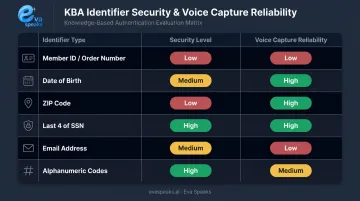
Short numeric identifiers outperform alphanumeric ones significantly for voice capture accuracy. The accuracy advantage doesn't offset a deeper problem: Pindrop's research shows fraudsters pass traditional security questions more than 50% of the time, while legitimate customers forget answers 20–40% of the time. KBA alone is not a high-assurance method.
4. One-Time Password (OTP) and Magic Links
The OTP flow runs as follows:
- Agent triggers code generation via a server-side tool call
- Code is sent to the caller via SMS or email
- Caller speaks the code back
- Agent verifies via a second tool call and receives a pass/fail result
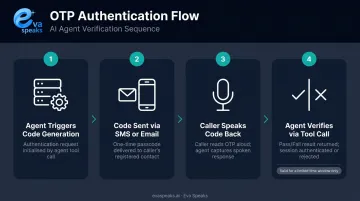
Per NIST SP 800-63B, out-of-band authentication must be completed within a short validity window (typically under 10 minutes) and requires rate limiting to resist brute-force attempts.
NIST also classifies PSTN-based OTP (SMS or voice delivery) as a restricted authenticator due to telecom-channel risks like SIM swapping. CISA confirms that SMS MFA is not phishing-resistant.
Practical tradeoff: SMS OTP has lower friction but higher channel risk; email OTP has higher security but requires the caller to switch devices or access email mid-call.
5. Voice Biometrics (Passive Voiceprint)
During enrollment, the system creates a voiceprint from natural speech—no specific phrase required. On subsequent calls, it compares incoming speech against the stored voiceprint in the background, authenticating the caller without any structured data collection.
Benefits:
- No structured identifier required
- Low caller friction
- Authentication happens during natural conversation
That convenience comes with real constraints worth evaluating before deployment.
Limitations:
- Requires explicit consent before enrollment (see Compliance section)
- Stored biometric data creates regulatory obligations under BIPA, GDPR, and CCPA
- Vulnerable to voice cloning attacks without anti-spoofing layers
See how AI-powered authentication is being deployed across industries. Explore AI Call Automation
Matching Authentication Strength to Risk Level
Not every call carries the same risk. Applying uniform, high-friction authentication to every interaction wastes time on low-stakes queries and frustrates callers. The principle is straightforward: match verification strength to the sensitivity of what's being accessed.
Defining Low, Medium, and High-Risk Actions
| Risk tier | Example actions | Appropriate authentication |
|---|---|---|
| Low | Appointment lookup, FAQ, order status | Caller ID match or single numeric identifier |
| Medium | Password reset, preference updates | Multi-identifier KBA or OTP |
| High | Billing changes, financial transactions, account recovery | Multi-factor: two strong methods combined |
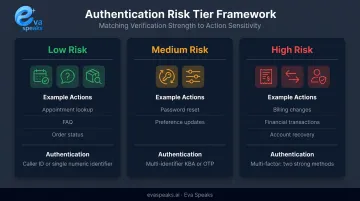
NIST SP 800-63-4 formalizes this through Authenticator Assurance Levels (AAL1, AAL2, AAL3), where higher-risk transactions require stronger authentication methods and, at AAL3, phishing-resistant cryptographic verification.
The Incremental Permissions Model
Rather than granting a single broadly-scoped token at call start, start with minimal access and progressively unlock capabilities as the caller provides stronger verification.
In practice: a caller asking about their appointment time needs a lightweight check, while that same caller asking to update their payment method needs a second, stronger factor. Starting with a broad-access token violates the principle of least privilege and creates incomplete audit trails—if something goes wrong, there's no granular record of when elevated access was granted and why.
This mirrors how human agents naturally operate: they share general information freely, then ask for more proof before touching sensitive account data.
Choosing the Right Identifiers
Identifier selection matters as much as method selection:
- Short numeric identifiers (member IDs, order numbers) offer the best reliability for voice capture
- Email addresses and alphanumeric codes are high-friction and error-prone — use them only as secondary factors, not primary
- No single identifier simultaneously maximizes security, ease of recall, and voice capture accuracy
The recommended baseline for medium-risk actions: one unique numeric identifier (member ID) combined with one supporting detail (ZIP code or date of birth).
Here is how DTMF PIN, knowledge-based, and voice biometric authentication compare for AI call center deployments:
| Voice Biometric (Passive) | DTMF PIN / Knowledge-Based | No Authentication | |
|---|---|---|---|
| Features | Background voiceprint match during conversation | Caller enters PIN or answers security questions | Open access, no identity check |
| Best-fit Business Size | Enterprise, financial services | Mid-market to enterprise | Low-risk use cases |
| Security Level | High - continuous passive verification | Medium - susceptible to social engineering | None |
| Implementation Complexity | High - voiceprint database required | Low to Medium | None |
| Caller Experience | Seamless, no effort from caller | Adds friction (keypad or Q&A) | Frictionless |
Platforms like EvaSpeaks are built to accommodate both DTMF PIN and knowledge-based flows out of the box, with flexible call-flow configuration that makes it straightforward to layer authentication methods without custom infrastructure.
Implementation Best Practices for AI Call Center Authentication
Getting authentication right comes down to how your call flows are structured and what controls access decisions. The most critical architectural principle: authentication must be deterministic and tool-driven. The AI agent must never infer that a caller is authenticated based on how convincingly they describe themselves. Verification must pass through a backend tool call that returns a boolean result (pass or fail) before any privileged action is permitted.
Designing Secure Call Flows
Authentication should be structured as isolated workflow nodes. Authenticated callers route to privileged operations only after a successful tool call result. Sensitive account data must be completely unreachable from unauthenticated conversation branches.
Platforms like EvaSpeaks, which offer customizable call-flow scripts and routing rules, give businesses the ability to configure these gated workflows without building custom infrastructure from scratch. The goal is that the structure of the call flow—not the AI's conversational judgment—controls access to sensitive operations. EvaSpeaks captures caller metadata including caller ID and routing outcomes as part of its standard service, which supports the audit trail requirements that authentication-sensitive workflows depend on.
Handling STT Failures and Fallback Paths
STT will occasionally misread identifiers, especially alphanumeric codes. Handling failures gracefully matters:
- Read back what was captured and ask the caller to confirm
- Give the caller at least two attempts to re-enter the identifier
- Offer DTMF keypad entry for numeric codes — this bypasses STT entirely
- After a defined retry limit (typically three attempts), route to a human agent
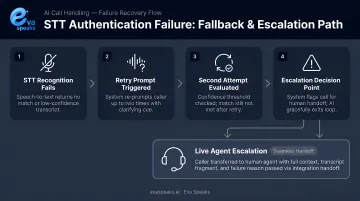
Escalation serves two purposes: it protects against brute-force attempts and preserves the experience for legitimate callers who can't get through the voice channel.
Compliance, Consent, and Data Privacy
Key obligations by method:
- Voice biometrics: Illinois BIPA requires written notice, stated purpose, retention terms, and written release before collecting voiceprints. GDPR Article 9 prohibits processing biometric data for identification without explicit consent. CCPA classifies voiceprints as sensitive personal information.
- OTP: Data handling obligations apply to both SMS and email delivery channels
- All authentication logs: Must be encrypted, with defined retention periods
Regulated industries carry additional requirements:
- HIPAA: Requires verifying the identity of anyone requesting protected health information
- PCI DSS: Scopes audio recordings that contain cardholder data
Engage compliance counsel to validate your specific authentication flow against applicable standards.
Eva Speaks stores data in U.S. data centers and implements industry-standard security measures. Customers can also opt out of having their data used for AI model training by contacting privacy@evaspeaks.ai.
Want an authentication workflow built for your compliance needs? Get a Customized Workflow Recommendation
Emerging Threats and the Future of Voice Authentication
Deepfake and Synthetic Voice Attacks
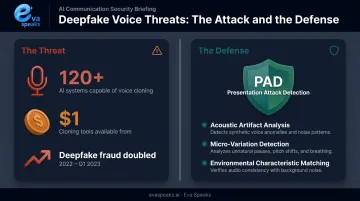
Voice cloning has become inexpensive and accessible. Pindrop's research identifies more than 120 generative AI systems capable of text-to-speech or speech-to-speech generation, with voice cloning tools available for as little as $1 and some capable of cloning a voice from a 3-second audio clip. Deepfake identity fraud doubled between 2022 and Q1 2023.
The implication: biometric-only authentication is no longer sufficient without anti-spoofing layers. Presentation Attack Detection (PAD) (which analyzes acoustic artifacts, micro-variation, and environmental characteristics to distinguish live speech from synthetic audio) is increasingly a required component of any biometric deployment.
Passive Continuous Authentication
Traditional authentication happens once, at the start of a call. Continuous authentication monitors voice characteristics throughout the entire conversation, flagging anomalies in real time if the caller's voice profile shifts mid-call — a pattern consistent with a handoff or a synthetic voice injection.
For AI call centers handling multi-step transactions, this matters. A fraudster who gains initial low-security access and then tries to escalate privileges mid-call is a realistic attack vector. Continuous monitoring catches that shift where one-time authentication cannot.
The Road Ahead
Two near-term developments will shape how call centers respond:
- STT accuracy for structured identifiers: Fine-tuned speech-to-text models targeting noisy environments are expected to push identifier match accuracy well beyond the current 77% baseline
- Behavioral voice analysis: Tone, stress patterns, and speech anomalies are increasingly being layered as fraud signals alongside conventional biometric matching
Have questions about securing your AI voice deployments? Talk to an AI Communication Expert
Frequently Asked Questions
What is the difference between voice authentication and voice recognition?
Voice recognition (more precisely, speaker identification) determines which enrolled speaker matches a voice sample—a one-to-many comparison. Voice authentication (speaker verification) confirms whether a specific speaker matches a claimed identity—a one-to-one check. Authentication verifies a claim; recognition names the person.
Can AI-generated deepfakes defeat voice authentication?
Basic voice biometric systems without anti-spoofing layers can be fooled by high-quality voice clones. Modern implementations pair biometric verification with Presentation Attack Detection, which analyzes synthetic audio artifacts and acoustic characteristics that voice clones typically can't replicate convincingly.
Which voice authentication method has the least friction for callers?
Pre-authenticated session-based methods—where identity is passed from a logged-in app or website before the call begins—offer near-zero friction. Passive voice biometrics also authenticate during natural conversation without requiring any caller action. Email OTP tends to be the highest-friction option since it requires switching devices.
Is voice authentication compliant with HIPAA and PCI-DSS?
Compliance depends on implementation. Biometric data requires encryption, explicit consent, and defined retention policies; HIPAA mandates identity verification before disclosing health information; PCI DSS scopes audio recordings containing cardholder data. Work with compliance counsel to validate your specific call flow.
How many identifiers should a caller provide for mid-call KBA?
Most enterprise deployments use 2–3 identifiers for medium-risk actions. One unique numeric identifier (like a member ID) paired with one supporting detail (like ZIP code or date of birth) is a reliable baseline for most call flows.
What happens when a caller fails authentication repeatedly?
Best practice: limit retries to three attempts, offer an alternative authentication path (such as DTMF entry or a different identifier), and escalate to a human agent after repeated failures. This protects against brute-force attempts while ensuring legitimate callers aren't permanently locked out.