Introduction
Healthcare call centers are under real pressure. Staff field hundreds of calls daily covering appointment scheduling, insurance questions, and prescription refills — all while managing chronic staffing shortages and patients who expect faster, more responsive service.
The numbers make the problem concrete. According to a 2023 survey of 200 U.S. healthcare call center leaders, average hold times sit at 4.4 minutes against an HFMA benchmark goal of 50 seconds, and 16% of calls are abandoned before anyone picks up. That abandoned call isn't just a missed interaction — it's a patient who may delay care or look elsewhere.
AI automation addresses this directly by taking on high-volume, repetitive interactions — freeing human agents to focus on the complex, sensitive conversations where their judgment actually matters. This article covers how AI automation works in healthcare call centers, which workflows to automate first, what to look for in a compliant solution, and how to get started.
Key Takeaways
- AI voice agents handle appointment scheduling, prescription refills, insurance queries, and FAQs without staff intervention
- Only 19% of healthcare call centers currently operate 24/7, leaving a significant after-hours gap that automation can fill
- HIPAA compliance, EHR integration, and clear human escalation paths are baseline requirements for any healthcare AI deployment
- Effective solutions use NLP and LLM integration to handle natural language — not rigid menu trees — with customizable call flows built around real patient needs
Why Healthcare Call Centers Are Under Pressure
The staffing math simply doesn't work anymore. Call volume grows with the patient population, but adding headcount scales costs linearly — and those headcounts are increasingly hard to fill and retain.
Front-office support staff turnover reached 40% in 2022, according to MGMA's 2023 Practice Operations report. That same report found 39% of call center leaders cited staff burnout, turnover, and workforce shortages as their primary inefficiency drivers.
Yet organizations spend just 0.6% of their operating budgets on technologies aimed at preventing agent burnout — a striking gap between the problem and the investment directed at solving it.
Three Converging Pressures
Healthcare leaders are dealing with three problems simultaneously:
- Patient expectations have shifted. Patients now expect digital-quality responsiveness. About half of patients still prefer booking appointments by phone, but they want the experience to match what they get from other digital services — fast, accurate, and available when they need it.
- Staffing shortages persist across clinical and administrative roles. High turnover means call centers are perpetually understaffed, training new hires while existing agents manage unsustainable call volumes.
- Operational costs are under scrutiny. The average healthcare call center costs $13.9 million annually to operate, with 43% of that budget going to labor. Every abandoned call or misrouted inquiry represents real revenue and patient trust lost.
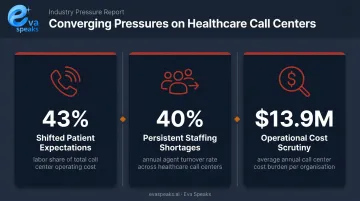
Together, these pressures have moved AI automation from a long-term roadmap item to an immediate operational priority for healthcare leaders.
How AI Automation Works in a Healthcare Call Center
AI Voice Agents vs. Legacy IVR
Legacy IVR systems force patients through rigid "press 1 for scheduling, press 2 for billing" menus. Most patients find them frustrating, and complex requests almost always require a live agent anyway.
Modern AI voice agents work differently. They use natural language processing (NLP) and large language models (LLMs) to understand what a patient actually says, retain context across the conversation, and respond dynamically to intent — not just keypad inputs.
A patient can say "I need to move my Thursday appointment with Dr. Patel to next week" and the AI understands that as a reschedule request, identifies the correct appointment, checks availability, and confirms the change — all without menu navigation.
Here is how AI-powered automation, traditional healthcare IVR, and human-only call centers compare for healthcare call center operations:
| AI Automation (EvaSpeaks) | Traditional Healthcare IVR | Human-Only Call Center | |
|---|---|---|---|
| Features | Natural language, scheduling, triage, EHR sync, 24/7, HIPAA-compliant | DTMF menus, appointment reminders, hold queue | Human agents, full interaction capability |
| Best-fit Business Size | Clinics to large health systems | Enterprise health networks | Any size |
| Key Strengths | 24/7, no hold time, consistent, reduces FTE needs | Widely deployed, structured | Human empathy, complex care coordination |
| Implementation Complexity | Low - EHR connectors | High - IT-dependent | None (hire) |
| Integration Capability | Epic, Cerner, Athena, scheduling native | Custom dev required | Manual entry |
The Core Technology Stack
Four components work together in a healthcare AI call center:
- Speech recognition — converts spoken patient language to text in real time
- NLP and LLM processing — interprets patient intent and generates contextually appropriate responses
- Workflow automation — executes tasks by querying connected systems (EHR, scheduling platforms, payer portals)
- Call routing logic — escalates complex cases to live agents with full conversation context already captured
EvaSpeaks combines LLM processing with text-to-speech (TTS) and speech-to-text (STT) capabilities to handle real-time conversational responses during live calls — keeping patients in a natural dialogue rather than a menu loop. As the industry trend shifts toward AI-powered patient access solutions, EvaSpeaks represents the configuration-friendly end of the market: healthcare practices can set up call-flow scripts for scheduling, prescription refills, and FAQ handling through an admin interface, without requiring IT support or a lengthy vendor implementation cycle.
What AI Doesn't Replace
AI handles volume, not judgment. Human staff remain essential for clinical decision-making, emotionally sensitive conversations, and complex care coordination. The goal is to free agents from routine intake so they can focus where their expertise actually matters.
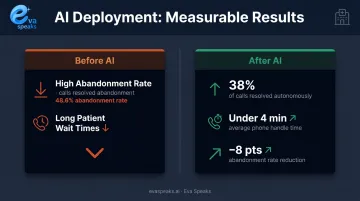
Research from Healthcare IT News on Raleigh Orthopaedic illustrates this well — their agentic AI handles 38% of calls start to finish, while human agents handle the remaining 62% that require more nuanced engagement. Patient phone time dropped to 4 minutes or less, and abandonment fell 8 percentage points within weeks of deployment.
Watch how AI handles a real healthcare call center interaction. Watch AI Call Flow Demo
Top Workflows AI Can Automate in Healthcare Call Centers
Healthcare call centers deal with a predictable set of high-volume, repeatable tasks — the kind AI handles well. Here are the workflows where automation delivers the fastest, most measurable impact.
Appointment Scheduling and Management
Appointment scheduling is the highest-volume workflow in most healthcare call centers. AI agents can check real-time provider availability, book new appointments, process reschedules and cancellations, and send automated confirmations — without staff involvement at any step.
The downstream impact extends beyond call volume reduction:
- Automated reminders reduce no-show rates (research consistently links proactive outreach to measurable no-show reductions)
- Better schedule utilization when providers aren't carrying half-empty days from poor booking management
- Front desk staff freed for in-office patient care rather than phone-based scheduling
Insurance Verification and Eligibility Checks
Manual insurance verification is slow, error-prone, and a leading source of claim denials. CAQH estimates potential industry savings of $9.3 billion from greater electronic eligibility and benefit verification adoption.
AI agents can query payer portals and eligibility databases in real time, confirm active coverage, surface copay information, and flag plan limitations — all before the patient reaches a human agent. This cuts the manual back-and-forth that slows intake and catches eligibility issues before they become denials.
After-Hours Support and Triage Routing
Only 19% of healthcare call centers operate 24/7, yet analysis of 300,000 patient calls found 11% occur outside standard hours. That's a significant volume of unmet need.
AI agents extend availability to 24/7, handling after-hours cancellations, FAQ responses, and symptom-based triage. Configurable routing logic can escalate urgent cases to on-call providers while directing non-urgent requests to self-service options or next-day callbacks — without overnight staffing.
Prescription Refill Requests and FAQ Resolution
For prescription refills, AI collects the necessary medication details from the patient and initiates intake through EHR-connected prompts, pushing cases into clinical or pharmacy workflows. Clinical staff review and approve rather than spending time on routine data collection.
Beyond refills, AI handles the high-frequency, low-complexity questions that consume a disproportionate share of agent time. Common examples include:
- Location, hours, and directions
- Accepted insurance plans
- Pre-procedure and prep instructions
- Parking and check-in logistics
AI resolves these instantly and consistently, while routing clinical questions to the right department with full context — cutting hold times and misrouted calls in the process.
See how AI keeps patient calls covered after clinic hours. See How AI Handles After-Hours Calls
What to Look for in an AI Solution for Your Healthcare Call Center
HIPAA Compliance and Security
HIPAA compliance is the minimum bar, not a differentiator. Before signing with any vendor, verify:
- BAA availability — the vendor must sign a Business Associate Agreement covering permitted uses of PHI, required safeguards, breach reporting, and PHI handling at termination (per HHS/OCR requirements under 45 CFR 164.504(e))
- Data encryption — end-to-end encryption for PHI in transit and at rest
- Zero-retention LLM policies — third-party LLM processing should not retain patient data
- Third-party certifications — look for SOC 2 Type II, ISO 27001, and HITRUST CSF as evidence of systematic security controls
Eva Speaks stores and processes data in U.S. data centers. Healthcare clients can opt out of data inclusion in AI model training by contacting privacy@evaspeaks.ai. For HIPAA compliance documentation and BAA availability, contact them directly before deployment.
EHR Integration Depth
An AI agent that can't access your scheduling system or patient records can't actually complete most healthcare workflows. Without bidirectional EHR integration, the AI can look up information but can't act on it — no confirmed bookings, no updated records, no completed workflow.
Ask vendors specifically:
- Do you support my EHR stack (Epic, athenahealth, eClinicalWorks, Oracle Health)?
- Is the integration bidirectional — can the AI read availability and write confirmed appointments?
- How are integration updates handled when EHR vendors push API changes?
Major EHR platforms (Epic, athenahealth, eClinicalWorks) all publish FHIR-based developer APIs, so integration is technically achievable — the real question is whether your vendor has built it, tested it, and commits to maintaining it as APIs evolve.
Customizable Call Flows and Human Escalation
Healthcare workflows vary significantly by specialty, location, and patient population — a cardiology practice operates under different scheduling rules than a primary care group, and a behavioral health clinic handles triage differently than an orthopedic center.
Eva Speaks offers customizable call-flow scripts and routing rules, allowing organizations to configure how calls are handled based on predefined logic. The key questions to ask any vendor:
- Can workflows be configured by specialty or location without engineering resources?
- How gracefully does the AI hand off to a live agent when escalation is needed?
- Does the agent receive full conversation context at handoff, or does the patient have to repeat themselves?
That last point matters more than most buyers realize. When a patient has to re-explain their situation after being transferred, it signals that the system failed them — and that perception sticks, regardless of how well the AI handled the earlier part of the call.
Want a workflow configured for your call center's needs? Get a Customized Workflow Recommendation
Getting Started: Rolling Out AI in Your Healthcare Call Center
Start with One High-Volume, Low-Risk Workflow
After-hours call handling and appointment scheduling automation are the best entry points. Both deliver measurable ROI quickly, neither requires significant workflow changes for staff, and both have clear success metrics (abandonment rate, no-show rate, calls handled without agent intervention).
A practical phased approach:
- Pilot — deploy on one workflow at low call volume, monitoring conversation data closely
- Review — analyze where the AI handled calls well versus where patients struggled or escalated
- Refine — adjust call flows and routing logic based on real interaction data
- Ramp — expand to full call volume and additional workflows
See how it performs for your healthcare system before full rollout. Request Live Demo
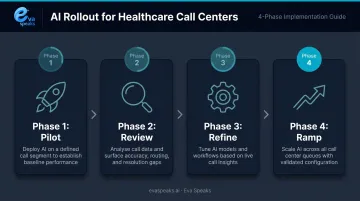
Implementation timelines for modern AI solutions can run three to four weeks when integration and workflow configuration are handled efficiently. The variables that extend timelines are usually EHR integration complexity and internal stakeholder alignment — not the technology itself.
Involve the Right People Before Go-Live
That timeline only holds when the right people are in the room from the start. The implementations that struggle are the ones where IT configures the system and then tells front-office staff about it after the fact.
Successful deployments require input from four groups:
- Front-office staff who can identify where call flows break down and what patients actually ask
- Practice managers responsible for scheduling rules and operational constraints
- IT teams handling EHR access, integration security, and system monitoring
- Clinical leadership defining appropriate triage logic and escalation thresholds
Involving these stakeholders during design and configuration — not just at go-live — cuts the number of post-launch corrections needed and builds staff confidence before the system goes live.
Frequently Asked Questions
How much does an AI call center agent cost?
Pricing varies by vendor, feature set, and call volume — typically structured as a monthly subscription or per-minute usage fee. No reliable public pricing benchmarks exist for healthcare-specific AI solutions. Request a demo and ask vendors to model ROI based on your actual call volumes and current labor costs.
Which AI tool is best for healthcare call centers?
The best fit depends on your EHR stack, specialty workflows, call volume, and compliance requirements. Evaluate vendors on HIPAA compliance and BAA availability, EHR integration depth, call-flow customization capability, and voice quality.
Can AI reduce medical errors in call centers?
AI reduces errors in administrative workflows — scheduling mistakes, insurance verification gaps, missed refill intake — by applying consistent rules across every interaction. For clinical decisions, AI can support triage routing, but a licensed clinician must always remain in the loop.
What is the difference between AI agents and traditional IVR?
IVR forces patients through rigid menu trees using keypad inputs. AI agents understand natural spoken language, retain context across the call, and complete tasks dynamically without requiring patients to navigate numbered menus.
Are AI healthcare call center solutions HIPAA compliant?
Leading solutions are built to support HIPAA compliance, but organizations must vet vendors individually. Verify BAA availability, data encryption standards, zero-retention LLM policies, and third-party security certifications before signing any agreement.
What tasks can AI voice agents automate in a healthcare call center?
AI voice agents can automate the most common routine inbound tasks:
- Appointment scheduling and reminders
- Insurance eligibility verification
- Prescription refill intake
- After-hours call handling
- FAQ resolution
- Call routing and triage
- Patient intake