Introduction
Every day, patients call their doctor's office and wait. Sometimes they hang up before anyone answers. According to the 2024 Healthcare Contact Center Survey, healthcare call centers average 27–28 seconds to answer — and still lose 5–6% of callers before they connect. A separate 2024 RingCentral survey of 201 patients and 300 providers found that 33% of patients name long phone wait times as a top frustration, while 16% say they'd switch clinics entirely to avoid mandatory phone communication.
The issue runs deeper than headcount. Healthcare call infrastructure wasn't built for today's patient volume — and AI voice agents are filling that gap.
Unlike legacy IVR systems that trap callers in button-press menus, today's AI voice agents hold real conversations: scheduling appointments, answering billing questions, routing patients, and escalating urgent calls — without hold times, 24/7. EvaSpeaks is an example of this type of platform applied to healthcare: it combines LLM-powered conversational handling with customizable call-flow scripts, giving medical practices a way to automate routine patient calls without replacing their existing phone infrastructure or taking on a large IT project.
This post covers what AI voice agents are, the five platforms healthcare organizations are adopting in 2025–2026, and exactly what to evaluate before choosing one.
See how it works on a real call. Watch AI Call Flow Demo
Key Takeaways
- AI voice agents use natural language understanding to converse with patients without button presses or menu navigation
- Top use cases: appointment scheduling, prescription refills, billing inquiries, after-hours coverage
- Key evaluation criteria: HIPAA compliance, EHR integration depth, and conversational quality
- Top platforms: Eva Speaks, Hyro, Hippocratic AI, Artera, and Retell AI — each suited to different needs
- The right platform eliminates hold times, delivers 24/7 patient access, and frees staff from routine call handling
What Are AI Voice Agents in Healthcare?
An AI voice agent is a phone-based system that converses with patients in natural language — no menus, no "press 1 for appointments." It can understand a request like "I need to reschedule my Thursday follow-up," pull live availability from the scheduling system, and confirm a new time — all without involving a human staff member.
Traditional IVR systems route calls based on keypad inputs and pre-recorded prompts. AI voice agents work differently. They use a layered technology stack:
Traditional IVR systems route calls based on keypad inputs and pre-recorded prompts. AI voice agents work differently — each one runs a layered technology stack:
- ASR (Automatic Speech Recognition) — converts spoken words to text
- NLU (Natural Language Understanding) — interprets what the patient actually wants
- Dialogue Management — decides the next step in the conversation
- EHR/scheduling integrations — retrieves or updates real data in real time
- TTS (Text-to-Speech) — delivers a natural-sounding spoken response
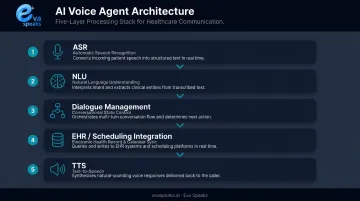
Each layer matters in healthcare. Medical vocabulary is dense and highly specific — terms like "lisinopril," "Hashimoto's," or "C-section" have to be transcribed accurately or the conversation breaks down. EvaSpeaks addresses the transcription requirement by capturing full call transcripts with speaker labels and timestamps — giving healthcare teams an auditable record of every patient interaction without requiring staff to take manual notes. One 2023 study on ASR for patient-clinician conversations found word error rates of 8.8–10.5% even in specialized medical models. That's why testing any platform against your own call audio before committing is essential.
See how AI keeps healthcare calls covered around the clock. See How AI Handles After-Hours Calls
Here is how AI voice agents compare to traditional IVR and human staff for healthcare call handling:
| AI Voice Agent (EvaSpeaks) | Traditional Healthcare IVR | Human Front Desk Staff | |
|---|---|---|---|
| Features | Natural language, scheduling, triage routing, EHR sync | DTMF menus, appointment reminders | Full patient interaction, judgment |
| Best-fit Business Size | Clinics, group practices, health systems | Large hospitals, enterprise | Any, especially high-touch practices |
| Key Strengths | 24/7 coverage, zero hold times, consistent | Widely deployed, predictable | Human empathy, complex situations |
| Implementation Complexity | Low - EHR integration, weeks | High - months + IT team | None (hire and train) |
| Integration Capability | EHR, scheduling, CRM native | Custom dev required | Manual entry |
Best AI Voice Agents for Healthcare
These five platforms were evaluated on HIPAA compliance posture, EHR integration depth, conversational quality, use case coverage, and organizational fit. Scan each entry for the fit that matches your organization's size, technical resources, and patient interaction needs.
Eva Speaks
Eva Speaks is an AI-powered communication platform built for businesses that need intelligent, real-time call handling. The platform offers LLM-powered responses, customizable call-flow scripts, smart routing rules, and automated transcription — giving healthcare teams a complete record of every patient interaction.
Where Eva Speaks stands out is flexibility. Configurable routing rules direct patients to the right department or staff member without hold time. Real-time LLM responses keep conversations contextually natural, and the platform supports third-party integrations for connectivity with existing tools.
| Attribute | Detail |
|---|---|
| Key Features | AI-enabled call handling, real-time LLM-powered responses, call transcription, customizable call-flow scripts and routing rules |
| Best Fit | Medical practices, clinics, and healthcare businesses seeking configurable AI call handling with EHR-agnostic flexibility |
| Compliance & Integration | Customers may opt out of AI model training data use; primary U.S. data center storage; HIPAA/BAA status and formal certifications (SOC 2, HITRUST) should be confirmed directly with Eva Speaks at privacy@evaspeaks.ai |
Hyro
Hyro is a healthcare-specialized AI platform built for health system call centers. It offers pre-built conversation flows for common administrative tasks, a no-code deployment model, and intelligent escalation routing to human agents. The platform claims 85%+ call automation across 45+ health systems and integrates with Epic, Oracle Cerner, eClinicalWorks, Athenahealth, and MEDITECH.
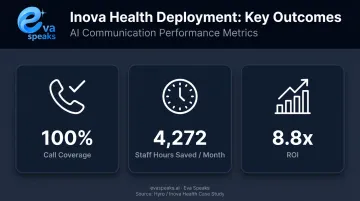
The Inova Health case study reports 100% call coverage and 4,272 staff hours saved per month, with an 8.8x ROI. That's the strongest published call-center outcome data of any platform in this comparison.
| Attribute | Detail |
|---|---|
| Key Features | Pre-built healthcare conversation flows, no-code configuration, intelligent escalation to human agents |
| Best Fit | Mid-to-large health systems wanting a managed, healthcare-specialized solution with fast deployment |
| Compliance & Integration | HIPAA and SOC II compliance stated on official pages; Epic, Oracle Cerner, eClinicalWorks, Athenahealth, MEDITECH; HITRUST certification not confirmed — verify directly with Hyro |
Hippocratic AI
Hippocratic AI is a clinical-grade conversational AI platform focused explicitly on patient safety. Its use cases go well beyond scheduling — post-discharge follow-up calls, chronic disease check-ins, and pre-visit clinical intake are all covered. The platform was tested using 7,500+ U.S.-licensed clinicians and 725,000 test calls to validate safety and accuracy.
This positions Hippocratic AI differently from administrative-only platforms: it's designed for interactions where incorrect information could directly affect patient outcomes.
| Attribute | Detail |
|---|---|
| Key Features | Clinical safety protocols, post-discharge outreach, chronic disease check-in calls, pre-visit intake automation |
| Best Fit | Health systems prioritizing clinical-grade AI for higher-stakes patient interactions beyond administrative tasks |
| Compliance & Integration | Epic Showroom lists Hippocratic AI Scheduling as a live connection; BAA availability and full HIPAA compliance posture not confirmed in official sources — require vendor documentation before live PHI use |
Artera
Artera (formerly WELL Health) combines AI voice agent capabilities with a broader omnichannel patient communications platform. It handles both inbound administrative calls and outbound proactive outreach — care gap closure, annual wellness reminders, and post-discharge follow-up.
Artera holds 2026 Best in KLAS for Patient Communications, has been HITRUST certified since 2019, and maintains SOC 2 Type 2 compliance. Integration breadth is the widest of any platform here — API, FHIR, and HL7v2 connectivity with Epic, Oracle, MEDITECH, athenahealth, eClinicalWorks, NextGen, and several others — making it a strong fit for organizations with complex EHR environments.
| Attribute | Detail |
|---|---|
| Key Features | Inbound + outbound AI voice agents, EHR integration via HL7/FHIR, care gap outreach, appointment scheduling and reminders |
| Best Fit | Health systems and large physician groups wanting a unified patient engagement platform with voice AI built in |
| Compliance & Integration | HIPAA compliant; HITRUST certified since 2019; SOC 2 Type 2; integrates with Epic, Oracle, MEDITECH, athenahealth, eClinicalWorks, NextGen, ModMed, and more |
Retell AI
Retell AI is a developer-first voice AI platform built on LLM technology. Rather than deploying pre-configured workflows, it gives engineering teams the building blocks to create fully custom healthcare voice agents. The platform supports multi-turn dialogue, barge-in detection, Twilio/SIP telephony, and custom call logic.
The platform holds HIPAA compliance, SOC 2 Type 1 and Type 2 certification, and signed BAA availability through its Trust Center. A healthcare-adjacent case study with GiftHealth reports 4x operational efficiency gains using Retell AI. That said, named EHR integrations are not confirmed — verify compatibility before deployment in a PHI environment.
| Attribute | Detail |
|---|---|
| Key Features | LLM-native voice agent framework, custom workflow builder, barge-in detection, multi-turn dialogue management |
| Best Fit | Development teams building custom healthcare voice solutions who need a flexible, API-driven platform |
| Compliance & Integration | HIPAA compliant; SOC 2 Type 1 and Type 2; BAA available via Trust Center; Twilio/SIP telephony; named EHR vendor integrations not confirmed — verify before deployment |
Explore how healthcare teams are using this technology. See Industry Use Cases
How to Choose the Right AI Voice Agent for Healthcare
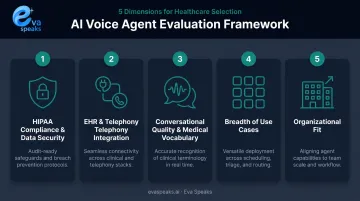
The Five Evaluation Dimensions
Platforms in this space were assessed across:
- HIPAA compliance and data security posture
- EHR and telephony integration depth
- Conversational quality and medical vocabulary accuracy
- Breadth of supported use cases
- Fit for the organization's size and technical capabilities
A common mistake: buyers over-index on price or polished demos without verifying compliance documentation or integration completeness. Gaps in either area are expensive to discover after go-live.
HIPAA Compliance Deserves More Than a Checkbox
The question isn't whether phone calls are HIPAA-permissible — HHS confirms that vendors who create, receive, maintain, or transmit PHI generally require a Business Associate Agreement. Ask every vendor:
- Where is voice data processed and stored? U.S.-only vs. distributed infrastructure matters for data sovereignty.
- Is a signed BAA standard or available on request?
- How long are call recordings and transcripts retained by default?
- Is private cloud or on-premise deployment available for organizations with strict data sovereignty requirements?
- What certifications exist? SOC 2 Type 2 and HITRUST are the most meaningful for healthcare.
Don't accept "HIPAA compliant" as a complete answer. Ask for documentation.
EHR Integration Determines Real-World Value
Compliance confirms a vendor can be trusted with data. Integration determines whether the tool actually does anything useful with it. A voice agent that can't read real-time scheduling availability or write interactions back to the patient record adds minimal value over a basic phone tree. According to 2025 KLAS acute-care EHR market share data, Epic holds 42.3% of U.S. hospital market share by count and 54.9% by bed count — making Epic integration effectively required for most health systems.
Before signing a contract:
- Test the integration against your specific EHR version, not just a general partnership claim
- Confirm whether the platform reads live availability or relies on batch sync
- Ask whether patient interactions are written back to the record automatically or require manual entry
- Verify whether HL7/FHIR standards are supported for long-term interoperability
Want to see how it fits your clinic's workflows? Request Live Demo
Conclusion
AI voice agents are no longer experimental. They are a deployable operational layer that eliminates hold times, extends patient access around the clock, and turns a historically frustrating first contact into a reliable one.
The right platform depends on what you actually need. Hyro and Artera are the strongest choices for enterprise health systems that need proven deployments, deep EHR integration, and compliance depth. Hippocratic AI suits organizations handling clinical-grade interactions where patient safety is the priority. Retell AI fits development teams that need architectural control. Eva Speaks offers a flexible, LLM-powered starting point for clinics and practices that need configurable AI call handling without heavy IT lift.
If you're a healthcare business or medical practice looking for an AI call handling solution with customizable call flows, smart routing, and real-time LLM responses, Eva Speaks is built to handle patient communication from day one. Contact the team to see how it fits your practice's specific needs.
Frequently Asked Questions
What is a voice calling AI agent for healthcare?
A voice calling AI agent for healthcare is an AI-powered system that handles patient phone calls through natural spoken conversation — automating tasks like appointment scheduling, prescription refills, and billing inquiries without requiring callers to navigate button-press IVR menus. It understands intent, pulls relevant data, and responds naturally in real time.
Are AI voice agents HIPAA compliant?
HIPAA compliance varies by platform. At minimum, look for a signed Business Associate Agreement, end-to-end encryption, access controls, and audit logging. Always request compliance documentation before routing live PHI through any vendor.
What is the best AI to use for healthcare?
It depends on the use case. Administrative-focused platforms like Eva Speaks or Hyro suit practices needing call automation and scheduling. Clinical-grade platforms like Hippocratic AI are designed for higher-stakes interactions like post-discharge follow-up. HIPAA compliance and EHR integration should be baseline requirements regardless of which platform you evaluate.
What is the best AI voice agent platform?
No single platform is universally best. The right choice depends on organization size, technical resources, and specific use case requirements. This post covers five strong options — from developer-friendly API frameworks like Retell AI to fully managed healthcare-specialized solutions like Hyro and Artera — each suited to different buyer profiles.
What's the best AI voice for virtual reception?
The strongest options handle multi-turn conversations, integrate with scheduling and EHR systems, and provide 24/7 availability. Eva Speaks, Hyro, and Artera are all solid picks — Eva Speaks for configurable flexibility, Hyro for managed deployment, and Artera for full omnichannel coverage.
How do AI voice agents improve patient experience?
AI voice agents eliminate hold times, provide 24/7 access to scheduling and administrative support, and route patients to the right resource faster. They also pull patient context from integrated systems, so callers don't repeat themselves across multiple contacts — turning one of healthcare's most common friction points into a faster, simpler experience.