AI-based virtual receptionists close that gap. They handle inbound calls around the clock using natural language processing and large language models, without adding headcount or shift premiums. For many businesses, always-on availability isn't a premium feature anymore — it's table stakes.
This guide covers how AI receptionists work, what they can do, which businesses benefit most, and how to choose the right platform for your needs.
Watch how round-the-clock AI call handling actually works. Watch AI Call Flow Demo
Key Takeaways
- AI receptionists handle calls, schedule appointments, route inquiries, and capture leads 24/7 with no staffing overhead
- Unlike rigid phone menus, they hold natural two-way conversations and manage multiple simultaneous calls
- Strongest use cases: healthcare scheduling, legal client intake, home services, and any business that receives calls outside office hours
- When evaluating platforms, prioritize NLP quality, CRM/calendar integration, customizable call flows, and data security
What Is an AI-Based Virtual Receptionist and How Does It Work?
An AI-based virtual receptionist is a software system that manages inbound calls autonomously using natural language processing (NLP), speech recognition, and large language models (LLMs). Where a human receptionist brings empathy and judgment, and a traditional IVR forces callers through rigid menu trees, an AI receptionist holds a two-way conversation — understanding what the caller needs and taking action in real time.
The Call Flow, End to End
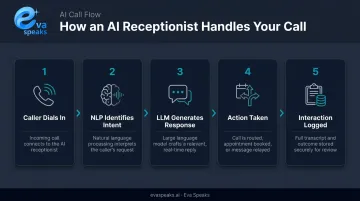
Here's what happens from the moment a call comes in:
- Caller dials in — the AI answers immediately, regardless of time or day
- NLP identifies intent — the system processes the caller's words in real time to understand what they need
- LLM generates a response — rather than matching keywords to pre-scripted answers, the LLM handles context, follow-up questions, and conversational changes mid-sentence
- Action is taken — the AI books an appointment, routes to the right person, captures lead details, or answers an FAQ
- Interaction is logged — a transcript and call summary are recorded automatically
The "24/7" part works because AI receptionists run on cloud infrastructure. There's no shift schedule, no overtime cost, no holiday coverage gap. Platforms like EvaSpeaks are built on this model — combining LLM integration with configurable call-flow scripts and real-time AI responses so the system adapts to each call rather than forcing callers to adapt to it. EvaSpeaks specifically is designed to require minimal infrastructure on the business side: no dedicated hardware, no on-premise software, and configuration through a non-technical dashboard — which is why both a solo practitioner and a multi-location group can deploy it using the same platform.
AI receptionists are not voice bots. They don't trap callers in menus or read from a fixed script — they handle full conversational threads, including mid-call direction changes, and escalate to a human agent when the situation requires it.
Core Capabilities That Enable 24/7 AI Receptionist Operations
Intelligent Call Handling and Routing
An AI receptionist identifies caller intent from the first few seconds of a conversation — not by asking callers to press a number, but by listening to what they say. From there, it routes to the right department, team member, or external number based on pre-configured rules.
The concurrency advantage is significant. A single human receptionist handles one call at a time. An AI system can manage multiple simultaneous inbound calls, which means no busy signals during peak demand and no calls going to voicemail because the line is occupied.
Eva Speaks supports configurable routing rules and call-flow scripts, allowing businesses to define exactly how calls are handled based on caller intent, time of day, and department.
Automated Appointment Scheduling
AI receptionists connect to calendar systems in real time to offer available slots, confirm bookings, and prevent double-booking — all within a single call. No callbacks, no back-and-forth emails.
Calendly's 2024 State of Meetings survey of more than 2,000 professionals found that 80% say scheduling automation saves at least 30 minutes per day. AI receptionist scheduling takes that a step further by handling the entire conversation, not just the calendar mechanics.
Businesses can configure intake questions, booking rules, and service-specific call flows — tailoring the scheduling conversation to their actual workflow rather than using a generic script.
Lead Capture and Qualification
When a prospect calls, the AI collects name, contact details, and service need, then asks configured qualifying questions before routing or wrapping up. That structured data feeds directly into the CRM so the sales team can follow up immediately — no manual transcription, no data entry.
CRM and Business System Integration
Two-way integration with CRM platforms and workflow tools means every AI-handled interaction is automatically logged and tagged with caller ID, intent, and routing outcome. Staff open their CRM and find complete call records, not a stack of sticky notes.
Eva Speaks connects with third-party platforms so businesses can route data into the tools they already use — no rebuilding required.
Call Transcription and Analytics
Every call generates a transcript and metadata — caller ID, duration, routing outcome. This data surfaces call volume patterns, common inquiry types, and peak hours — directly informing call flow adjustments and staffing decisions.
Eva Speaks includes transcription as part of its core platform. Data is stored in U.S. data centers, and customers can opt out of having their calls used for AI model training.
Key analytics outputs include:
- Call volume by hour and day of week
- Most frequent inquiry categories
- Routing outcomes and escalation rates
- Average call duration by call type
See how AI keeps your business available 24/7. See How AI Handles After-Hours Calls
AI Receptionist vs. Human Receptionist vs. Traditional IVR
| AI Receptionist | Human Receptionist | Traditional IVR | |
|---|---|---|---|
| Availability | 24/7, no gaps | Shift-based | 24/7 |
| Concurrent calls | Multiple simultaneous | One at a time | Multiple |
| Conversation quality | Natural language, LLM-powered | Empathetic, adaptive | Rigid menu navigation |
| Cost structure | Flat or usage-based (from ~$95/month) | Salary + benefits (~$37,230/year median + ~28% in benefits) | Setup + ongoing maintenance |
| Best fit | Always-on coverage, volume handling, lead capture | High-stakes or emotionally complex interactions | Simple, high-volume routing only |
The human receptionist cost benchmark comes from BLS data: median pay of $37,230/year in May 2024, with benefits adding 27.9% to total compensation. For 24/7 coverage, that means multiple full-time roles — a cost structure that doesn't make sense for most SMBs.
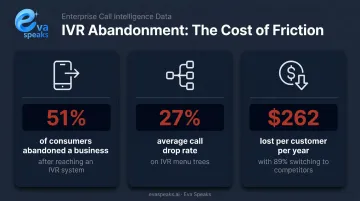
The cost of human staffing is only half the equation. Traditional IVR creates a different kind of loss — customer abandonment. Vonage research found that 51% of consumers had abandoned a business after reaching an IVR, with callers dropping 27% of calls on average when they hit a menu tree. The estimated cost: $262 per customer per year, with 89% of that abandoned spend going directly to competitors.
AI receptionists handle volume, availability, and routine interactions well — but they're not suited for every call. Complex problems, distressed callers, and high-stakes decisions still benefit from human judgment. Platforms built for real-world use include live-agent escalation triggered by keywords, sentiment cues, or caller request, so the right calls reach a person without delay.
Key Business Benefits of Running an AI Receptionist Around the Clock
Capture Every High-Intent Lead
Customer intent peaks at the moment they call. An unanswered call at 9 PM doesn't just delay a lead — it loses it. HBR research on 2,241 U.S. companies found that firms responding within one hour were nearly 7x more likely to qualify a lead than those who waited even an hour longer. Only 37% of companies responded within that window, and 23% never responded at all.
An AI receptionist answers on the first ring, every time, regardless of hour.
Reduce Operational Overhead
Running human reception coverage 24/7 requires multiple full-time employees. At BLS median wages plus benefits, that adds up quickly. The cost difference is significant:
- Human 24/7 reception: 3–4 FTEs at BLS median wages (~$36K/year each) plus benefits
- AI receptionist platforms: Starting at roughly $95–$99/month for SMB tiers, scaling for higher volumes and enterprise needs
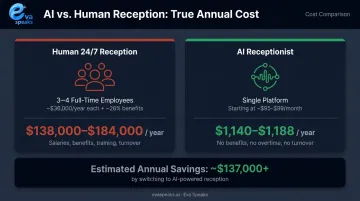
For most businesses, that's a six-figure annual difference in labor costs alone.
Free Staff for Higher-Value Work
The cost savings compound when you factor in what your team does with the time recovered. When routine call handling, FAQ responses, and appointment scheduling move to AI, staff shift toward in-person service, complex problem-solving, and the conversations that actually require human judgment. The result is higher output from the same headcount — without adding roles.
Deliver Consistent, Brand-Aligned Interactions at Scale
AI receptionists follow configured scripts and call flows consistently across every call, regardless of volume or time of day. There's no variation from staff fatigue, no inconsistency from turnover. Businesses configure tone, routing rules, and intake questions once, and the AI executes that configuration reliably.
Which Industries Benefit Most from 24/7 AI Receptionist Support
Healthcare and Dental Practices
AI receptionists handle appointment booking, patient intake questions, and reminder calls — reducing front-desk workload while keeping patients connected. Research published by Kaiser Permanente Washington found that an additional reminder reduced primary-care no-shows by 7% and mental-health no-shows by 11%.
HIPAA compliance is a critical consideration: any AI platform handling patient health information on behalf of a covered entity needs a Business Associate Agreement (BAA) in place.
Legal and Professional Services
The intake gap in legal is well-documented. Clio's 2024 secret shopper study of 500 law firms found that only 40% answered phone inquiries and only 33% responded to emailed inquiries.
An AI receptionist that answers immediately and qualifies callers before routing to an attorney is a direct competitive advantage in a market where most firms aren't responding at all.
Home Services, Real Estate, and Retail
When an HVAC technician is mid-job, a real estate agent is showing a property, or a retail owner is with a customer, calls go unanswered. An AI receptionist captures those after-hours booking requests and product inquiries before the caller moves on to a competitor.
Eva Speaks' configurable office hours and routing rules let businesses define exactly when and how calls are handled — supporting consistent coverage across multiple business types without adding headcount.
How to Choose the Right AI Virtual Receptionist for Your Business
Not all AI receptionist solutions are built the same way. Before comparing features, it helps to understand how the three main service models differ on the factors that matter most to a business adopting 24/7 coverage — specifically how fast you can go live, how pricing scales, and how much control you have over call flows.
| AI-Native (EvaSpeaks) | Hybrid Live + AI | 24/7 Live Answering Service | |
|---|---|---|---|
| Setup Time | Hours - no-code configuration | Days to weeks | Days - agent training required |
| 24/7 Coverage | Always on, no gaps | Depends on human shift coverage | Full 24/7 human staffing |
| Customization | Unlimited script/flow changes in minutes | Limited by agent training | Script-dependent, slower updates |
| Integration Capability | CRM, scheduling, EHR native | Varies | Manual or limited |
AI-native platforms like EvaSpeaks are designed to be configured without technical expertise — no hardware, no dedicated IT setup, and call flows that can be updated in the same dashboard used to review transcripts. That flexibility is what makes a single platform viable for both a solo practice and a multi-location operation.
Match the Tool to Your Needs First
Before evaluating platforms, assess your actual requirements:
- Solo operators and micro-businesses — need basic call answering, message capture, and simple appointment scheduling
- Growing SMBs — need CRM integration, concurrent call handling, and configurable routing
- Multi-location or enterprise — need API access, advanced analytics, custom call flows, and compliance documentation
Knowing where you stand prevents both overpaying for unused features and locking into a platform you'll outgrow.
Five Non-Negotiable Evaluation Criteria
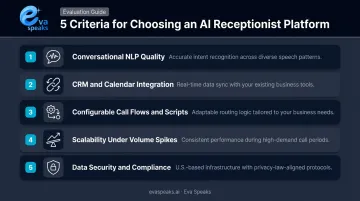
- Does it understand conversational speech, accents, and mid-sentence topic changes? Request a live demo with real-world scenarios before committing.
- Does it connect with your existing calendar and CRM? Salesforce research found small businesses manage an average of nine service channels — siloed tools add friction fast.
- Can you configure routing rules, intake questions, and business-specific scripts? Eva Speaks is built around LLM integration and adjustable call-flow logic, making it a practical fit for businesses that need tailored routing.
- Can the platform handle call volume spikes without degrading response quality?
- Where is call data stored? Is there an opt-out for AI training? For healthcare, is a BAA available? Eva Speaks stores data in U.S. data centers and provides an AI training opt-out via privacy@evaspeaks.ai.
Implementation Considerations
Once you've identified the right platform, implementation typically follows three phases: script and call-flow configuration, integration with calendars and CRM, and testing before go-live. A simple call-answering setup can launch quickly; a multi-department routing configuration with CRM write-back takes longer.
Ask prospective vendors what setup support is included and whether ongoing optimization is available after launch. G2's 2024 Buyer Behavior Report found that 57% of AI software buyers expected positive ROI within three months — achievable when the platform is properly configured from day one.
Ready to see round-the-clock coverage for your calls? Request Live Demo
Frequently Asked Questions
Can an AI-based virtual receptionist provide round-the-clock (24/7) support?
Yes. AI receptionists run on cloud infrastructure with no downtime, handling calls on evenings, weekends, and holidays without additional staffing costs. There's no shift schedule or overtime — the system is simply always on.
How much does an AI receptionist cost?
Pricing varies by platform and feature set. Simple call-answering tools for smaller businesses typically start around $95–$99/month, while enterprise-grade systems with CRM integration, analytics, and multilingual support run higher. Most platforms offer tiered plans based on call volume.
What does an AI receptionist do?
It answers inbound calls, identifies caller intent through NLP, schedules appointments, routes calls to the right person or department, and captures lead information. All of this runs without staff involvement in routine interactions, including after-hours calls.
Which is the best AI receptionist?
Evaluate options based on NLP quality, CRM and calendar compatibility, customizable call flows, scalability, and industry-specific compliance needs. The right fit varies by business size and sector, so prioritize the criteria most relevant to your workflows.
What is the best AI virtual receptionist for appointment scheduling?
Look for platforms that connect directly to calendar systems in real time, support natural two-way conversation to confirm slots, and log bookings automatically in your CRM. For service-based businesses, configurable intake questions within the scheduling flow are worth prioritizing.